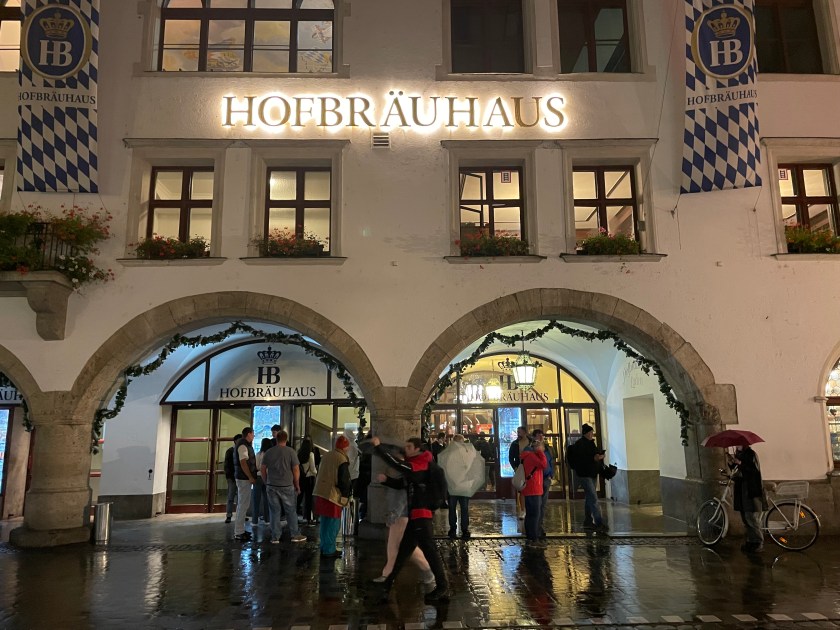
The Hofbrauhaus in Munich

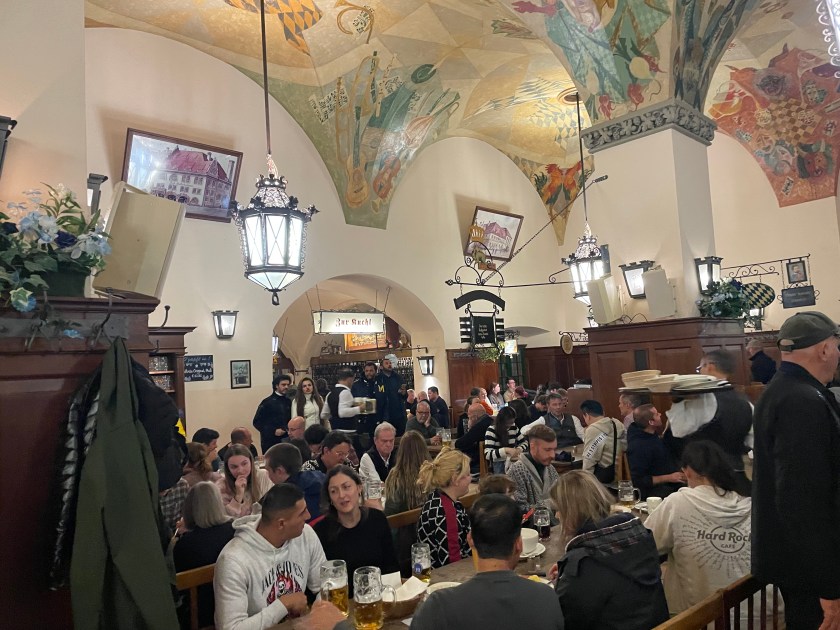
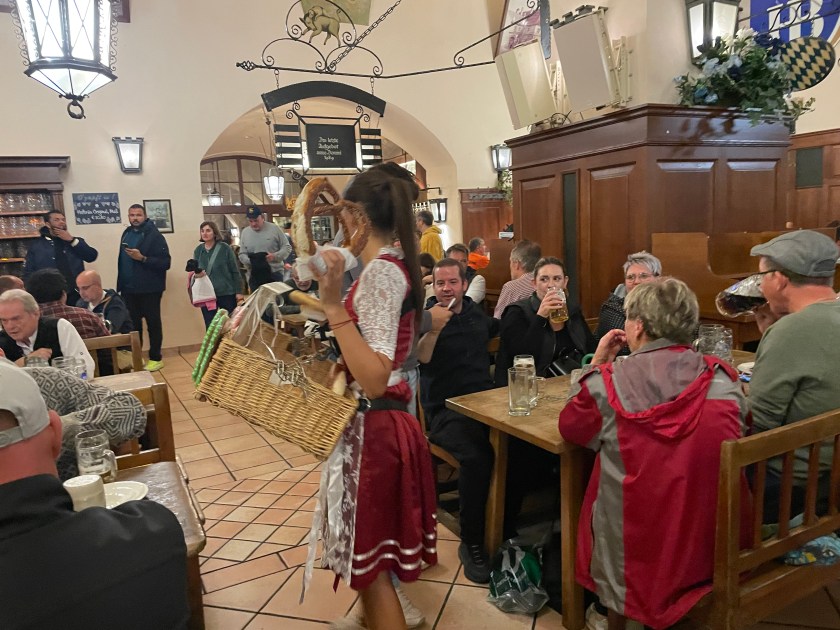
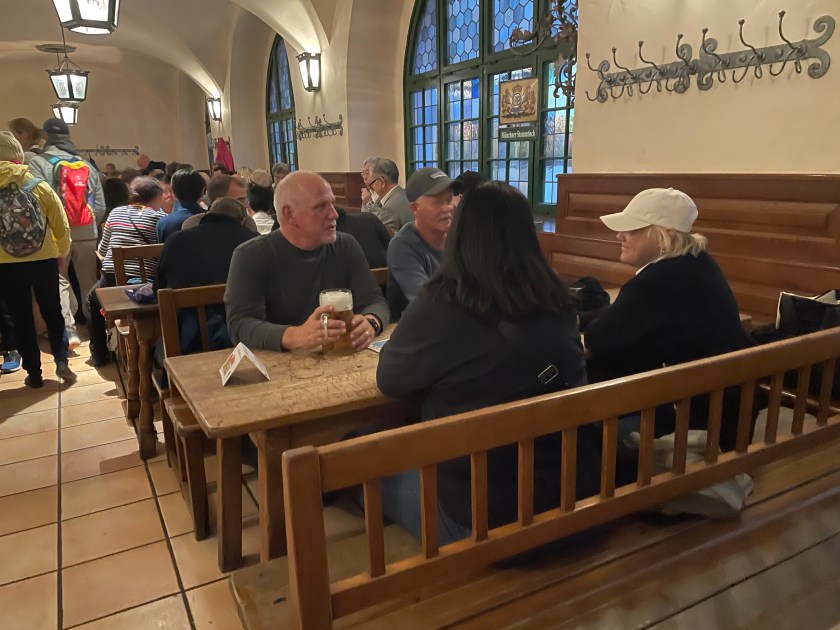
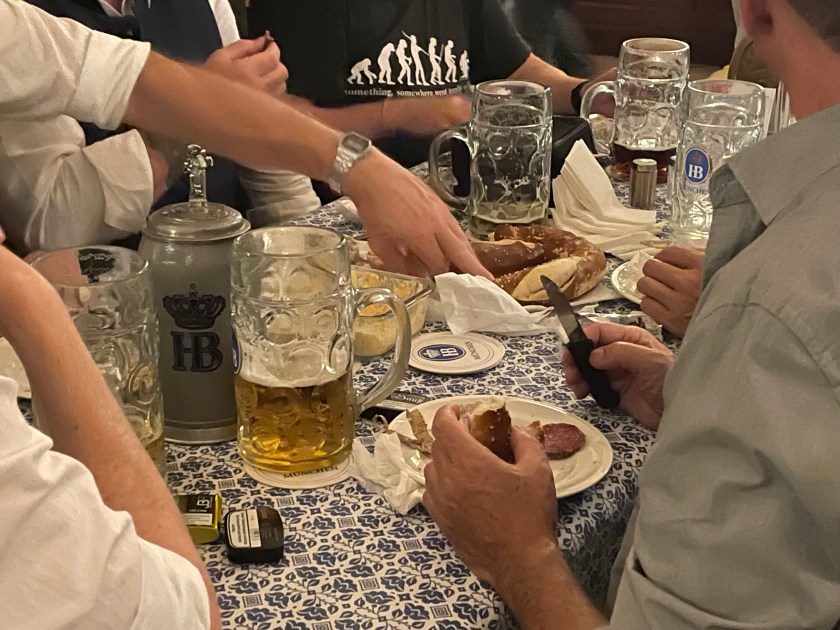
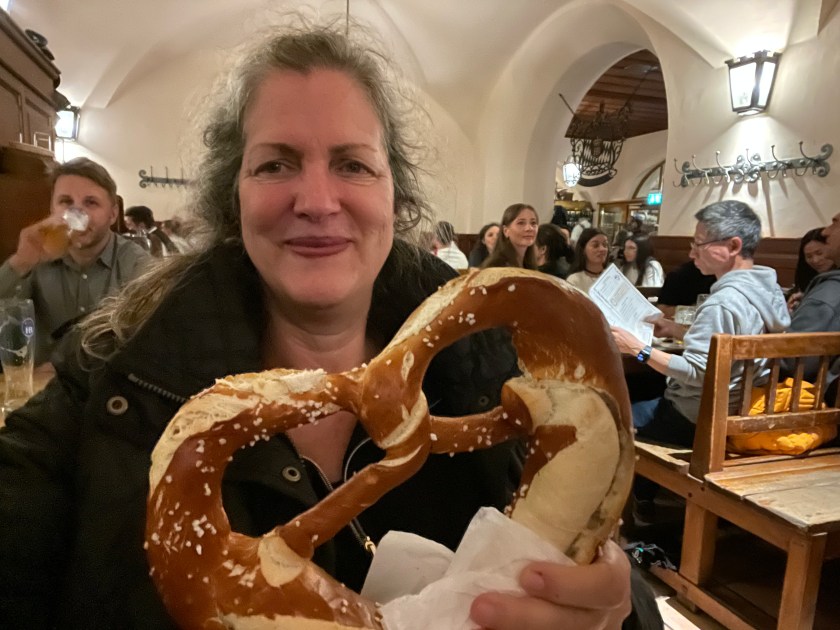
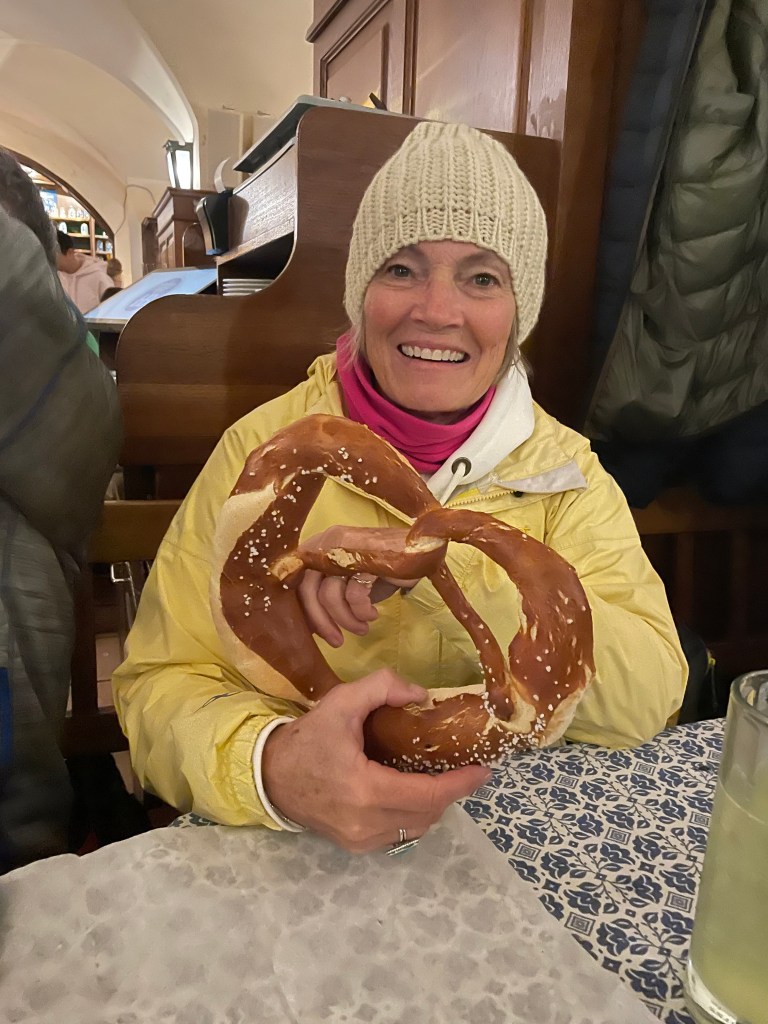
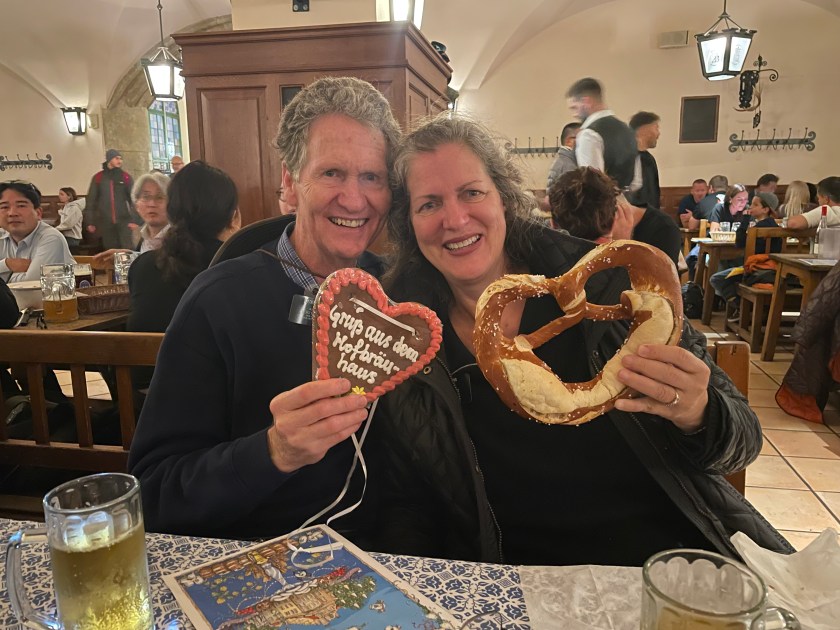
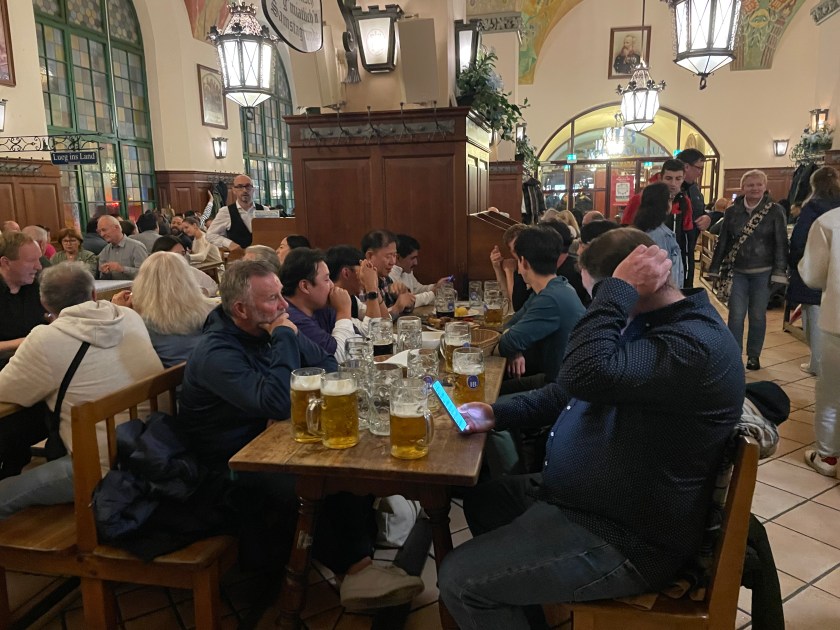
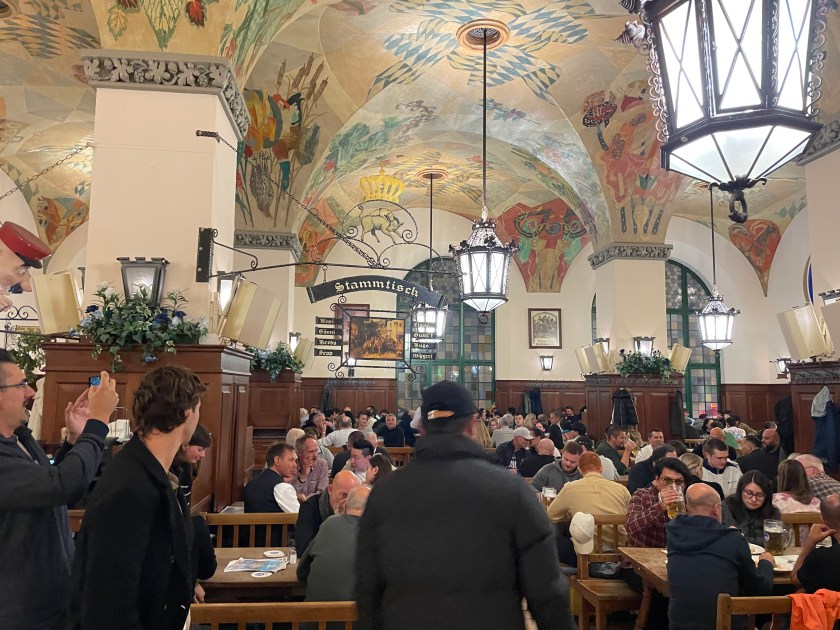
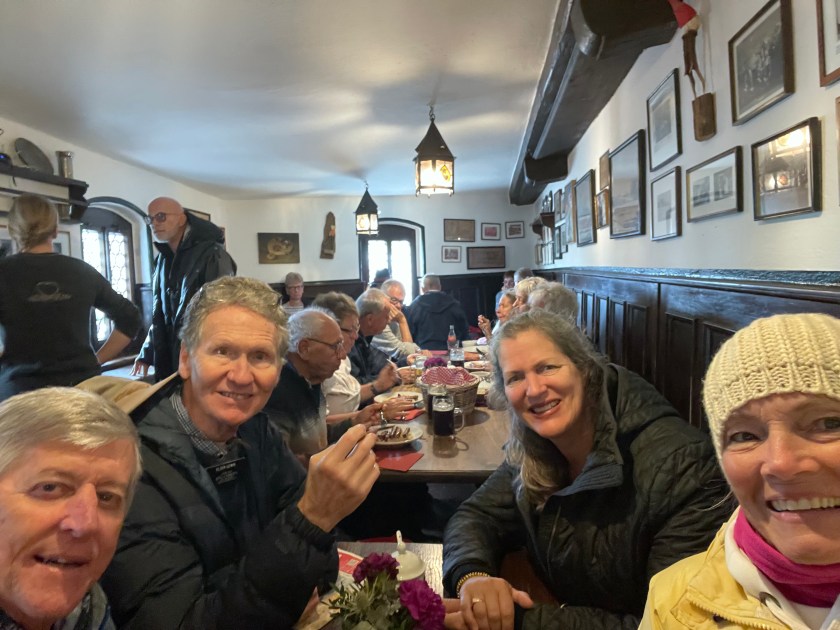
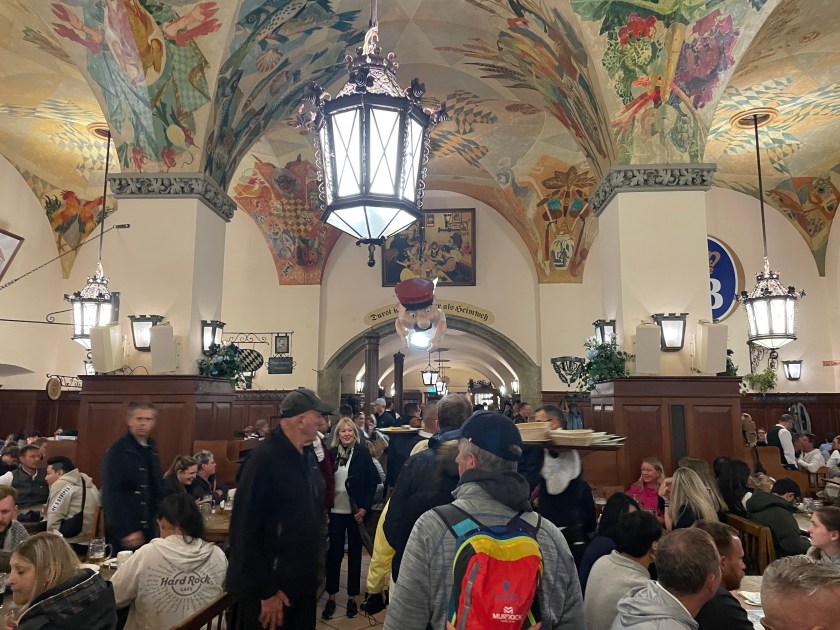
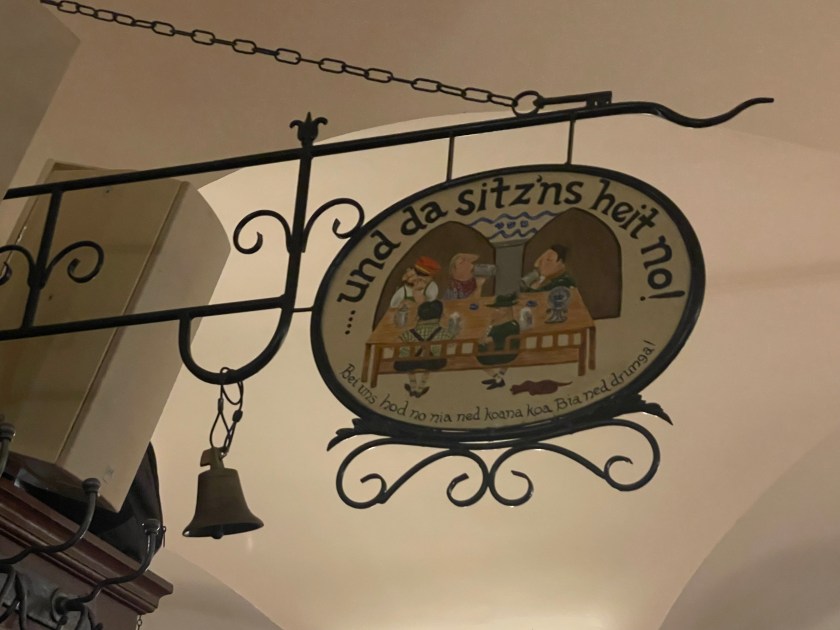
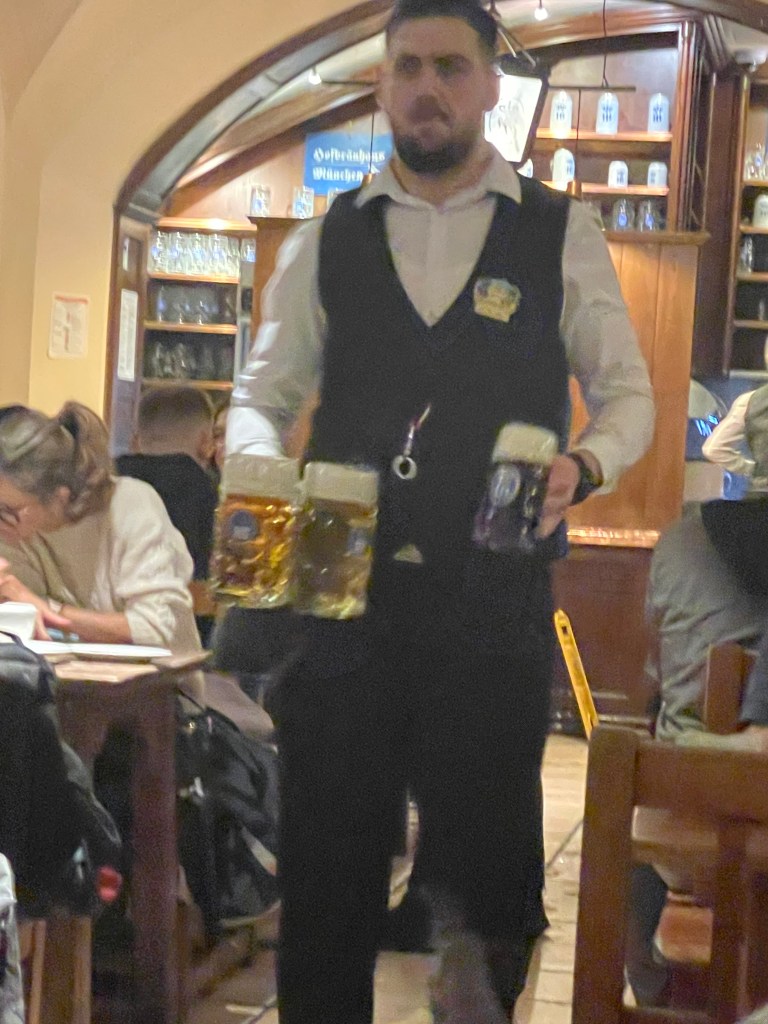
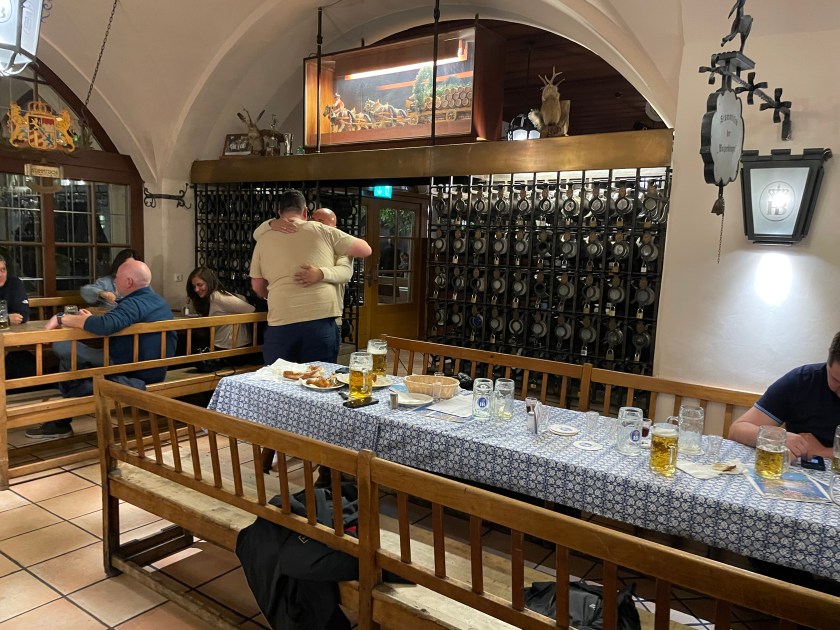
The Hofbrauhaus in Munich is a big sprawling old restaurant with an outdoor Biergarten (too rainy tonight) that seats 100s. It was packed full of people. You cannot make reservations–you just hover and wait for a table to be cleared. There were 100s of people there. It was rustic with heavy wooden tables that seat about 8–you just add yourselves to the others there. There were busy waiters with their hands wrapped around 4-6 Biersteins at a time and cute young girls with trays suspended with ribbons around their necks toting huge fresh pretzels and Lebkuchen. The girl told me they bake about 400 of these huge (5 Euro) pretzels every day. We got one to eat while we waited for our food and it was delicious.

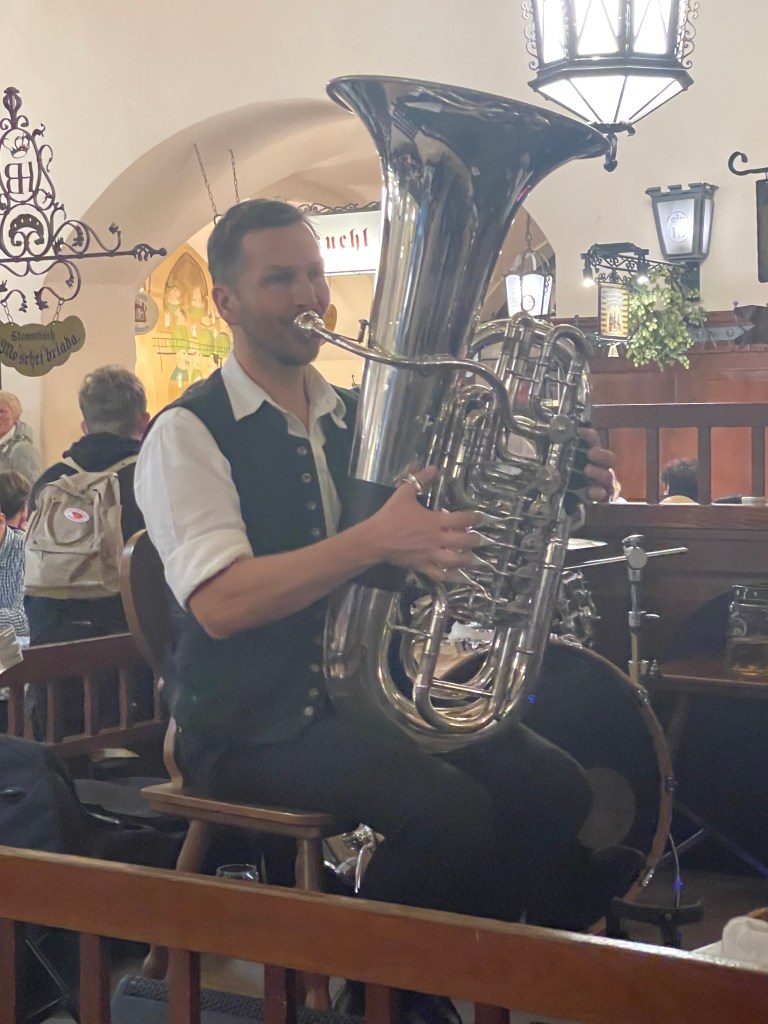
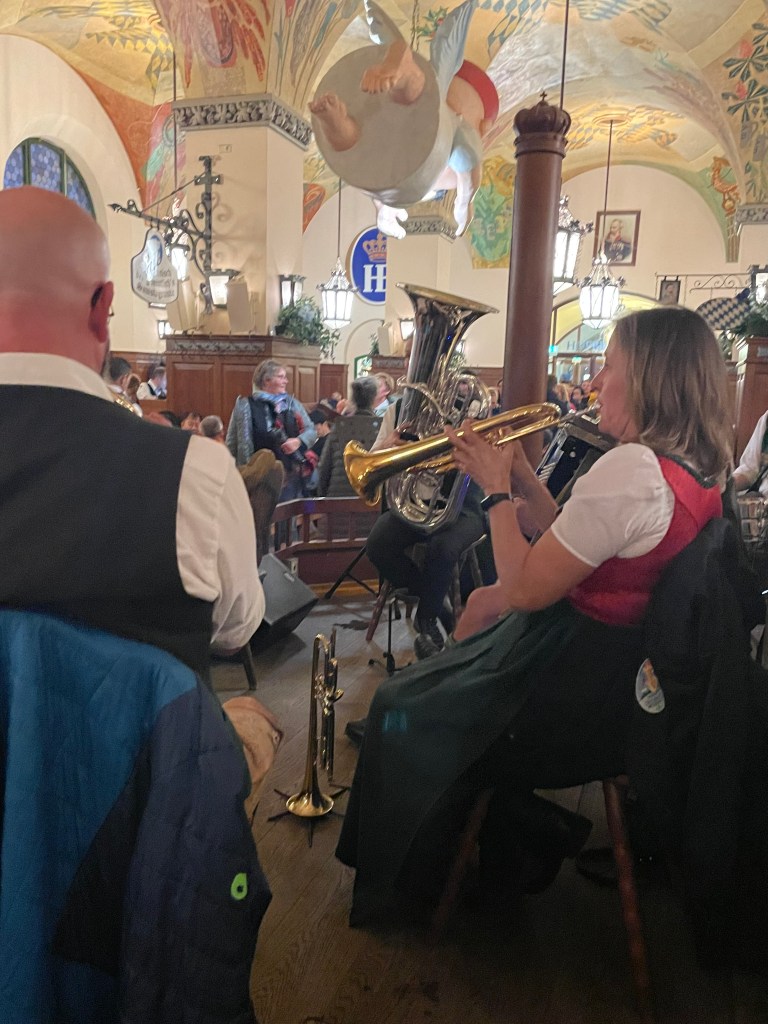
The place was crowded and loud. There was an oom pa-pa band playing live music, especially the famous “In Munchen steht ein Hofbrauhaus, eins, zwei, g-suffa!”
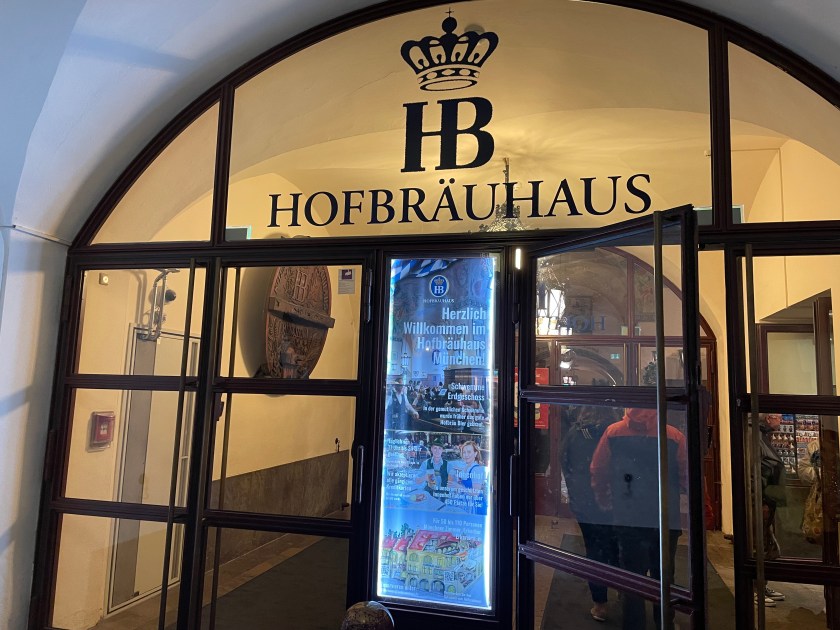
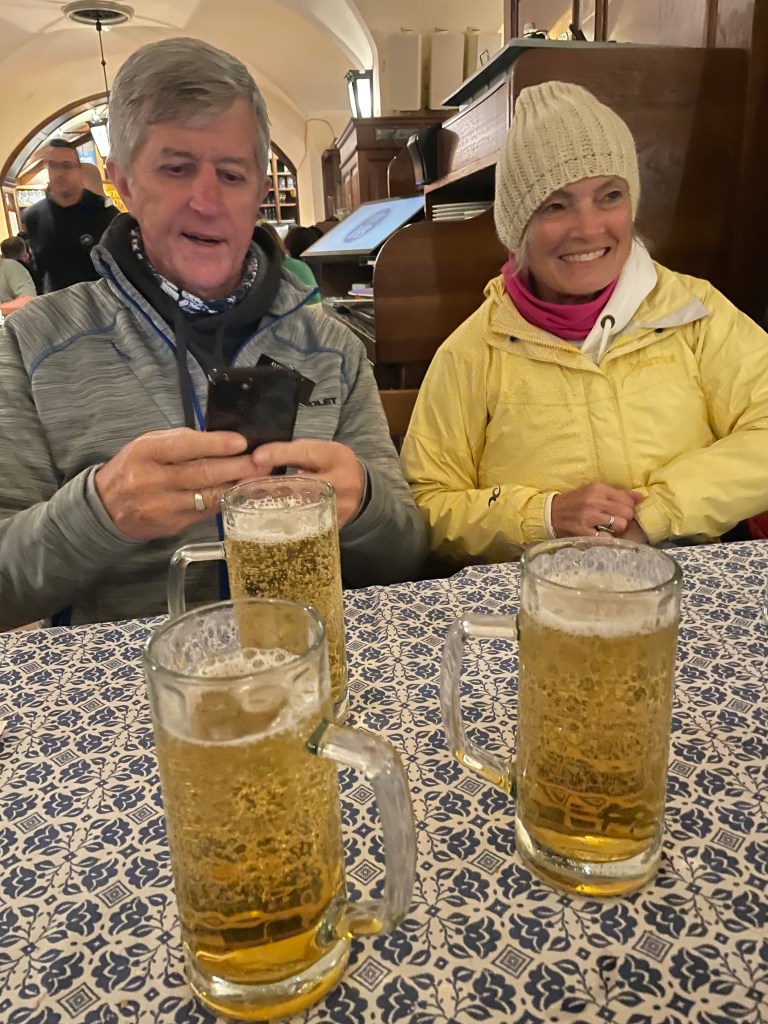
When we didn’t order beer, the waiter stared at us in unbelief.  We asked for Apfel Schorle, or fizzy apple juice.
Here’s some interesting information found in Wikipedia and various sites about this historic place:

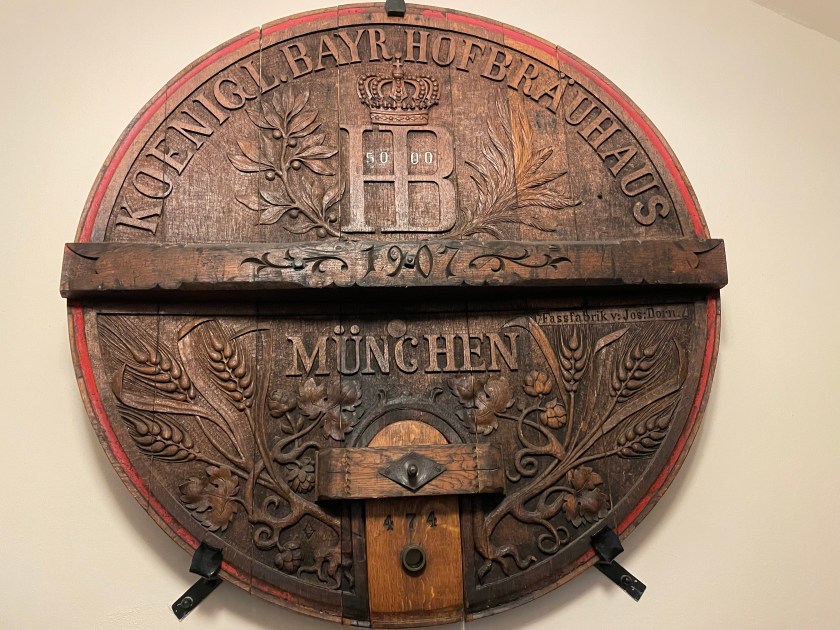
The Hofbräuhaus am Platzl is a beer hall in Munich, Bavaria, Germany, originally built in 1589 by Bavarian Duke Maximilian I as an extension of the Staatliches Hofbräuhaus in München brewery. The general public was admitted in 1828 by Ludwig I. The building was completely remodeled in 1897 by Max Littmann when the brewery moved to the suburbs. All of the rooms except the historic beer hall (“Schwemme”) were destroyed in the World War II bombings. The reopening of the Festival Hall in 1958 marked the end of the post-war restoration work.

History
William V, Duke of Bavaria found the beer in Munich bad so he imported beer from Saxony. He eventually asked his royal court to find a solution. A local brewery followed in 1589.

On February 24, 1920, the Hofbräuhaus am Platzl is where Nazi Germany dictator Adolf Hitler made a speech founding the National Socialist German Workers’ Party, or the Nazi Party.

The Hofbräuhaus was largely destroyed from allied bombing raids during World War II, but by Munich’s 800th anniversary in 1958 the building had been faithfully reconstructed.

Features
The Hofbräuhaus Saal c. 1902
The restaurant comprises most of the Hofbräuhaus am Platzl, which also includes a ballroom and outdoor Wirtsgarten. Its menu features such traditional favorites of Bavarian cuisine as Brezn (soft pretzel), Obatzda (cheese dip), Hax’n, and sausages such as Bratwurst and Weisswurst. Brews include Helles and Dunkles served in a Maß, Weißbier, and wine.

Munich’s largest tourist attraction after the Oktoberfest, the Hofbräuhaus am Platzl is also frequented by locals, many of whom keep their personal mugs (“Krüge”) stored there. During regular hours traditional Bavarian music is played. The famous Hofbräuhaus song (Hofbräuhaus-Lied), composed in 1935 by Wilhelm “Wiga” Gabriel, goes: “In München steht ein Hofbräuhaus, eine, zwei, g’suffa!” (“There’s a Hofbräuhaus in Munich—one, two, down the hatch!” in the local dialect).

Famous patrons
Wolfgang Amadeus Mozart lived around the block from the beer hall in the late eighteenth century. In a poem he wrote, Mozart claimed to have written the opera Idomeneo after several visits to the Hofbräuhaus fortified him for the task.[citation needed] In the nineteenth century, most of the breweries in Munich, including the Hofbräuhaus, were converted into large beer halls, restaurants, and entertainment centers with large, cavernous meeting rooms for weddings, concerts, and plays. In the period just before World War One, Vladimir Lenin lived in Munich and reportedly visited the Hofbräuhaus on a regular basis. In 1919, the Munich Communist government set up headquarters in the beer hall, and in February 1920 Adolf Hitler and the National Socialists held their first meeting in the Festsaal, the Festival Room, on the third floor.

On 24th February 1920, Hitler presented the Nazi Party’s Twenty Five Point Program in the Hofbräuhaus. On that day, the Nazi party held a large public meeting and whilst Hitler was speaking, the meeting erupted into a melee. There was a massive fight between the Social Democrat and Communist opponents of the Nazi party, whose thugs eventually won the melee. Hitler managed to finish his address, notwithstanding the chaos of smashed tables and chairs and hurled beer mugs all about him. On 4 November 1921 the Hofbräuhaus was also the birthplace of the later feared Nazi street fighting organization, the Sturmabteilungen, or SA.
—————–
Lyrics to Hofbräuhaus-Lied, one of the all-time classic songs at the Munich Oktoberfest
This is one of the best-known German classics – right up there with Nena and her 99 Luftballons.
The Hofbräuhaus-Lied (Hofbräuhaus Song) is a classic of the German oom-pah form and a principal ode to Munich’s famed beer hall.
It was written in 1935, not by a Munich local, but a Berliner known as Wilhelm “Wiga” Gabriel.
hofbrauhaus lied lyricsWiga’s other “hits” were unfortunately patriotic marching anthems for the Third Reich.
But that said, no-one seems to remember when the song comes ’round at Oktoberfest anyway.

English Hofbräuhaus-Lied Lyrics
“the Hofbräuhaus-Song”

There, where the green Isar flows,
Where you greet with “Greetings God!”, [Wo man mit “GrüßGott” dich grüßt,]
Lies my beautiful Munich city,
The likes of which you’ve never seen.
Water is cheap, pure and good,
But it thins our blood,
Far better is a drop of golden wine,
But the best is this:

In Munich is the Hofbräuhaus:
One, two, drink up! [g-suffa is more like “down the hatch]
There so many kegs are emptied:
One, two, drink up!
There is always some good man:
One, two, drink up!
Who wants to show how much he can drink
He starts in the early morning
And late in the evening he comes out
Because it’s so nice at the Hofbräuhaus.

There you don’t drink out of a glass,
There’s only “the big beer krug!”
And when the first beer krug is empty,
The waitress Reserl soon brings you more.
Often the women at home get a fright,
That the man’s gone so long.
But the good neighbors,
They know better!

In Munich is the Hofbräuhaus:
One, two, drink up!
There so many kegs are emptied:
One, two, drink up!
There is always some good man:
One, two, drink up!
Who wants to show how much he can drink
He starts in the early morning
And late in the evening he comes out
Because it’s so nice at the Hofbräuhaus.

Although so many other cities,
Have things to see,
There’s one thing that’s nowhere else but here: That’s Munich beer.
Who thought up this little song
Has for so many long nights
Studied Munich’s beer
And has comprehensively tried it out.

In Munich is the Hofbräuhaus:
One, two, drink up!
Where the kegs are always flowing:
One, two, drink up!
There is always some brave man:
One, two, drink up!
Who wants to show how much he can drink
He starts in the early morning
And late in the evening he comes out
Because it’s so nice at the Hofbräuhaus.
—————-
I also found this interview with the manager very interesting:
Over a mug of beer…
By Bernhard Leitner – Rolling Pin
Aug, 2022
For more than 20 years, Michael Möller has been in charge of the legendary Hofbräu in Munich. Over a mug of beer, the passionate restaurateur talks about the ambitious franchise concept, the immense expectations and what the Free State of Bavaria has to do with it.
3500 seats, more than 400 knuckles of pork a day, gallons of beer and an annual turnover of more than 50 million euros. For 400 years, the Hofbräuhaus in Munich has been a supreme gastronomic institution. The owner of this money maker with a total of 13 franchise outlets is actually the Free State of Bavaria. In an exclusive interview, managing director Michael Möller explains how to run a company as a state-owned enterprise, how to bring tourists and locals together at the same table and why they don’t need dishwashers in the restaurant. . . .
. . . the Hofbräuhaus is not run by a private company, but rather by the Free State of Bavaria . . .
The Hofbräuhaus am Platz’l has been an institution in Munich for over 400 years.
What is the difference between beverage and food sales?
Möller: We have a total of 3500 seats on three levels. There’s a limit, though. In total we can take reservations for 2,500 seats, not including the beer garden. This is because fire protection regulations have become much stricter over the years. But really, we only try to be completely booked out twice a year: on New Year’s Eve and Carneval.
Today we generate 55 percent of our turnover with beer and 45 percent with food. This meant that we constantly had to expand the kitchen. However, we quickly reached the limits of our space, so we are now outsourcing many of the additional services we need for the kitchen. The preparation, making dumplings, seasoning, washing lettuce – all this is done outside of Munich. Our trucks are constantly driving back and forth. The same applies to dish washing. We collect all the dishes and drive to the outskirts of the city, where they are washed and then come back here because we simply don’t have the space in the Hofbräuhaus.
However, this has the advantage that we can use completely different machines that are much more environmentally friendly. This difference was noticeable right away, and so now we can focus on what we are really there for, namely cooking, eating and beer. . . .

What a very fun evening in a wild and crazy place!
An Afternoon in Munich

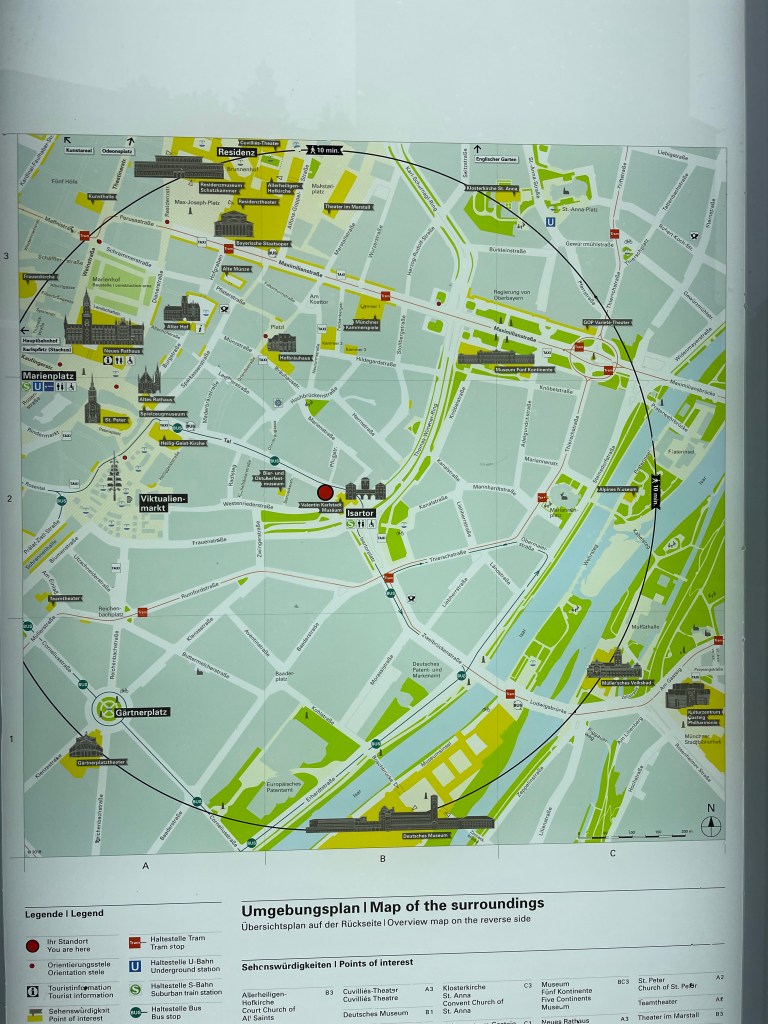
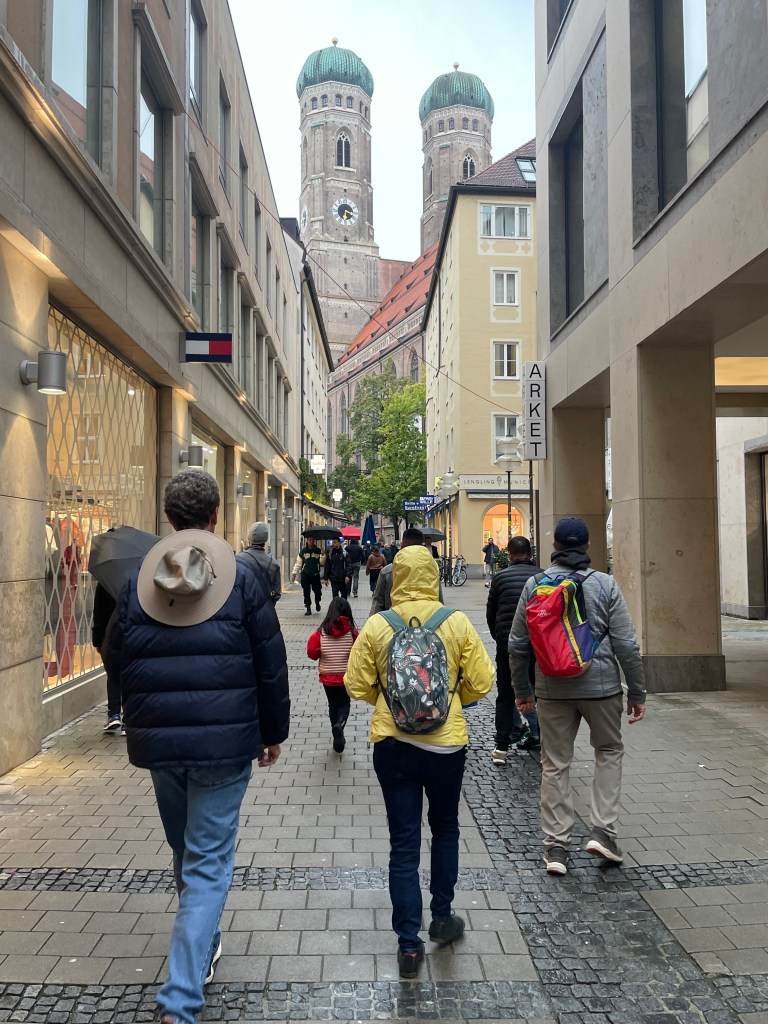
We stayed in Regensburg until about 2:30. Then drove to Munich, about 2 more hours away. It was rainy the whole way. We drove through lots of hops fields. I’ve never seen those anywhere but in Moxee, WA.  We checked in to our hotel, then headed out in the rain, walking about 20 minutes to the old city center part of town.

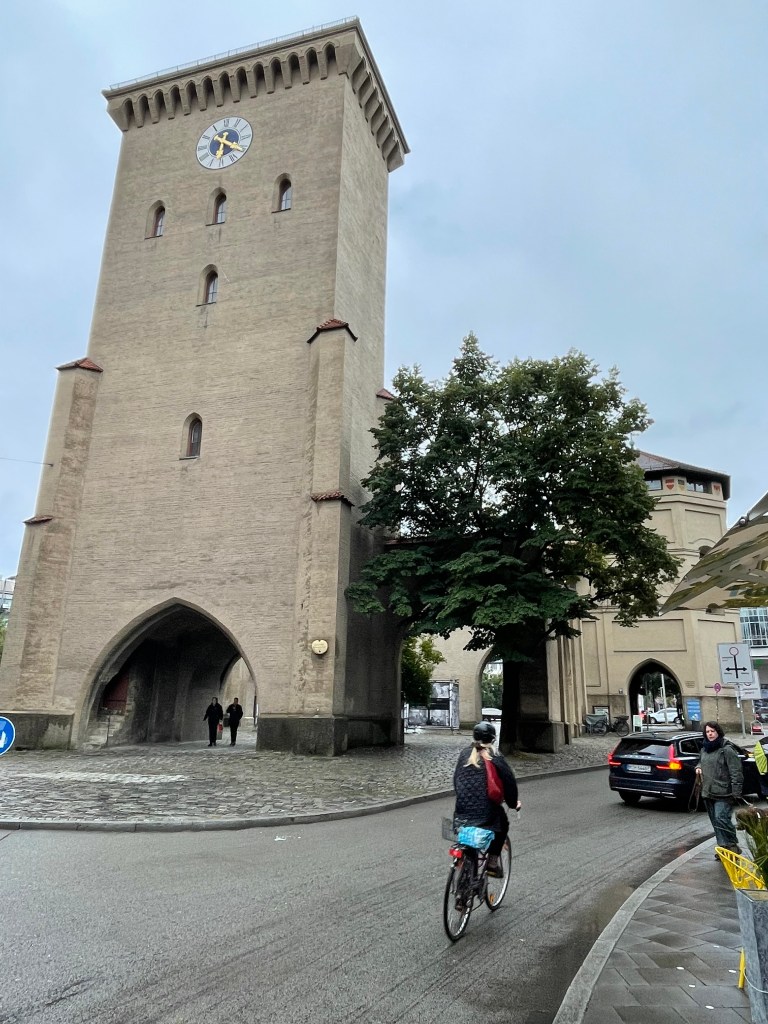
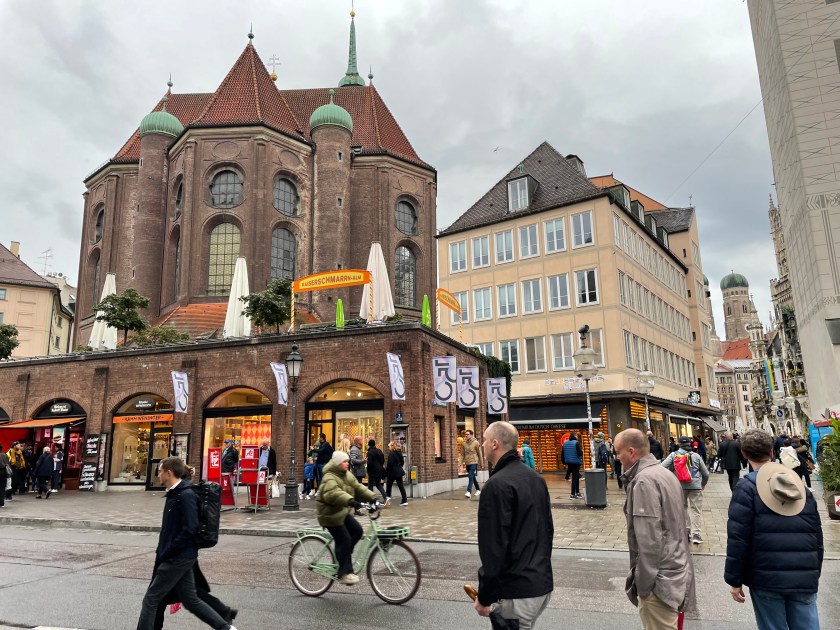
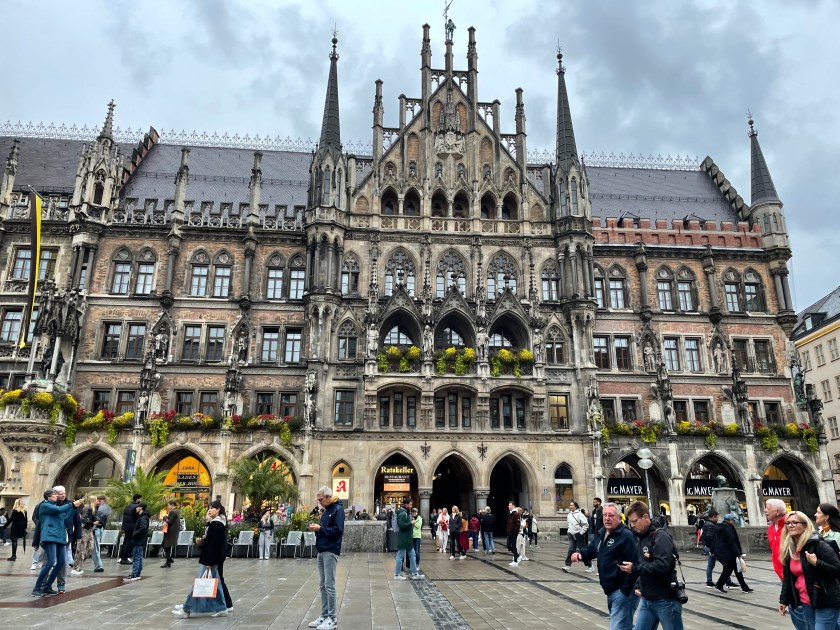
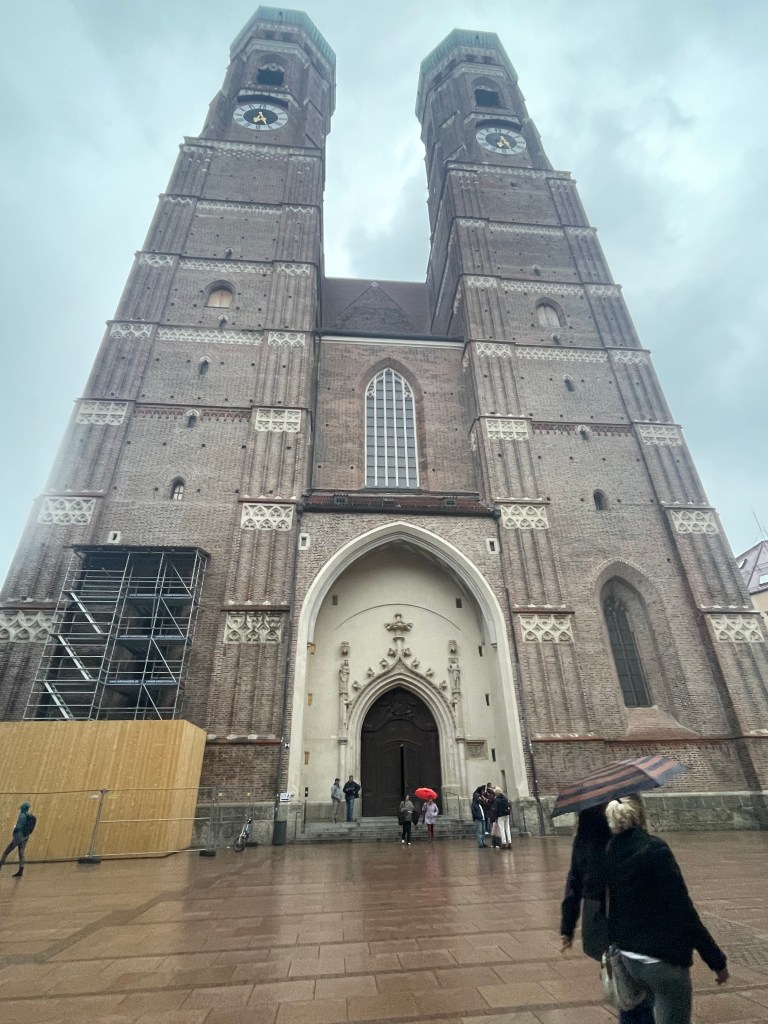
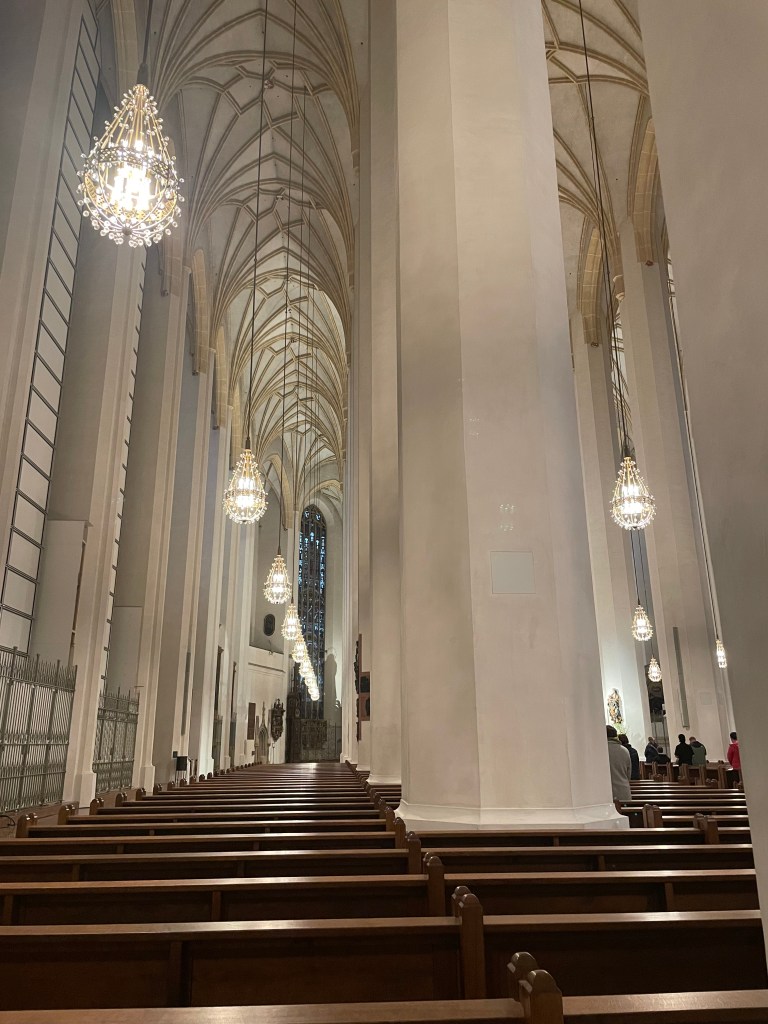
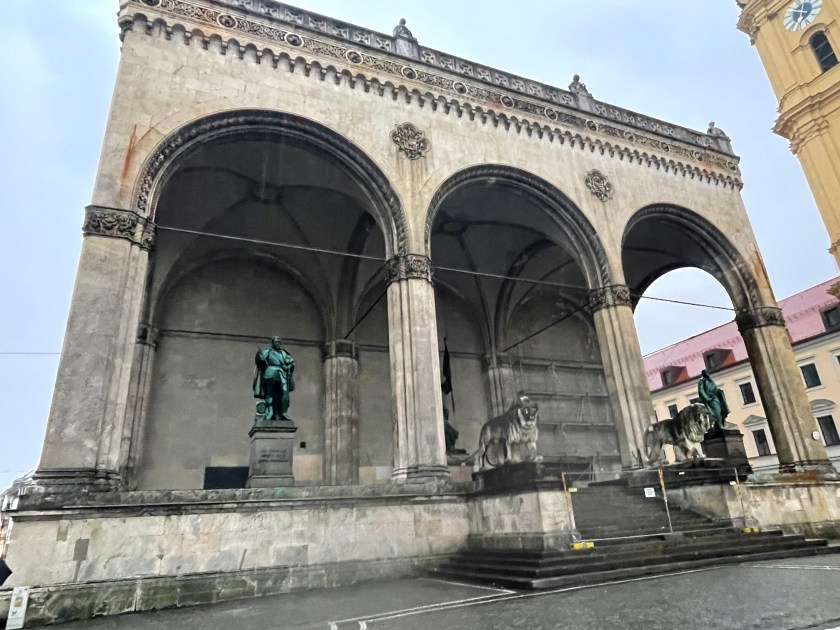
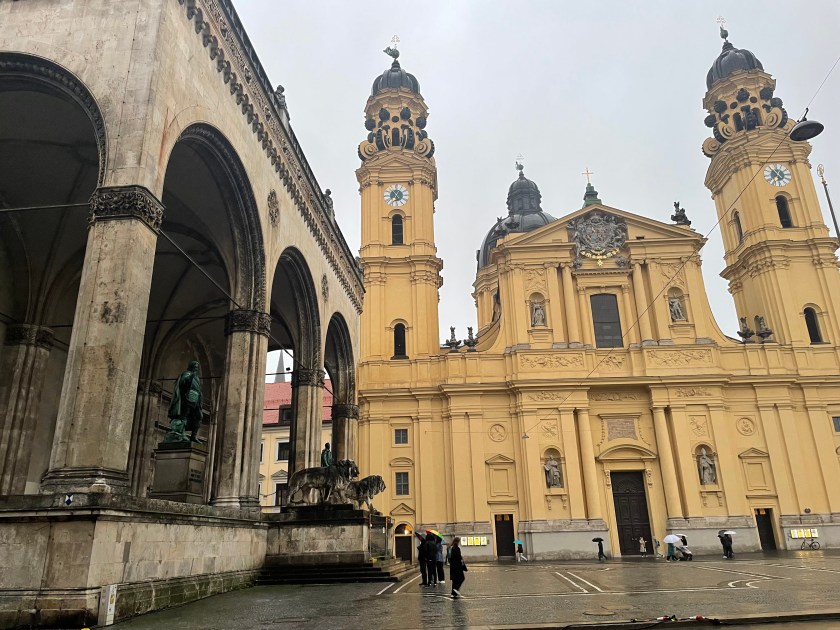
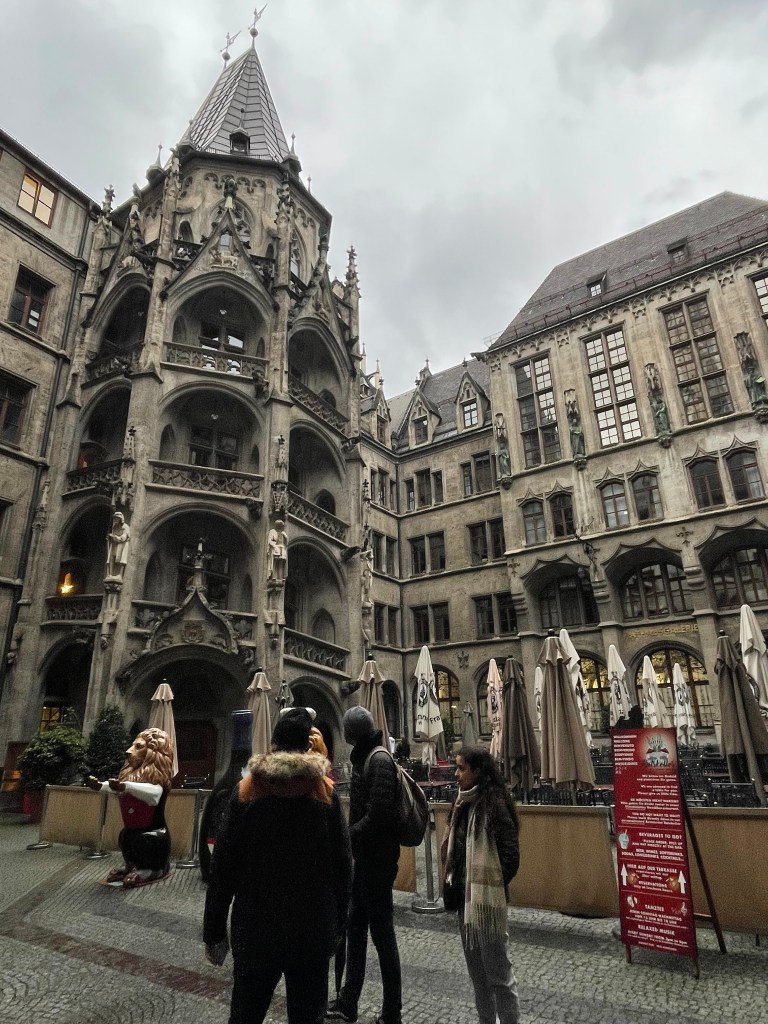
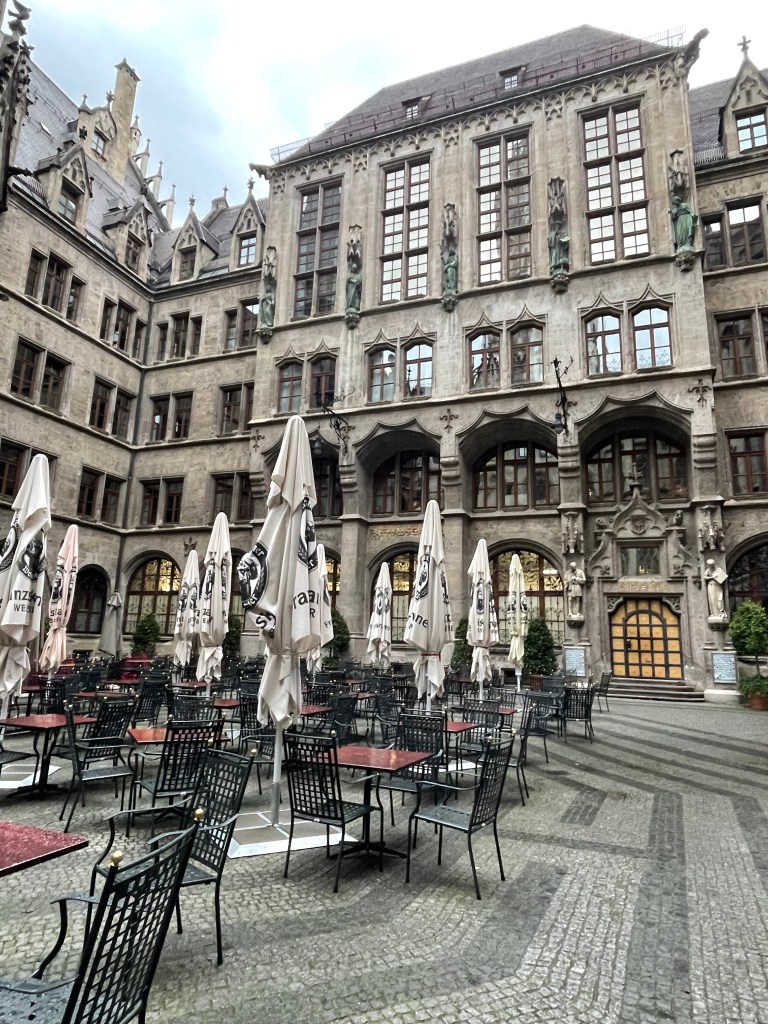
We spent the rest of the day there, visiting the old churches, the palace complex, the New Rathaus, the town squares. All in a steady drizzling rain.

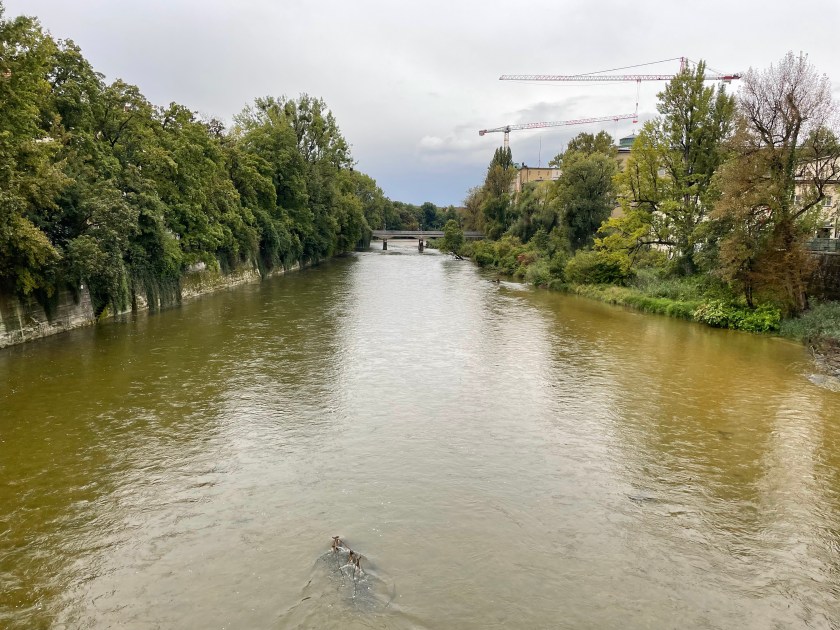
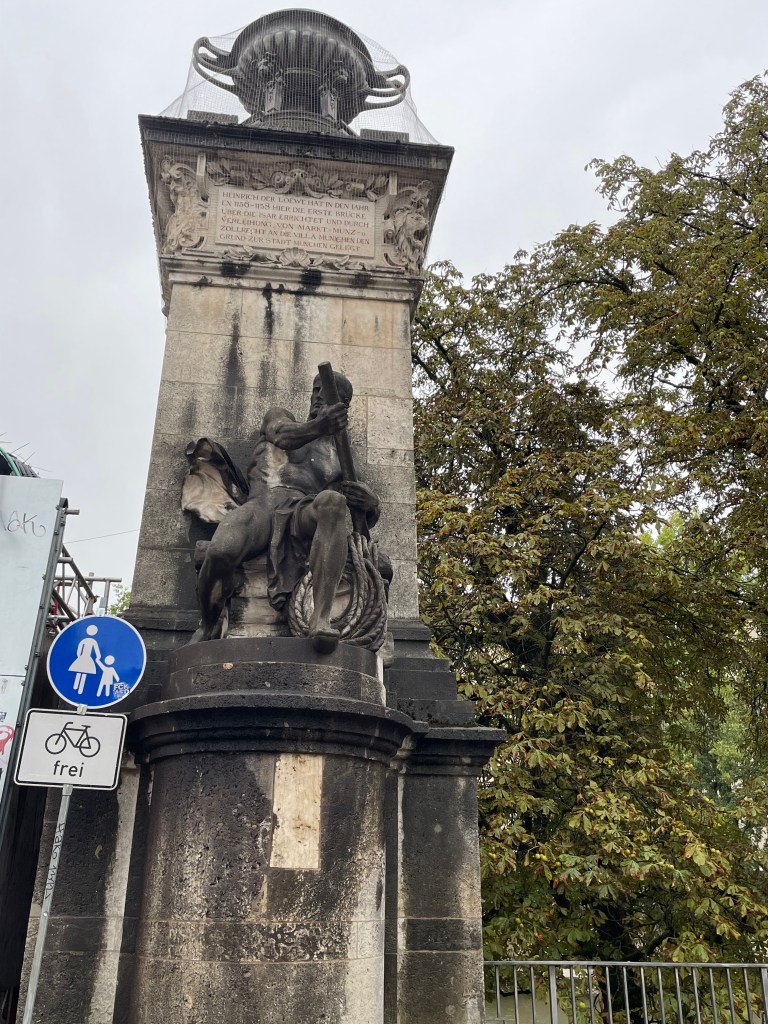
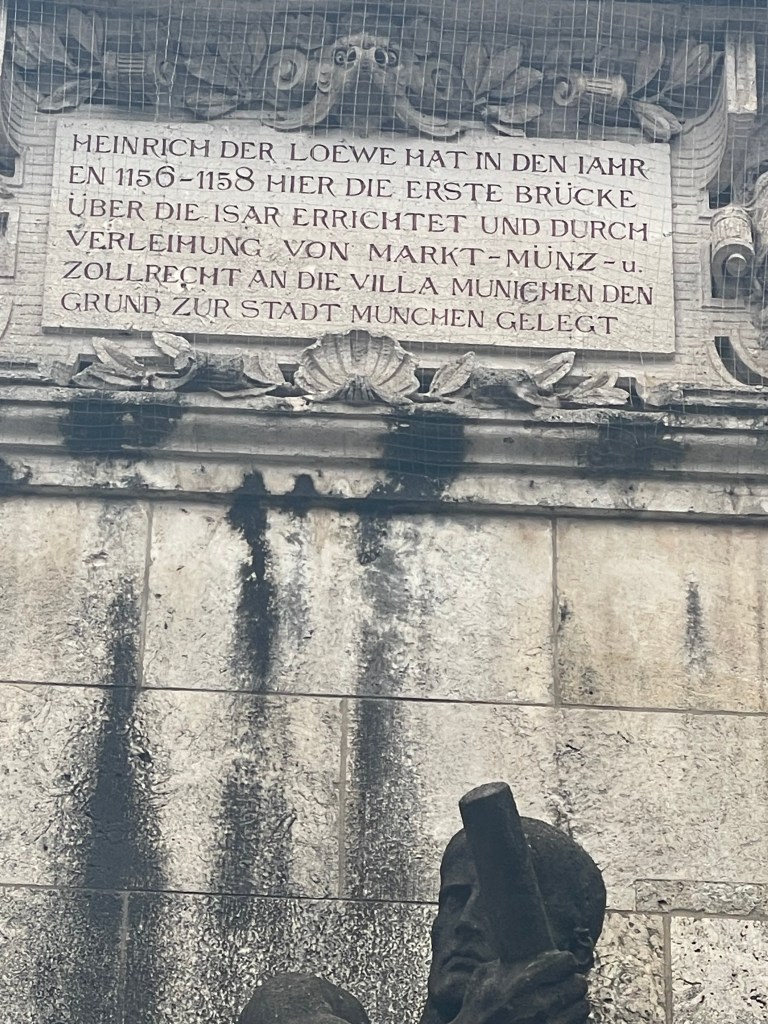
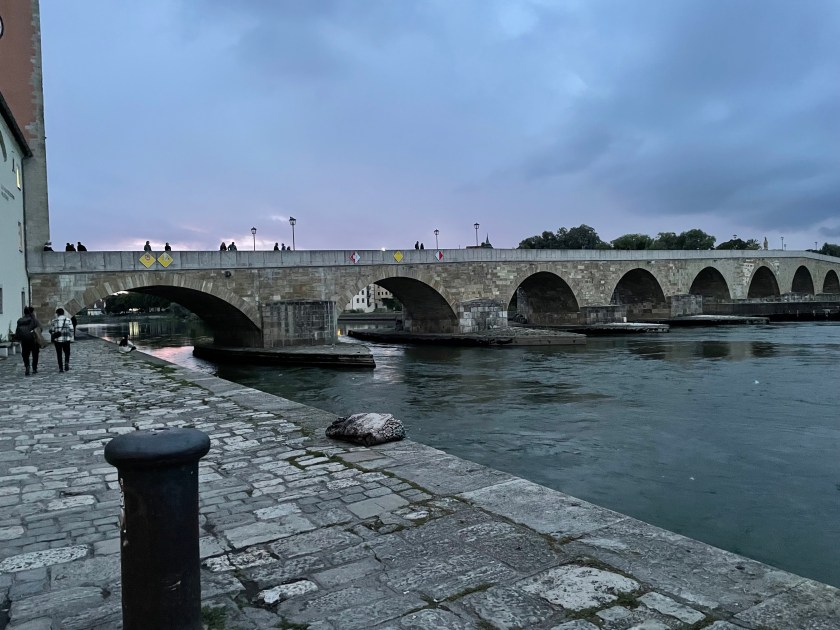
The first bridge was constructed here in 1156-1158.

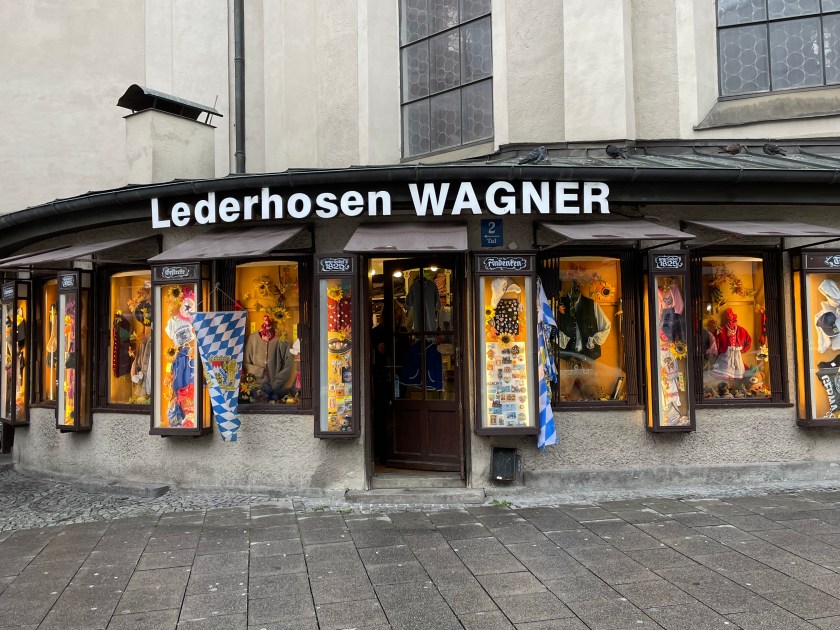
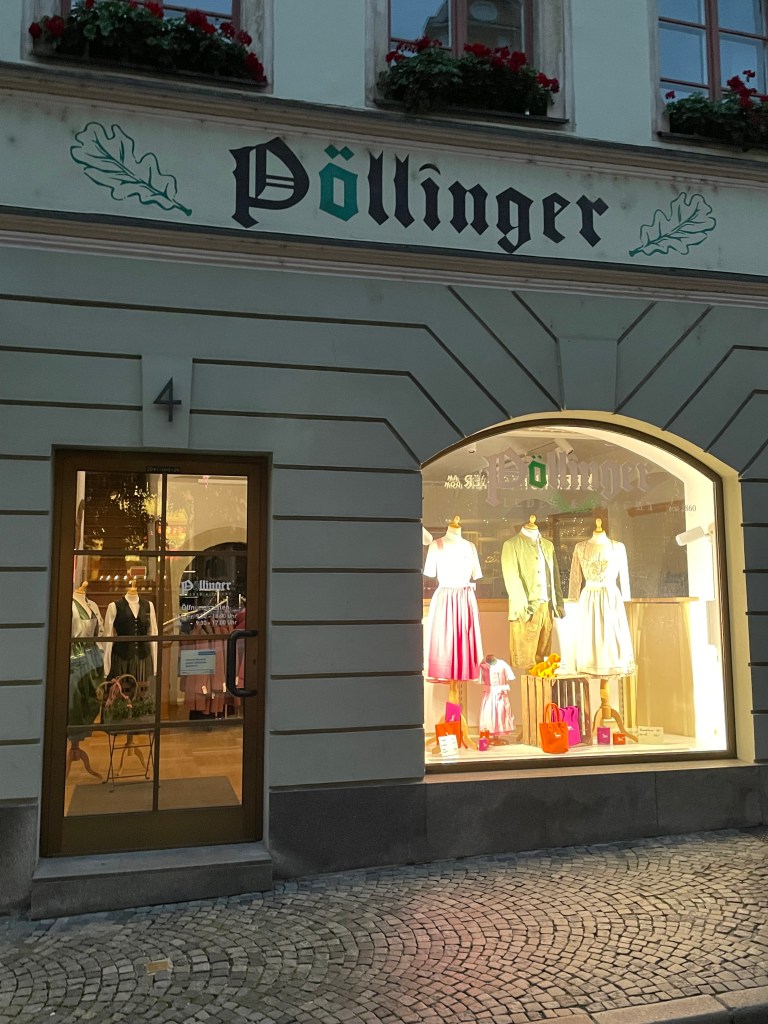
Here’s a shop just for Lederhosen!  There are lots of traditional clothing stores in Bavaria.

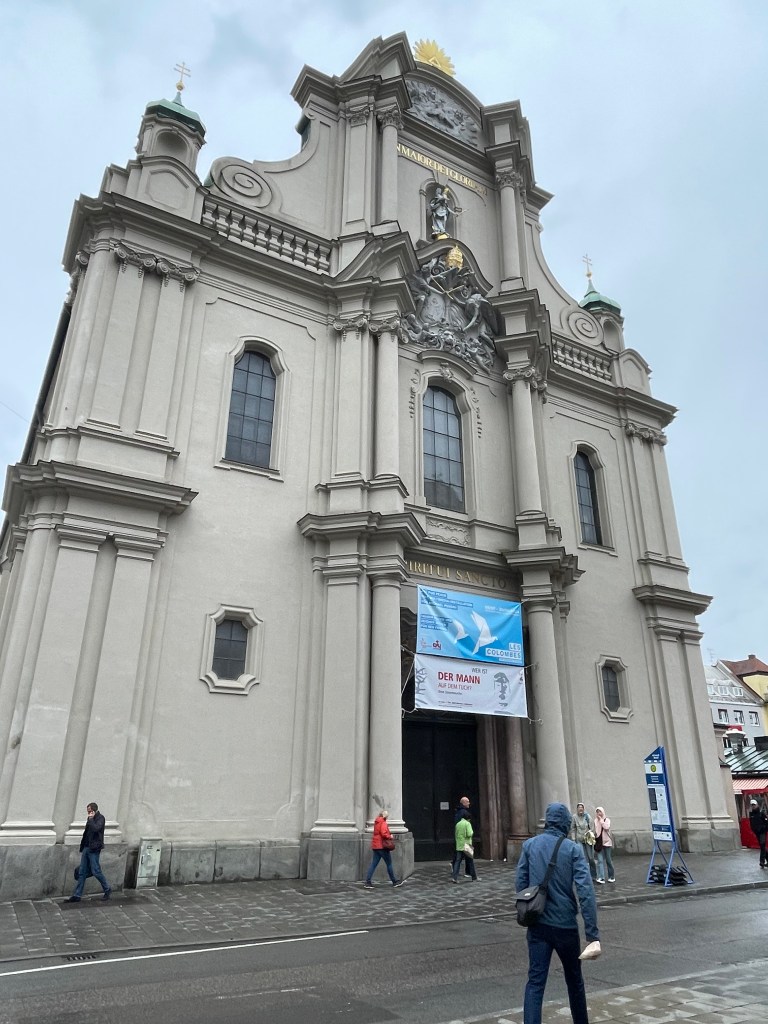
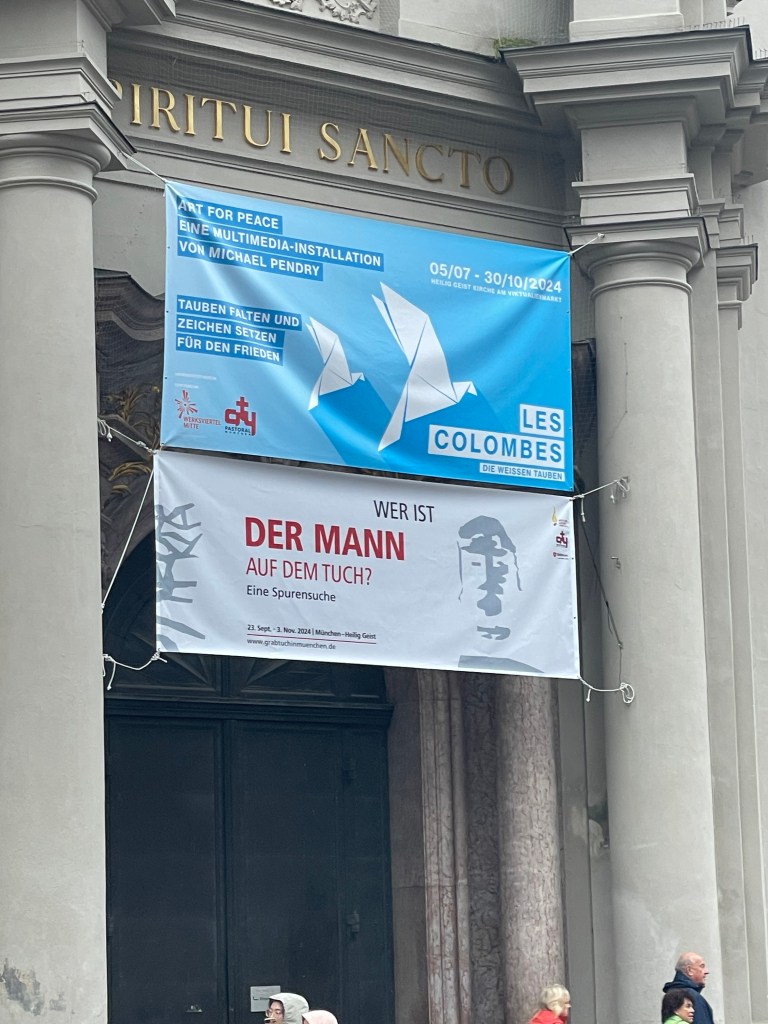
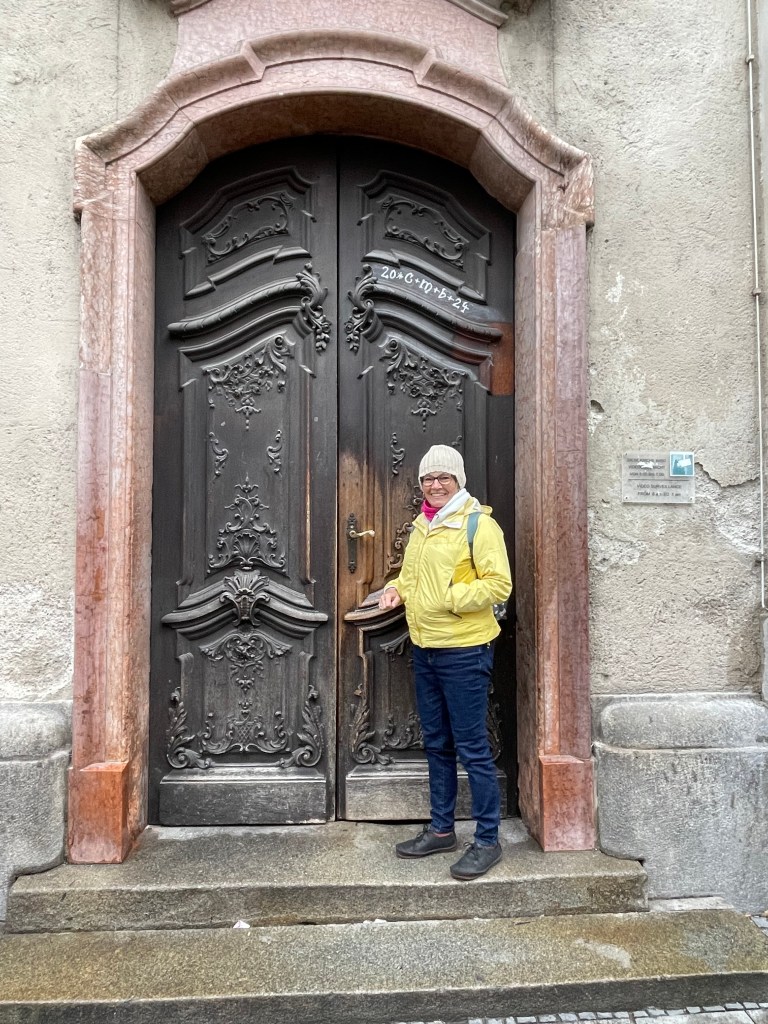
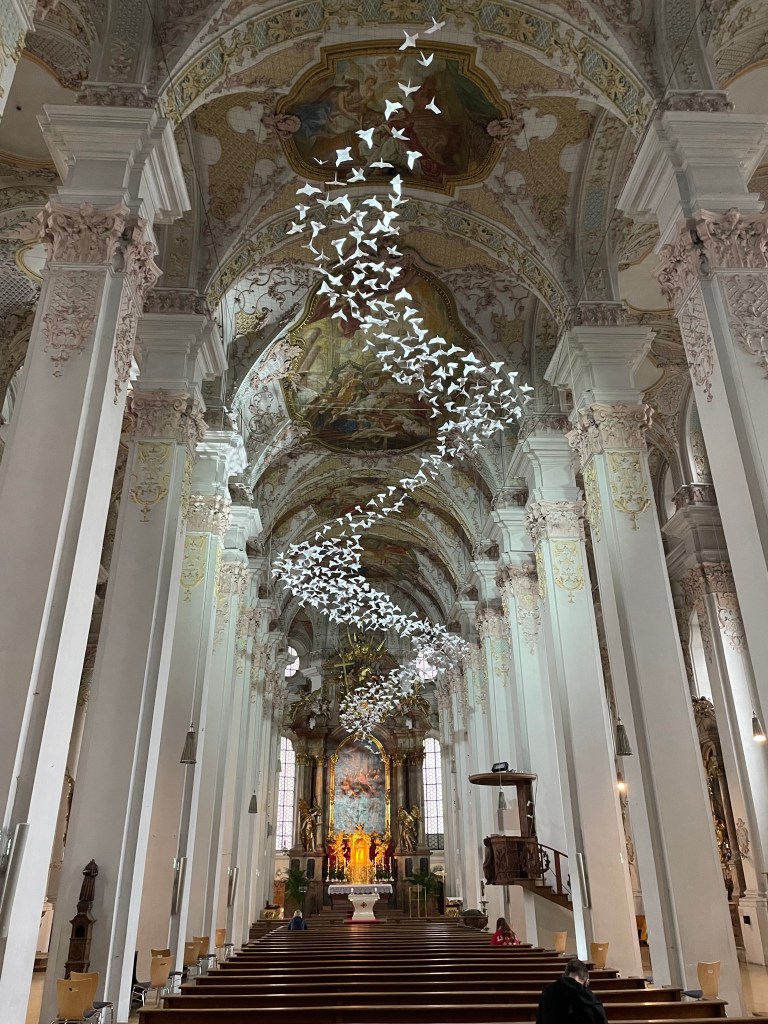
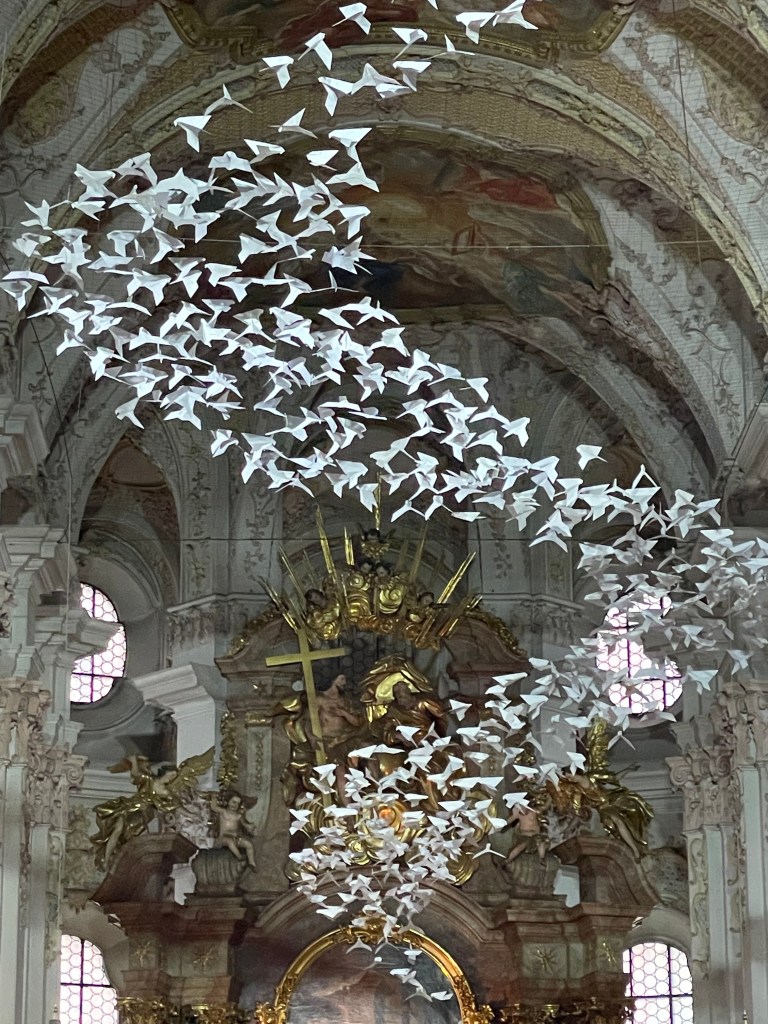
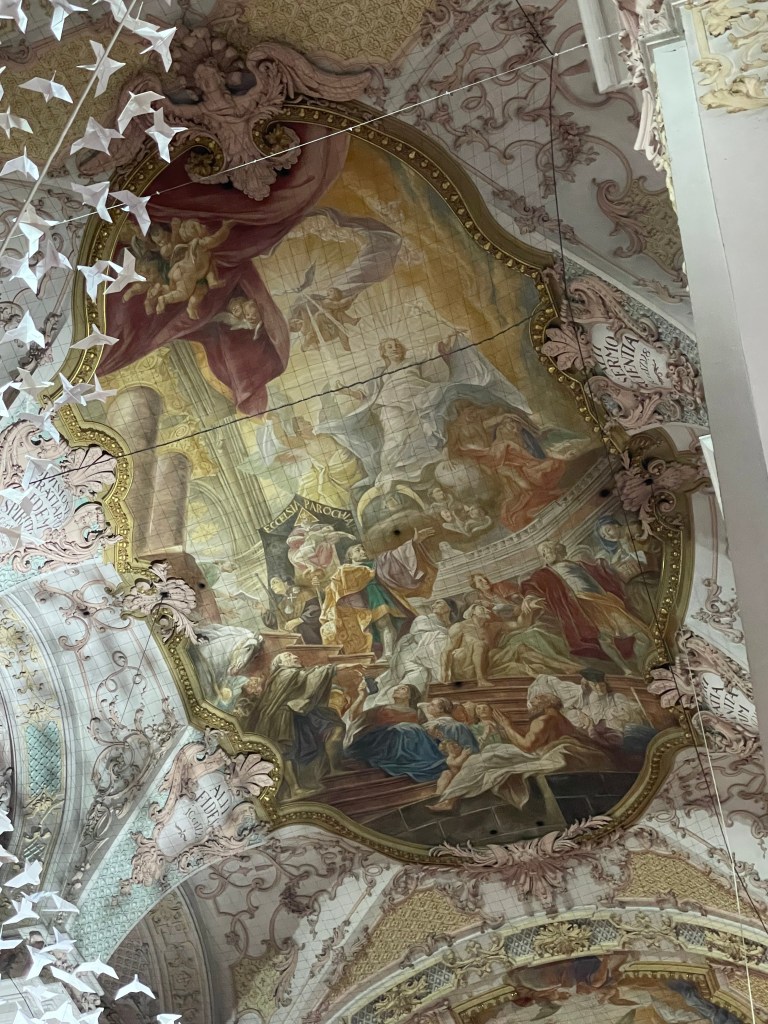
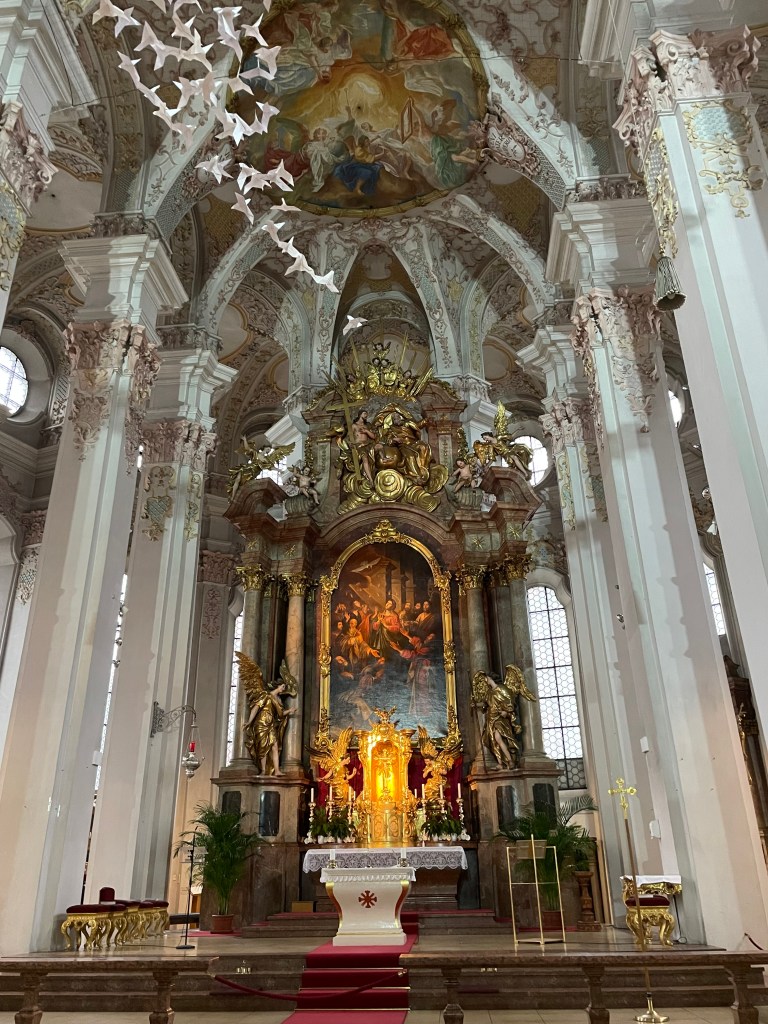
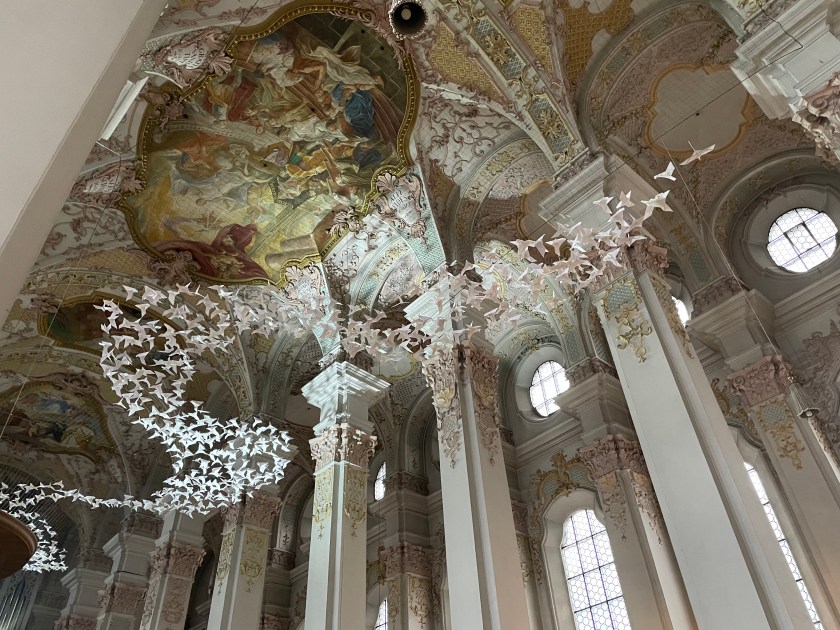
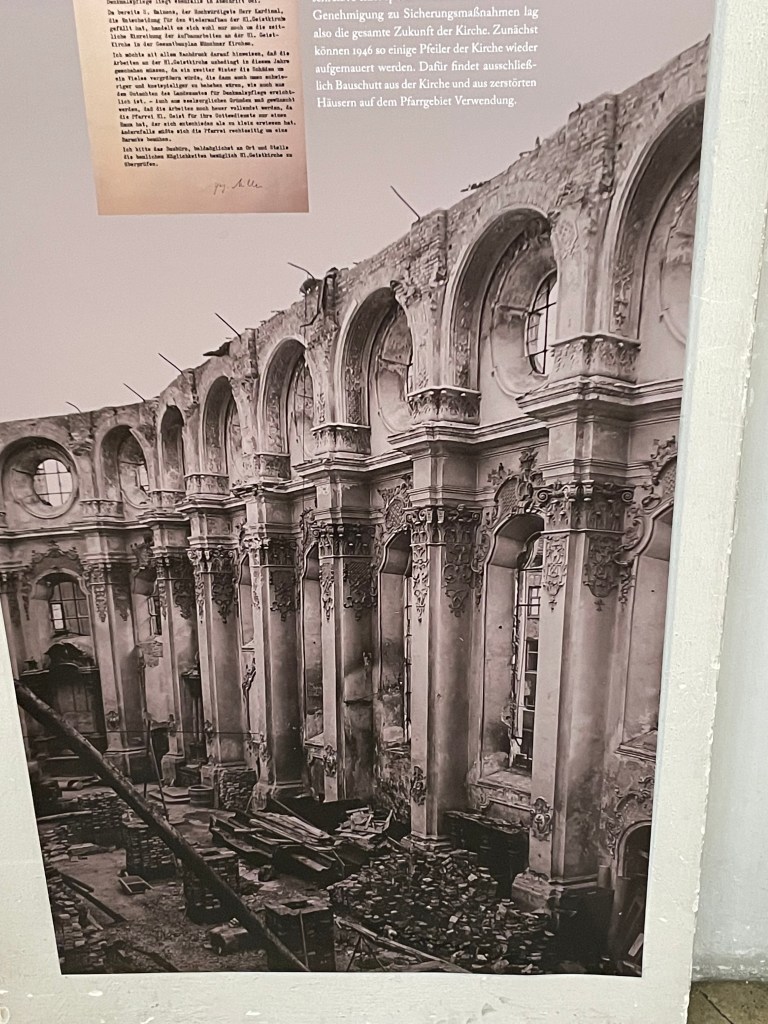
This church looked interesting, so we went in.  There was a beautiful art installation with paper doves of peace.

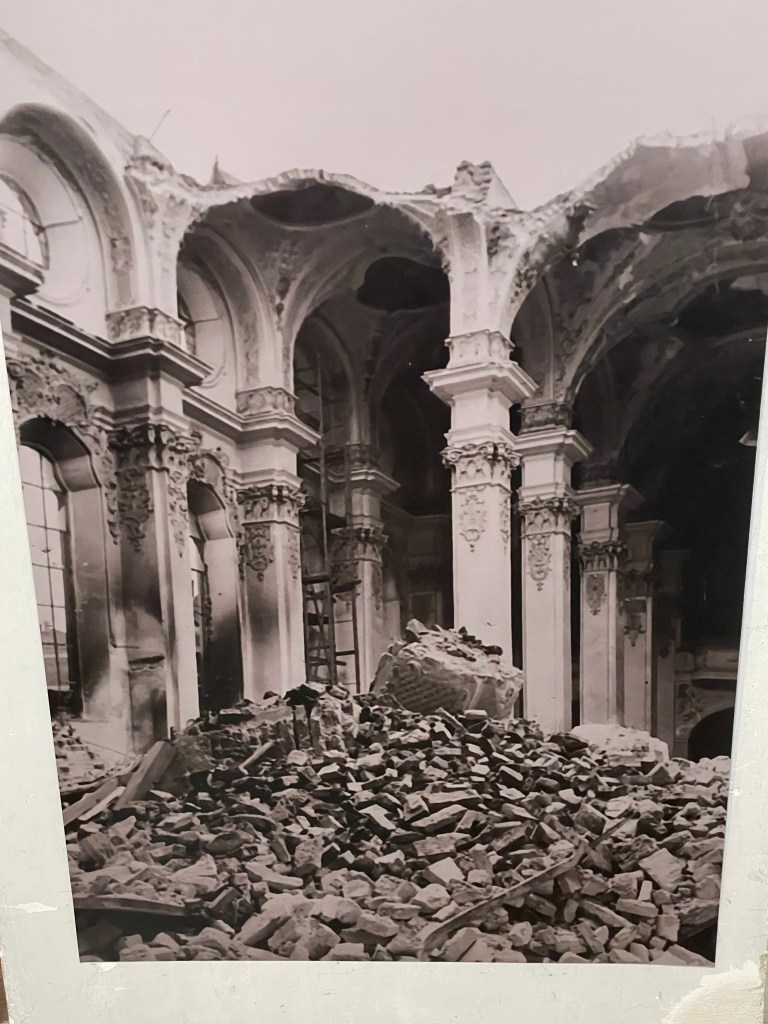
Here’s what the church looked like after being bombed in WWII:

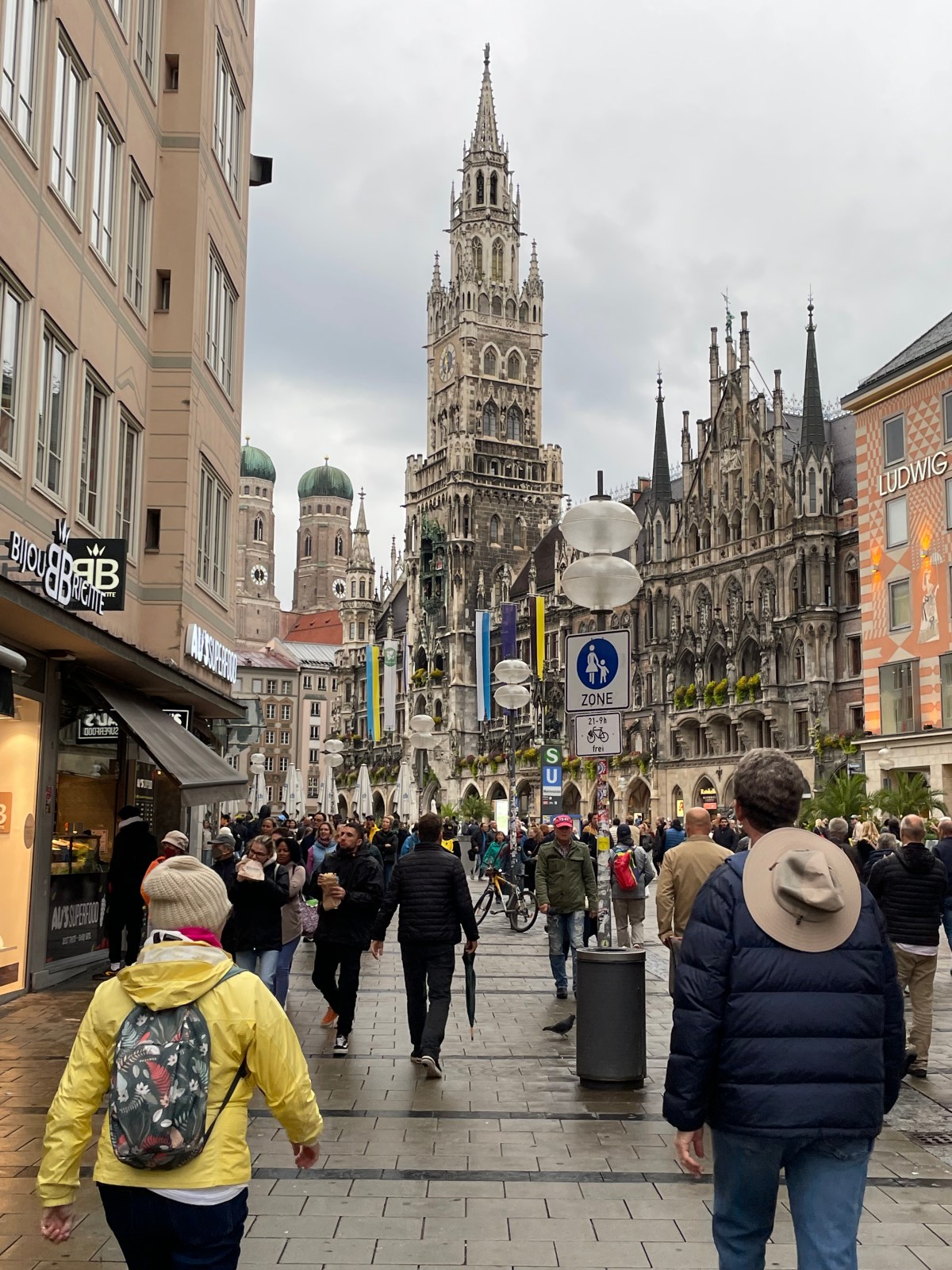
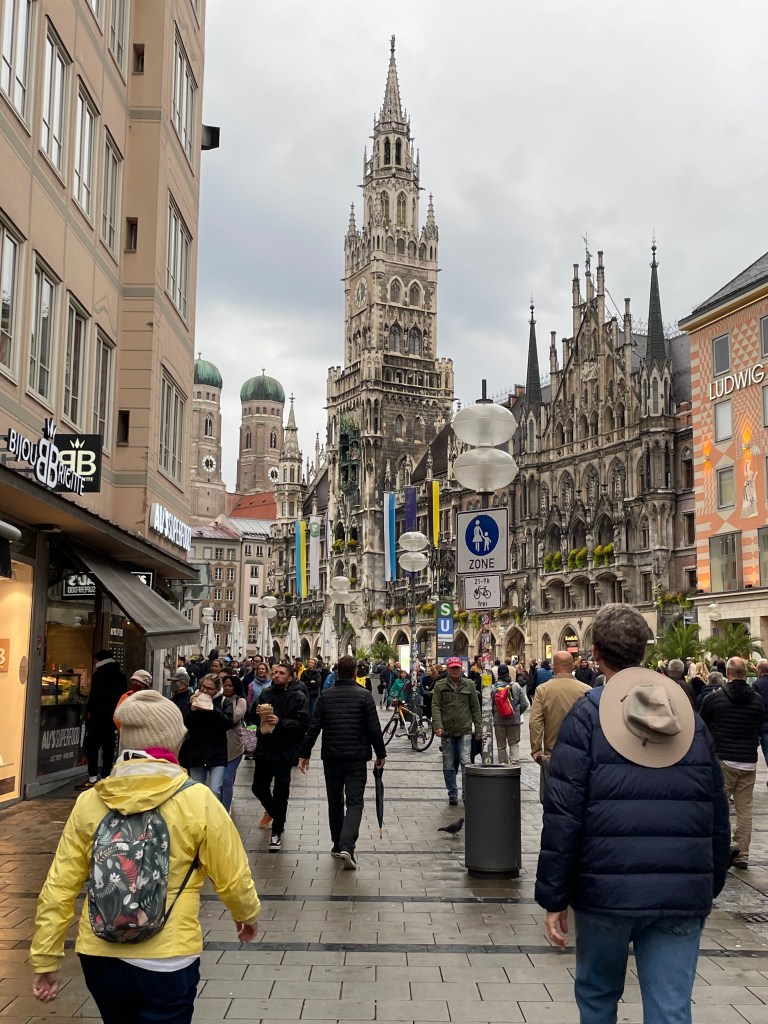
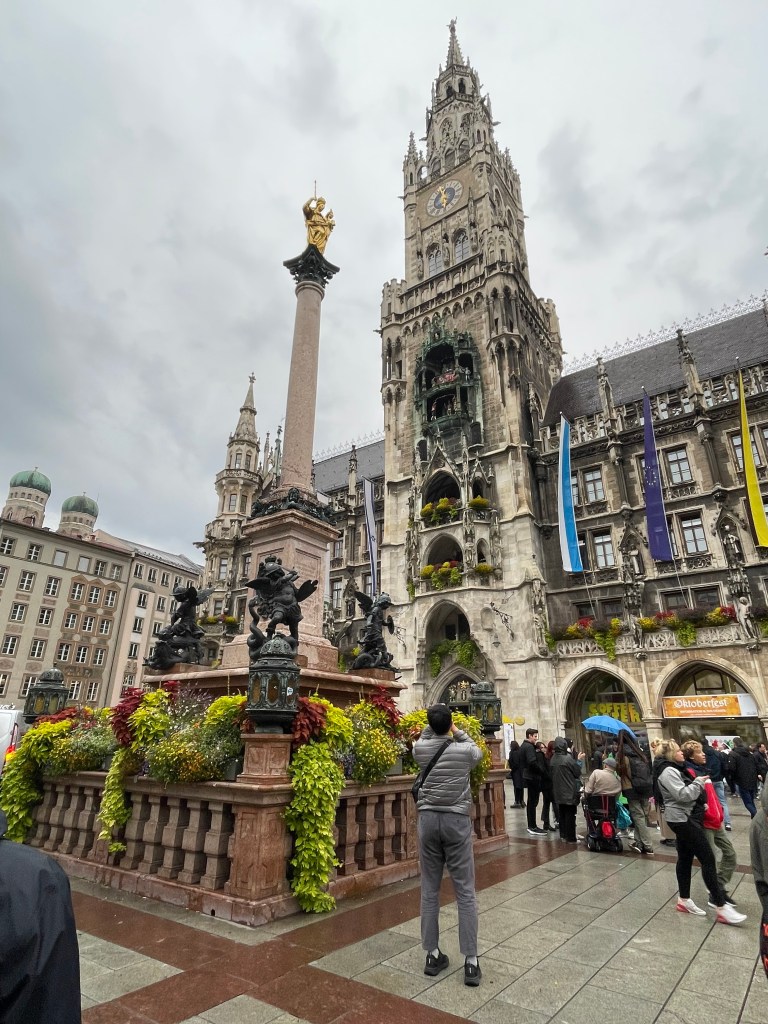
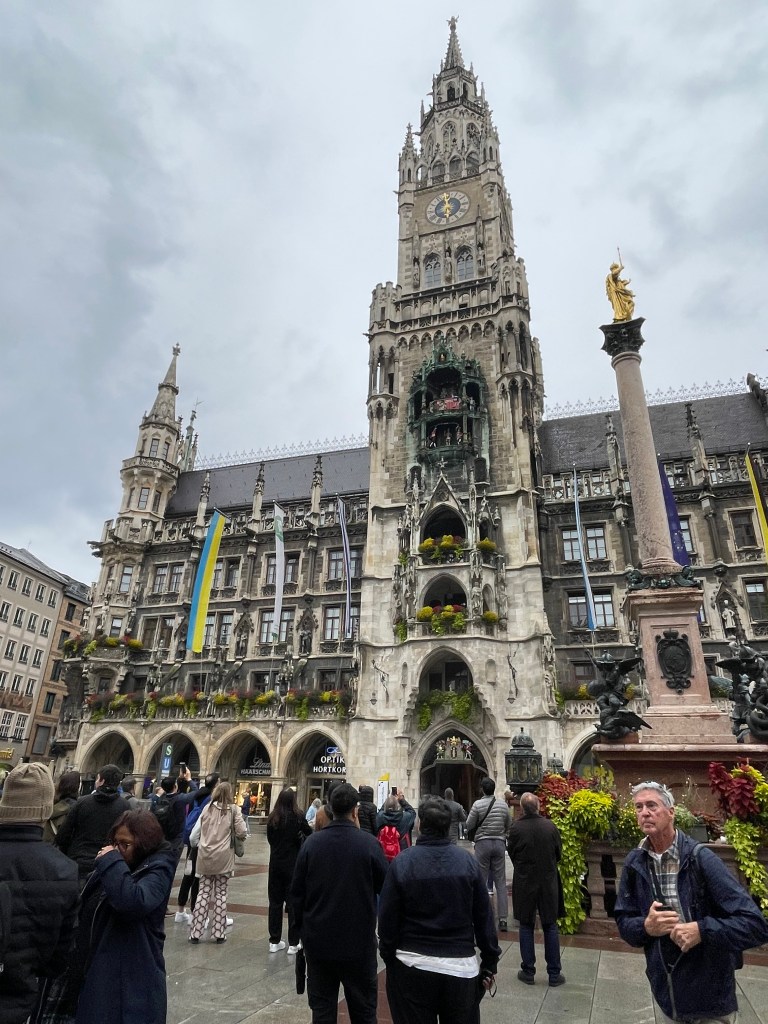
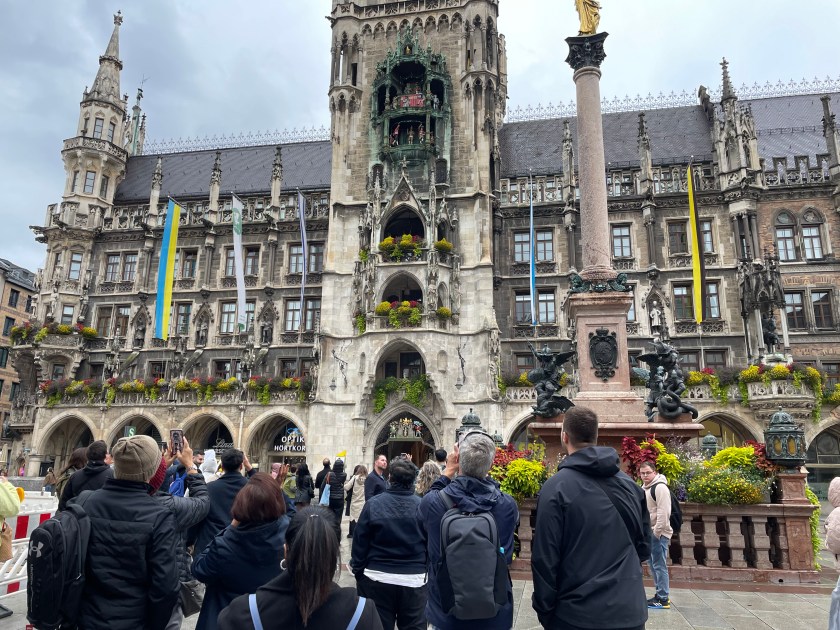
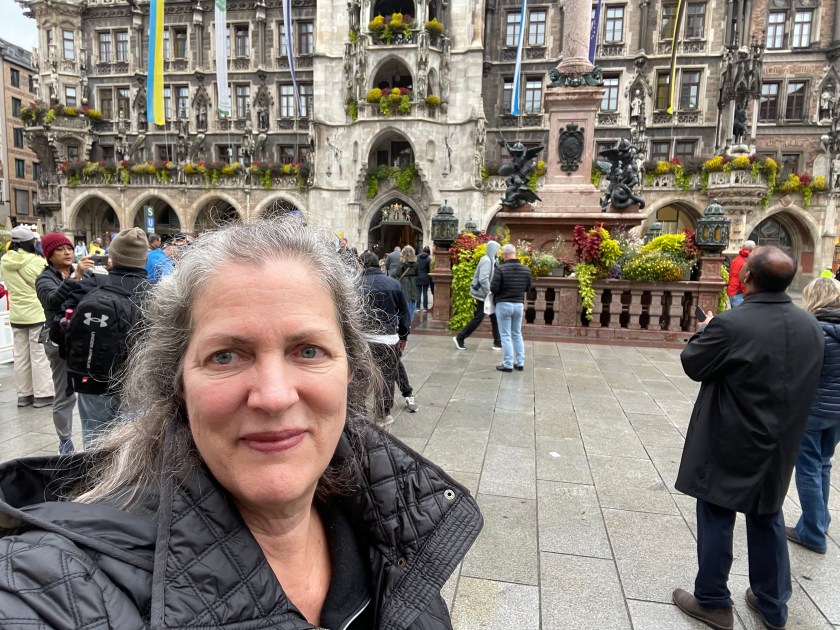
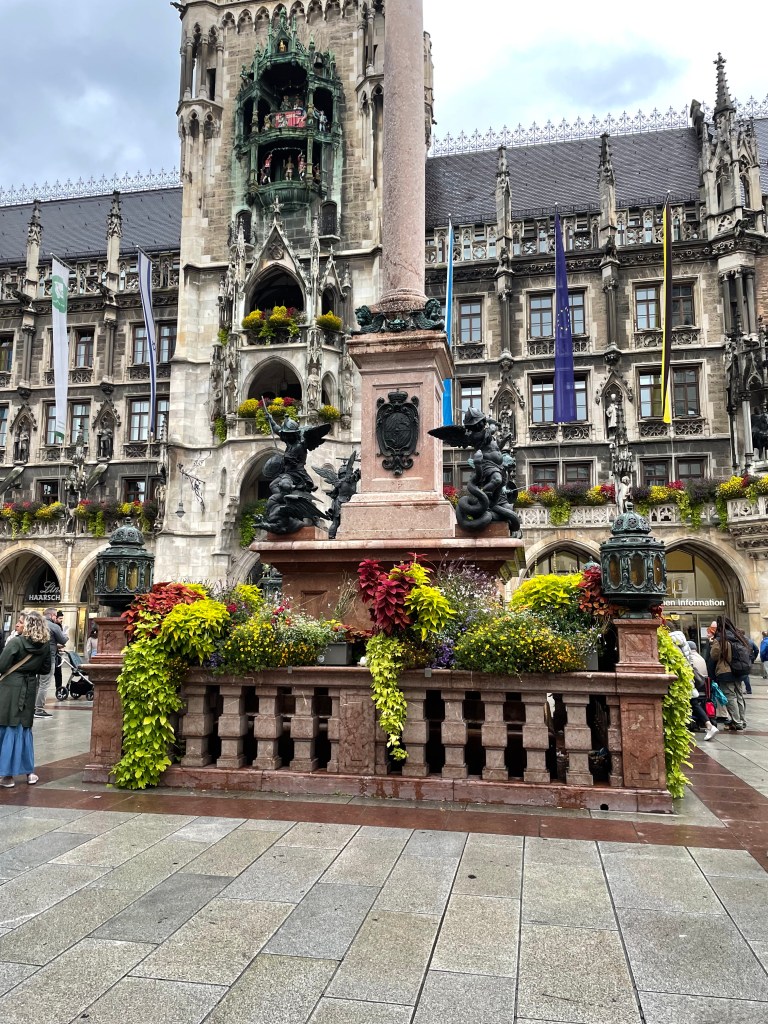
We continued on to Marienplatz in the heart of this city of 1 million people.

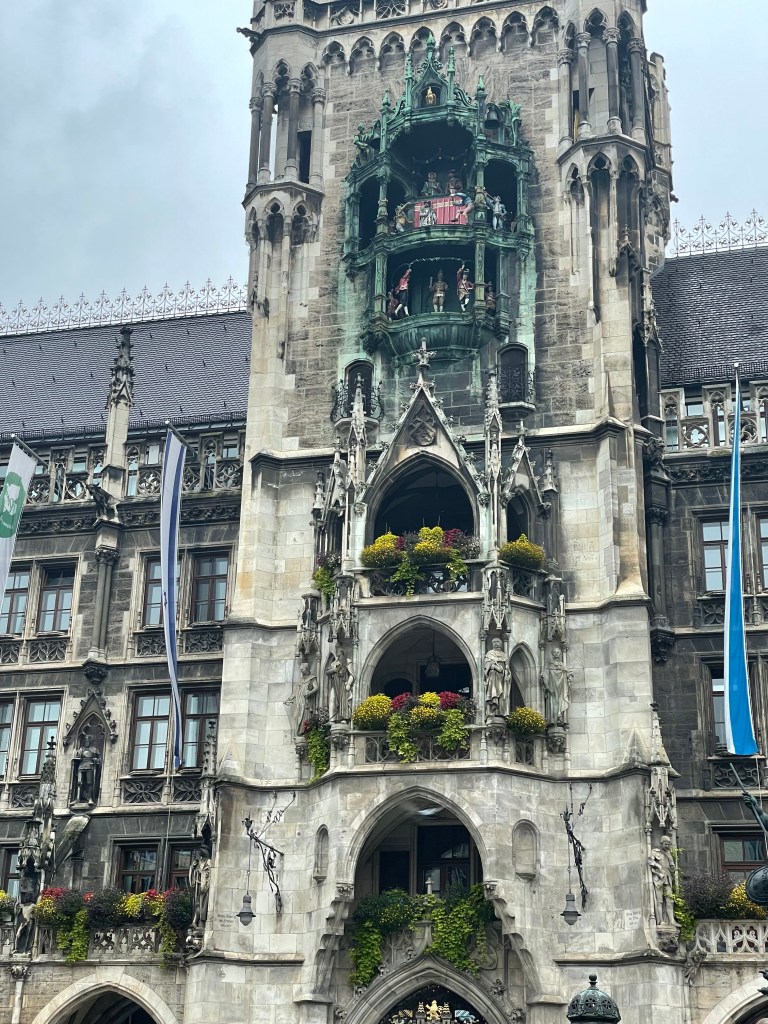
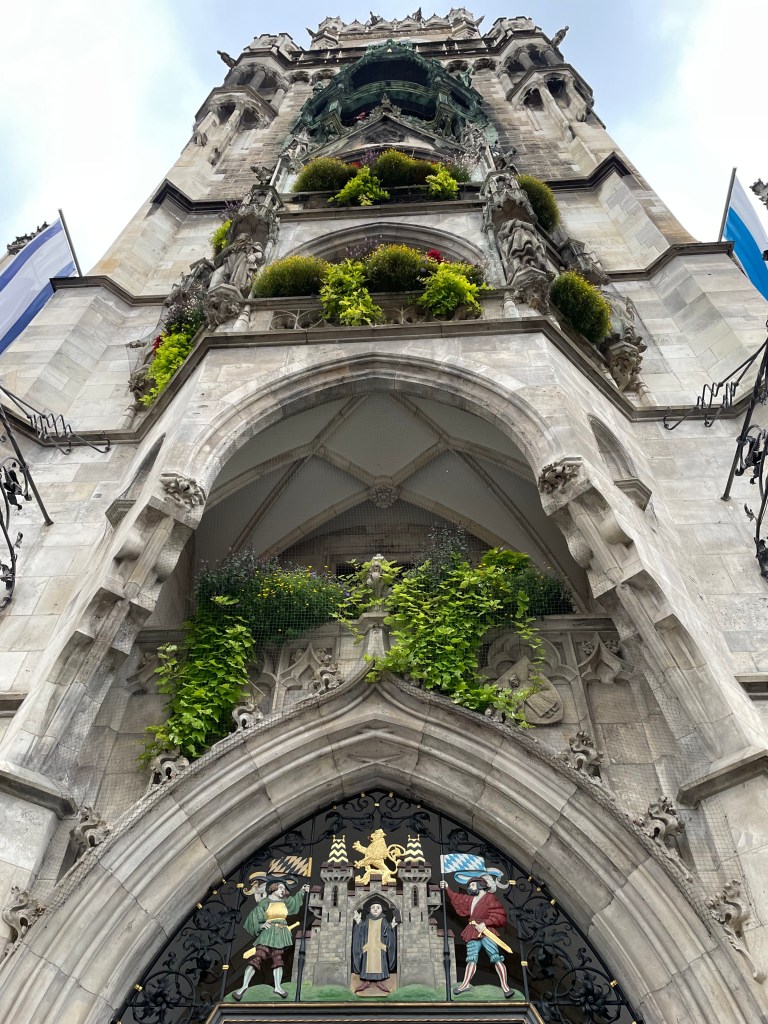
The famous clock tower:

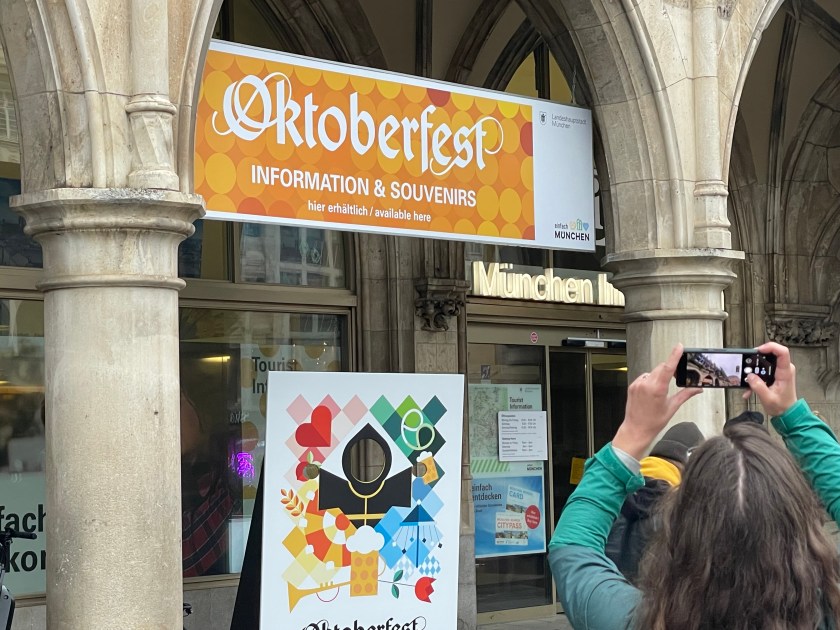
Next week Oktoberfest begins.  I’m glad we dodged that!  Here’s a bit about what is coming:

Oktoberfest’s roots can be traced back to 1810 in Munich, which is in the Bavarian region of Germany. On October 12th of that year, the future King Ludwig got married and invited the entire city to attend the celebration, which included a large feast and horse races.
Wikipedia:  Oktoberfest is the world’s largest Volksfest, featuring a beer festival and a travelling carnival, and is held annually in Munich, Bavaria, from mid- or late-September to the first Sunday in October, with more than six million international and national visitors attending the event. Locally, it is called d’Wiesn, after the colloquial name for the fairgrounds, Theresienwiese. Oktoberfest is an important part of local culture, having been held since the year 1810. Other cities across the world also hold Oktoberfest celebrations that are modeled after the original Munich event.
During the event, large quantities of Oktoberfest Beer are consumed: in 2014, 7.7 million litres (2,000,000 US gal) were served.[1][2] Visitors also enjoy numerous attractions, such as amusement rides, side stalls, and games. There is also a wide variety of traditional foods available.

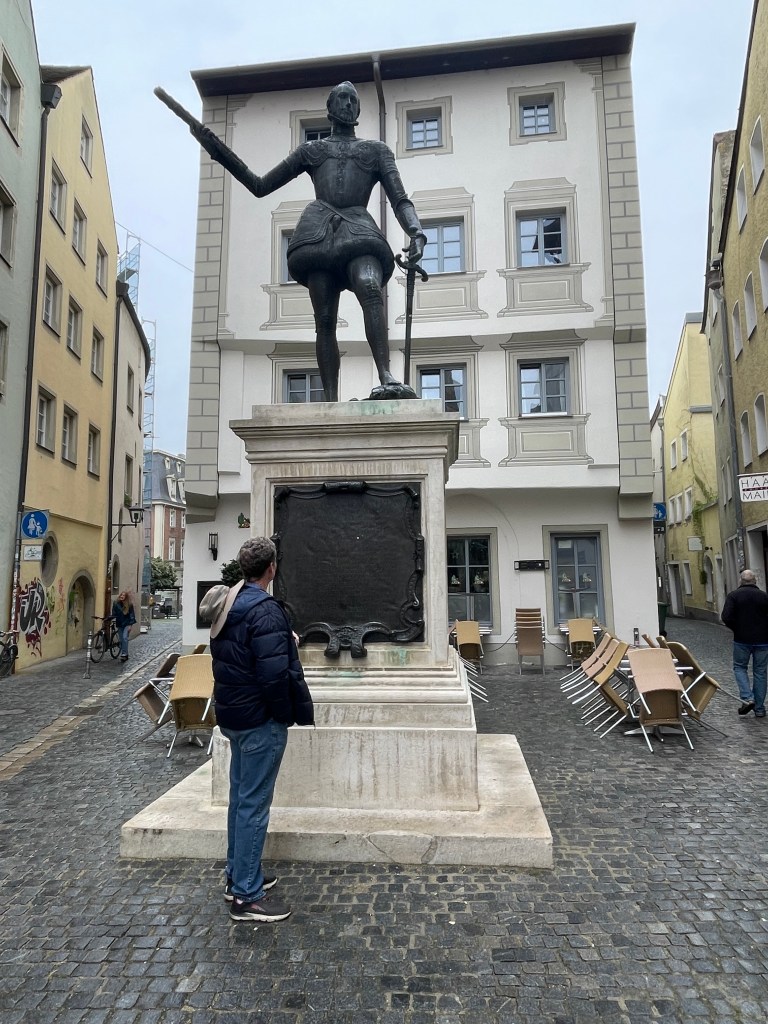
Around the square–

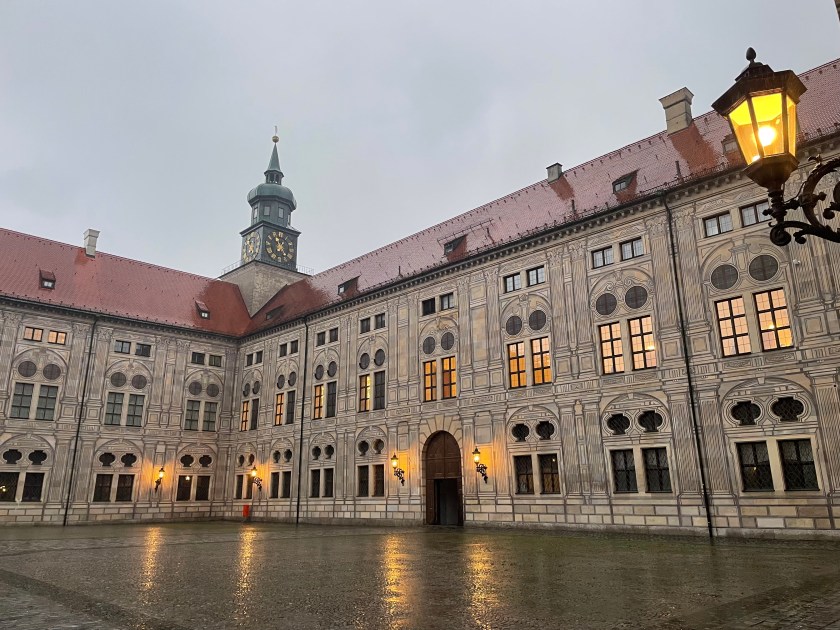
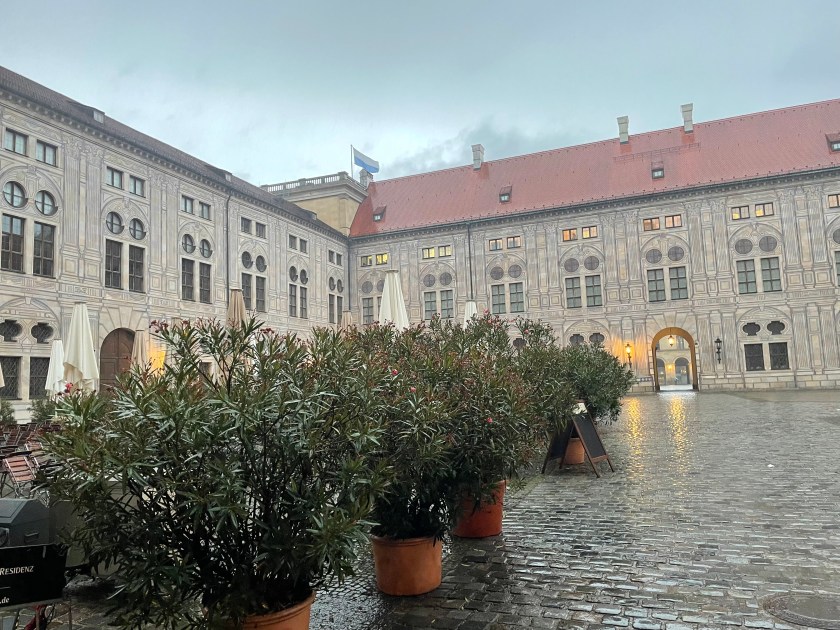
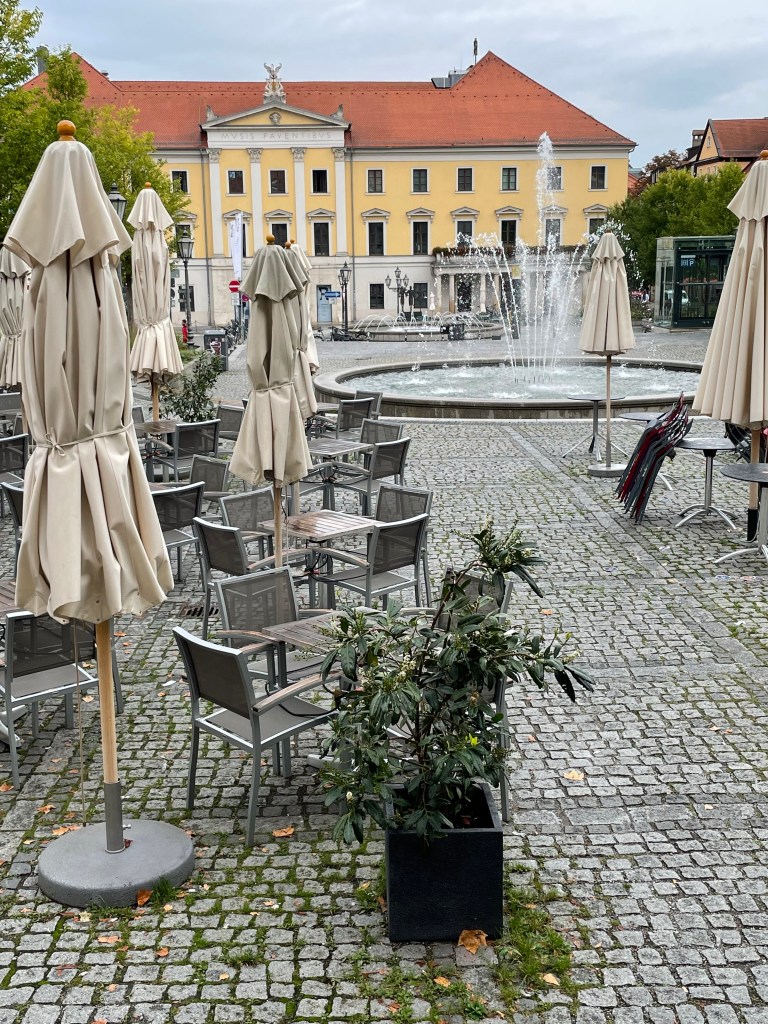
This is the Palace.  It would be fun to visit if you had time.  This evening everything was cold and wet and closed.

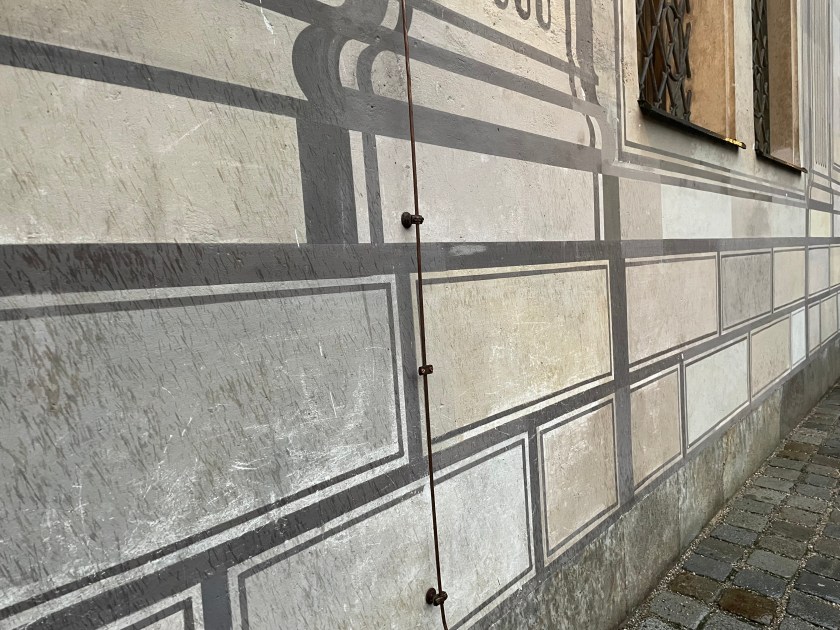
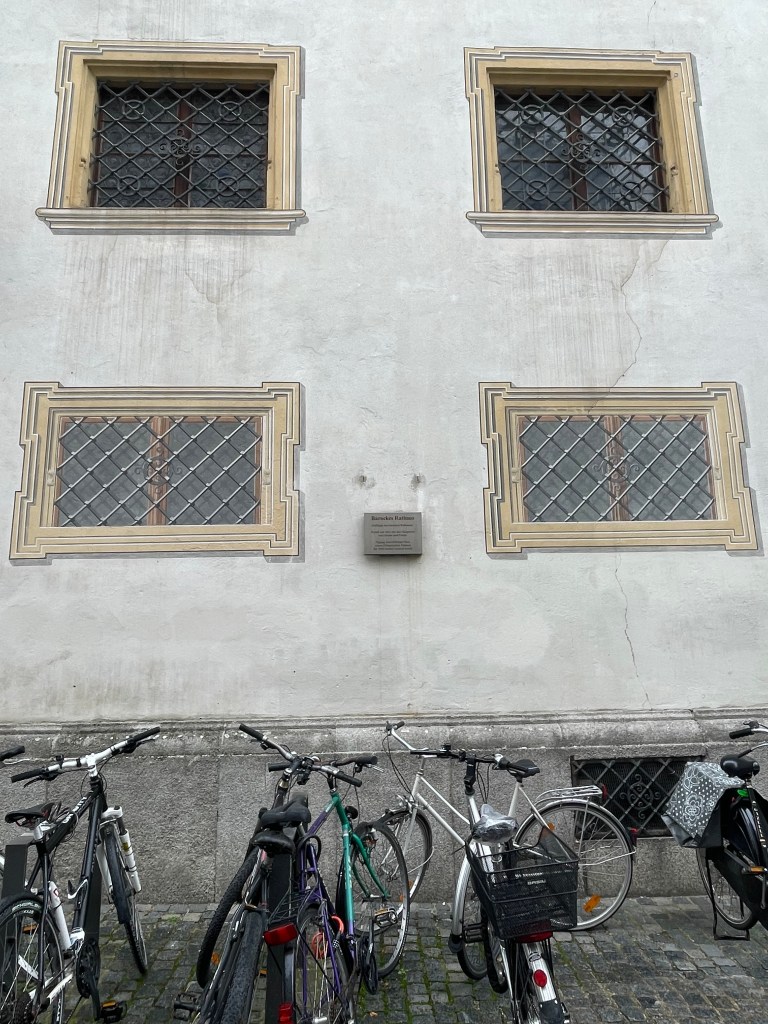
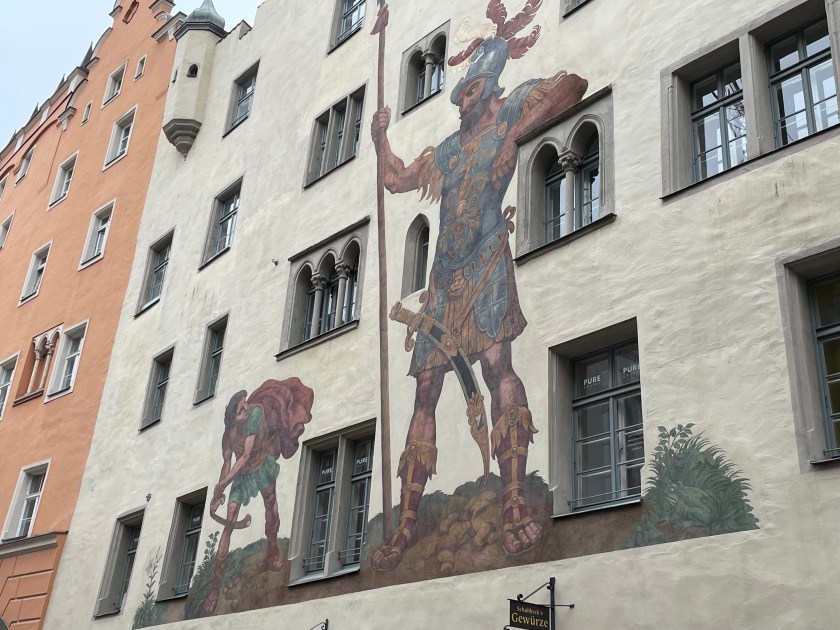
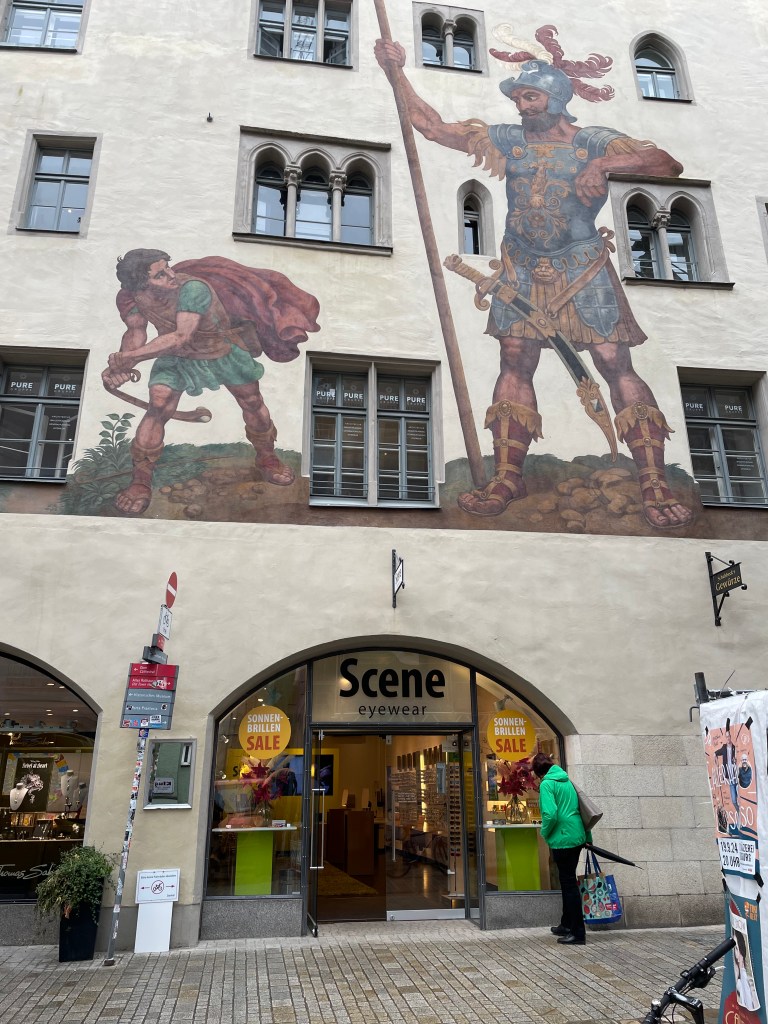
Interesting to see that what looks like stonework, is actually just painted on.

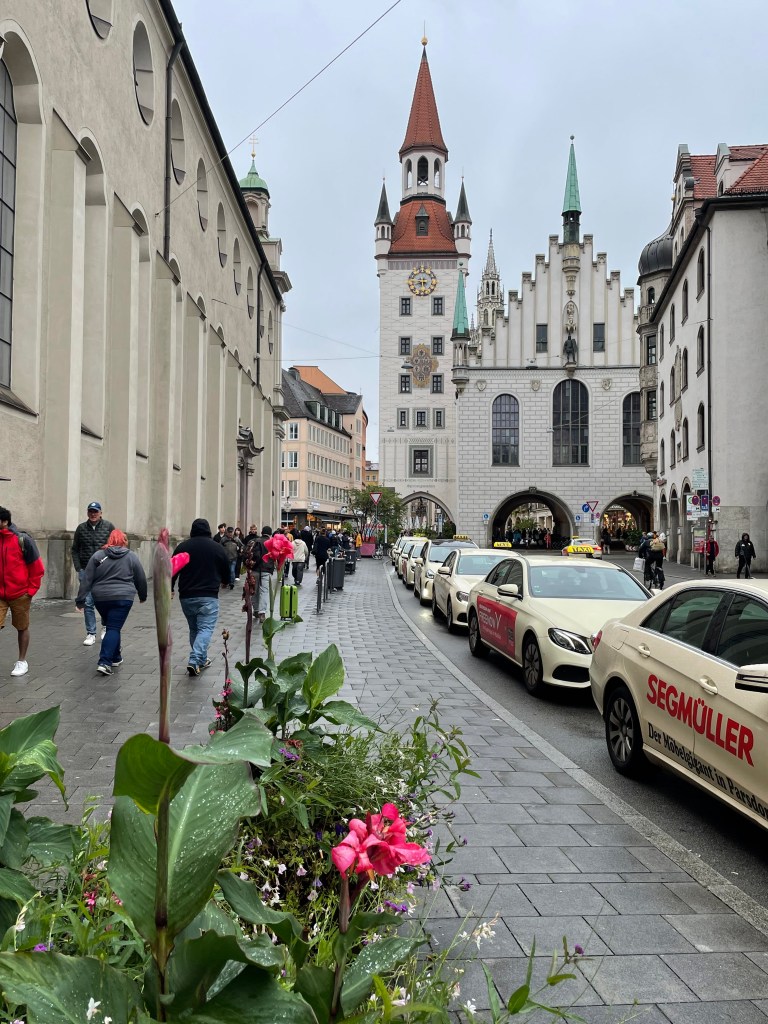
By now we were HUNGRY and cold and wet and it was time to go find the Hofbrauhaus!

The Churches of Regensburg

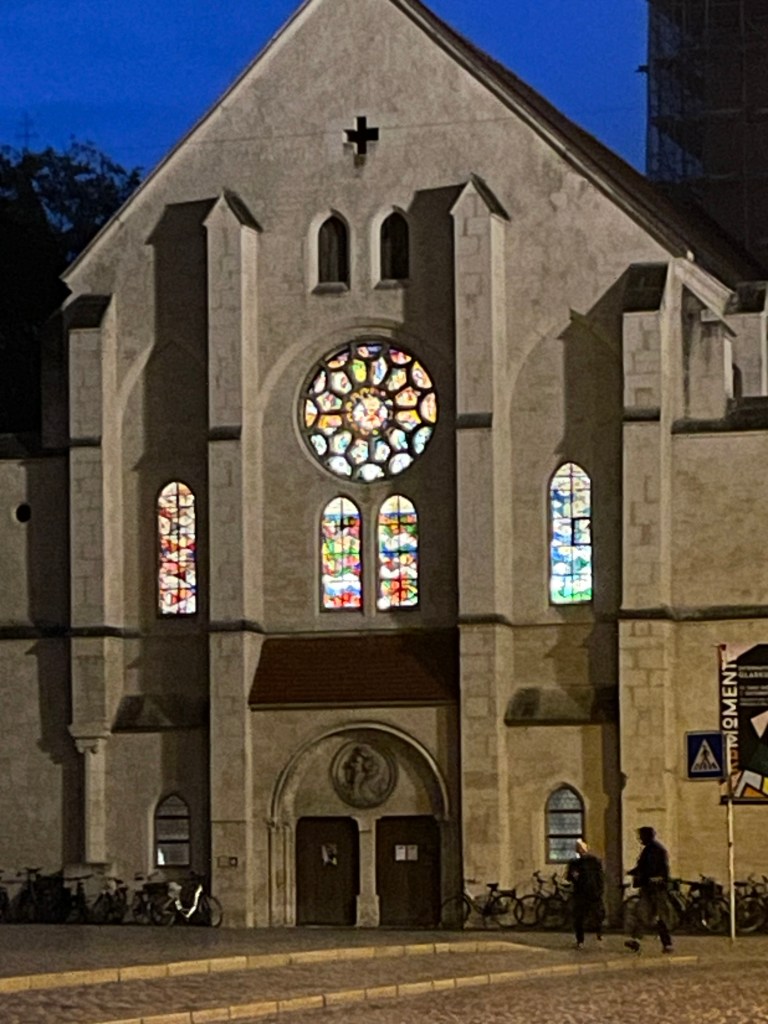
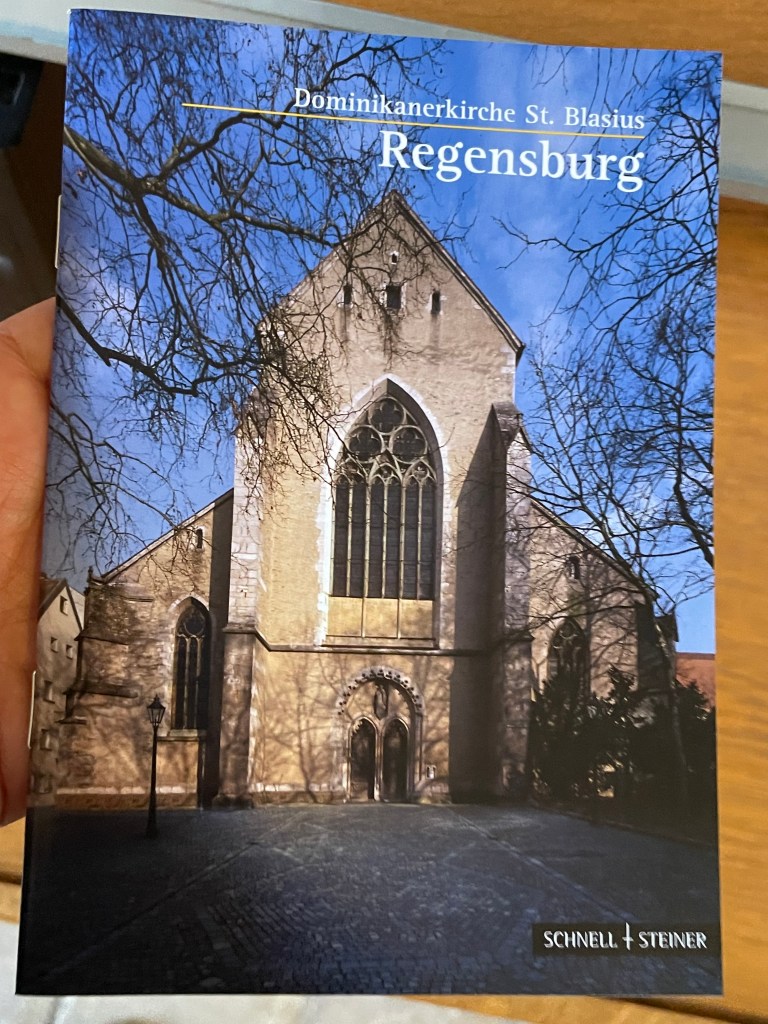
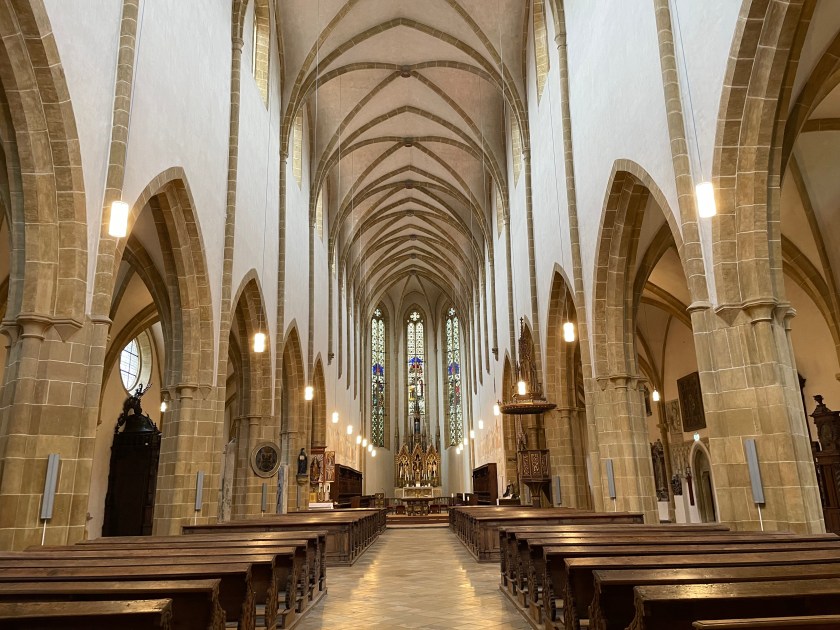
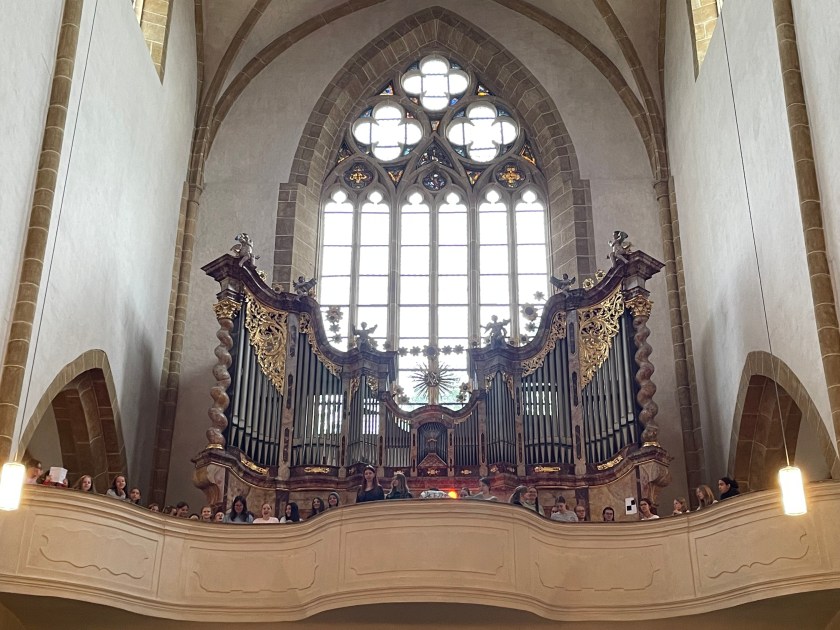
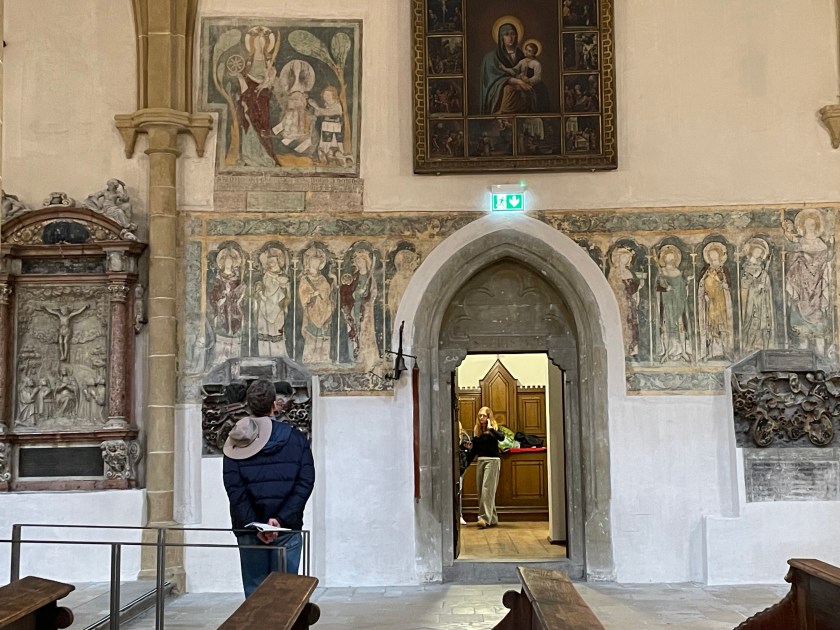
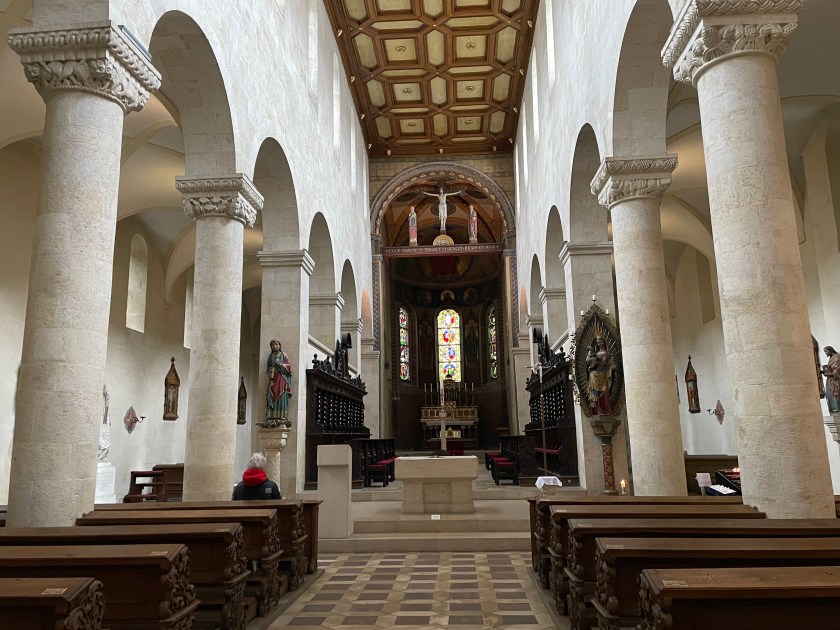
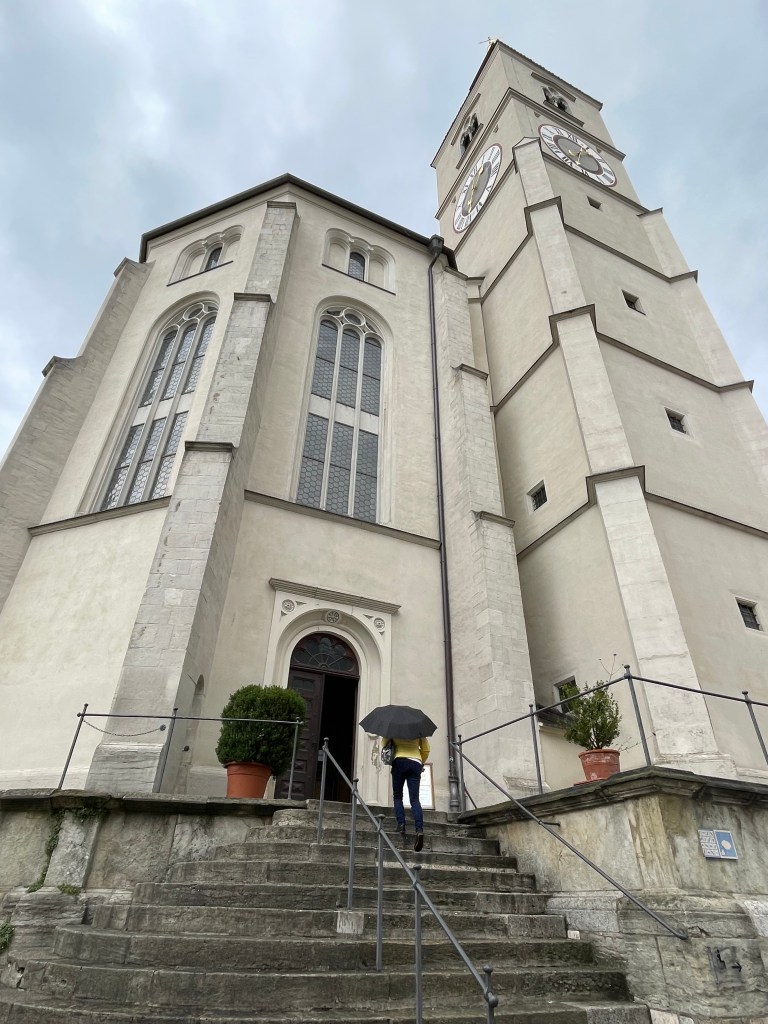
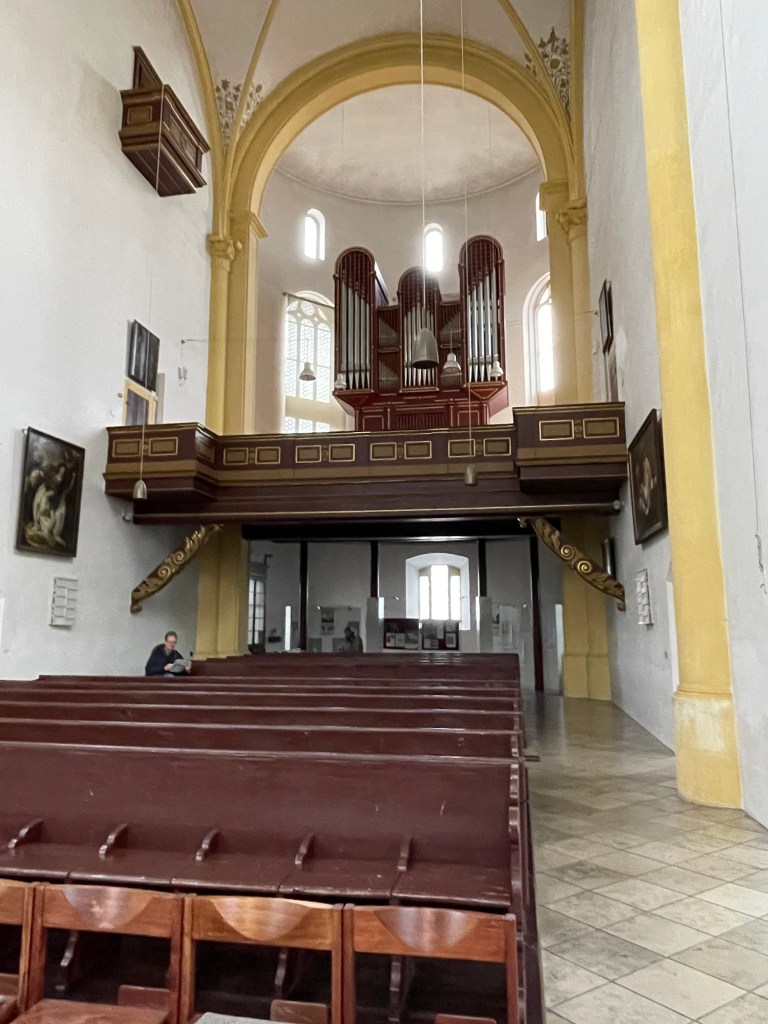
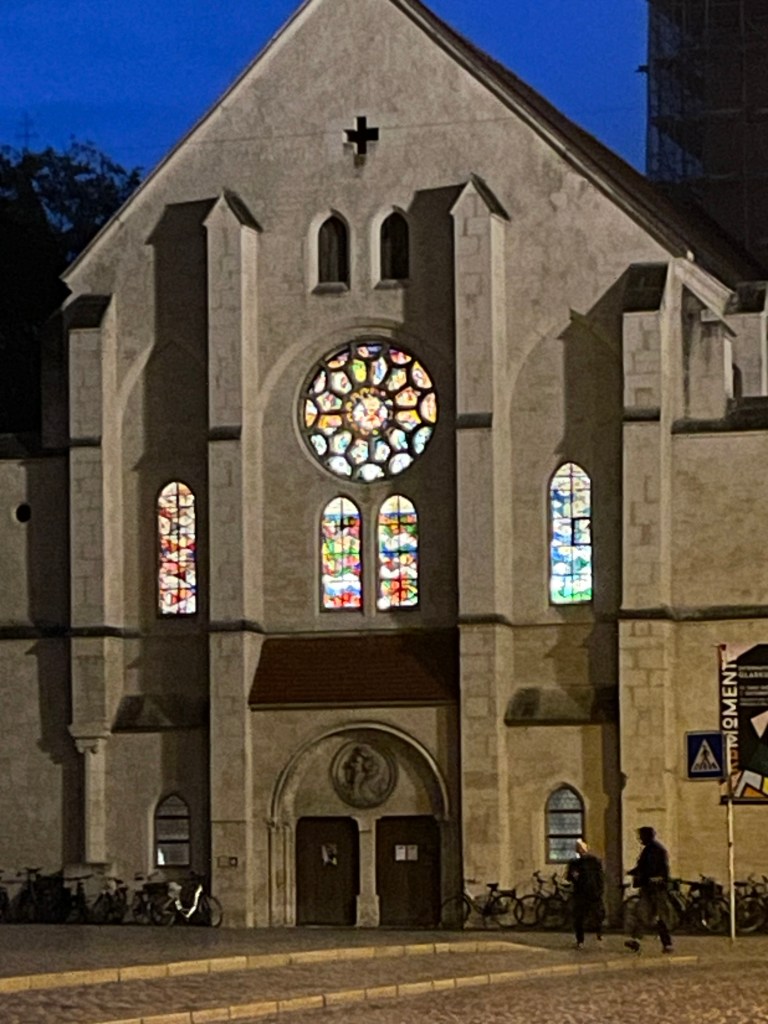
Last night we wandered by the cathedral and the church above.  We returned to there later today.  This morning we first visited the Dominikanerkirche St. Basius.  As we stepped through the big heavy doors, we heard heavenly music, and we turned to find it.  It filled the entire church like heavenly angels.  We discovered a girls’ choir practicing up in the organ loft.  It was absolutely heavenly.

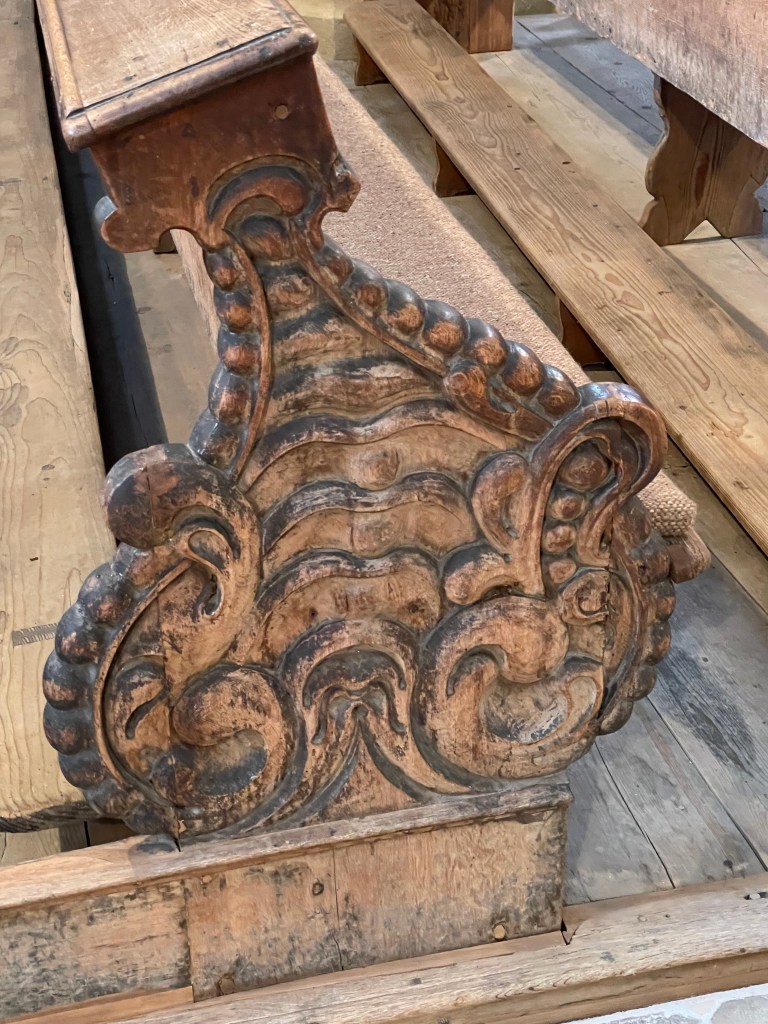
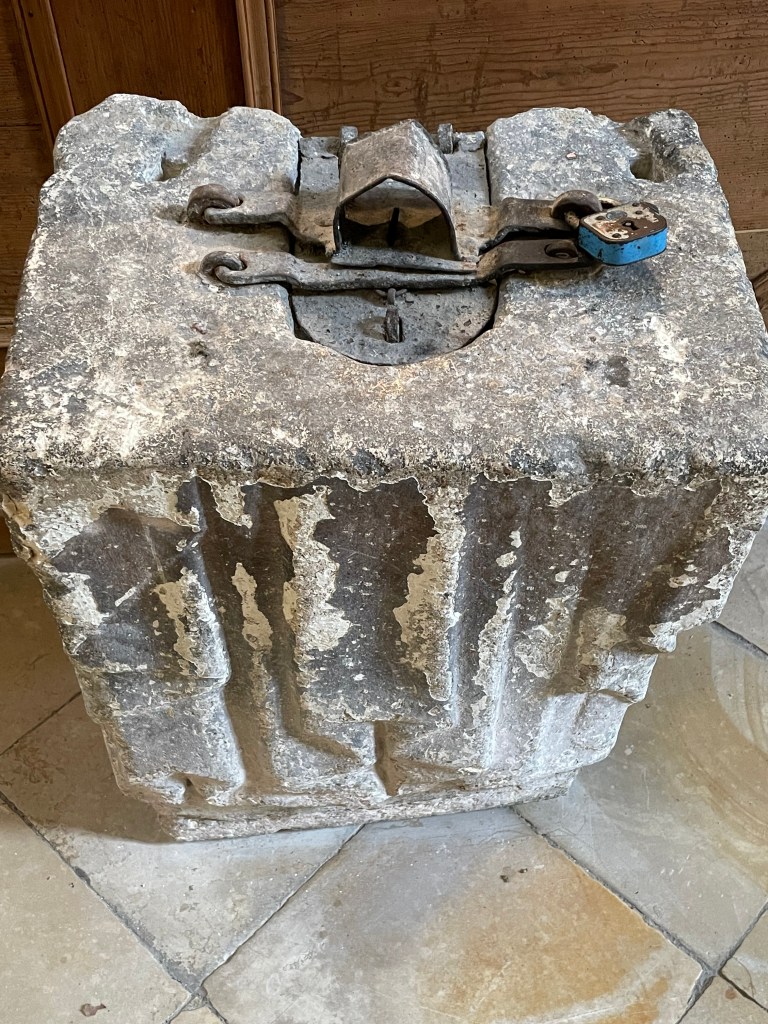
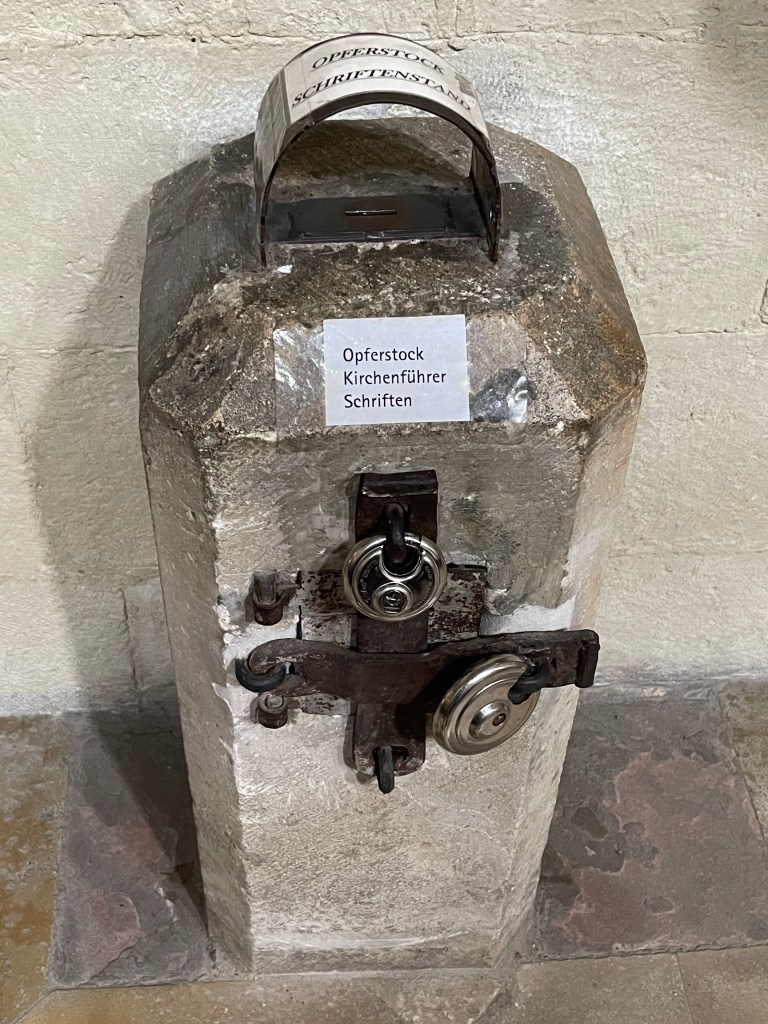
Alms boxes were kept under lock and key.

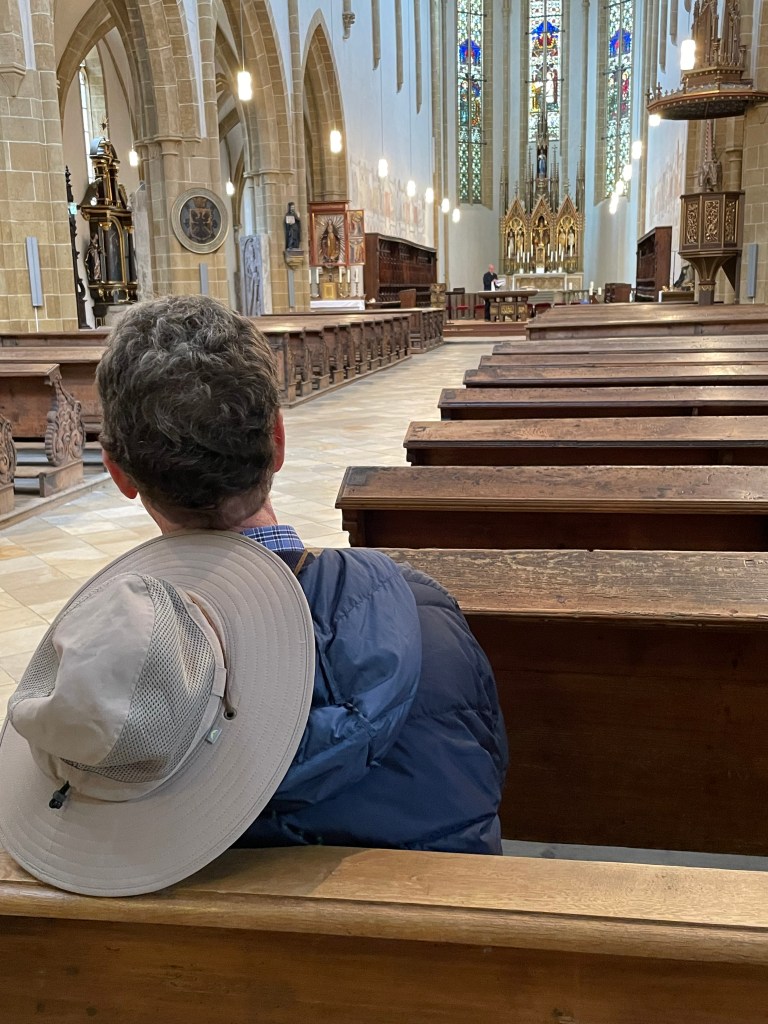
We sat for some time here, enjoying the choir rehearsal.

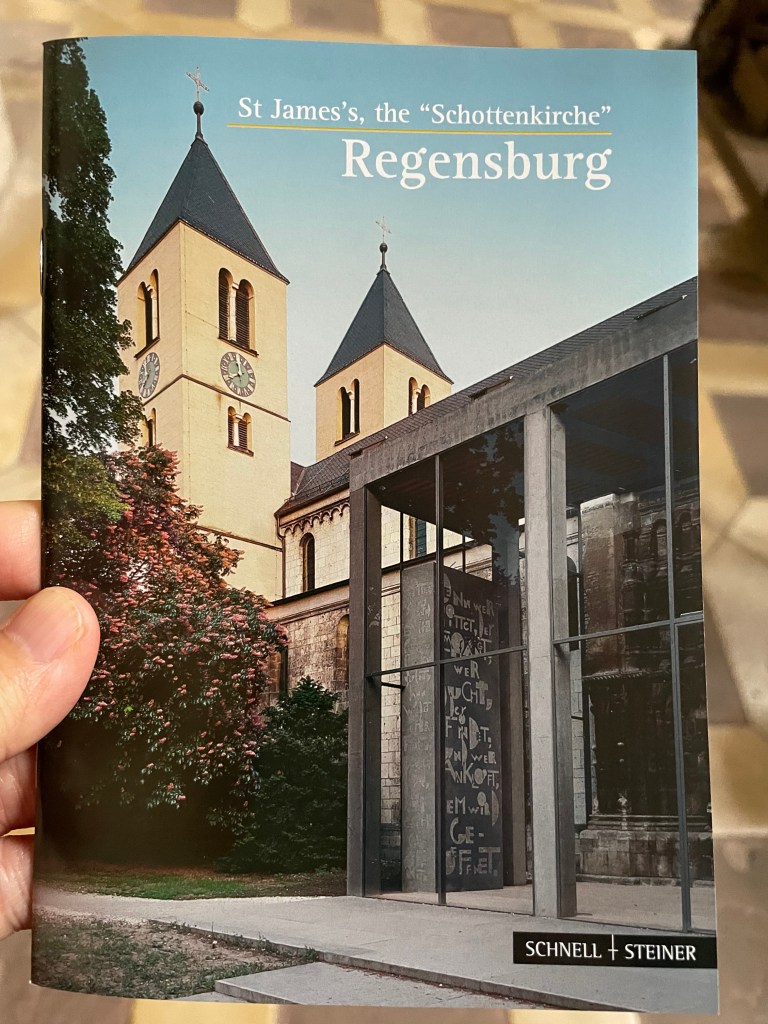
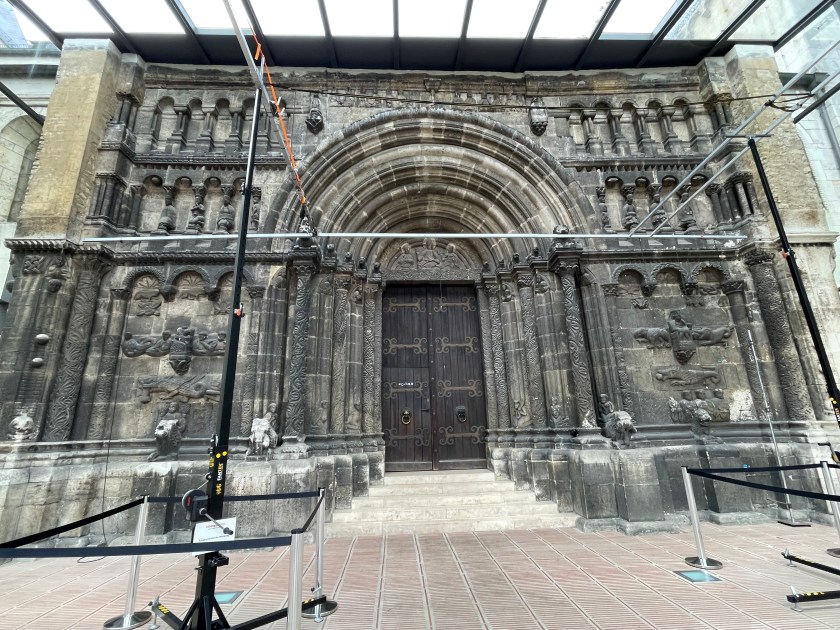
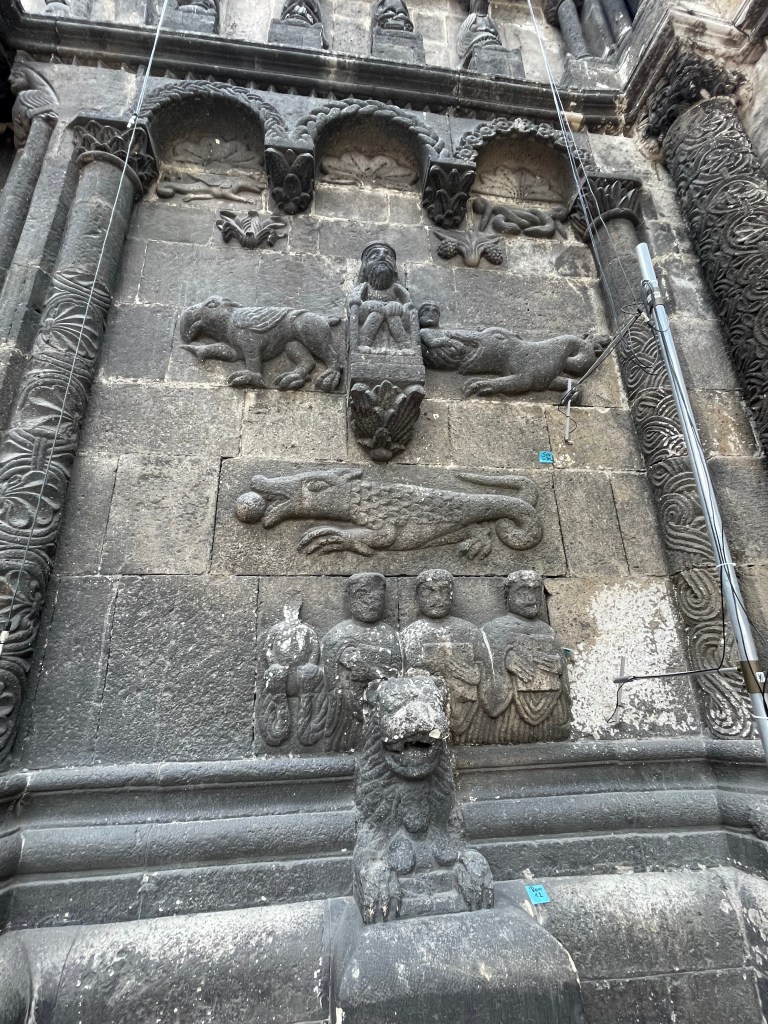
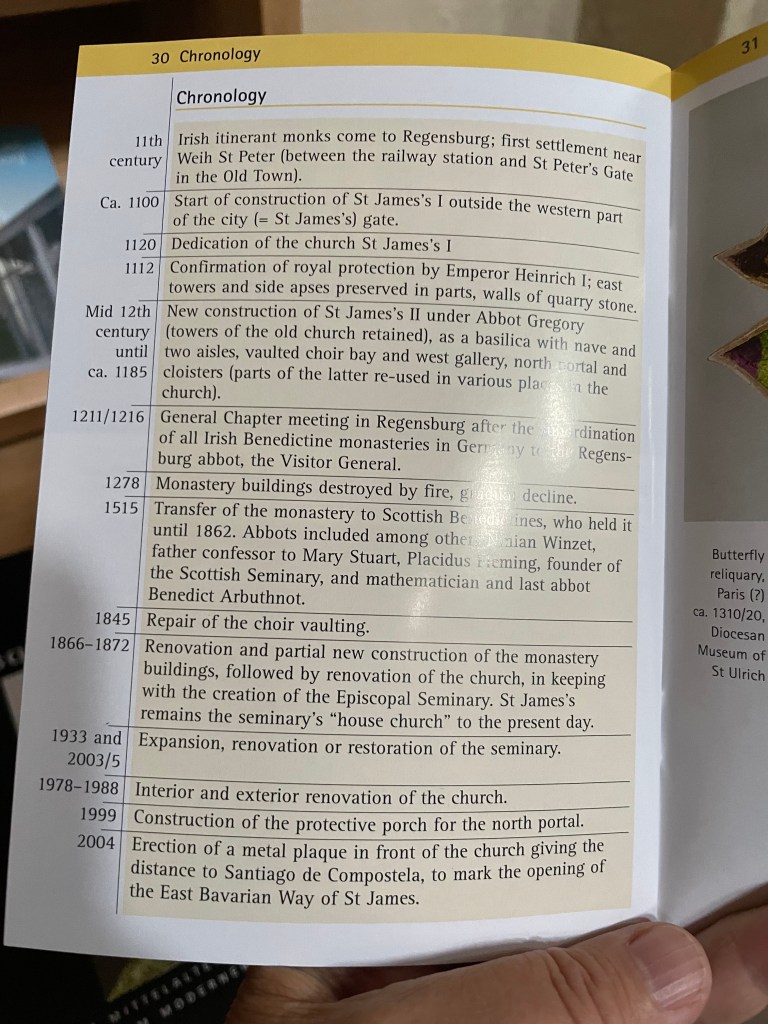
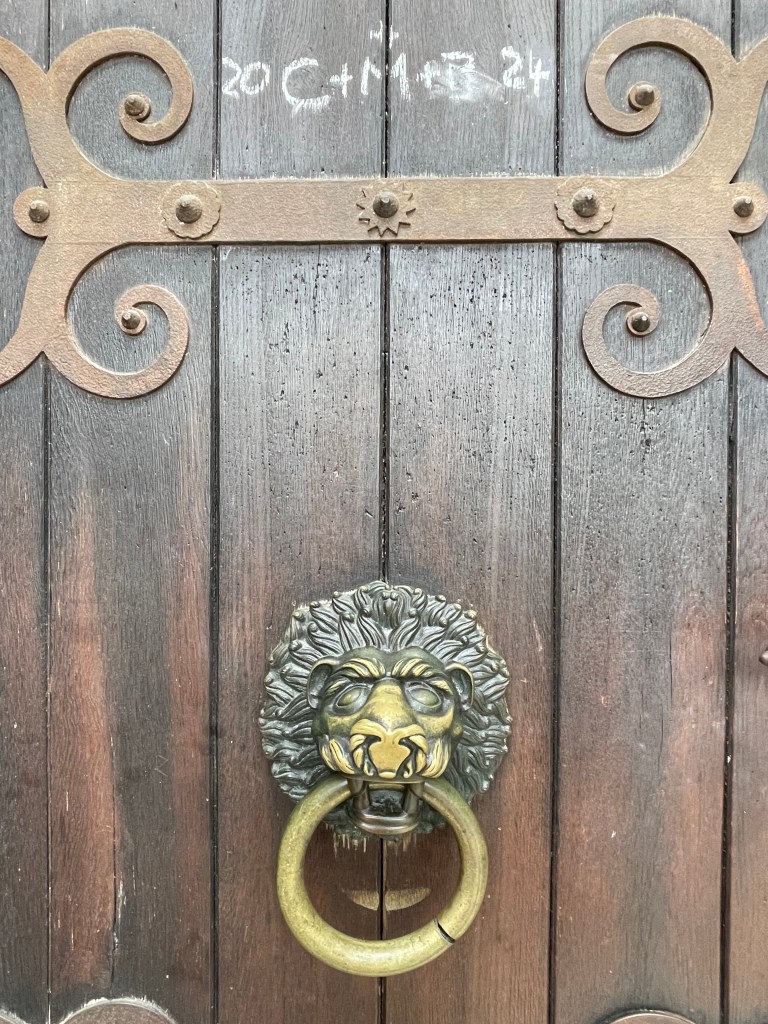
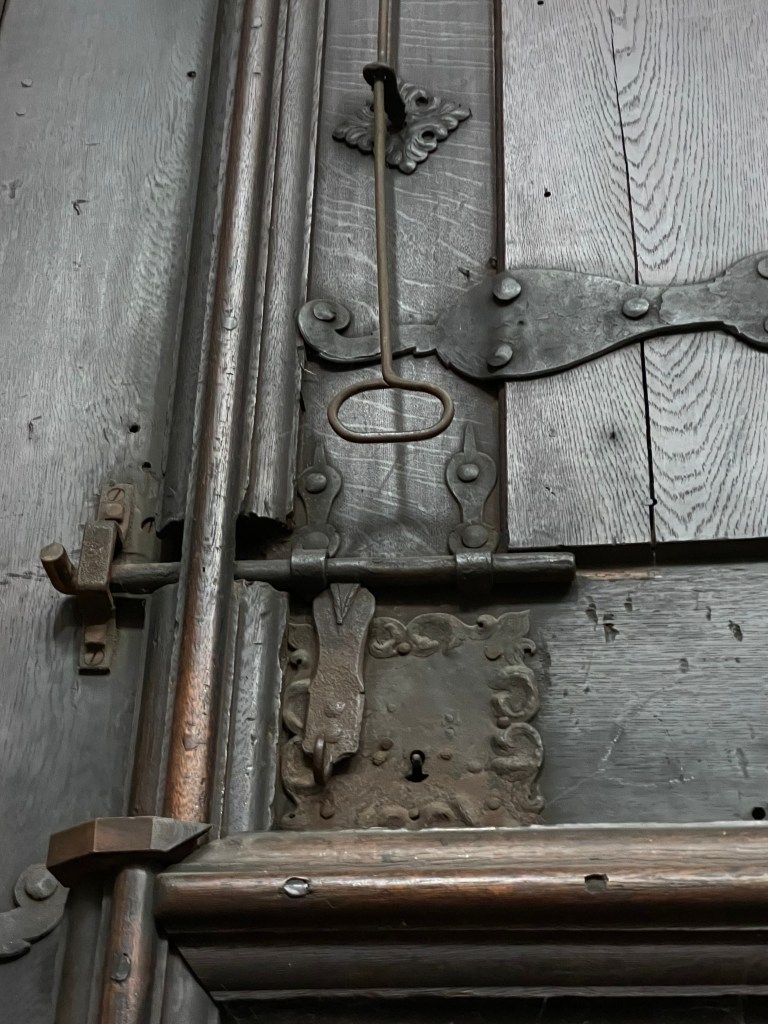
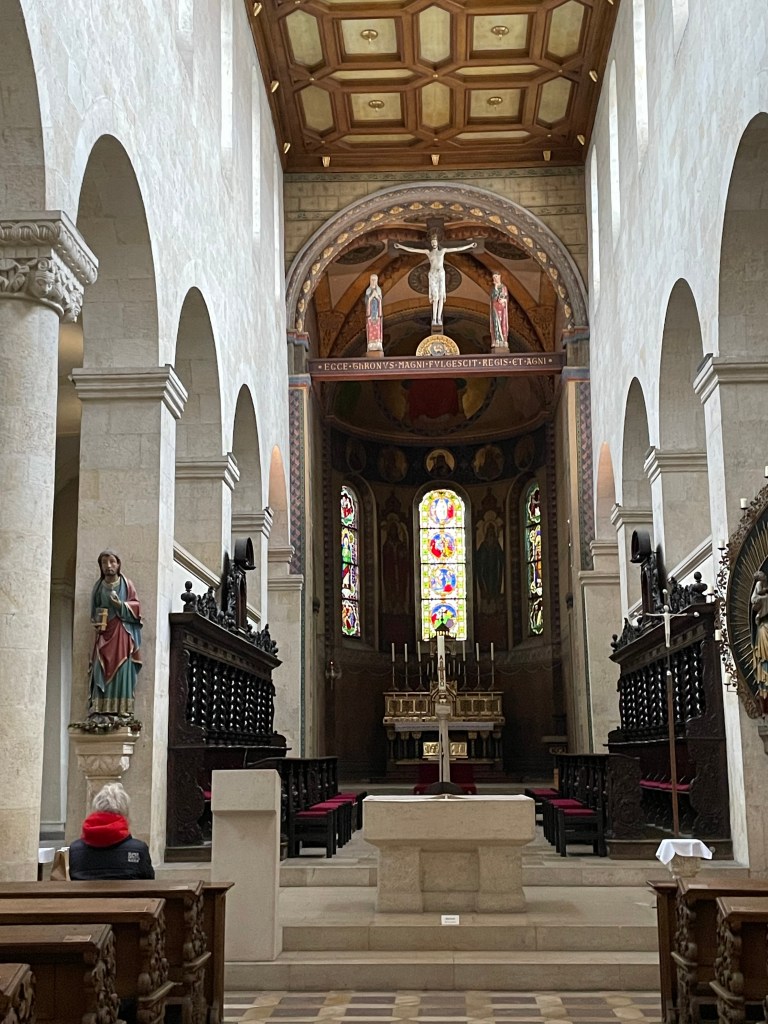
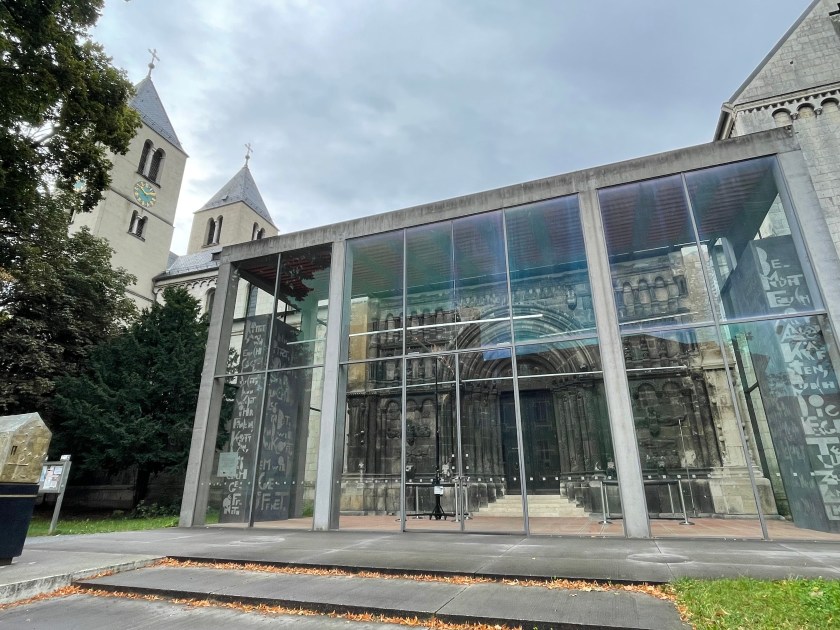
Another church we visited was St. James’s, the Schottenkirche.

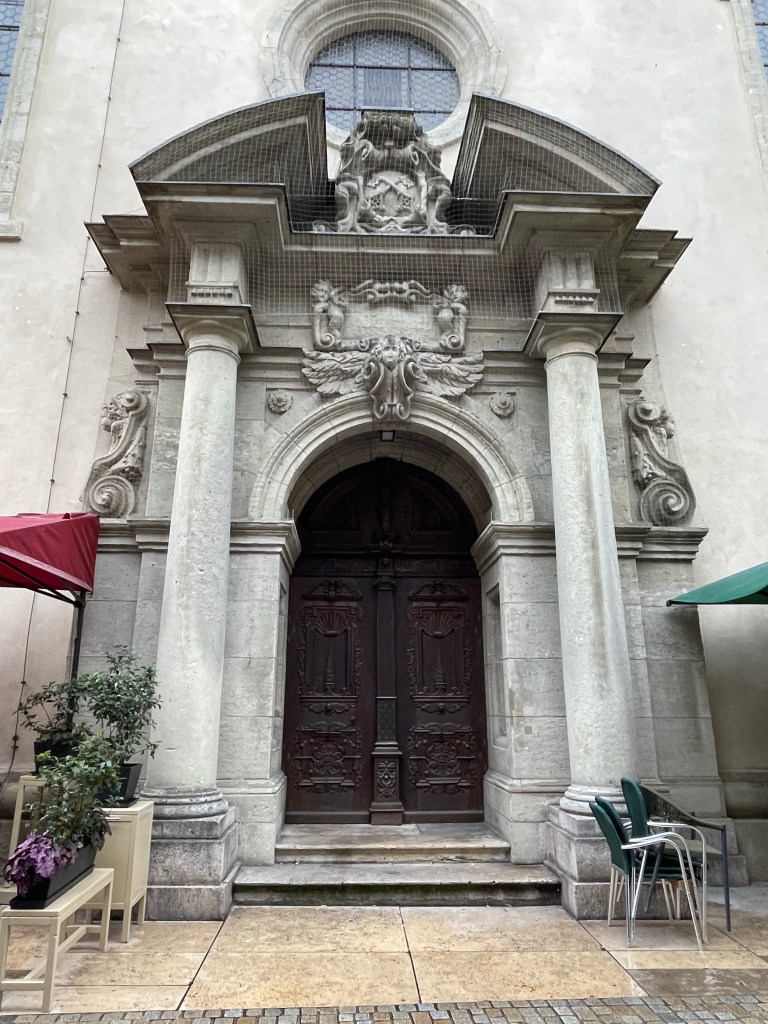
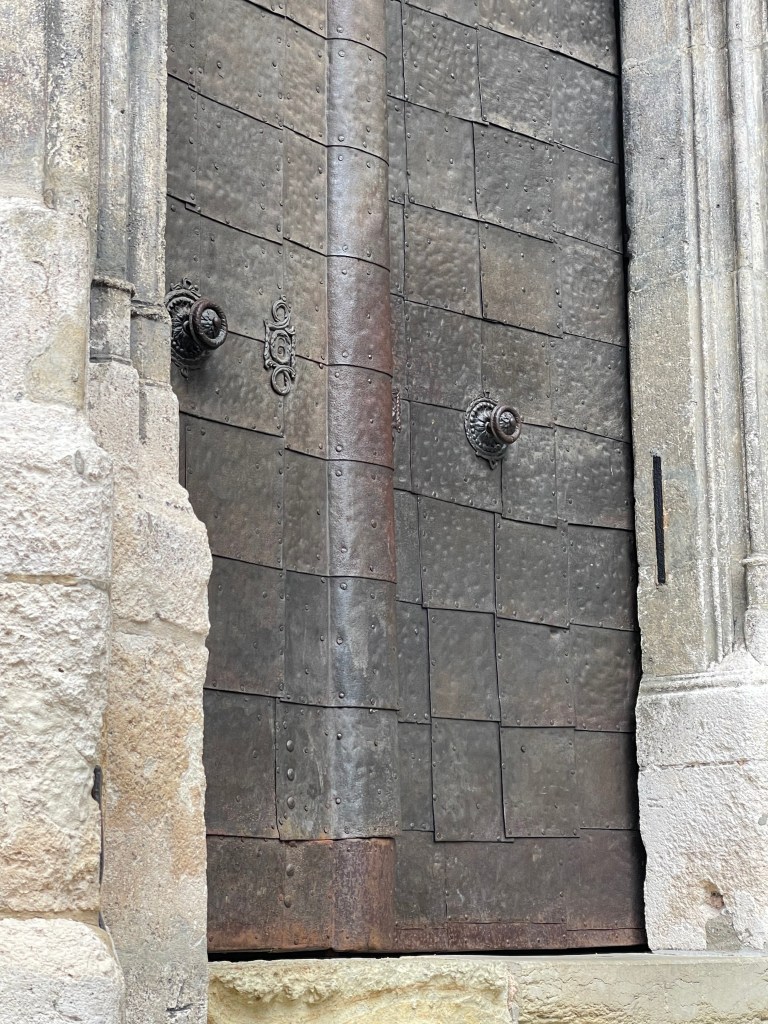
This magnificent front portal is now protected from the elements.

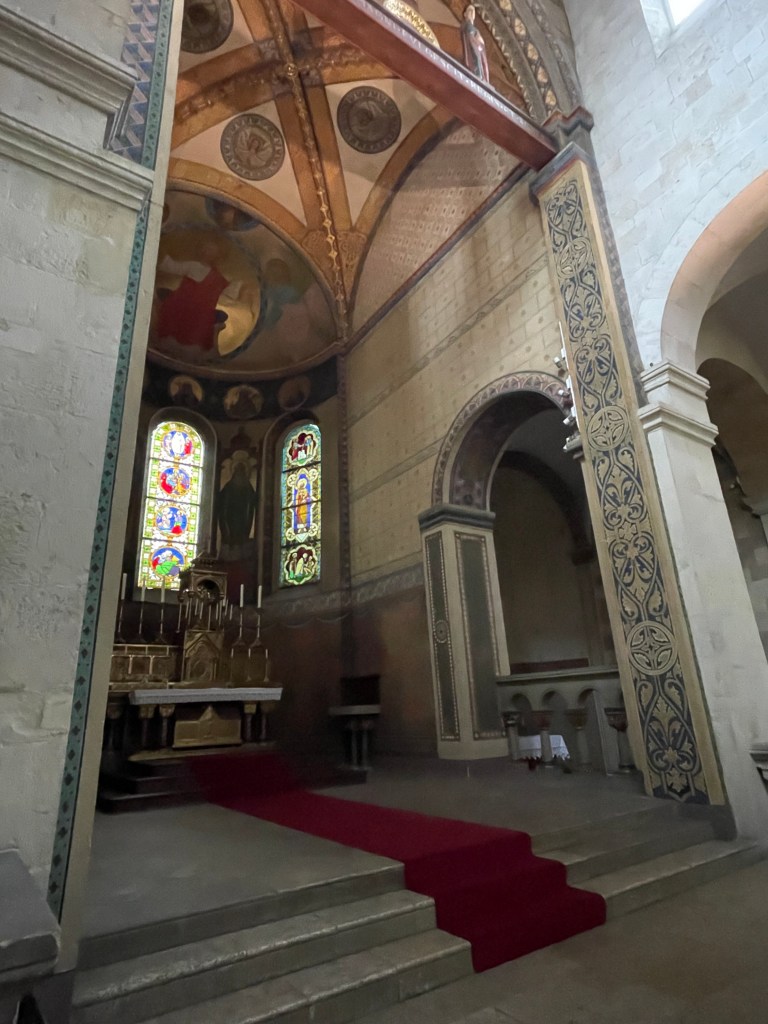
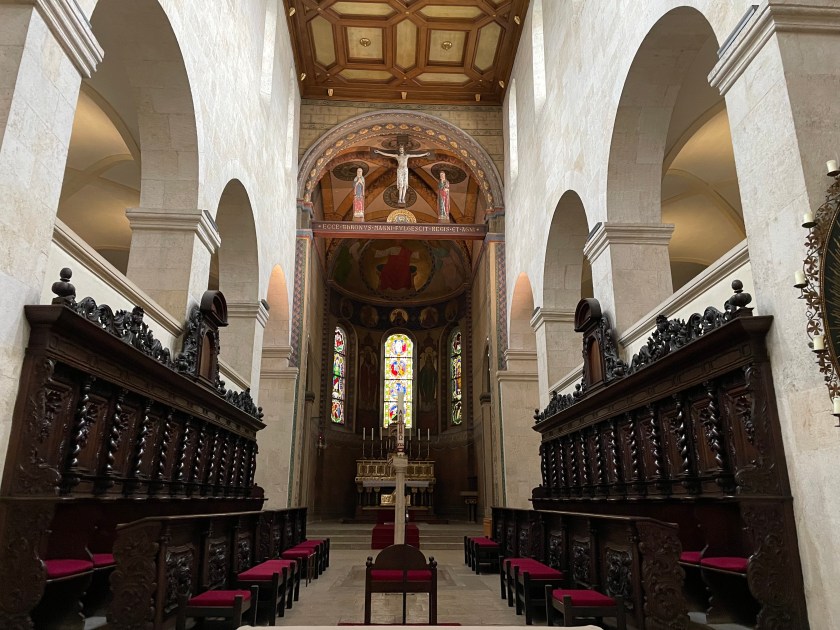
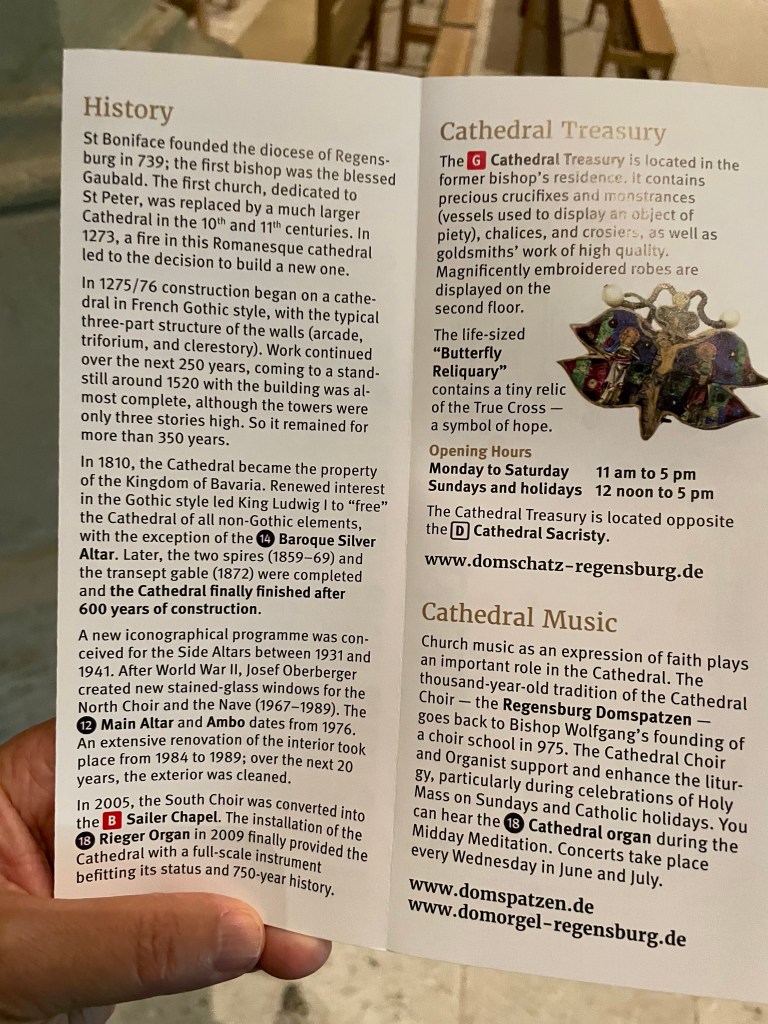
Here’s a bit of the history of this ancient church, where construction began in about 1100.  The church was dedicated in 1120.

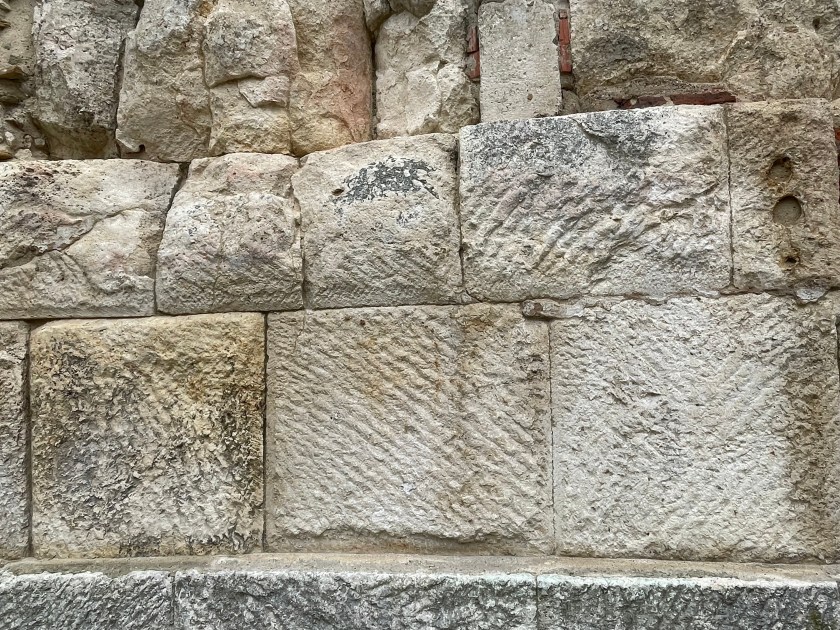
Stone fabric:

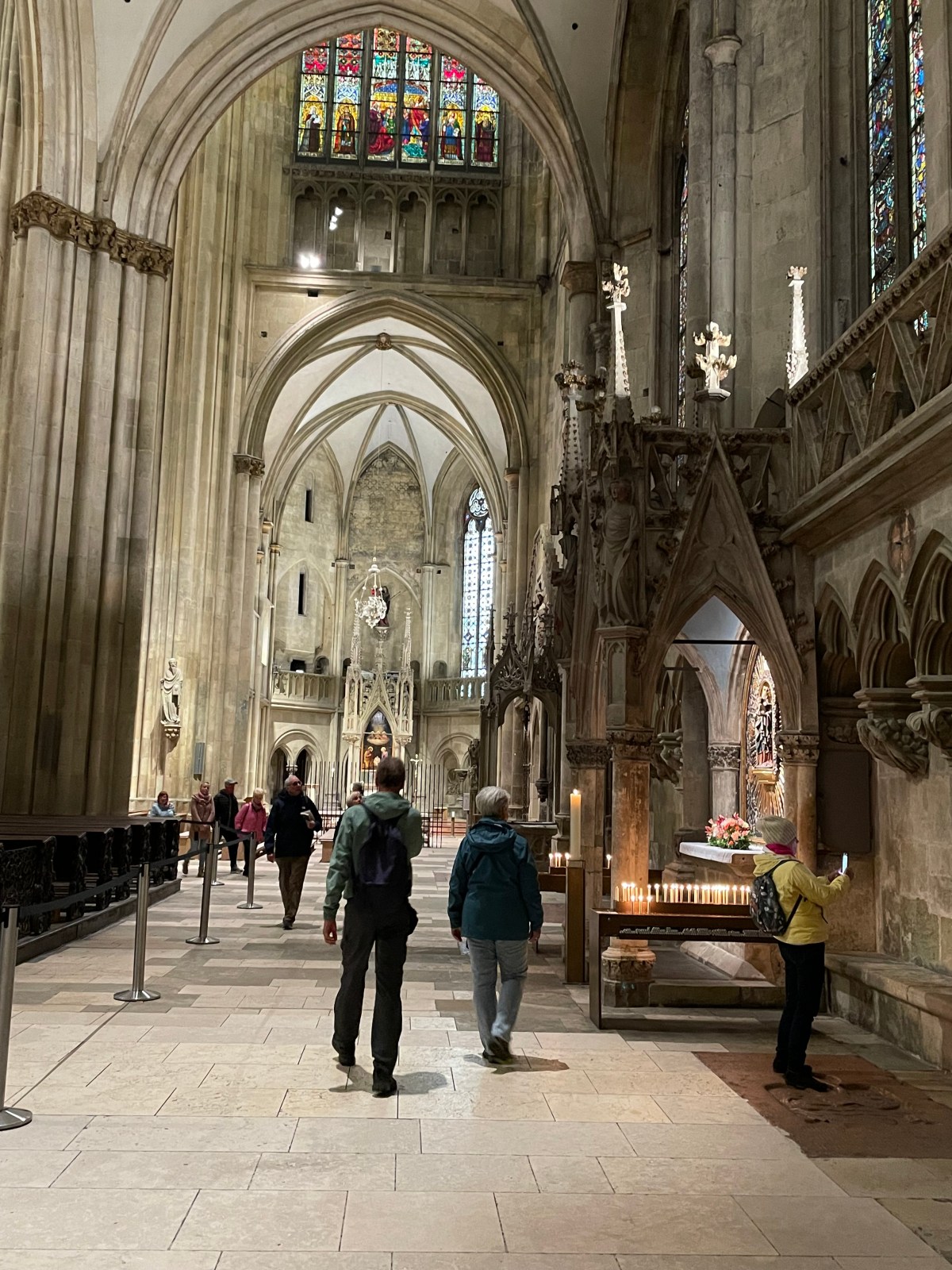
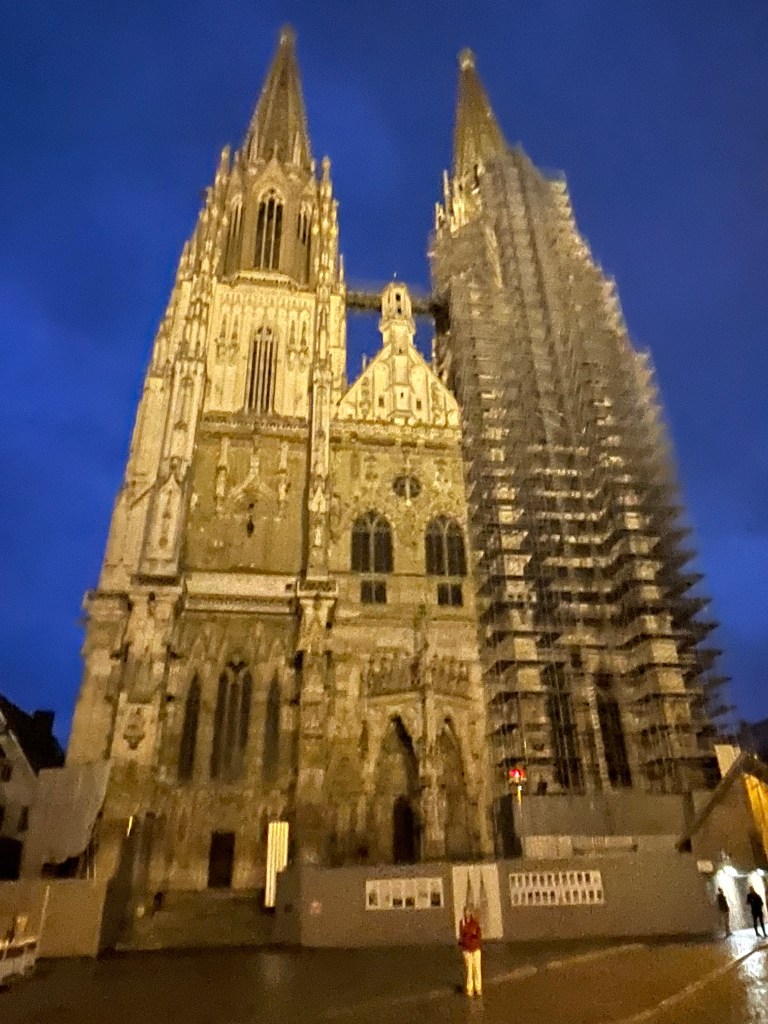
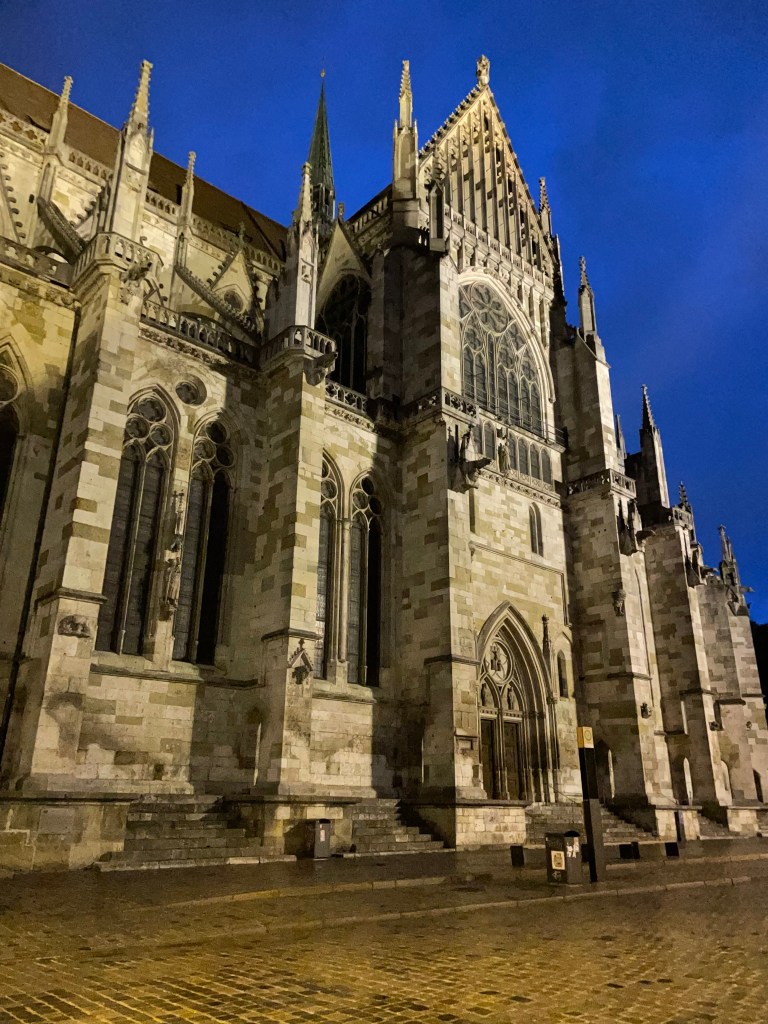
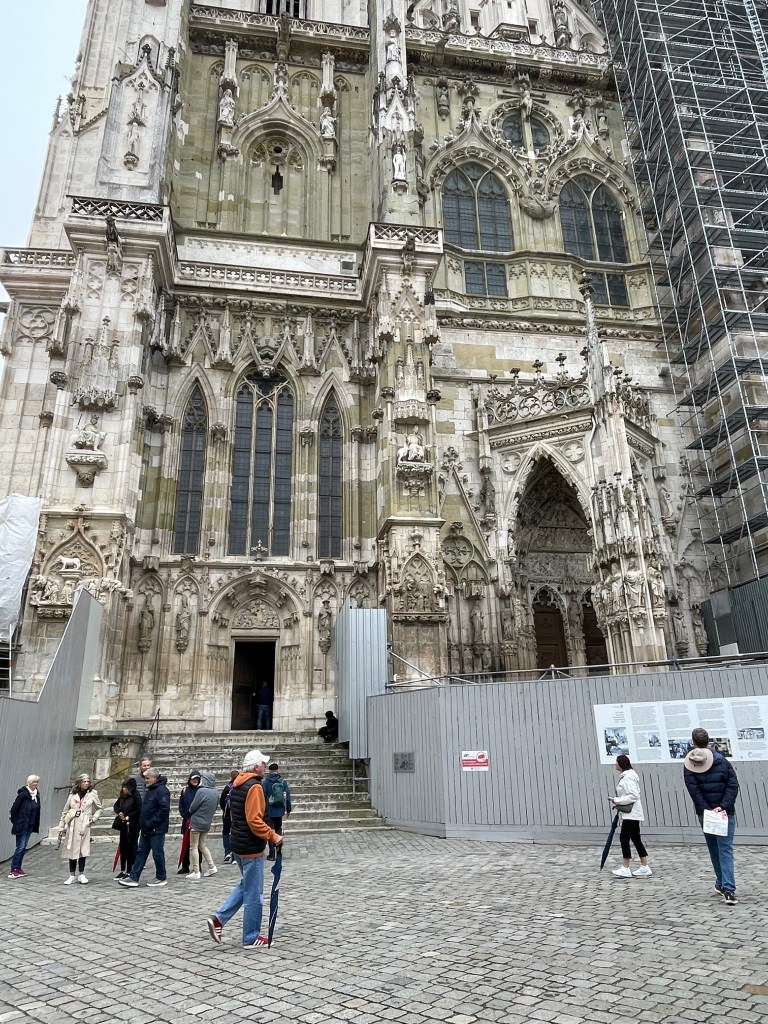
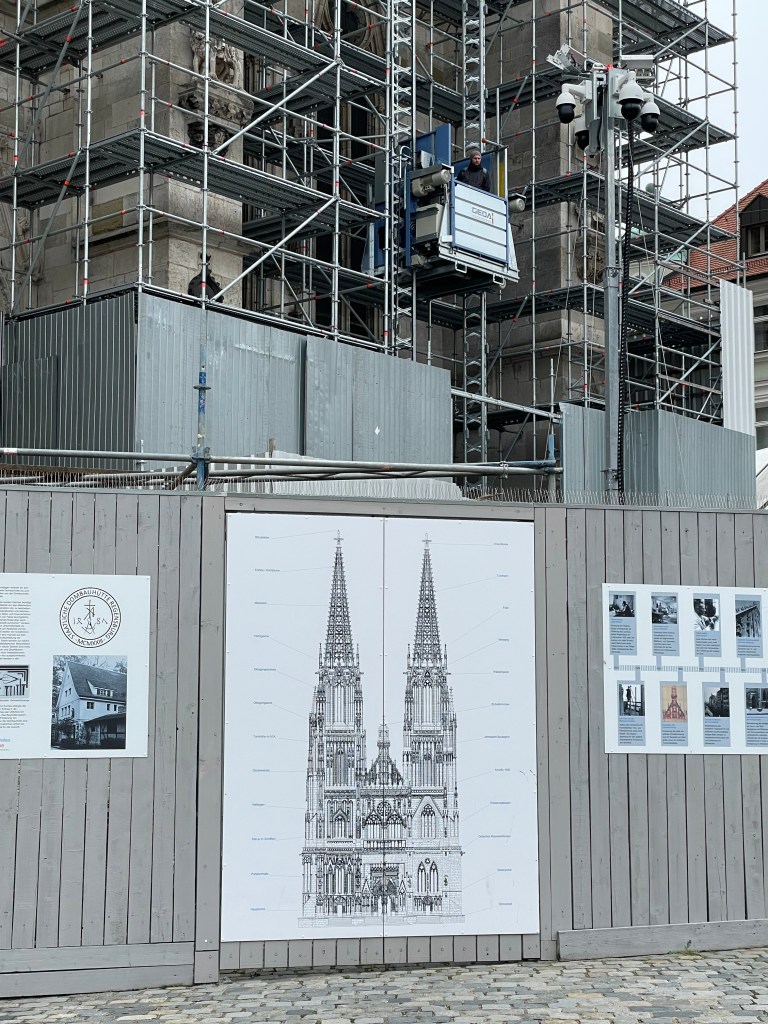
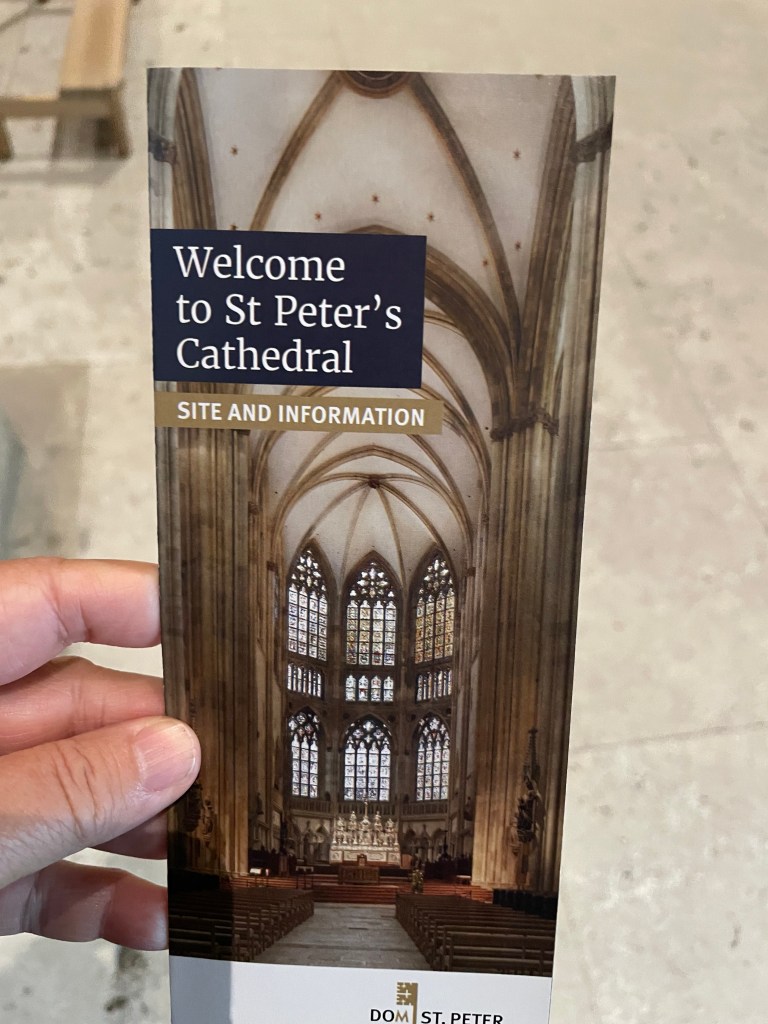
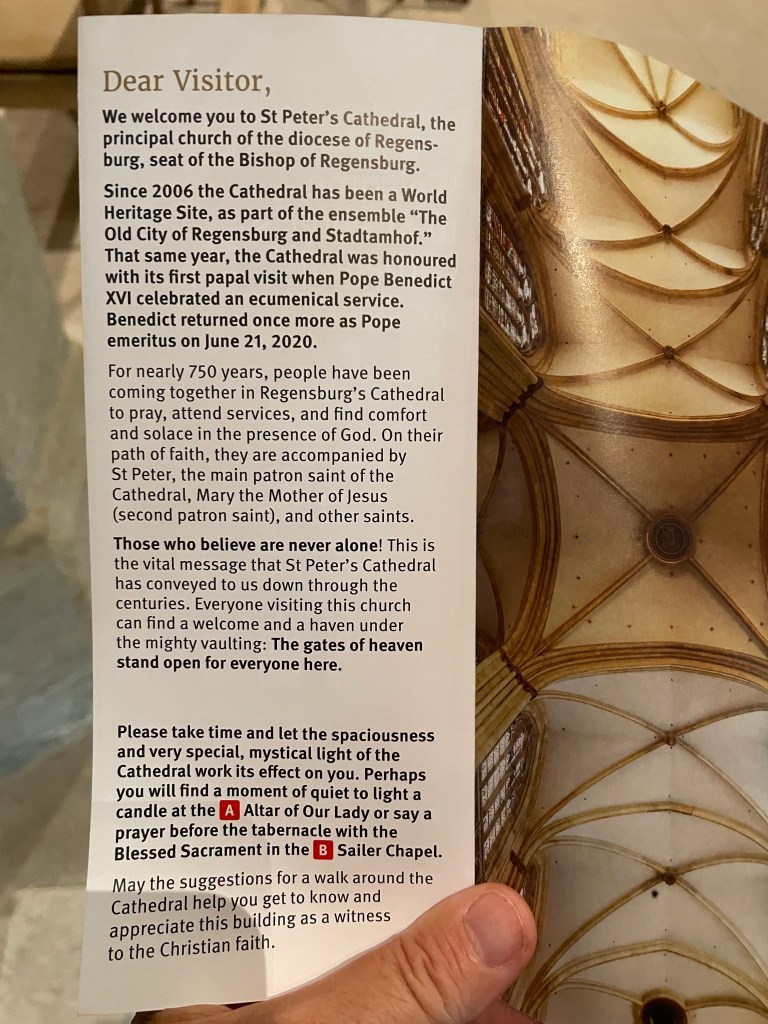
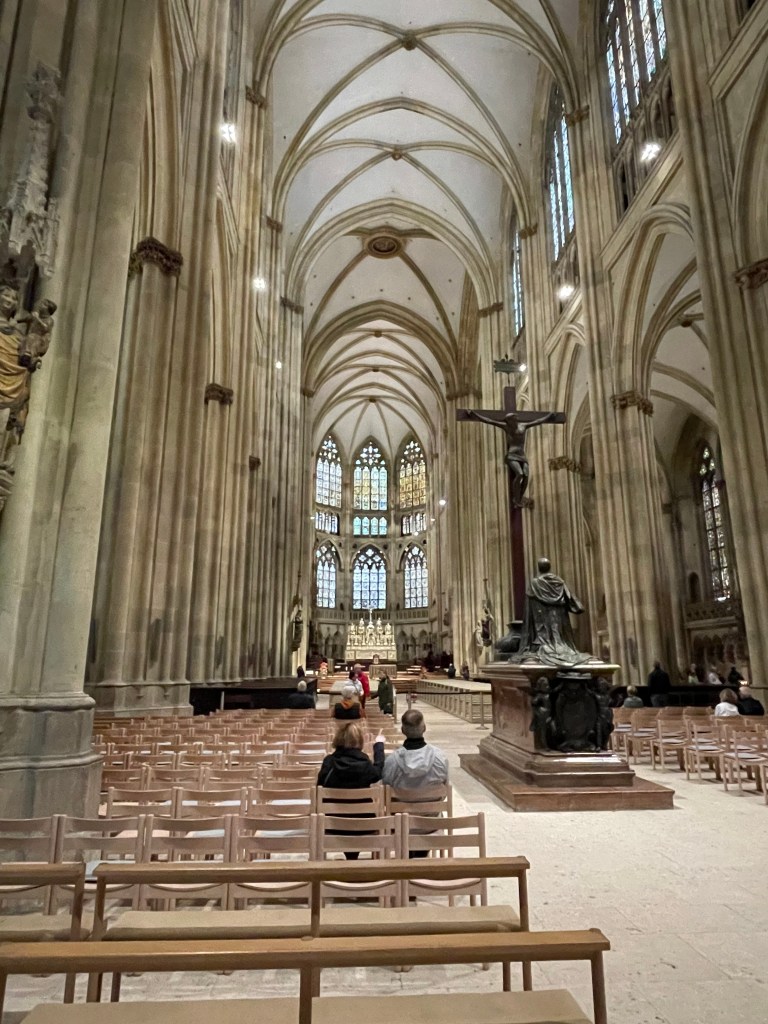
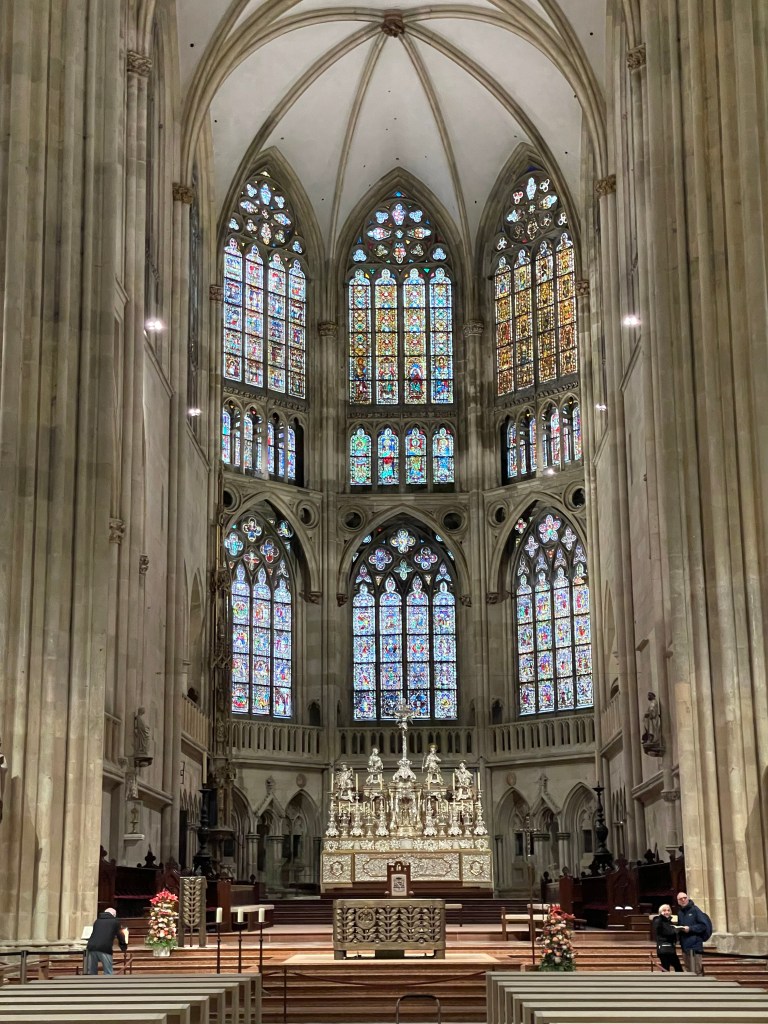
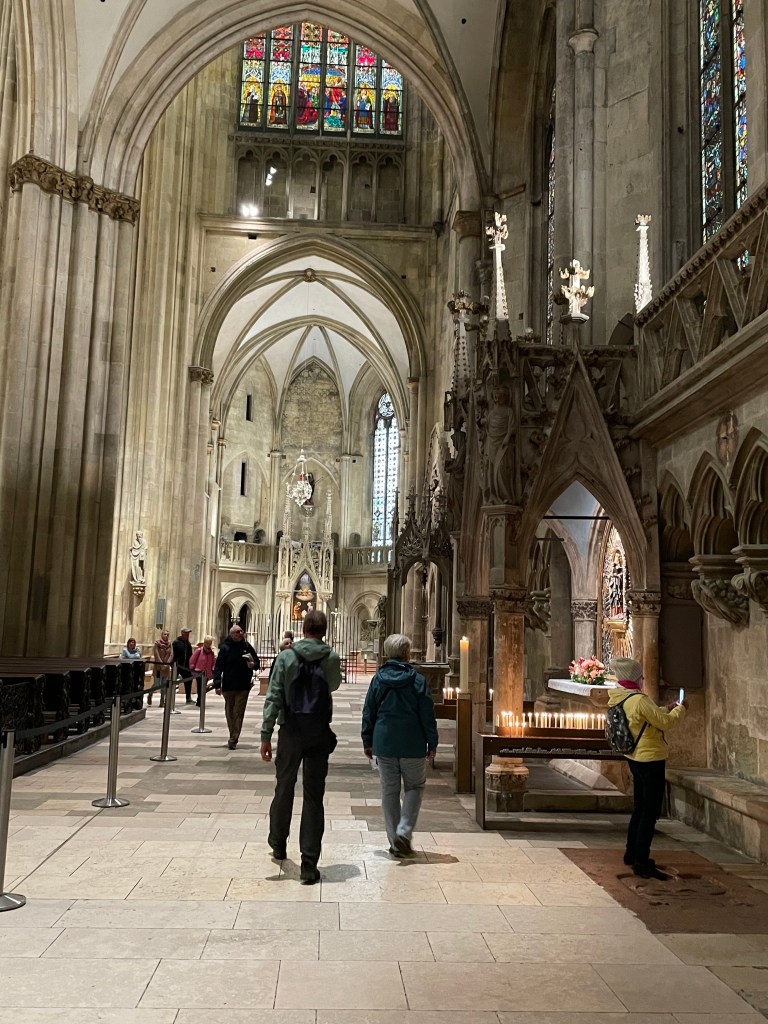
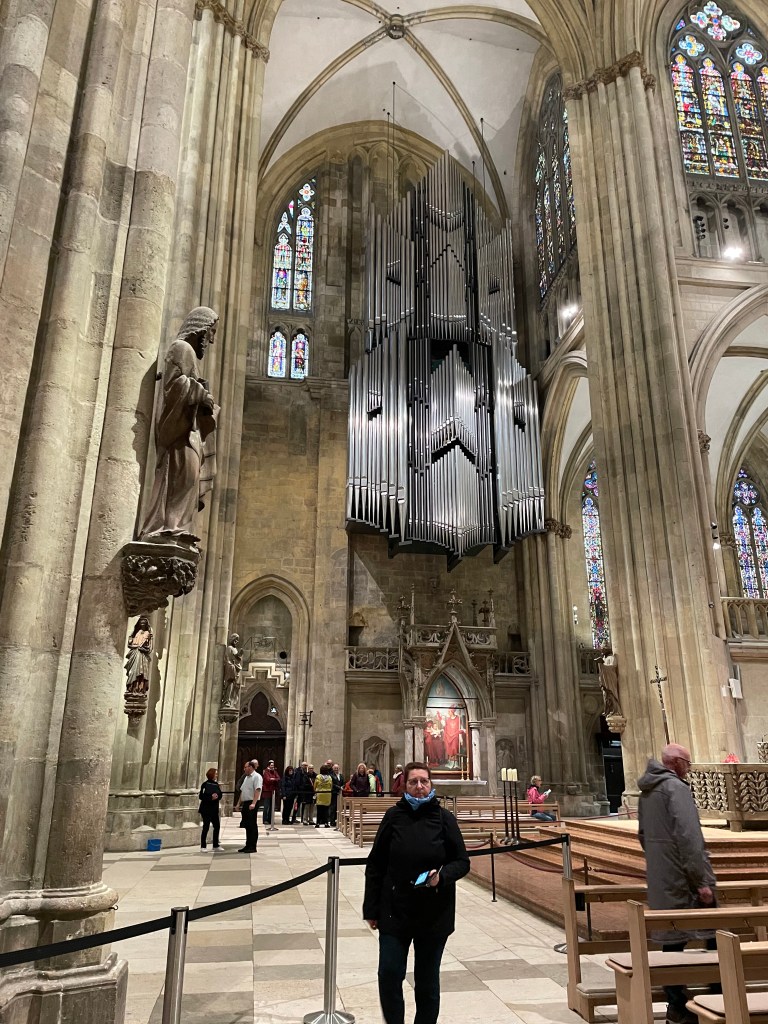
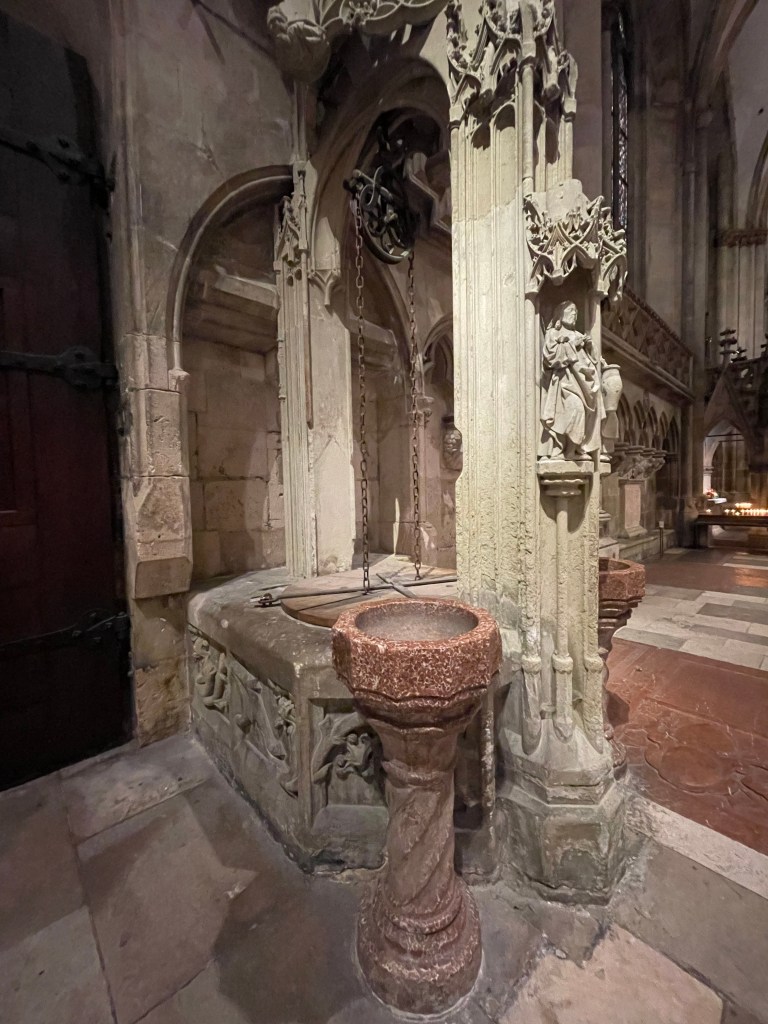
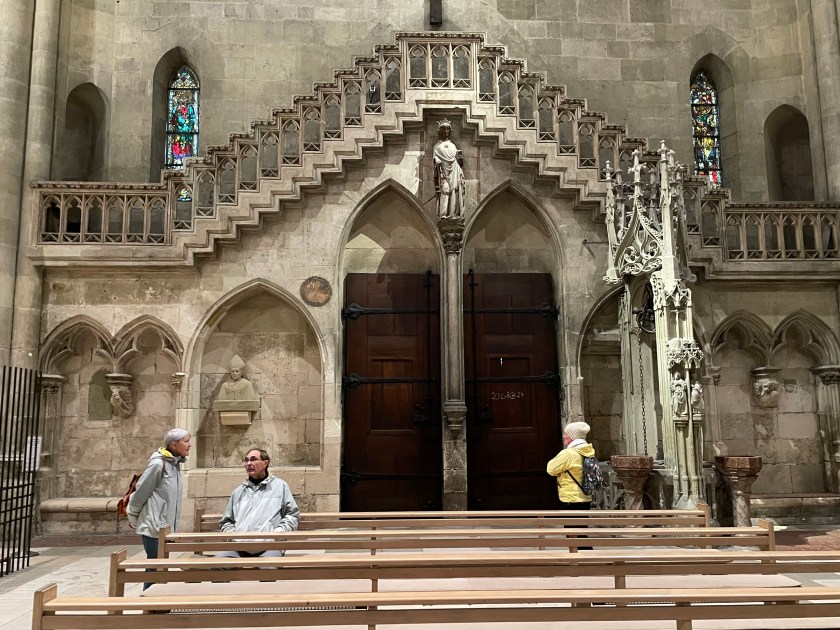
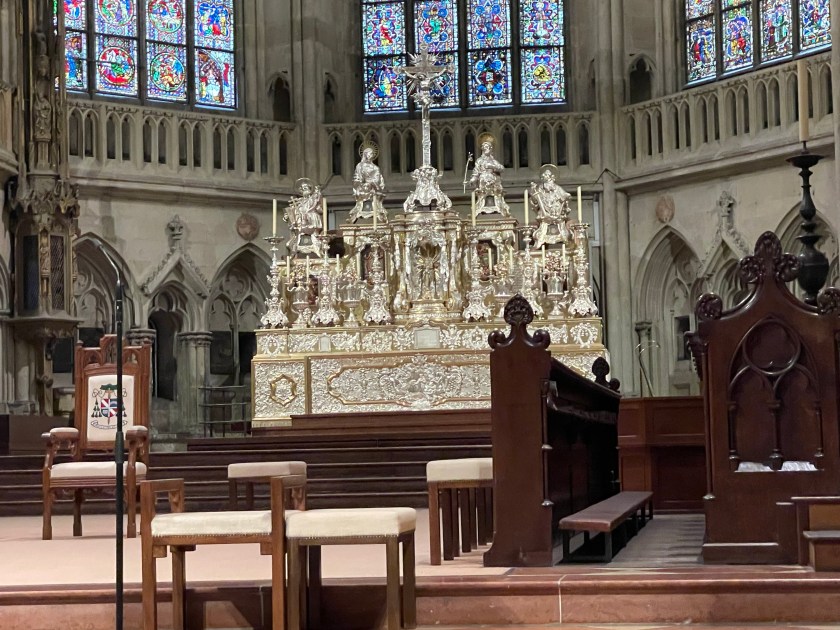
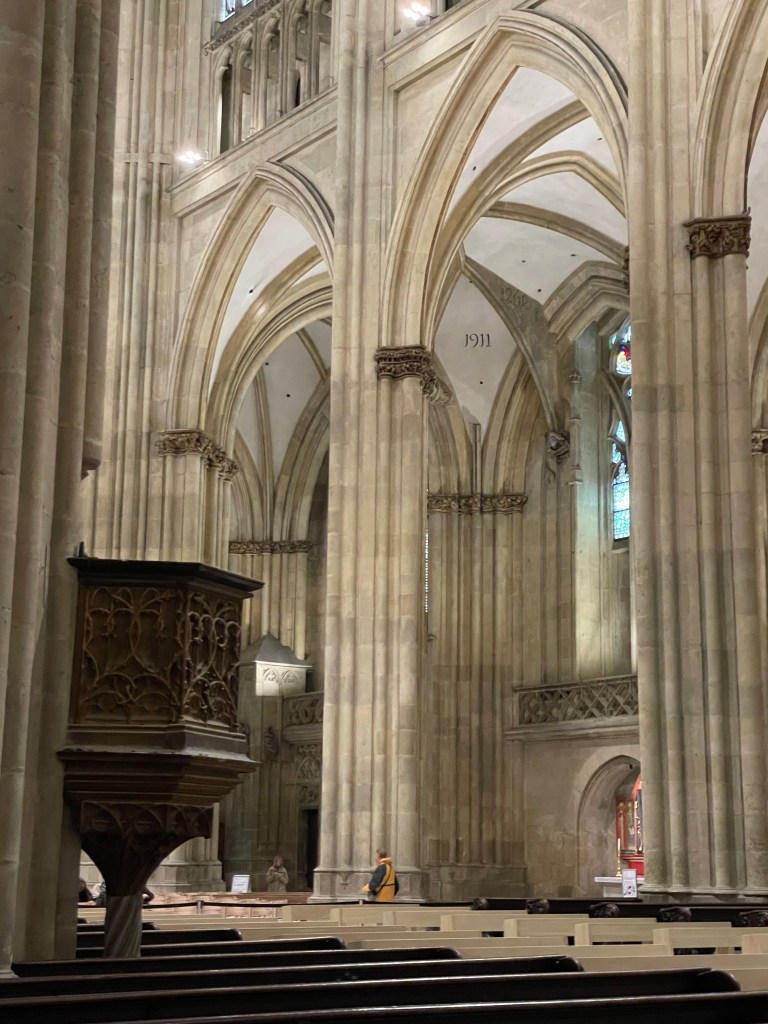
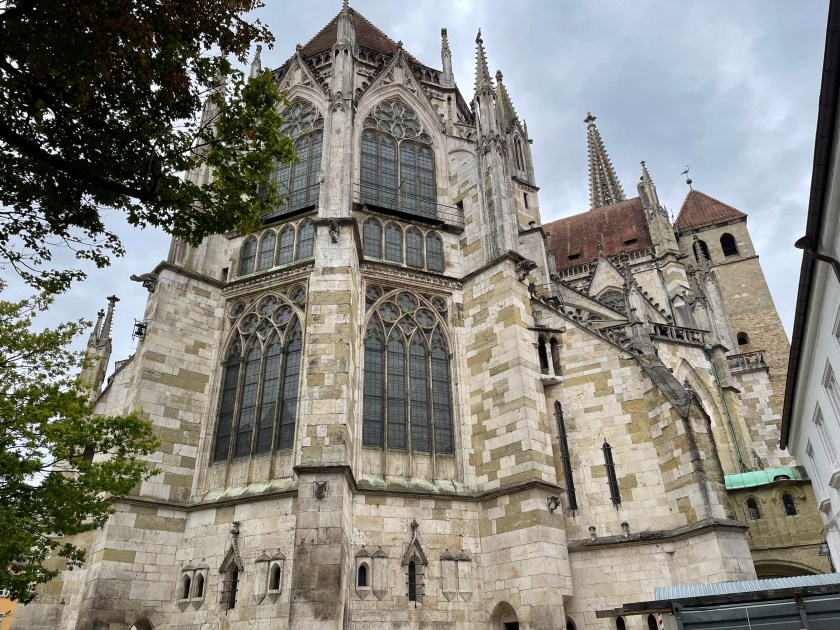
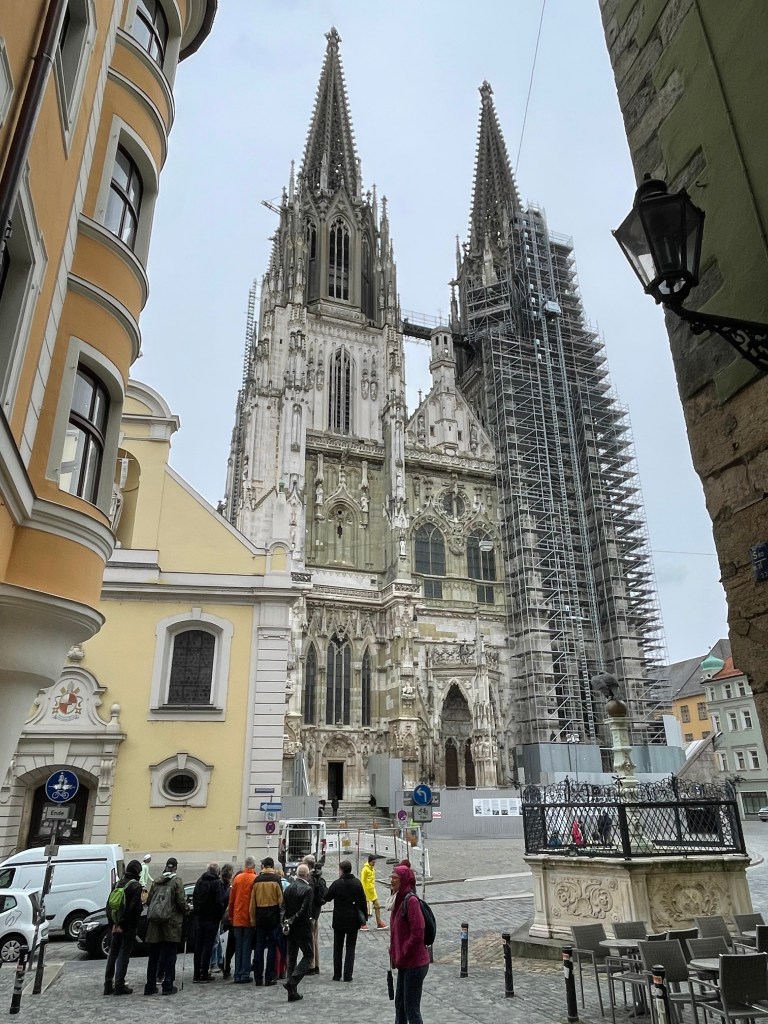
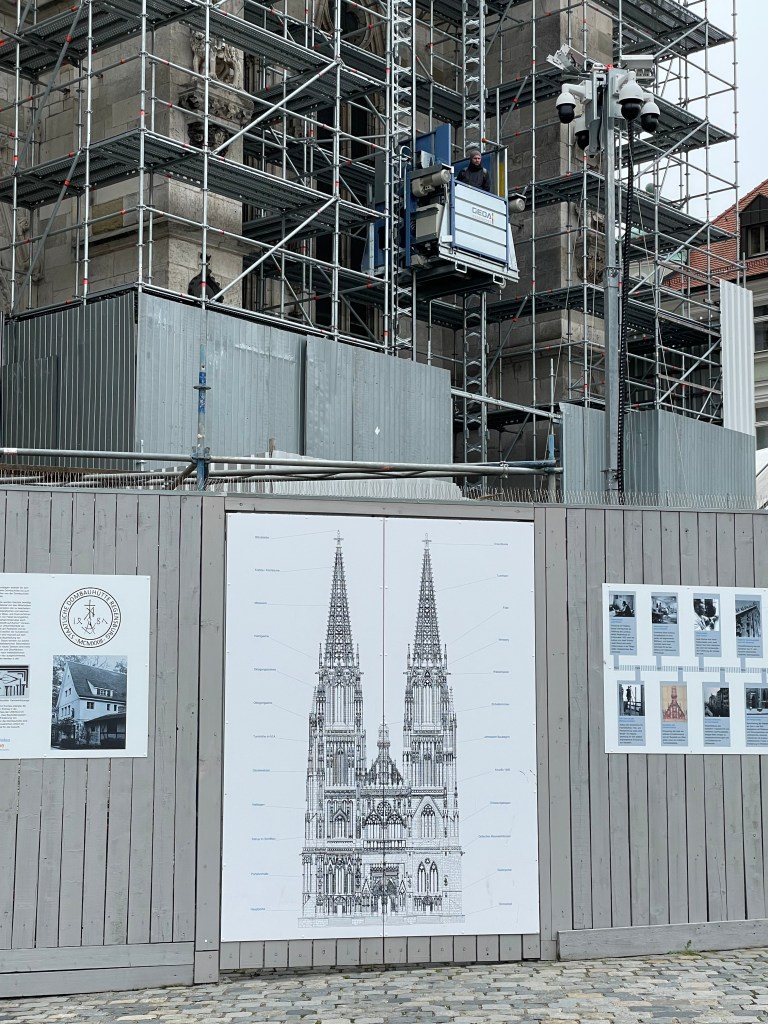
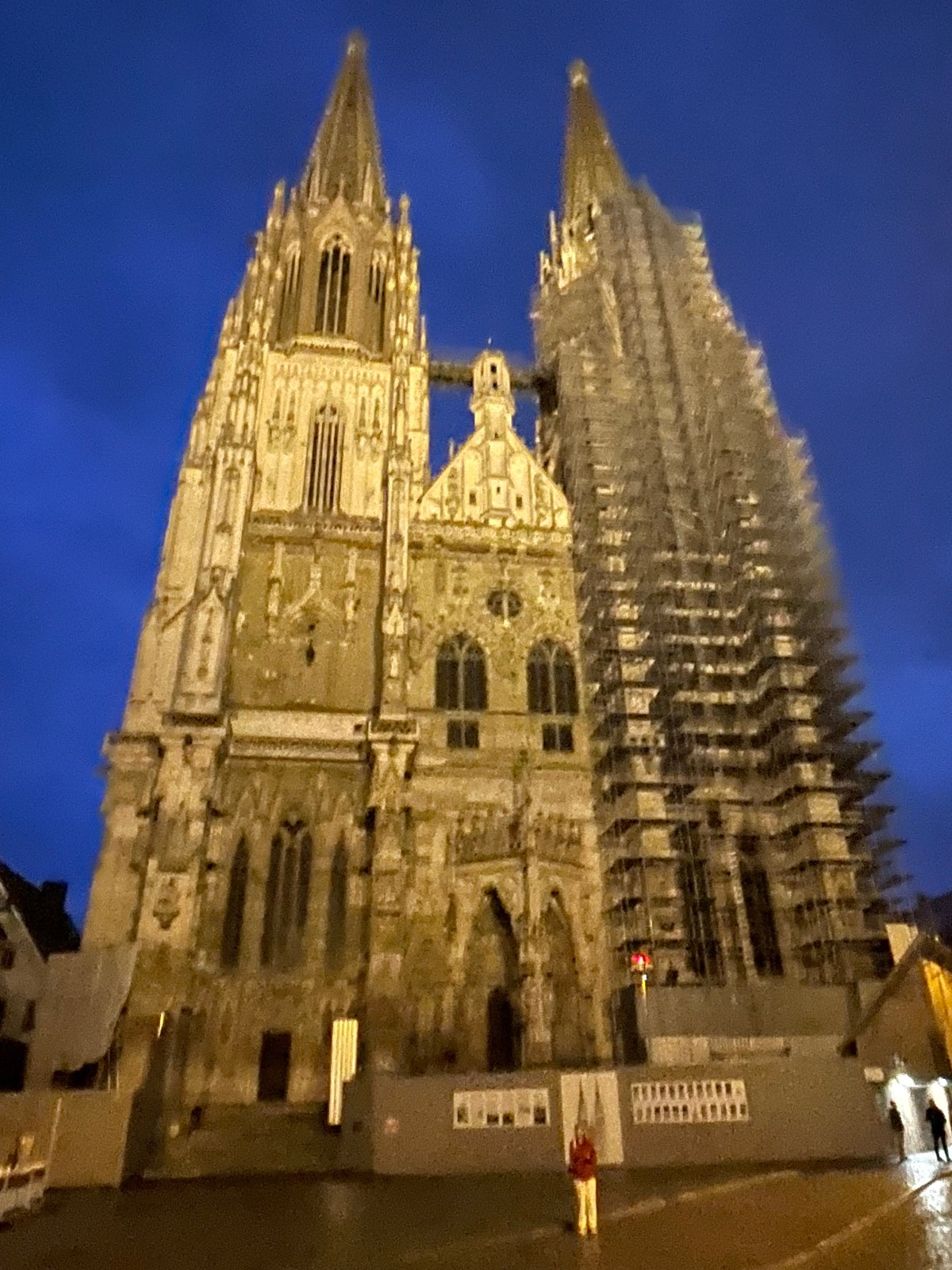
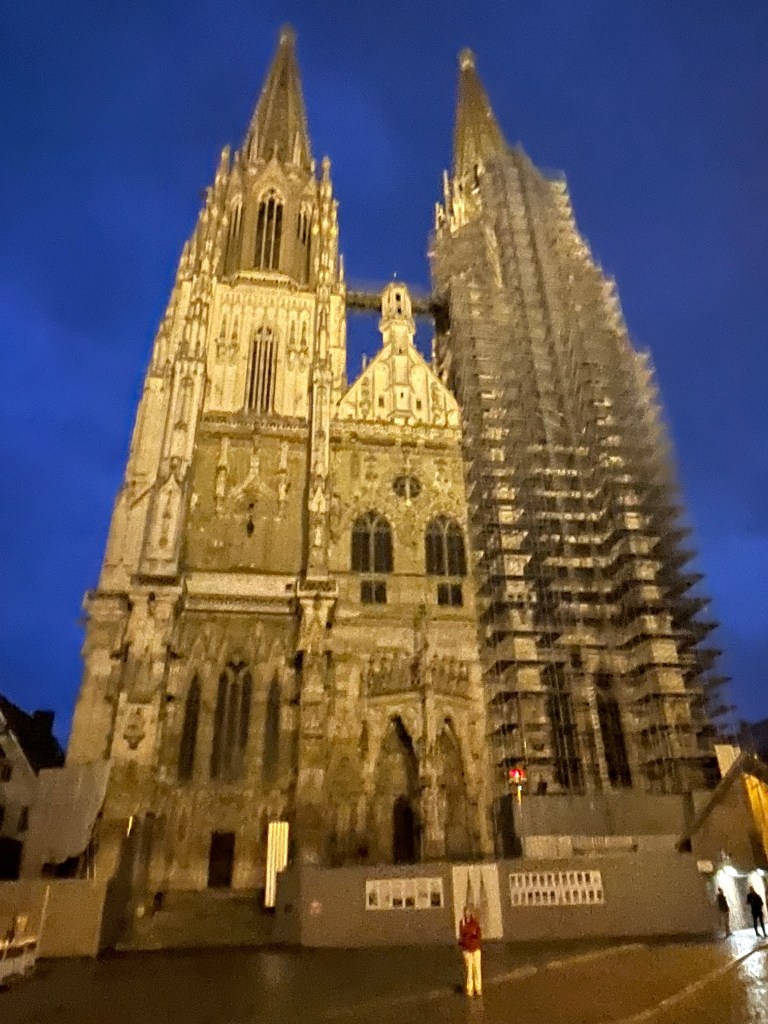
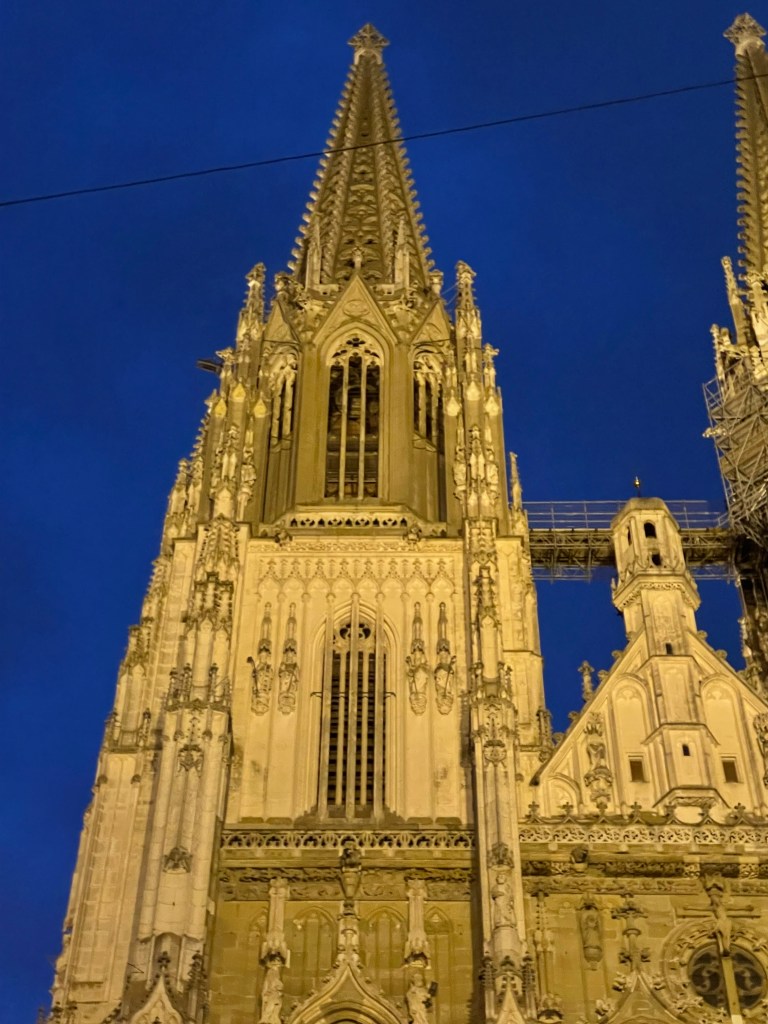
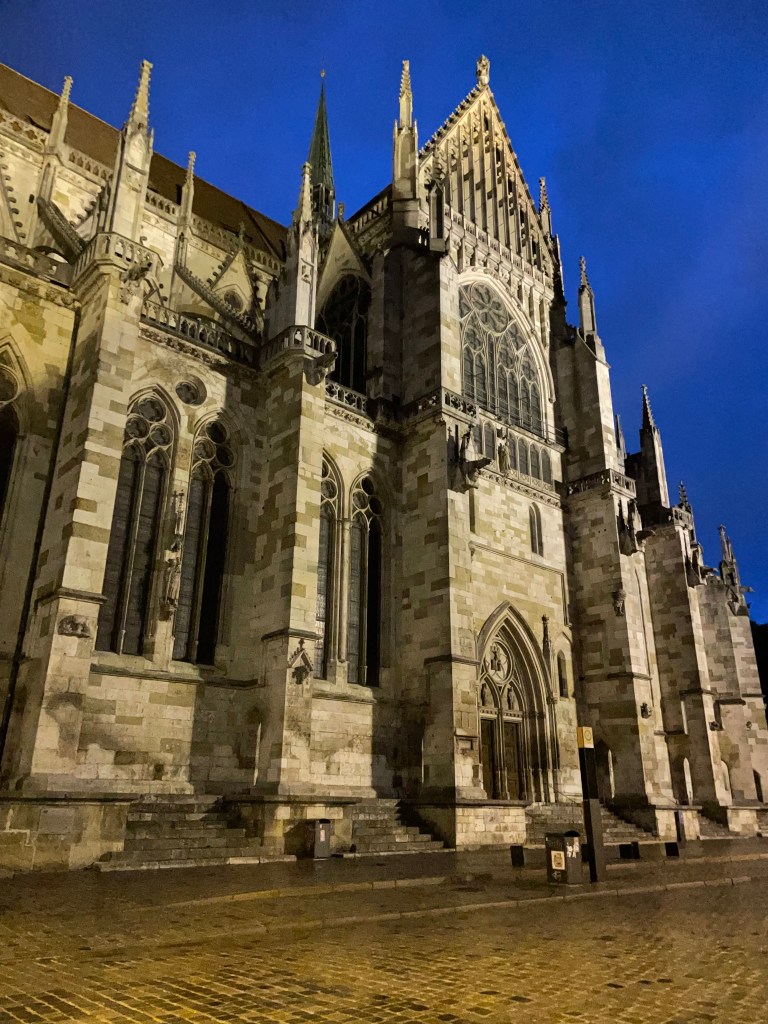
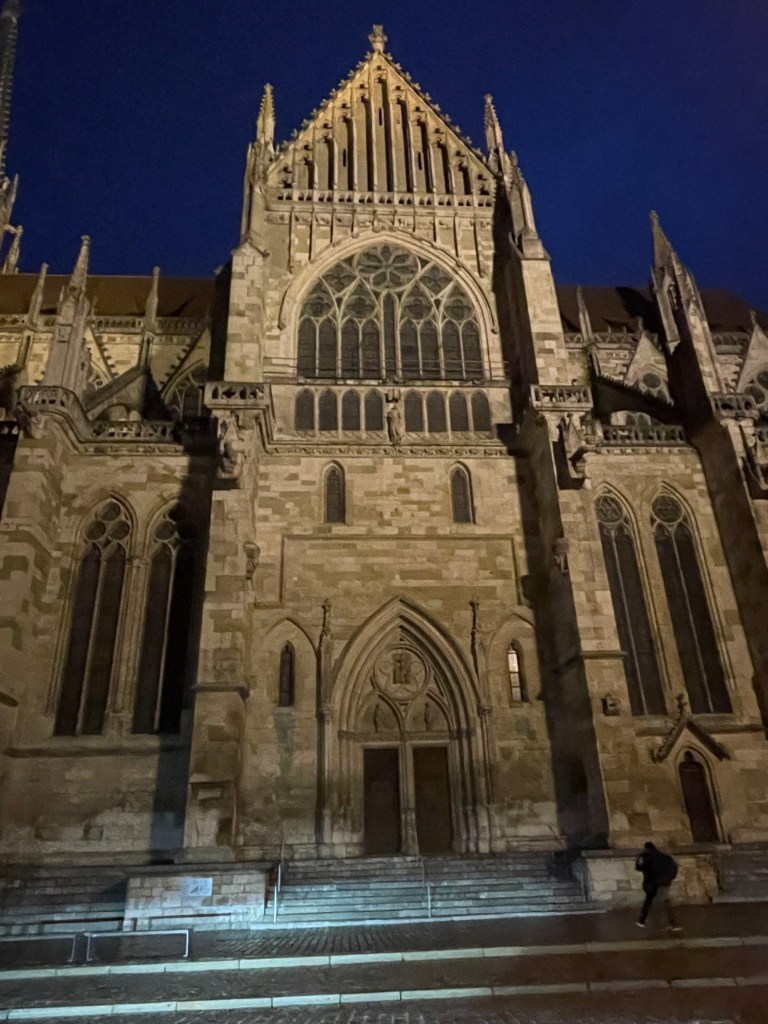
Next we went back to the Dom, or the main cathedral here in Regensburg.  Construction on this cathedral began in 1275/76 and continued for the next 250 years.  Renovations are ongoing.

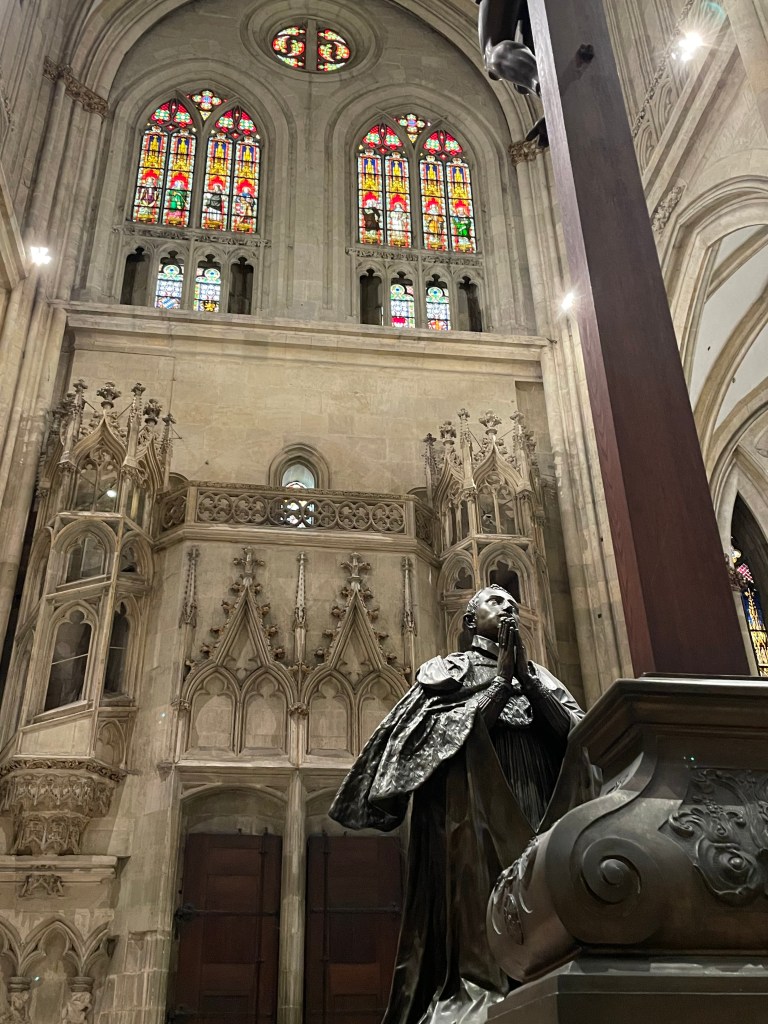
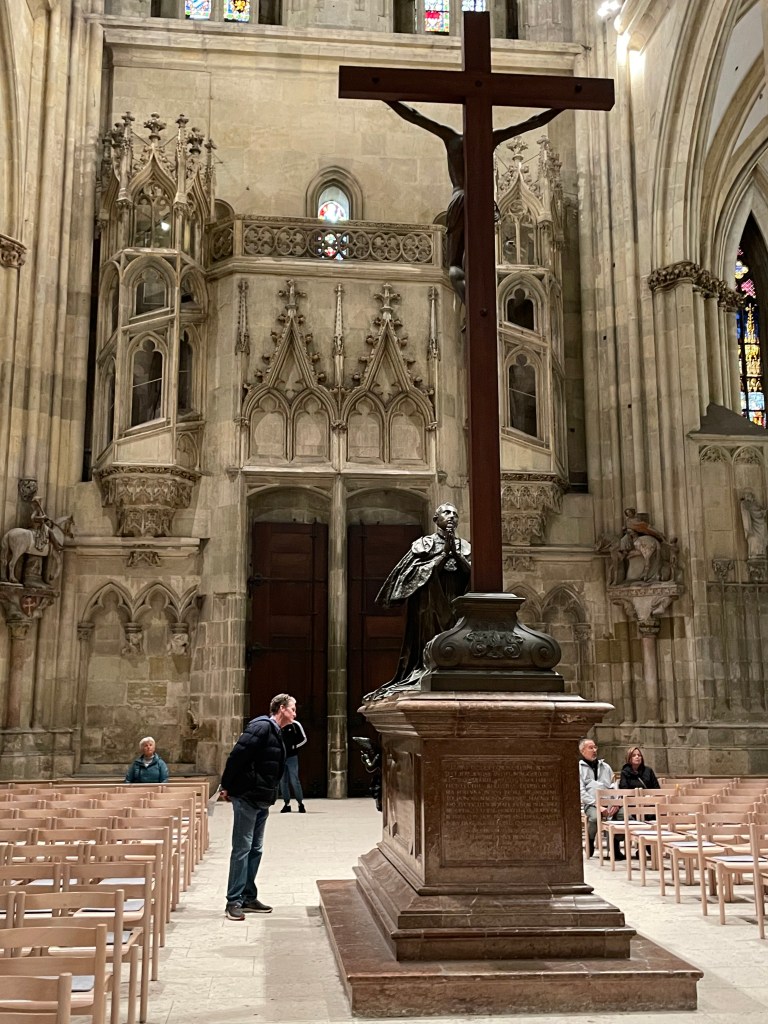
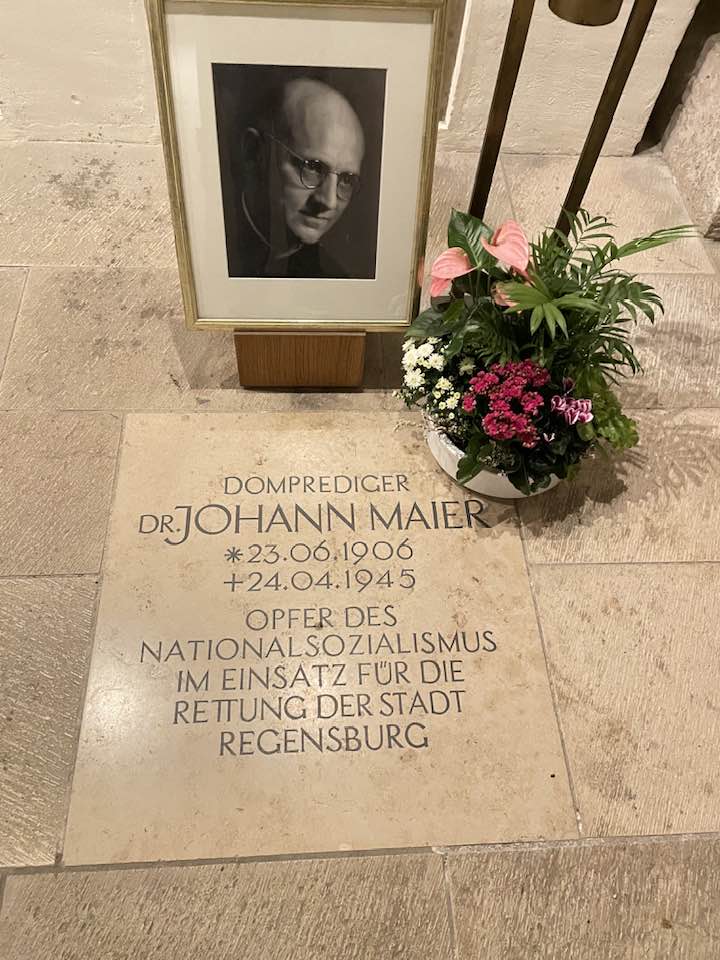
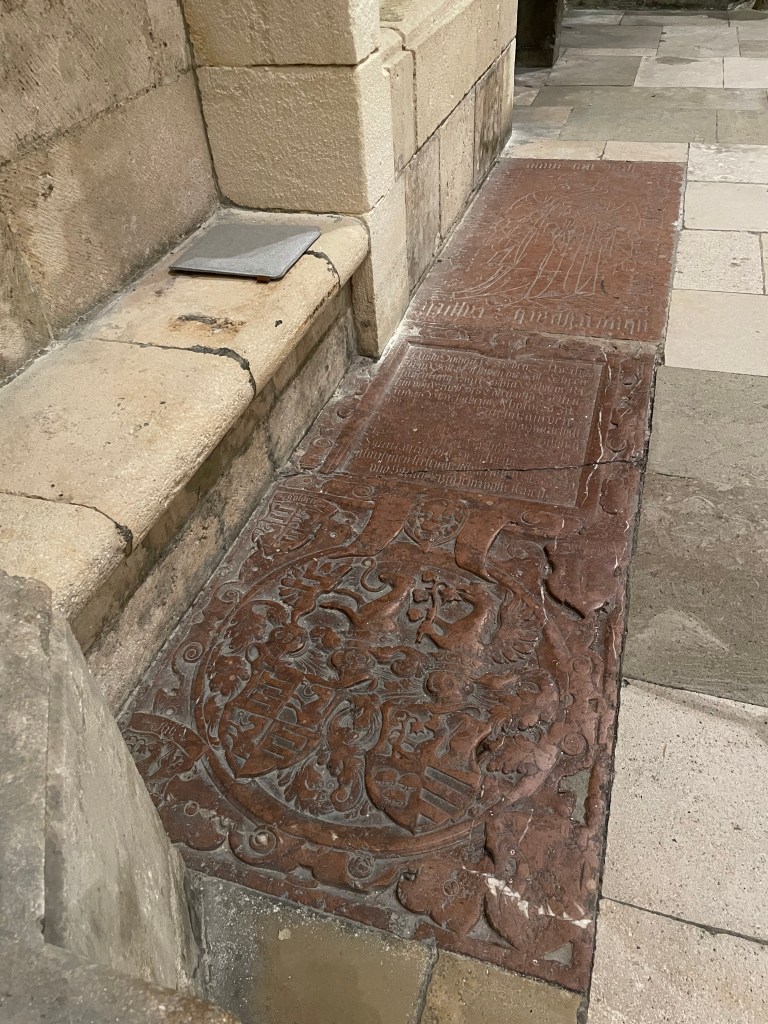
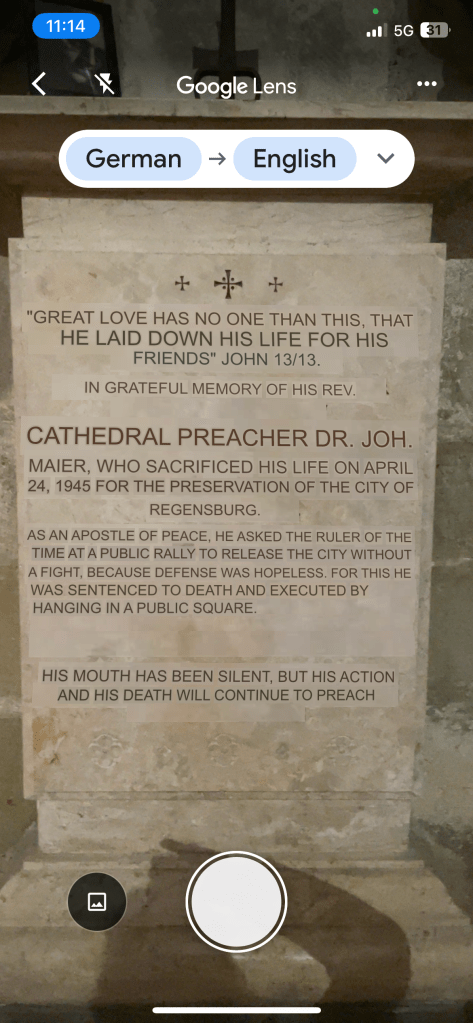
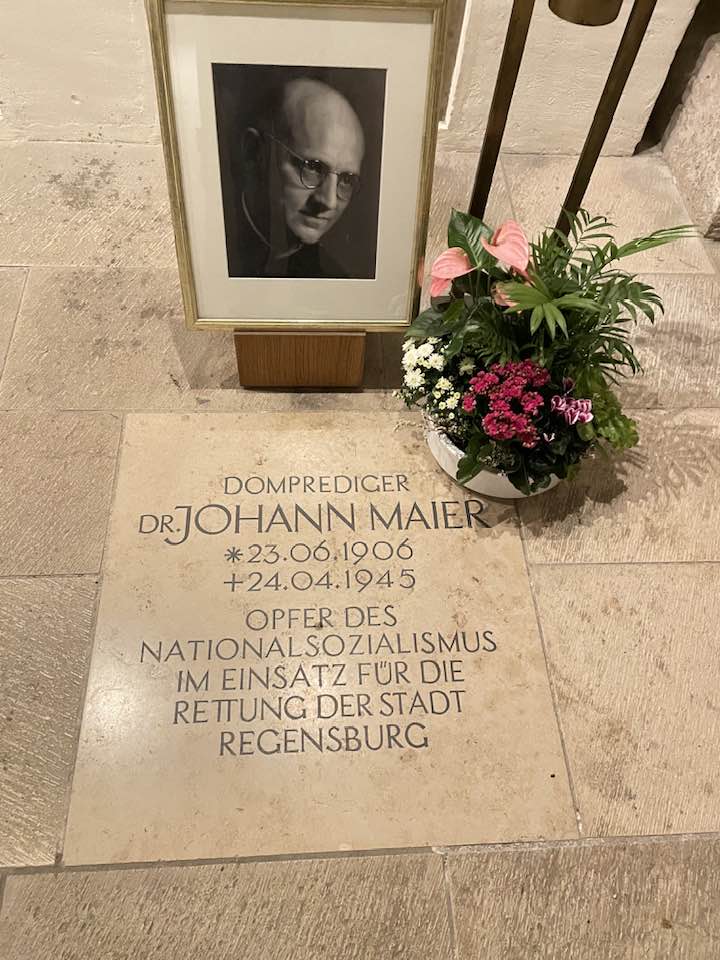
It was here where we found Dr. Johann Maier’s memorial and burial place.  He was murdered by the Nazis.

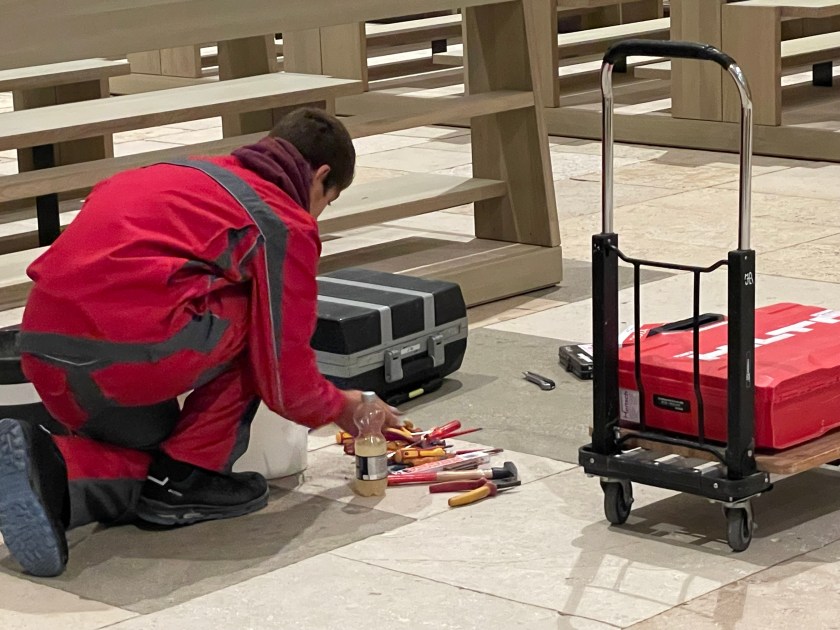
If you are a restoration specialist, there is always work for you in Germany!

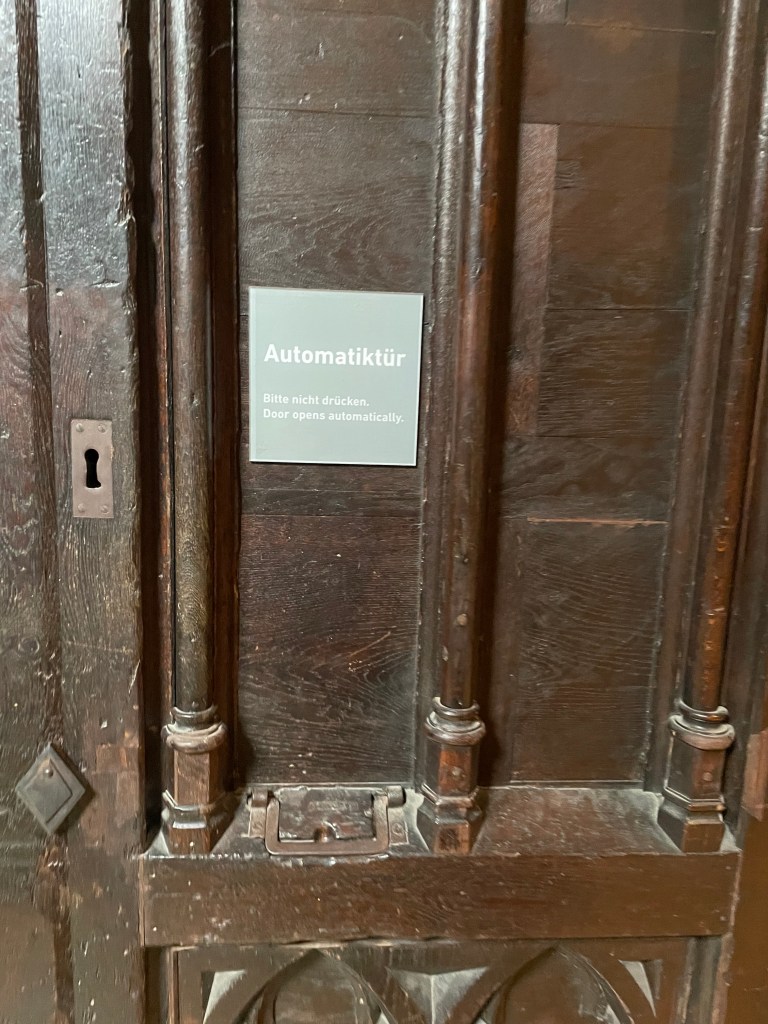
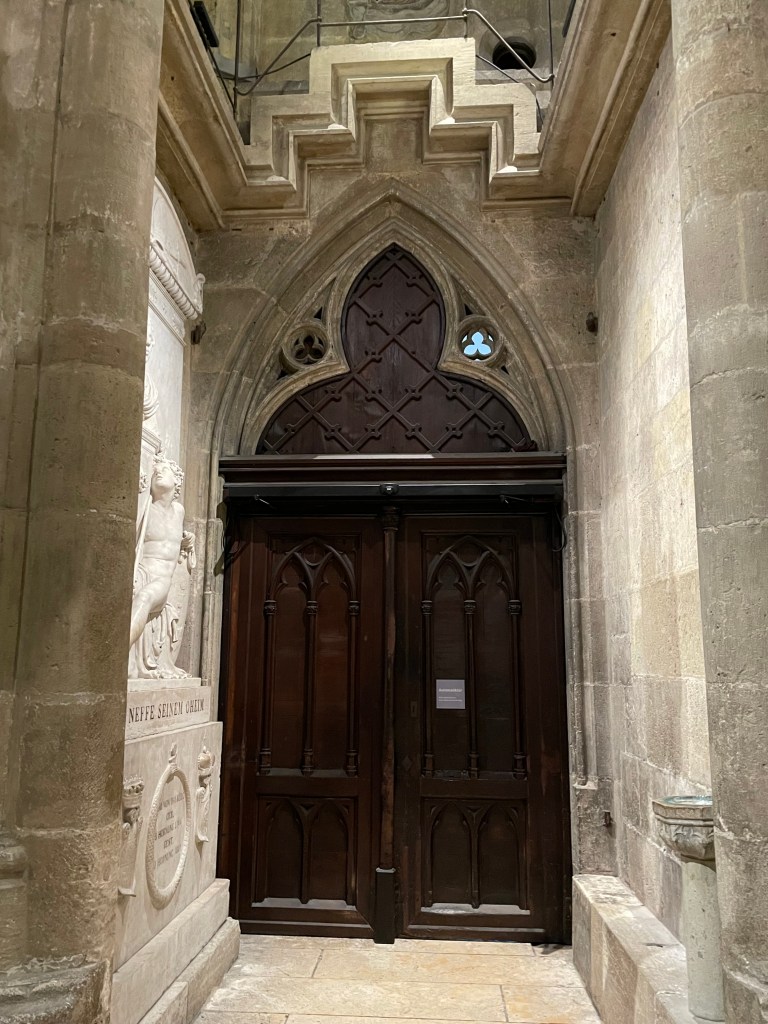
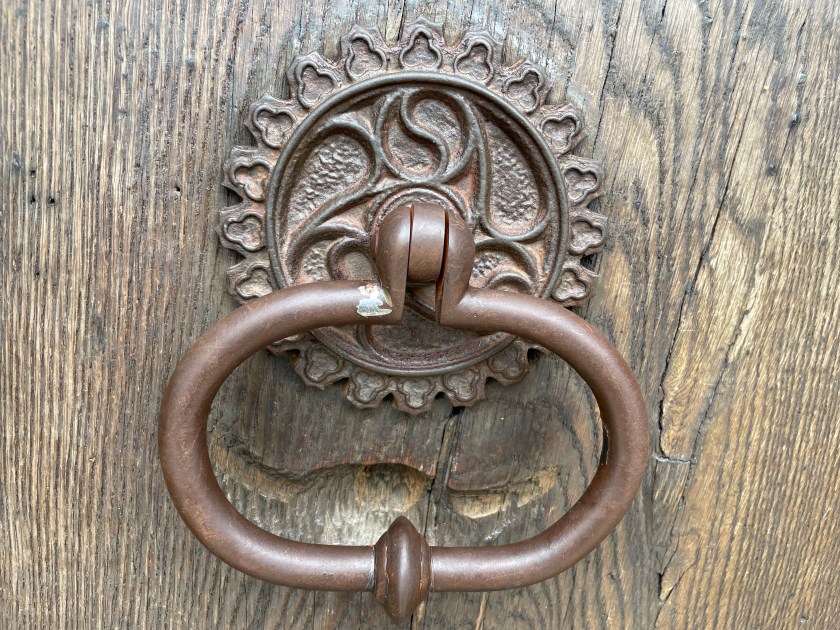
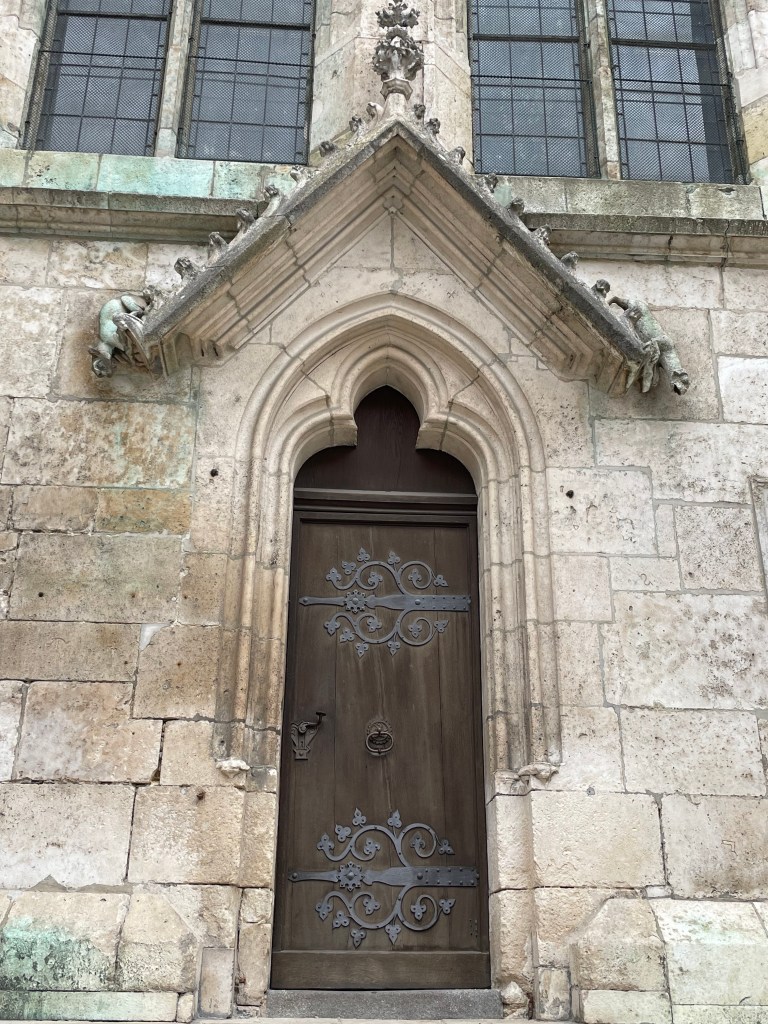
I did not expect to see a door like this open automatically!

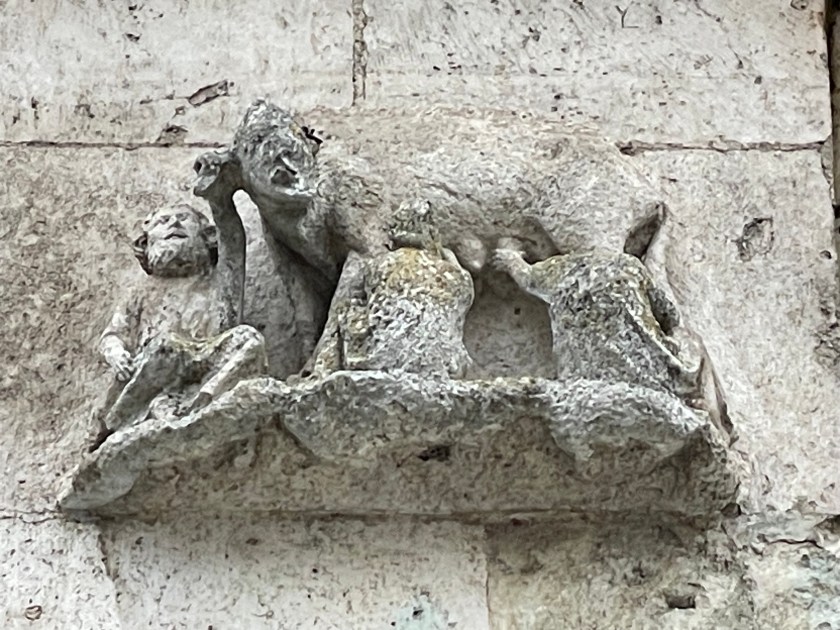
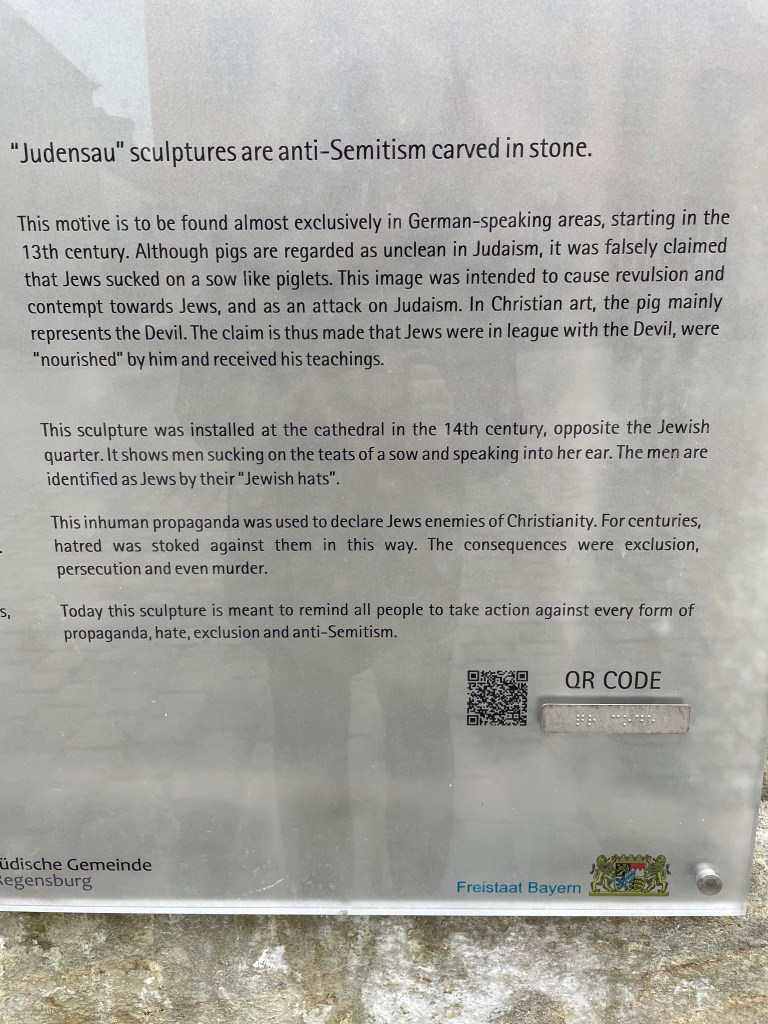
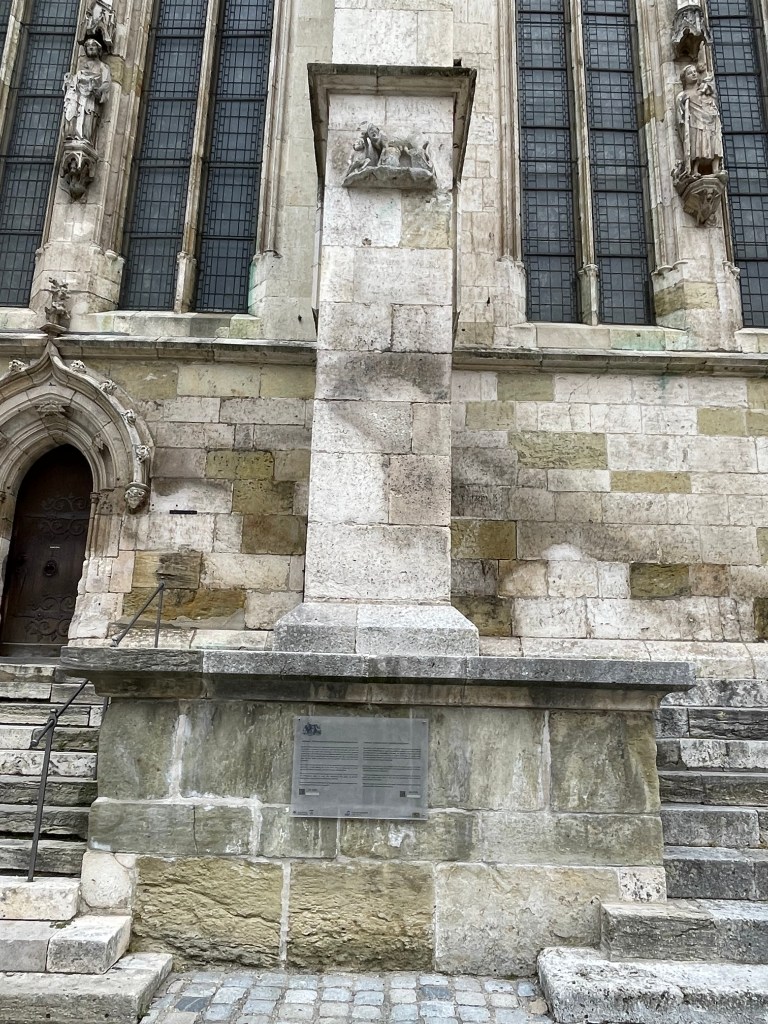
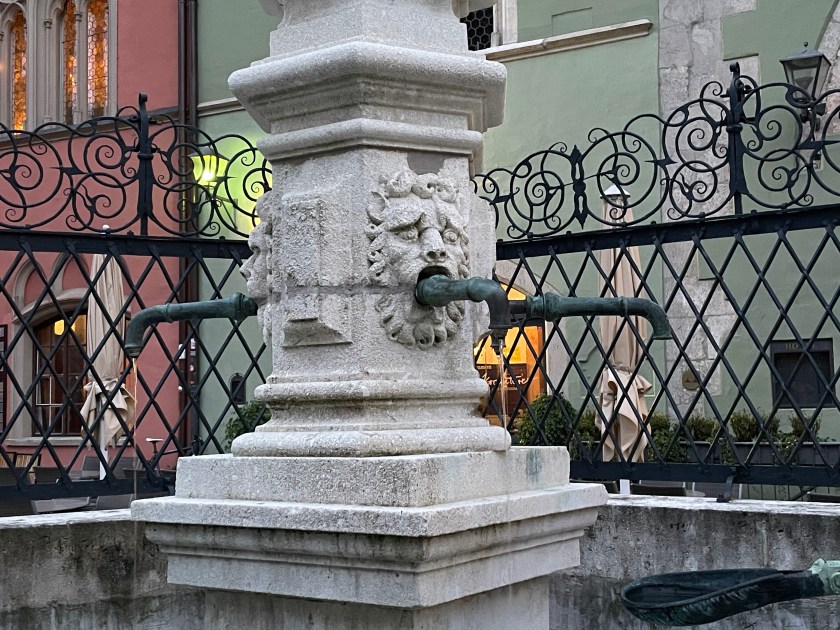
Here is an interesting stone carving outside the church.  Read about it below.

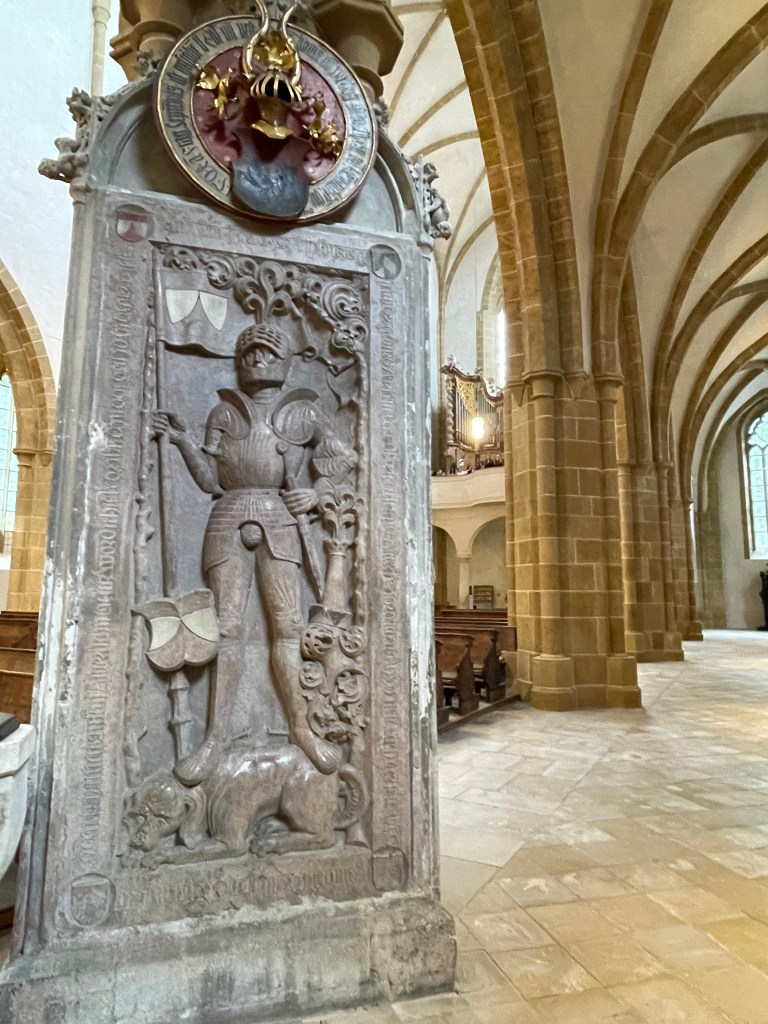
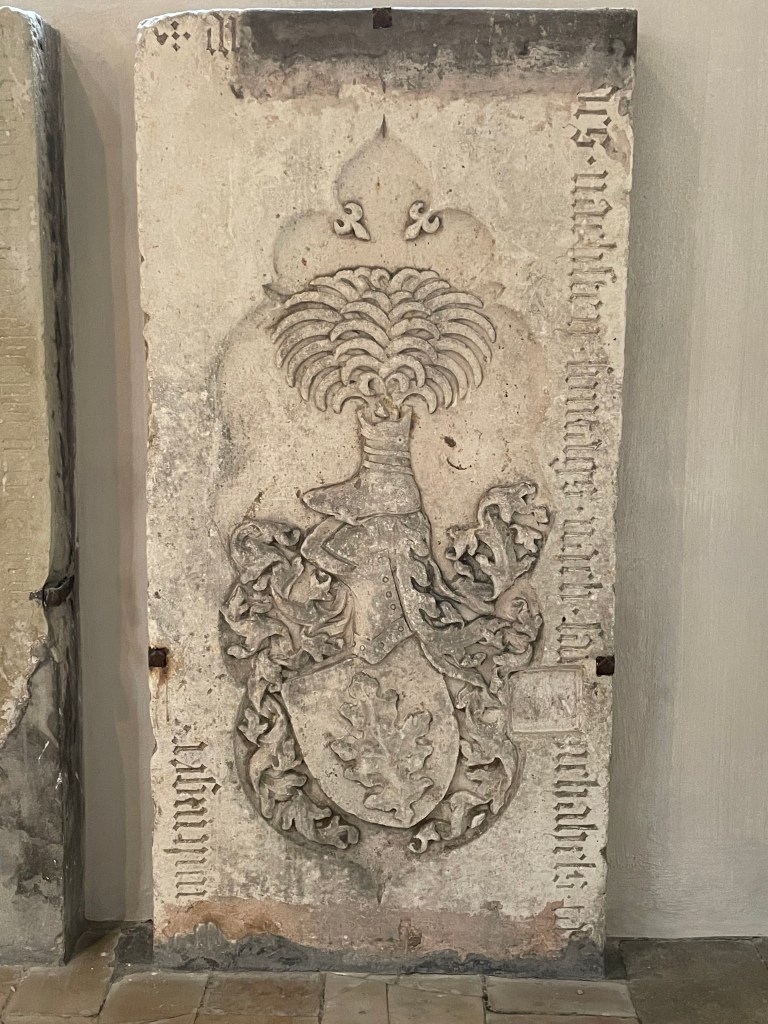
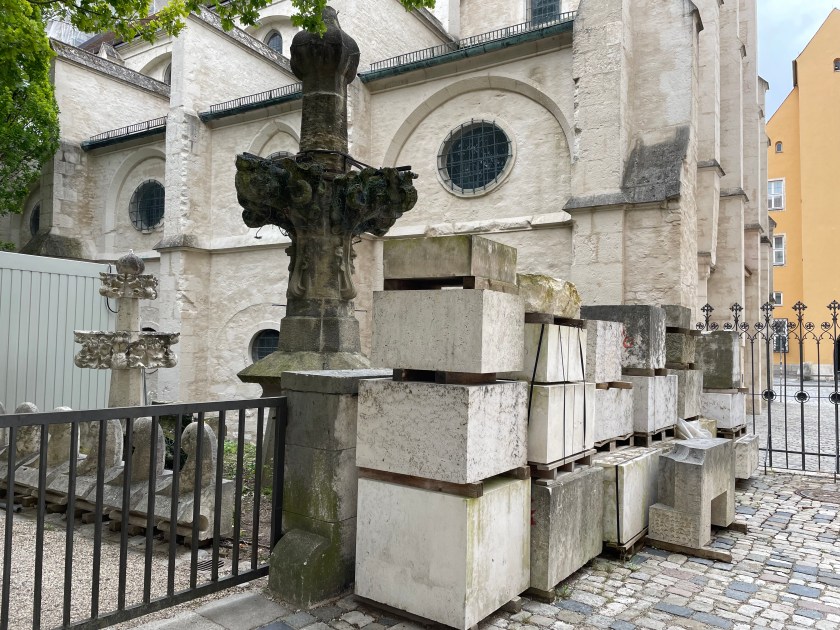
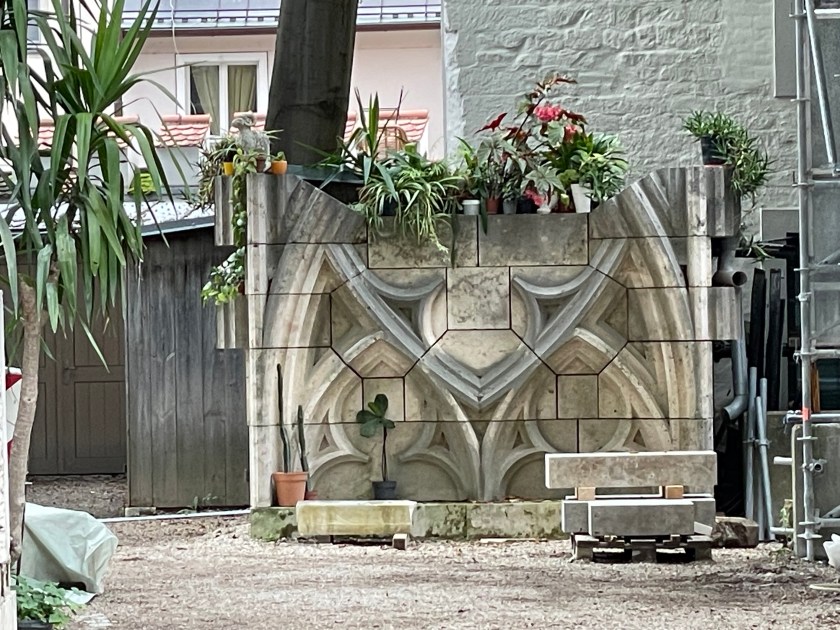
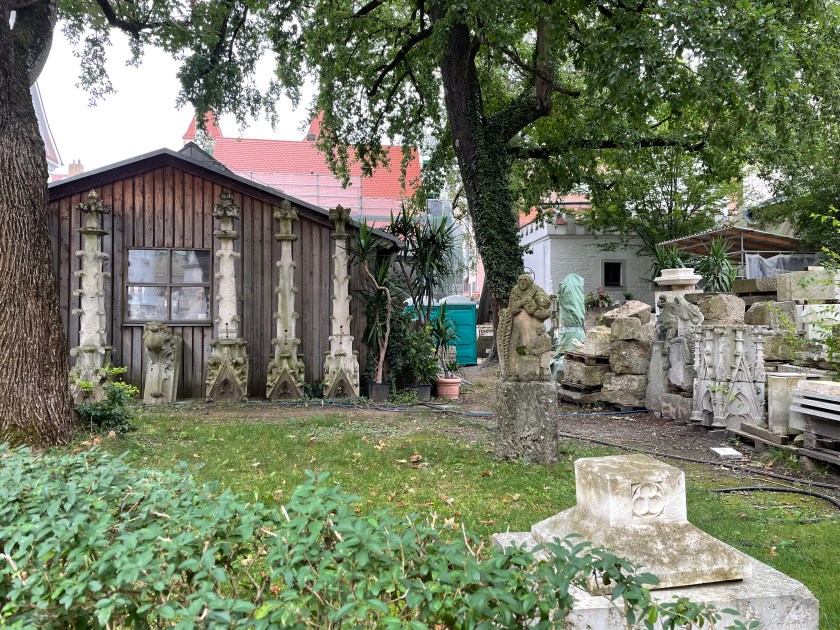
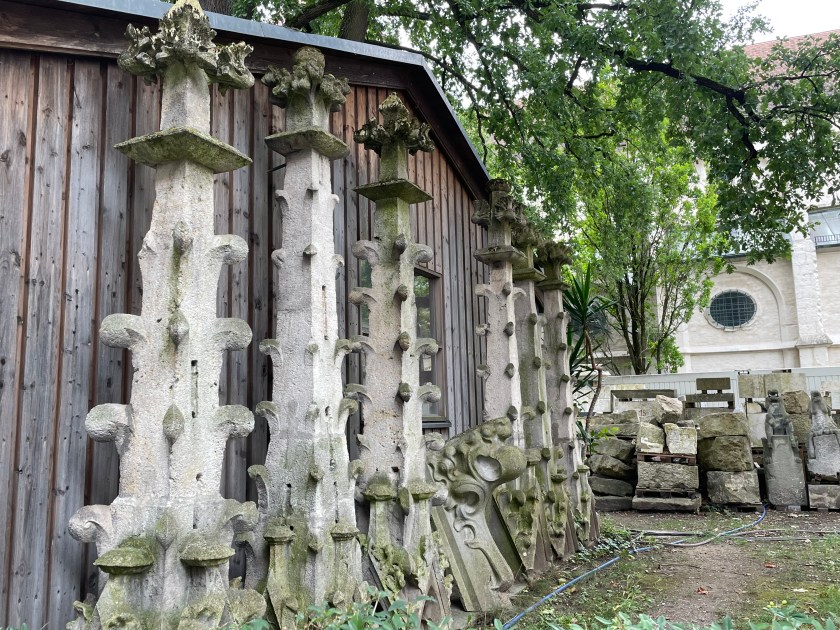
Behind the cathedral is what I’d call a stone yard or a cemetery for the parts and pieces that weren’t used during restoration and rebuilding.  This happens quite often after a building is bombed, then restored.

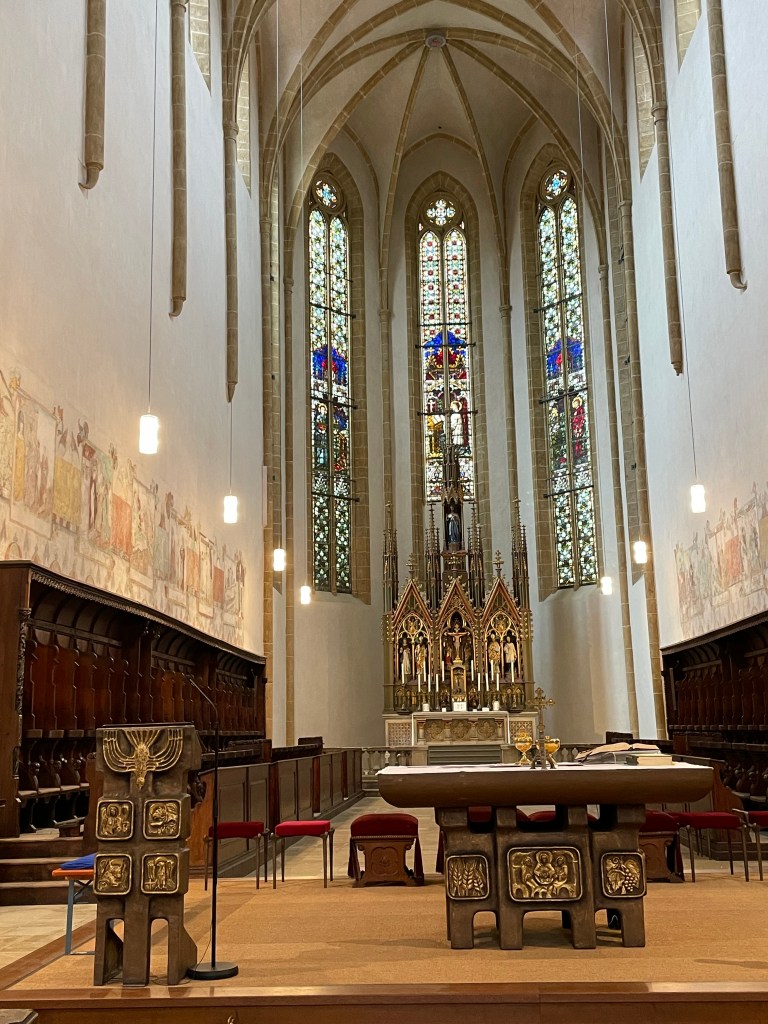
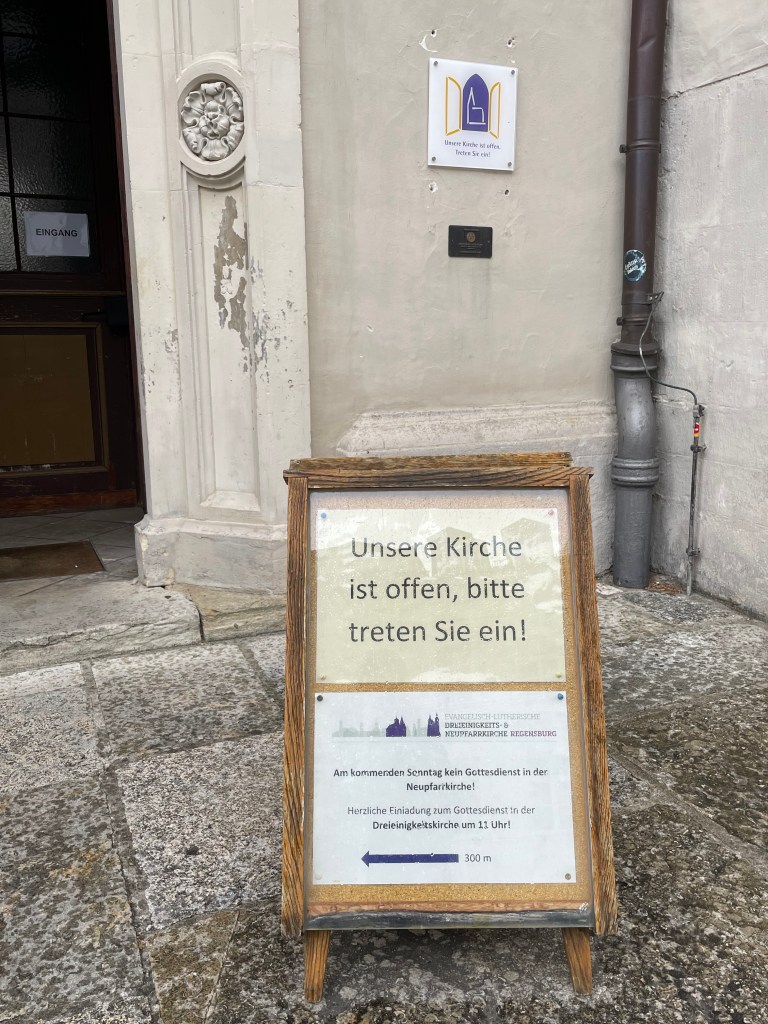
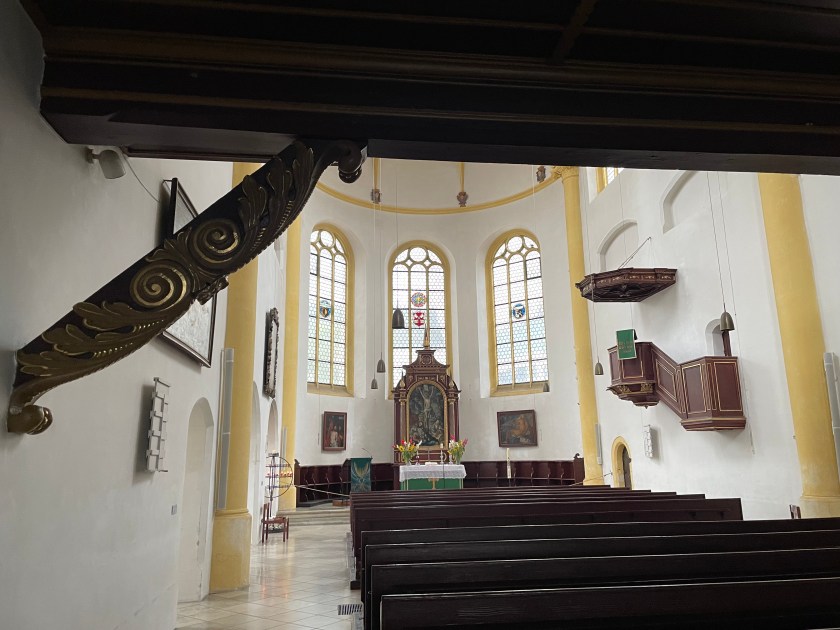
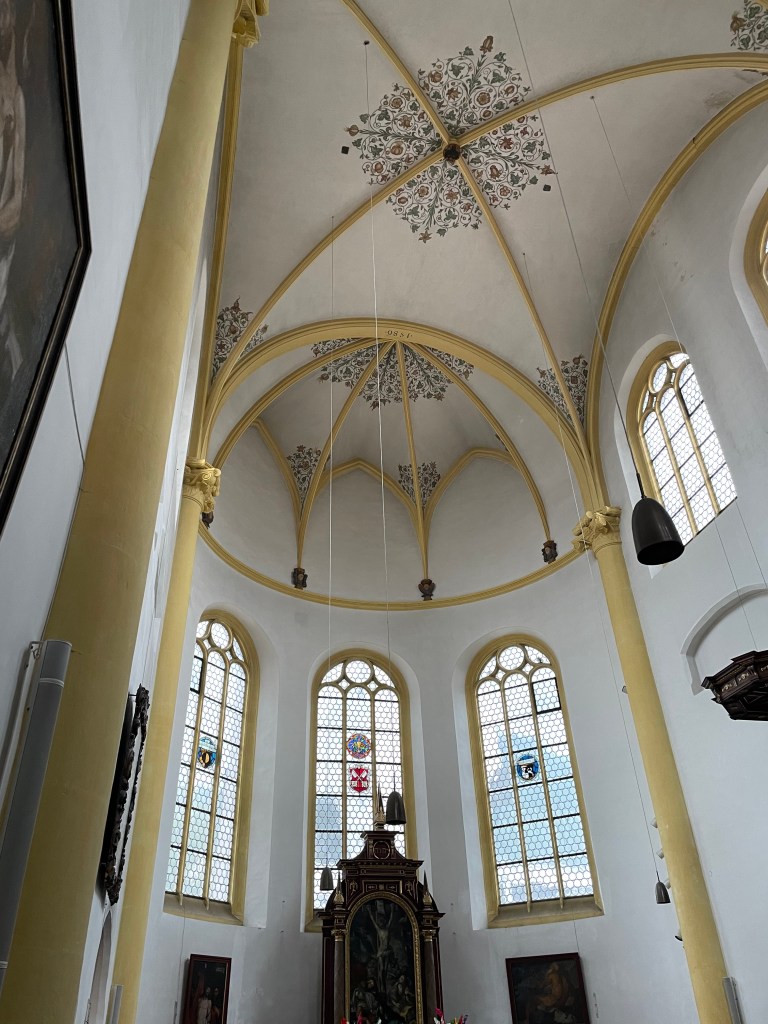
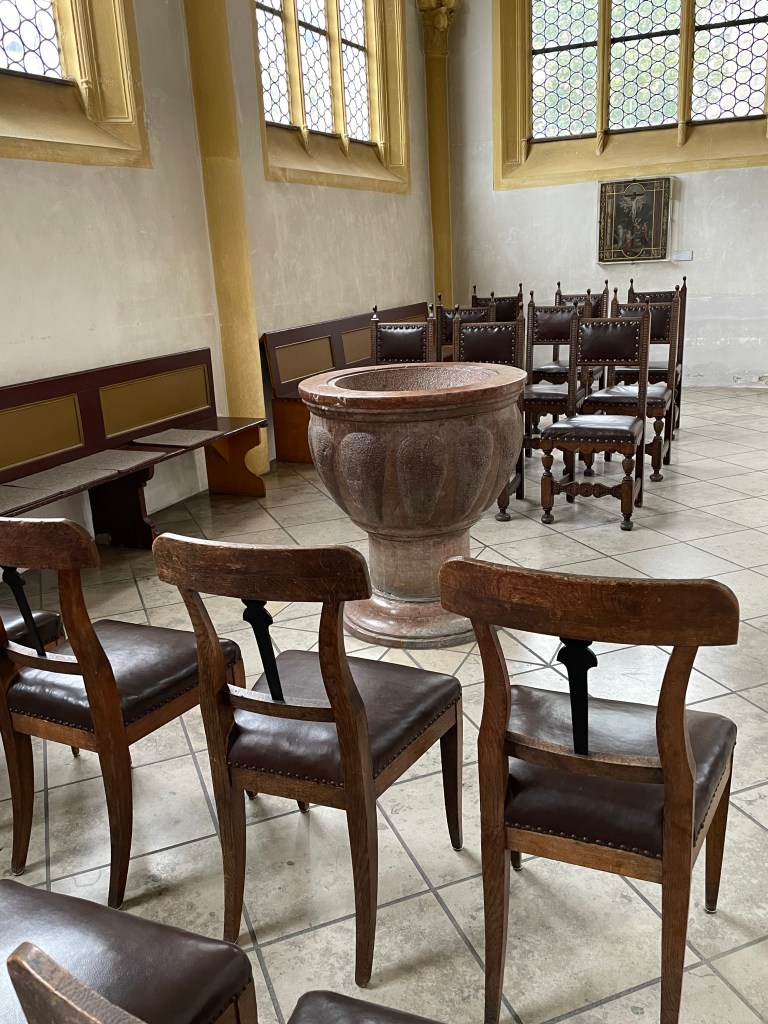
The Neupfarrkirche was the last church we visited in Regensburg.  Built in the 16th-century, this is an active Protest Parish church located at Naupfarrplatz in the Old Town of Regensburg. It was built upon the site of the Jewish Quarter after the Jewish followers were expelled from the city in the early part of that century.

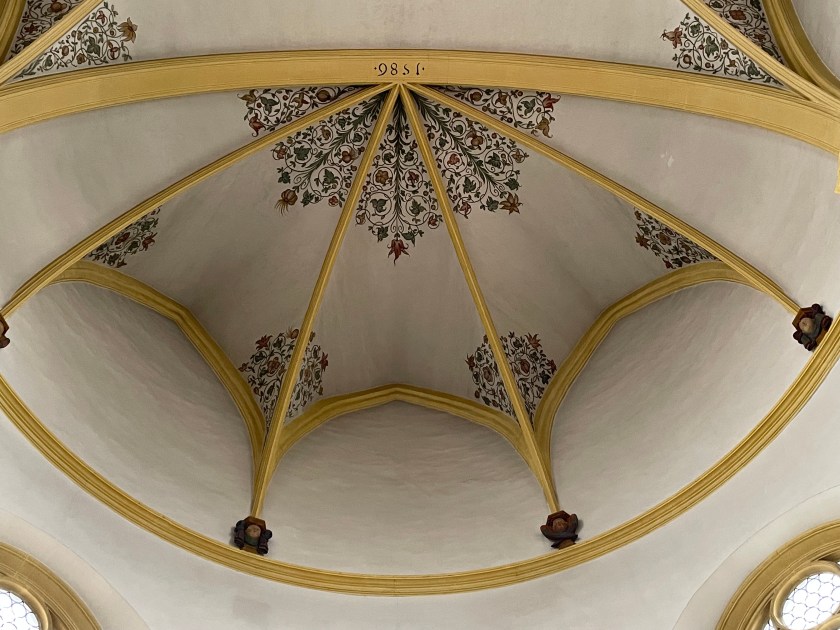
The ceiling was my favorite.

I always feel wonder when I am in these old places of worship.  Wonder at the beauty.  Wonder at the many hearts, through the centuries, turned here towards God.  Wonder at my place in His great plan.

Wandering Through Regensburg

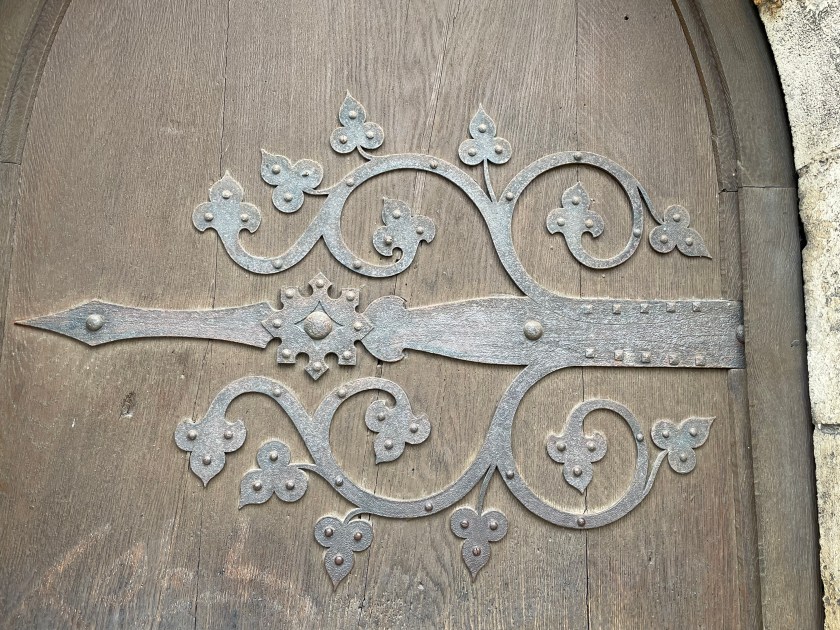
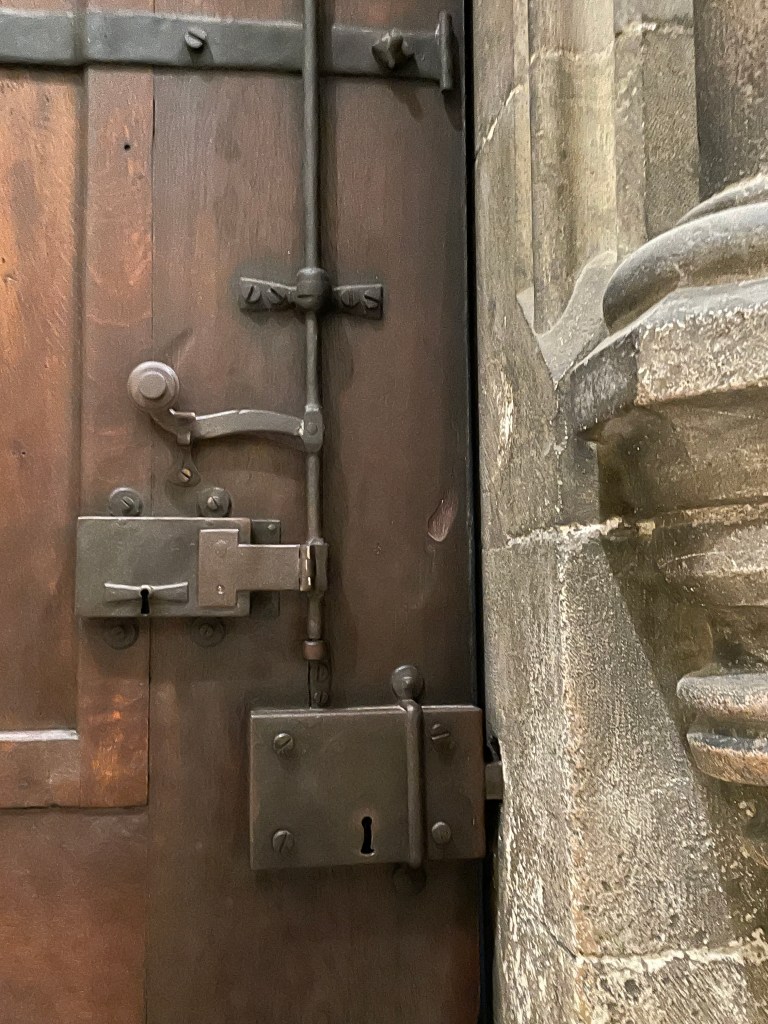
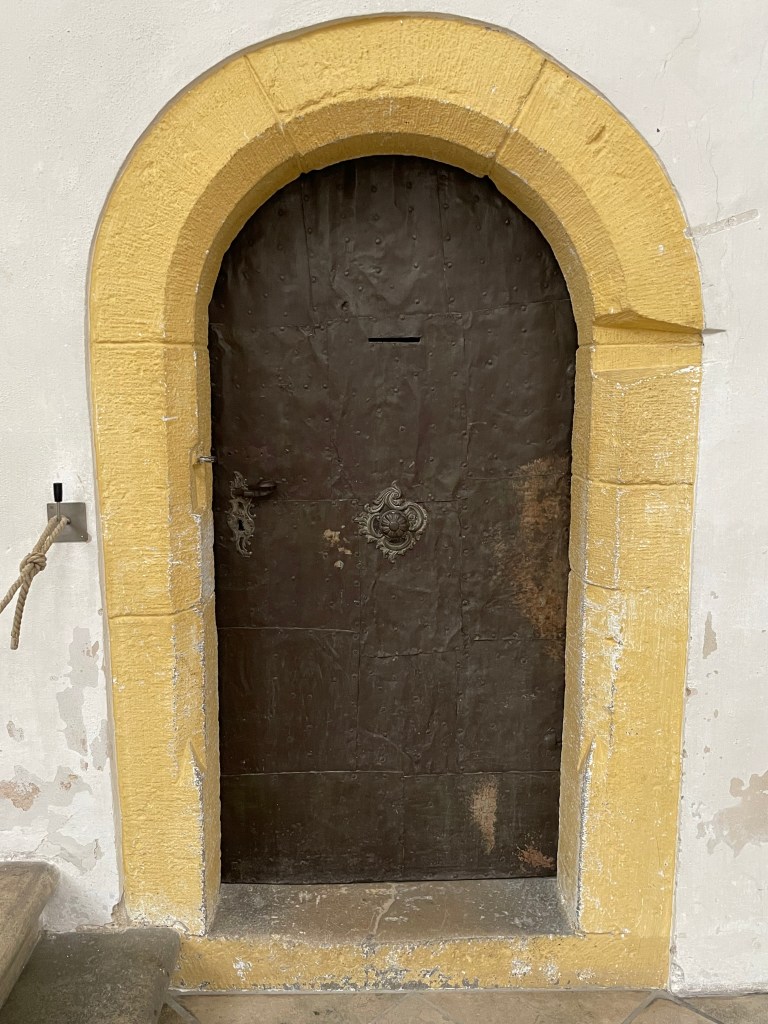
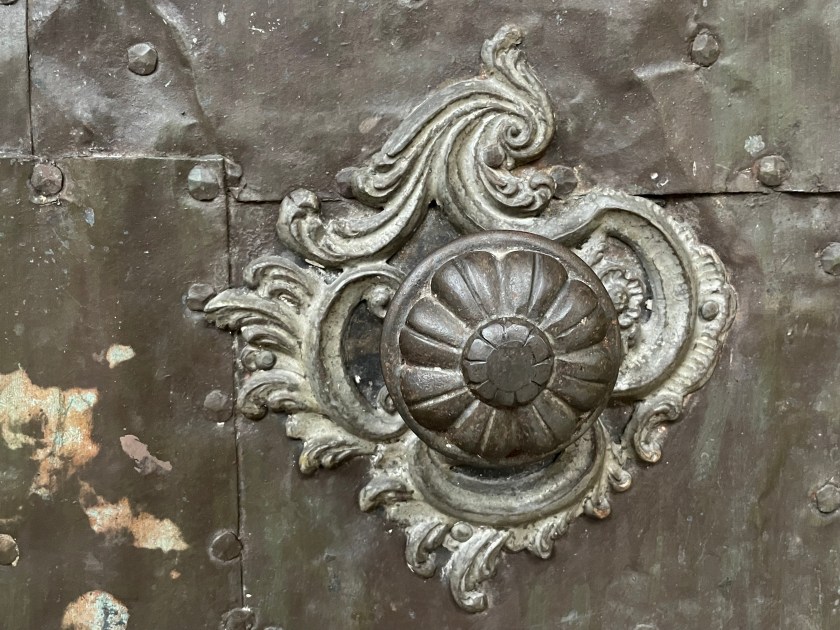
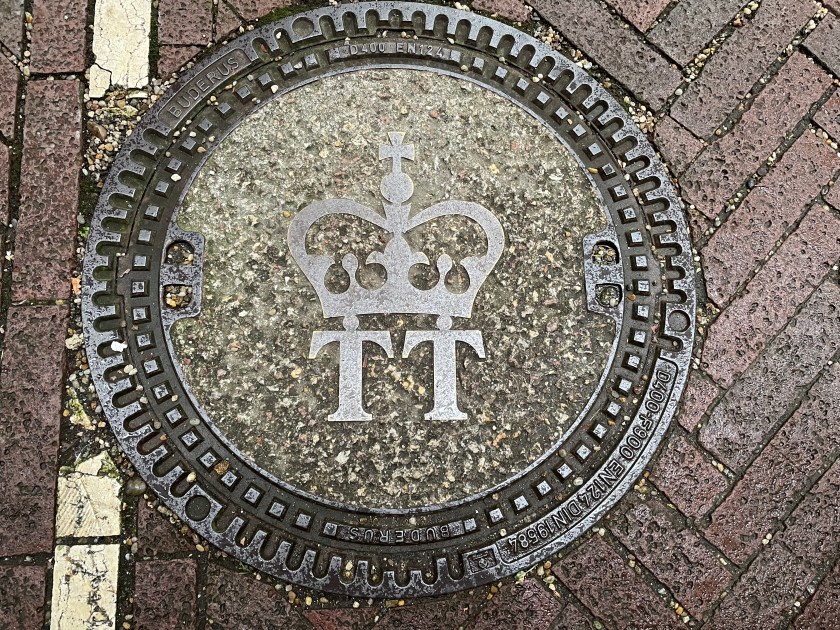
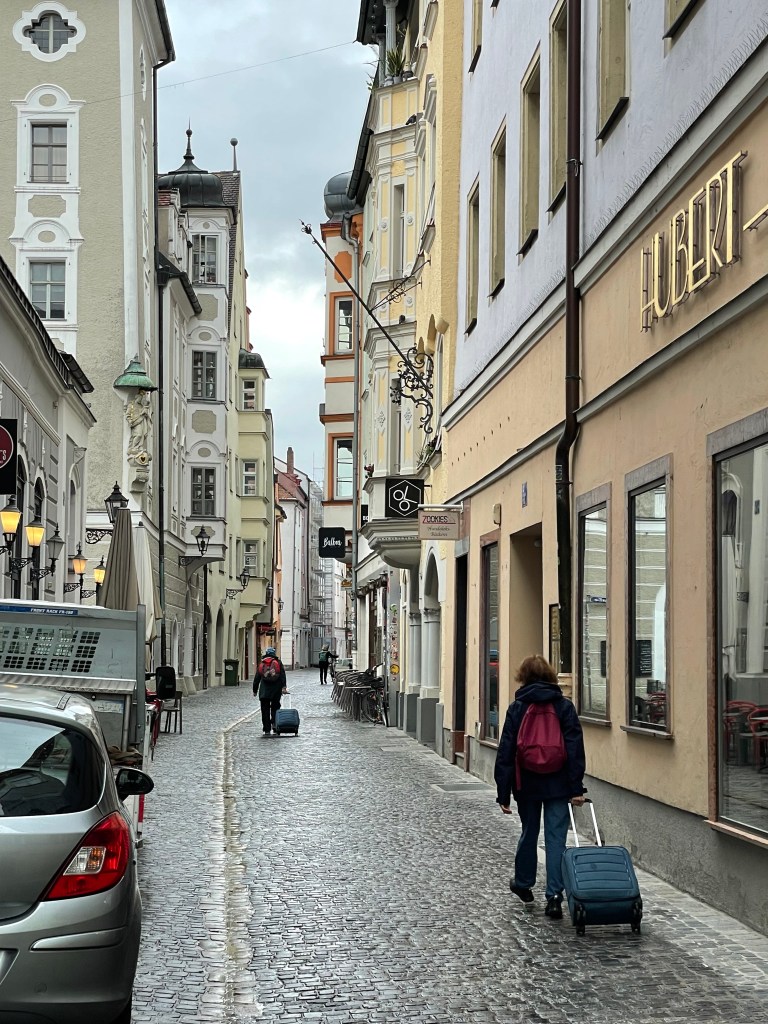
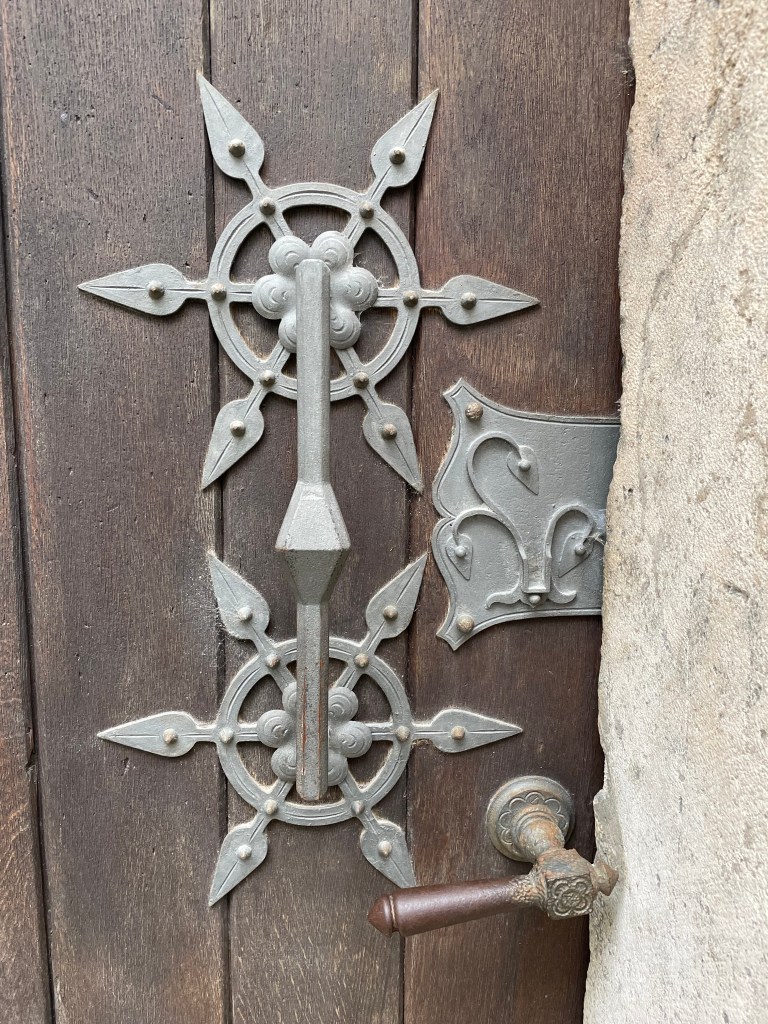
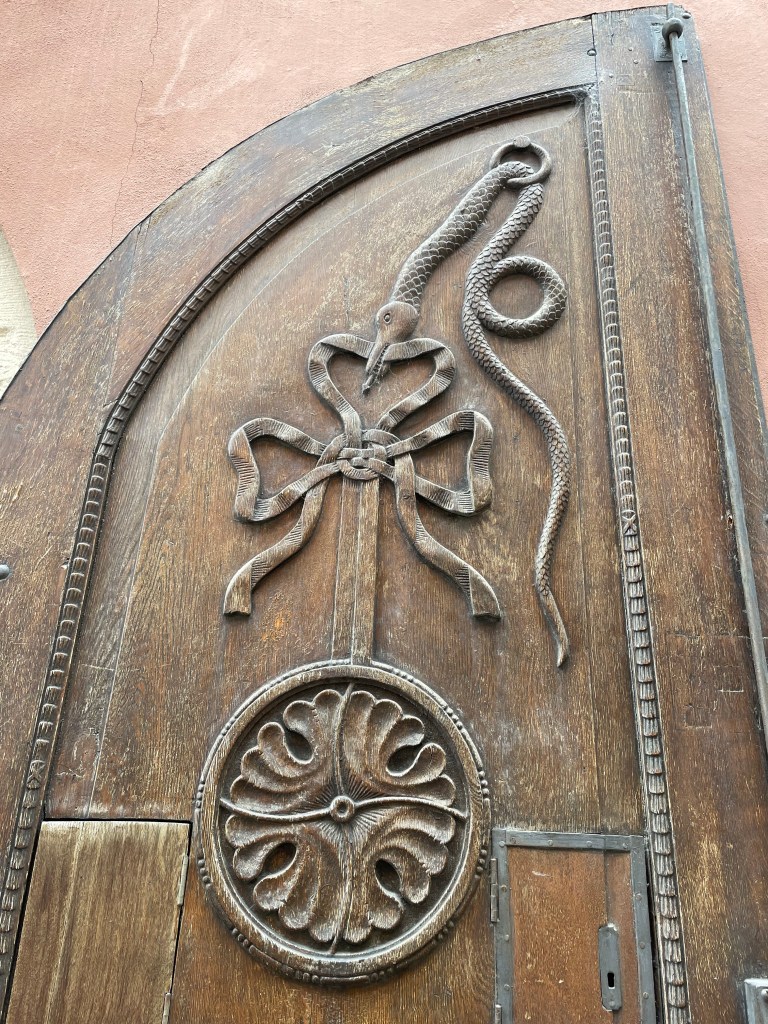
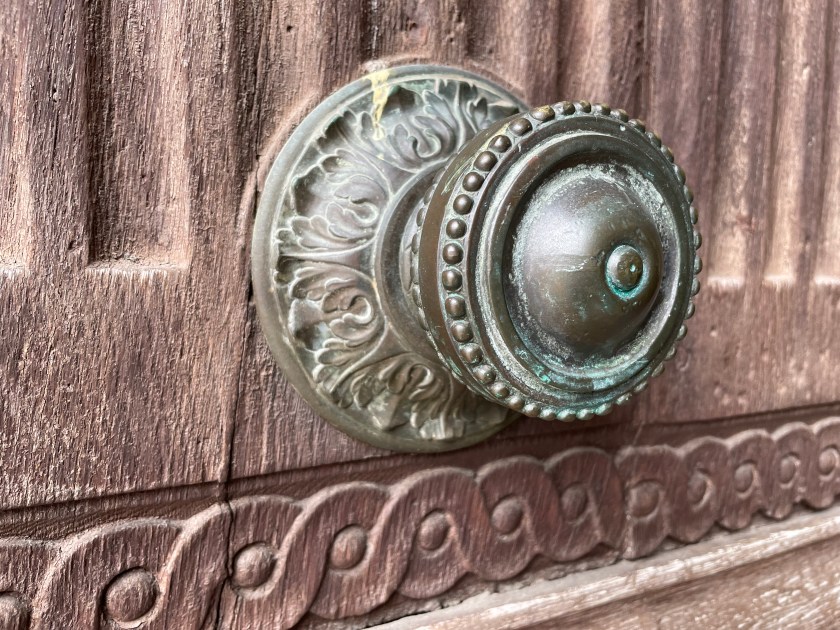
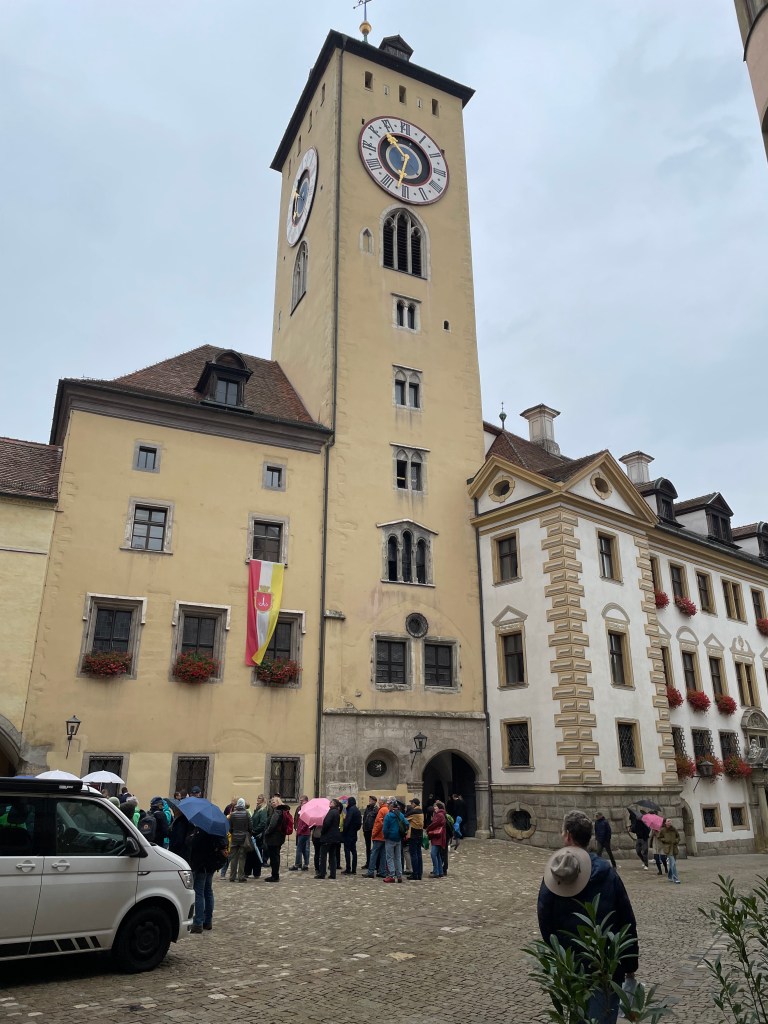
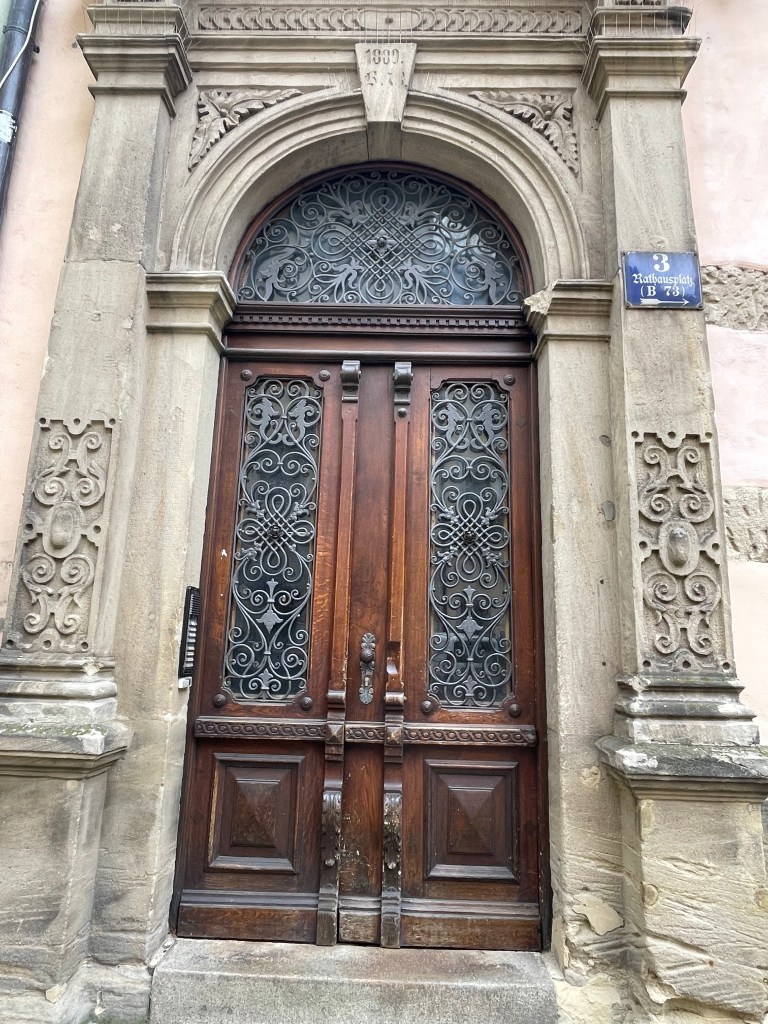
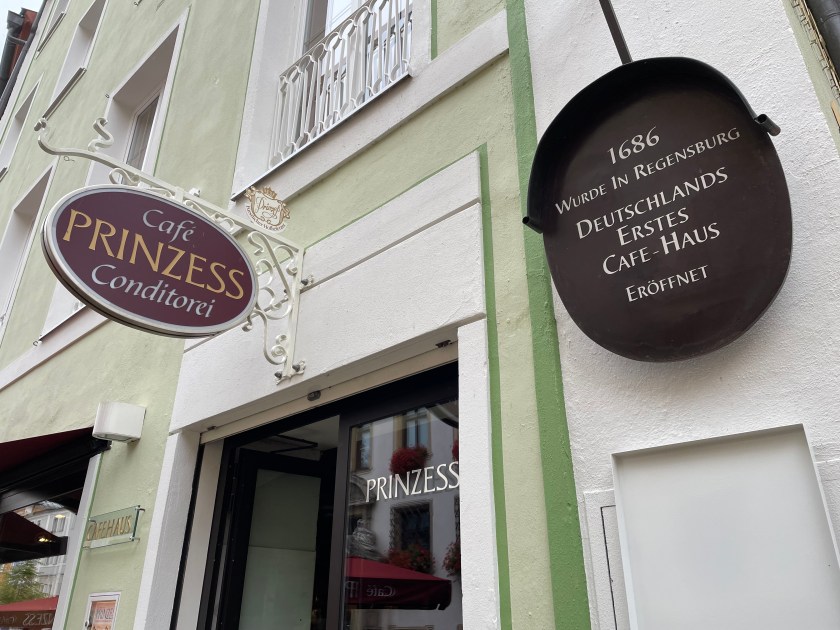
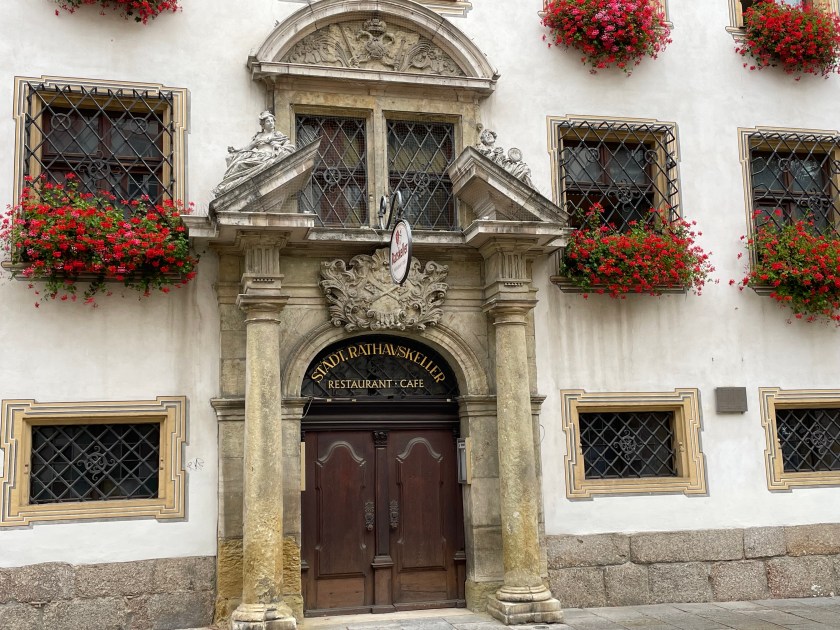
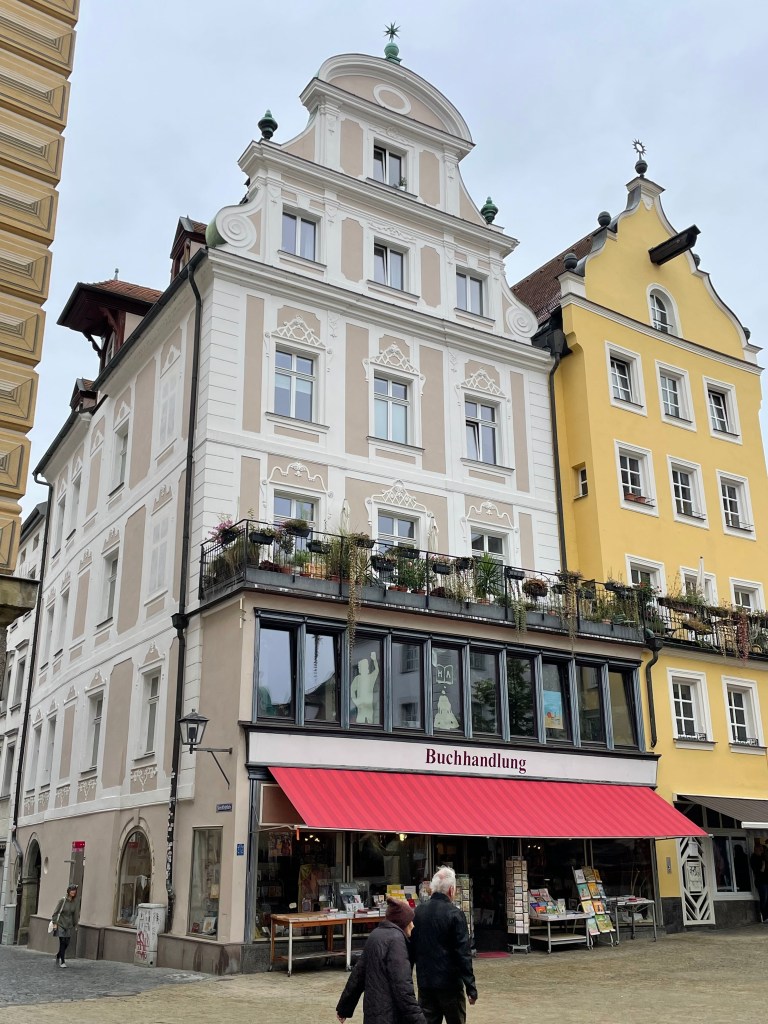
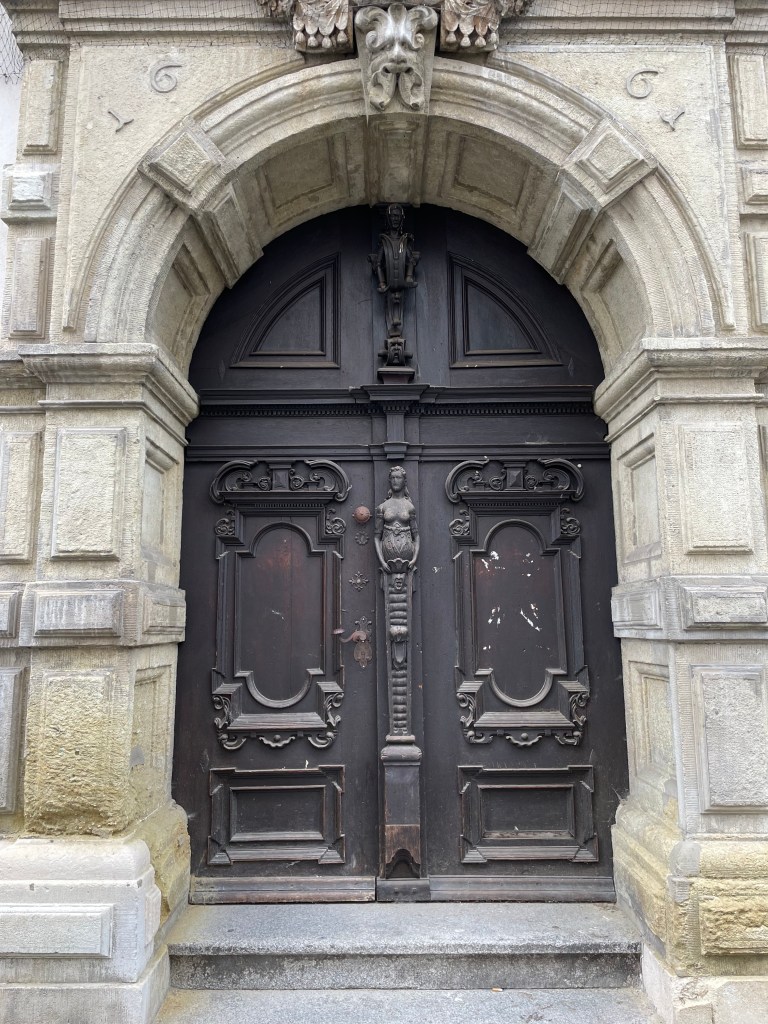
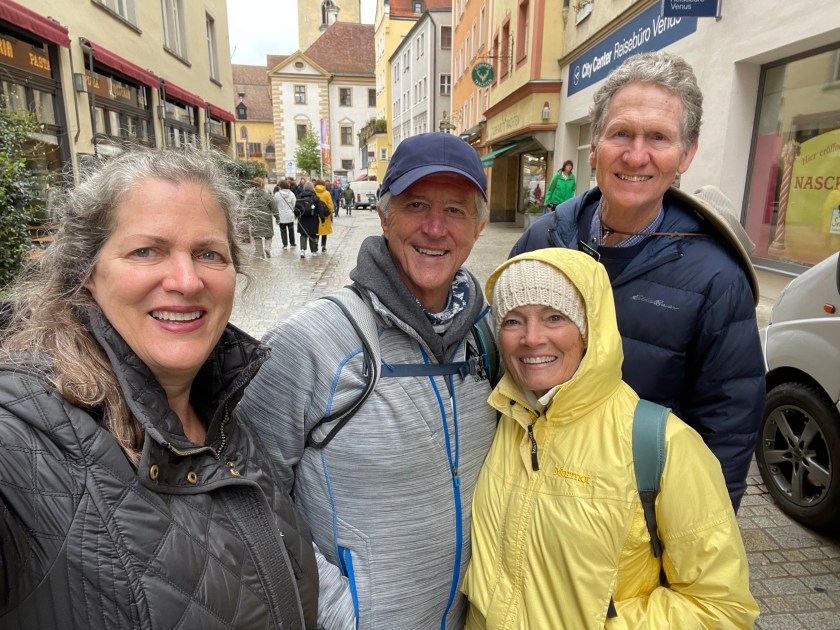
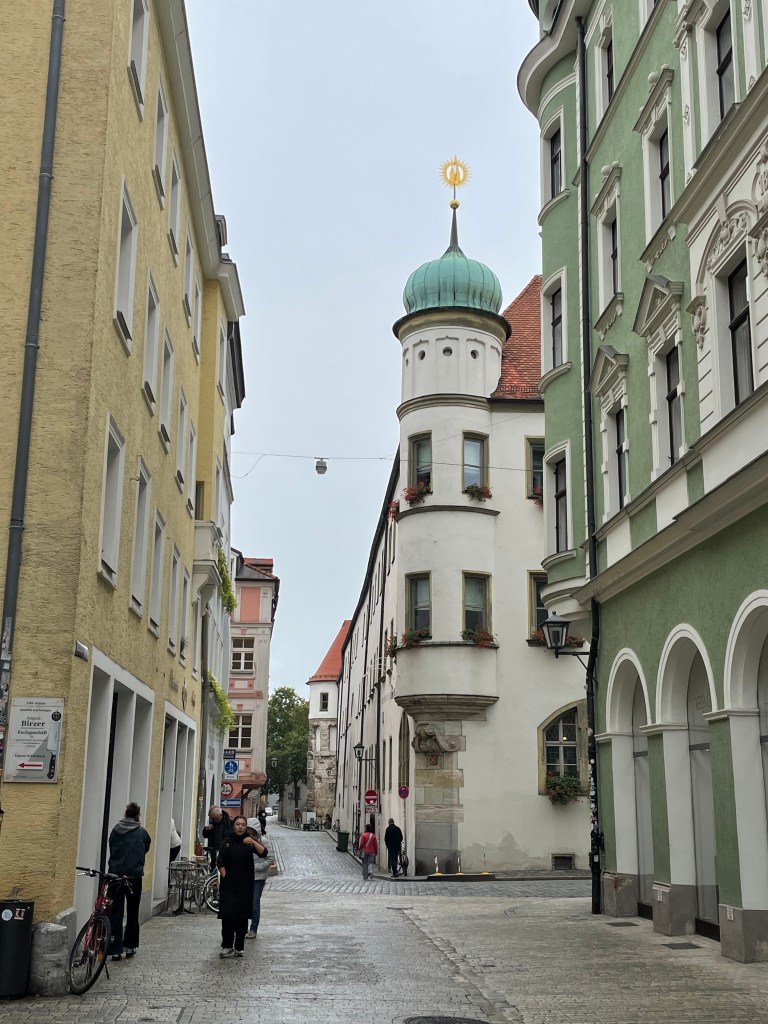
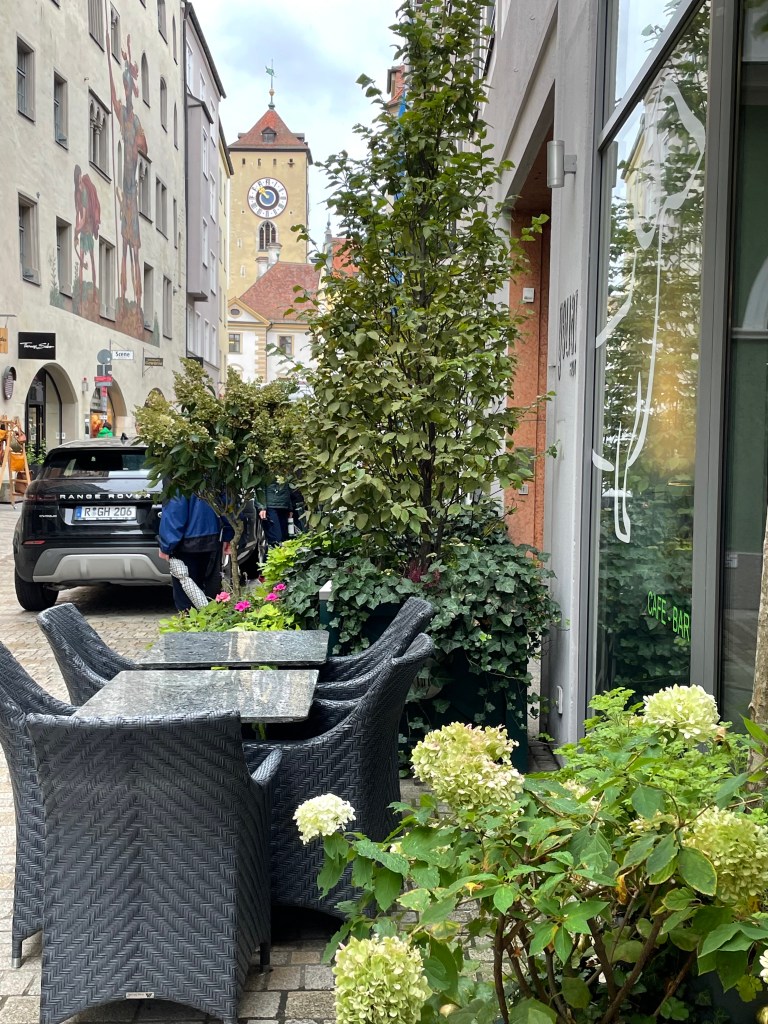
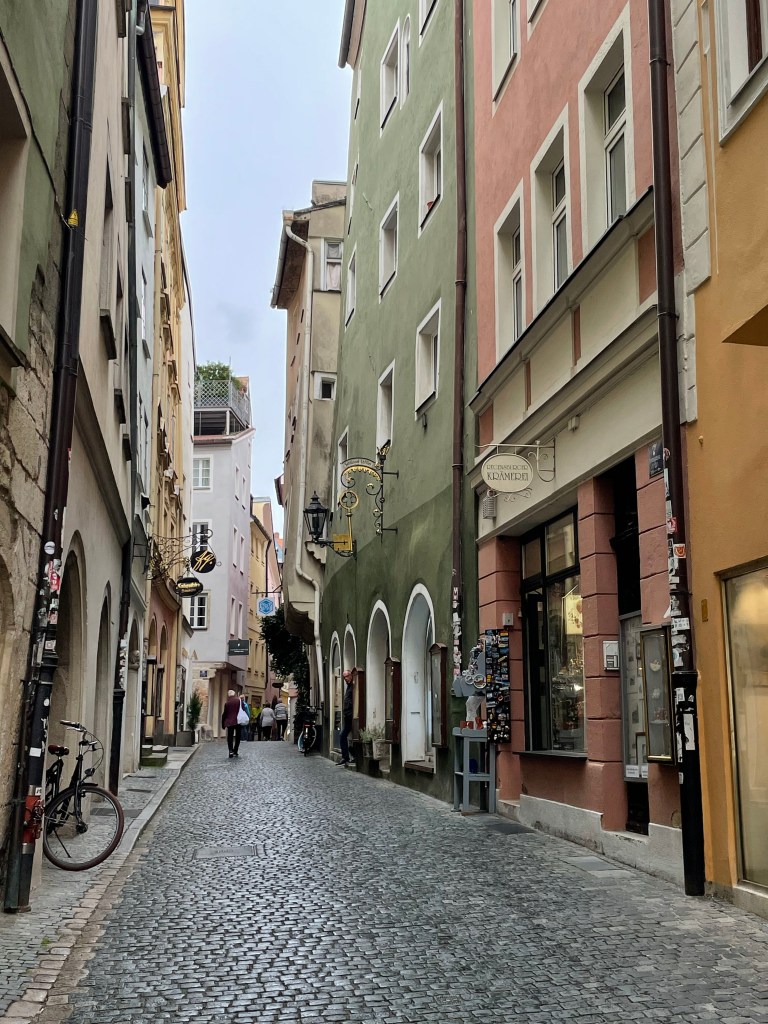
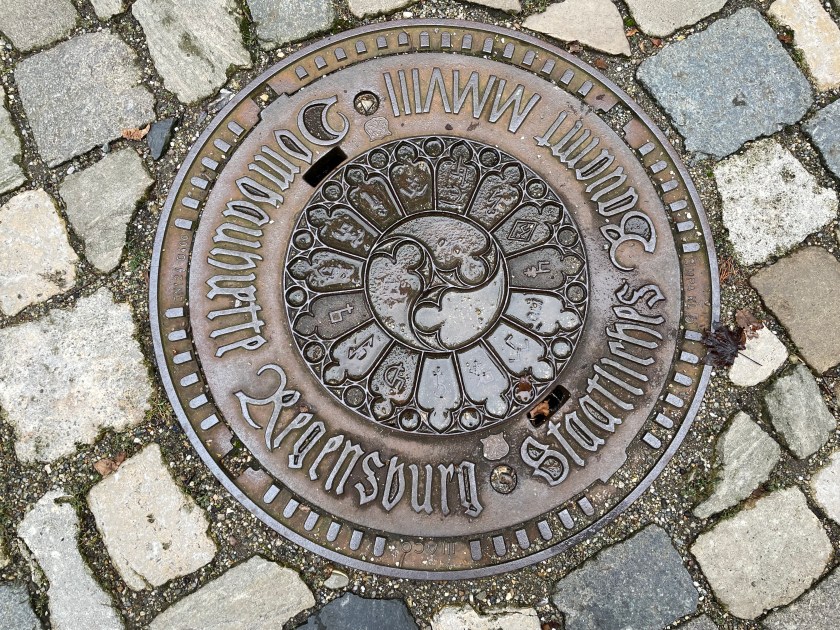
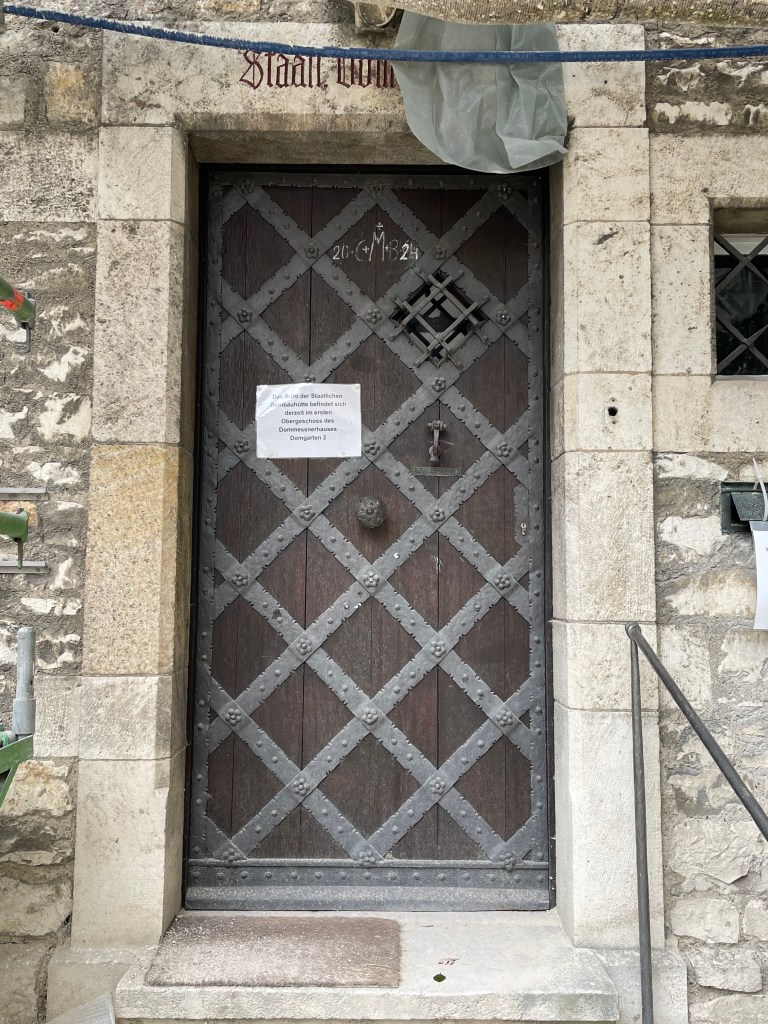
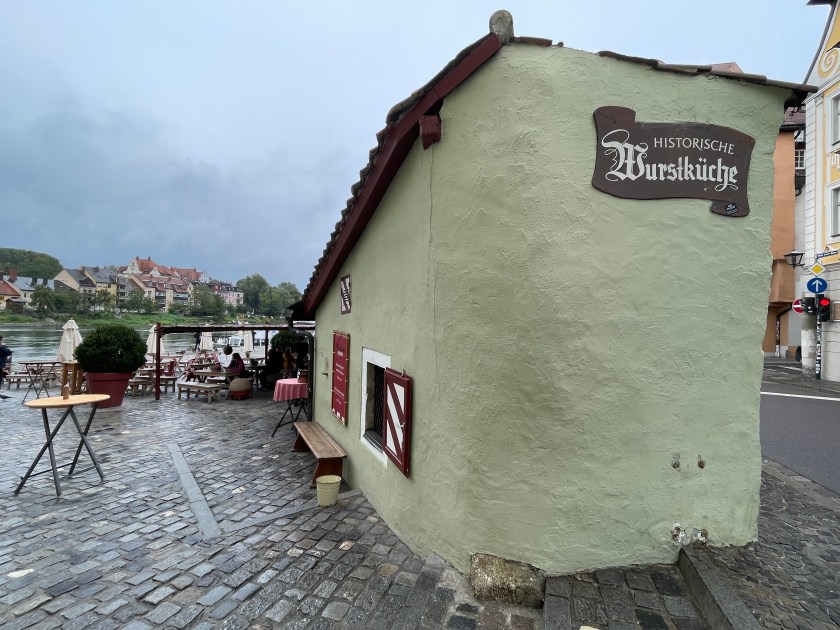
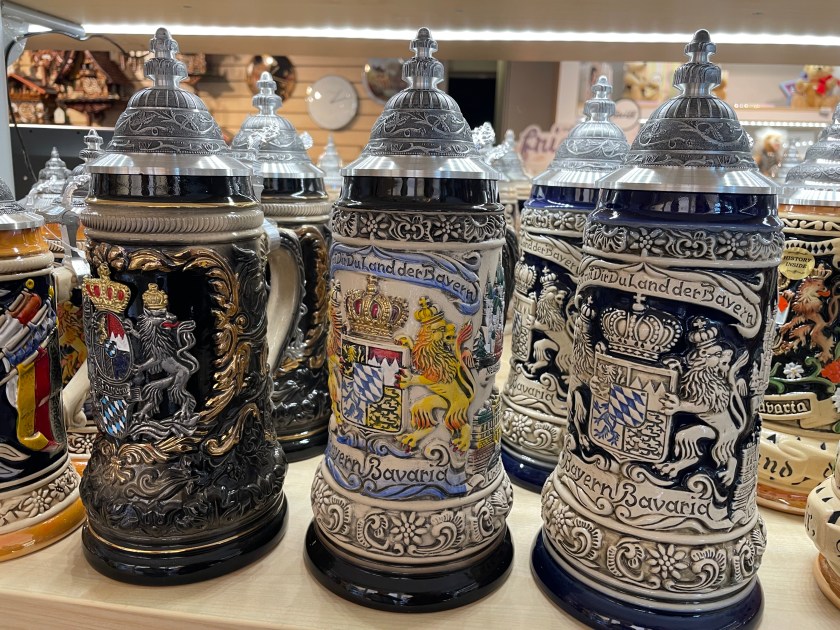
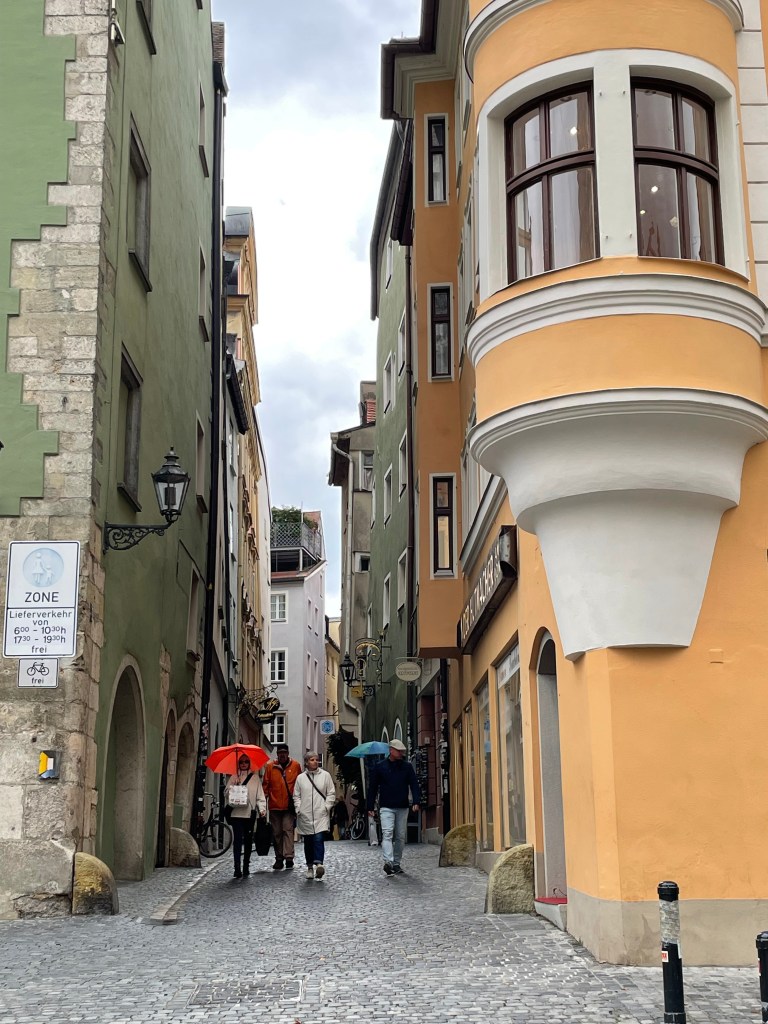
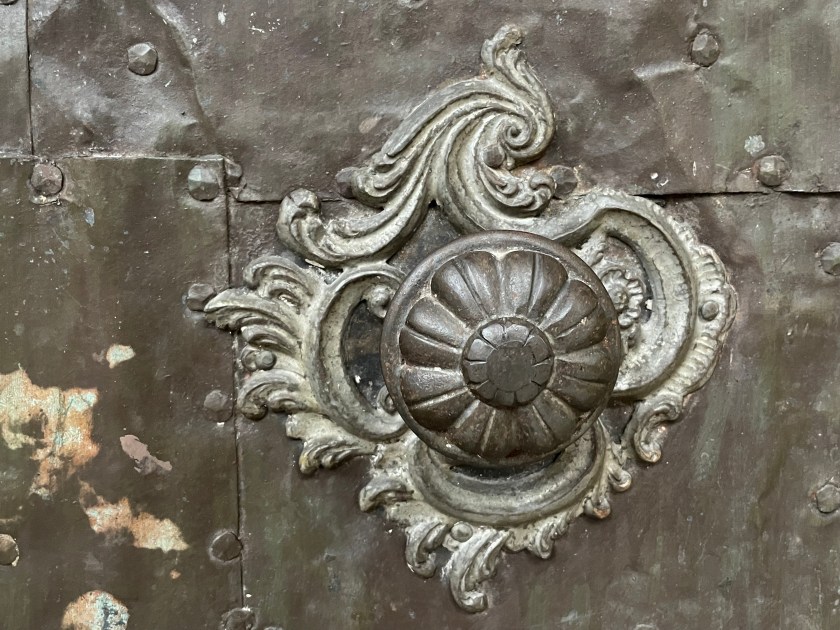
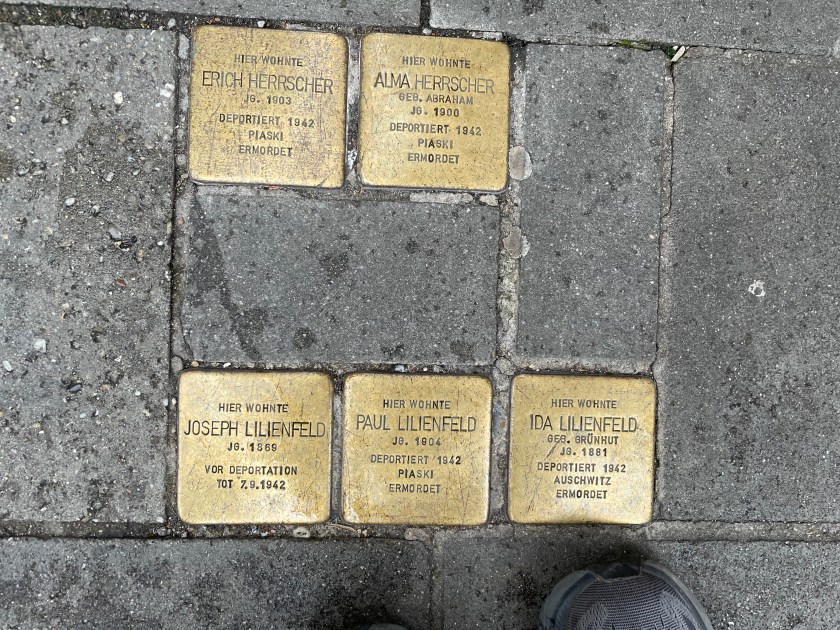
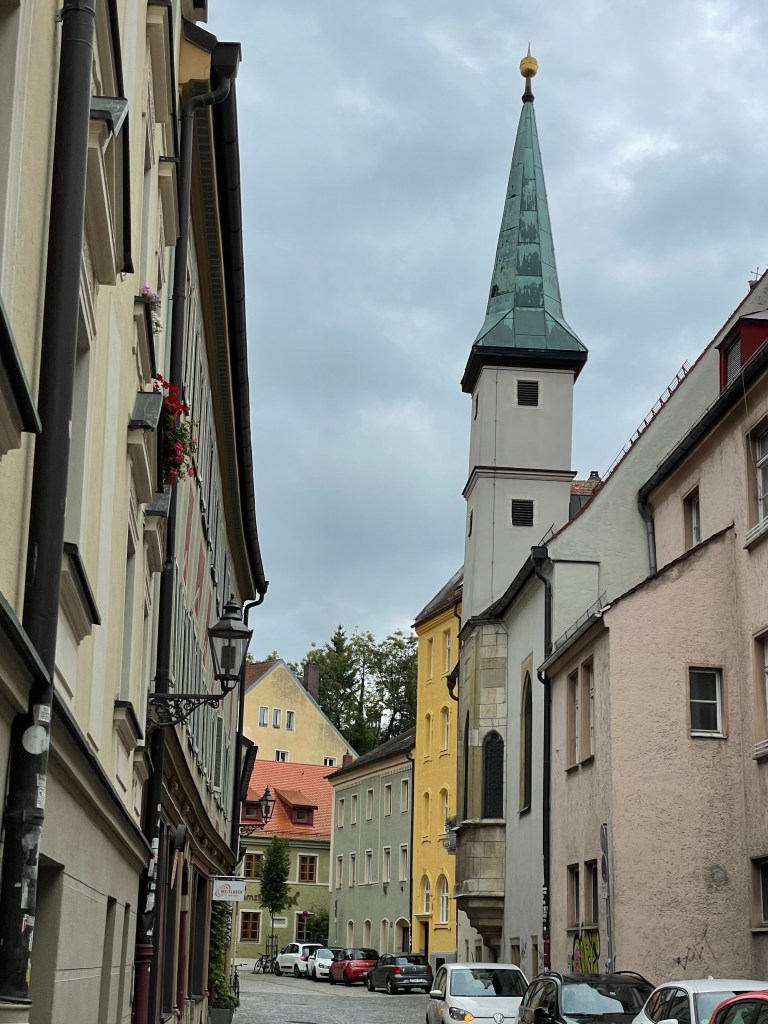
This morning we began our wanderings with the Conlins through the streets of Regensburg, where we spent the first half of our day.  We followed a general walking tour the hotel guy suggested, taking us to all the highlights of the town.  We loved it all.  Charming on a little bigger scale.  Big buildings, pastel colors, interesting roof lines, fun shop signs and little shops, cobblestone streets, Stolpersteine, interesting manhole covers, bakeries, old churches, detailed doors and hardware, a beautiful girls’ choir in an organ loft, another look at the 600 year-old stone bridge, buying some Christmas pull toys for the grandkids, eating Brats and Sauerkraut and Erdapfel Suppe (potato) at a 500 year-old Brat shop, walking in and out of rain, cuckoo clocks, Scott buying a Bierstein, plum Kuchen, a famous hat shop, Cathedrals, fresh raspberries, a Roman Wall from A.D. 179, and more.  We had a great day.

Here are some of the things we saw:

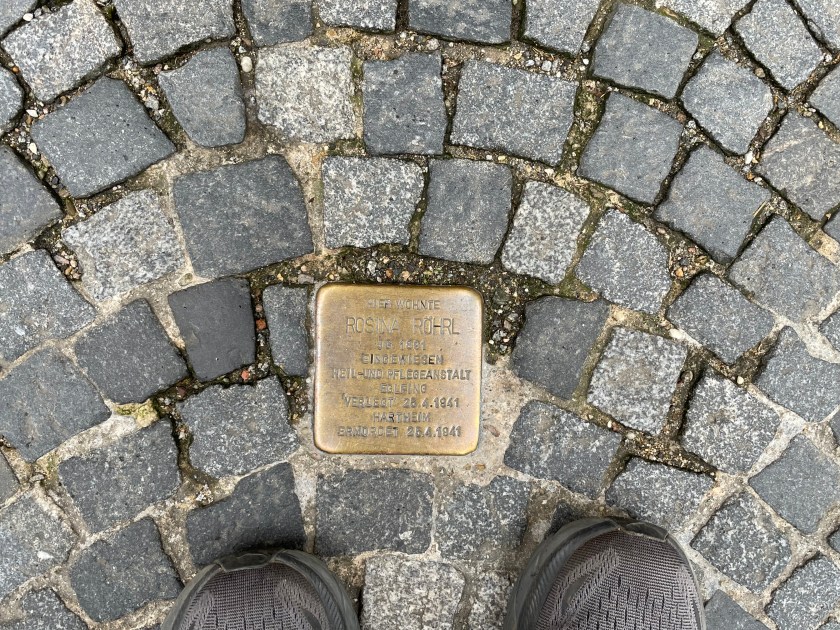
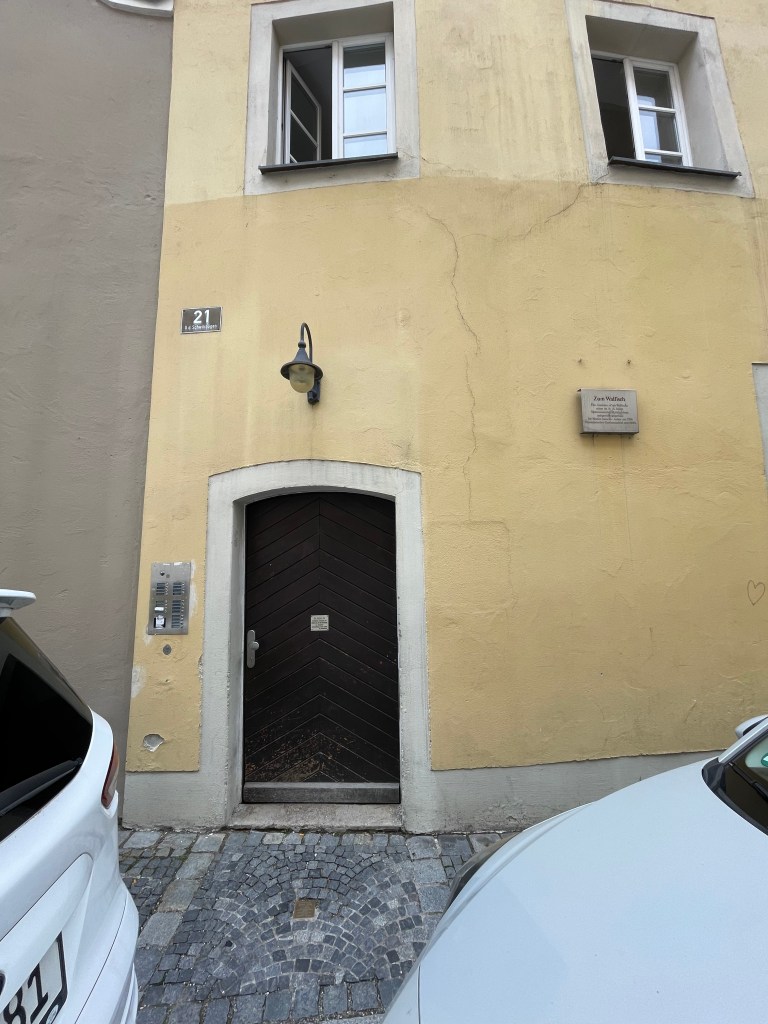
Karolina’s stone above and below is where she lived.

We came back to this church later when it opened.

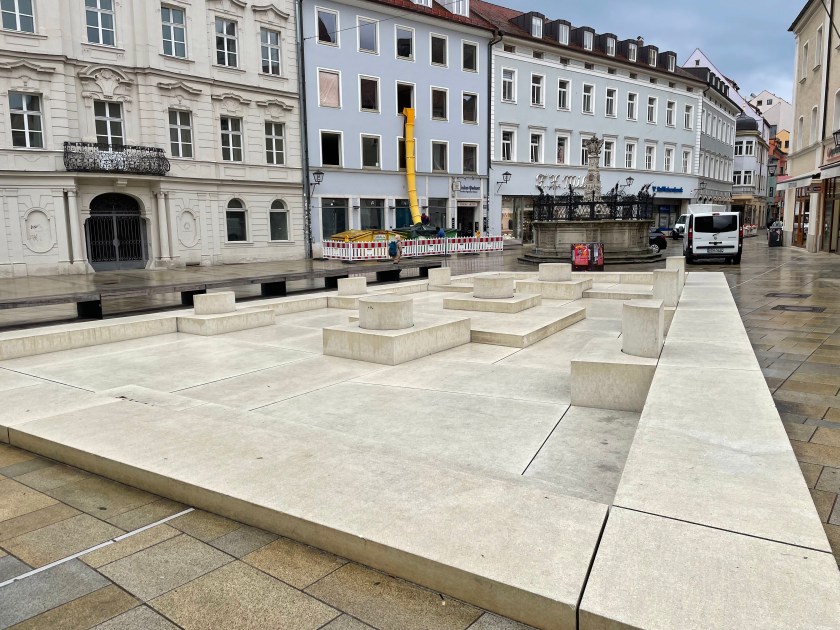
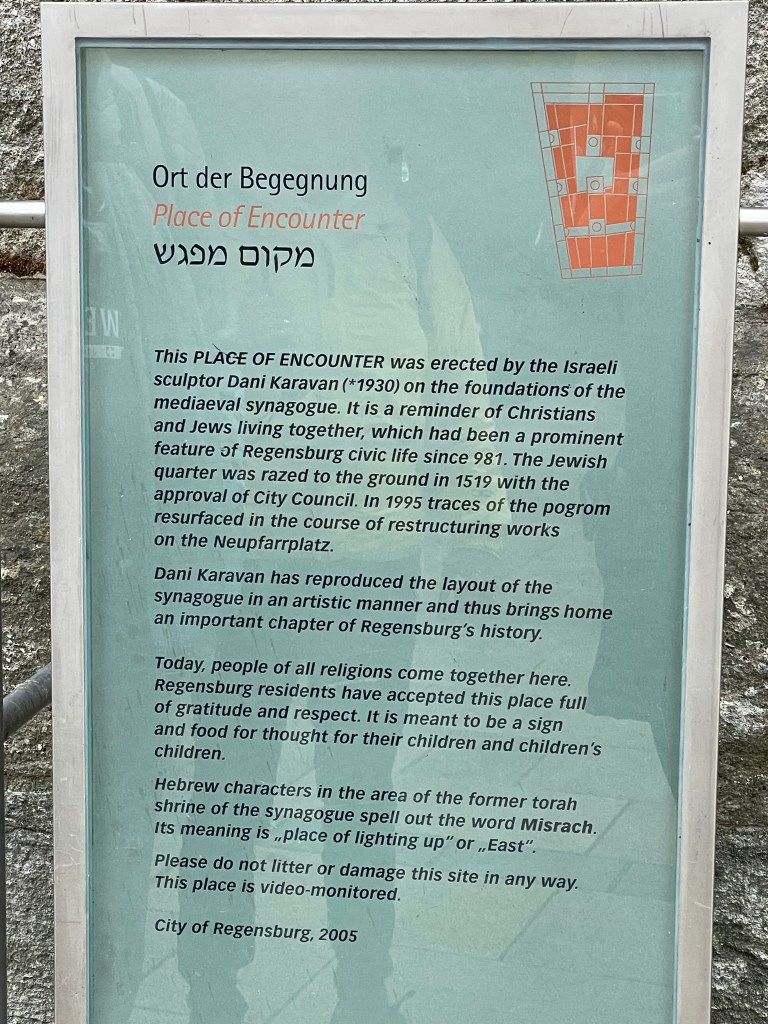
This memorial marks the spot where the Jewish synagogue once stood.

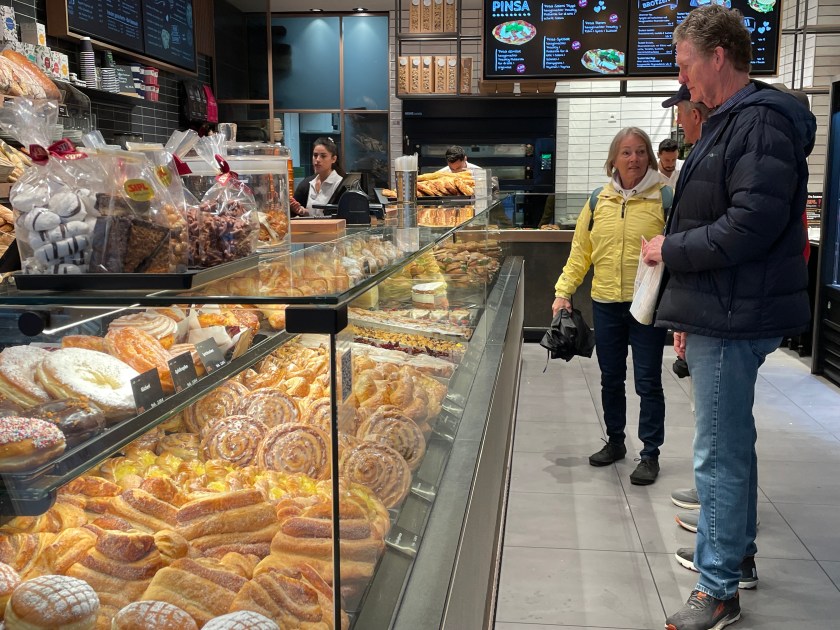
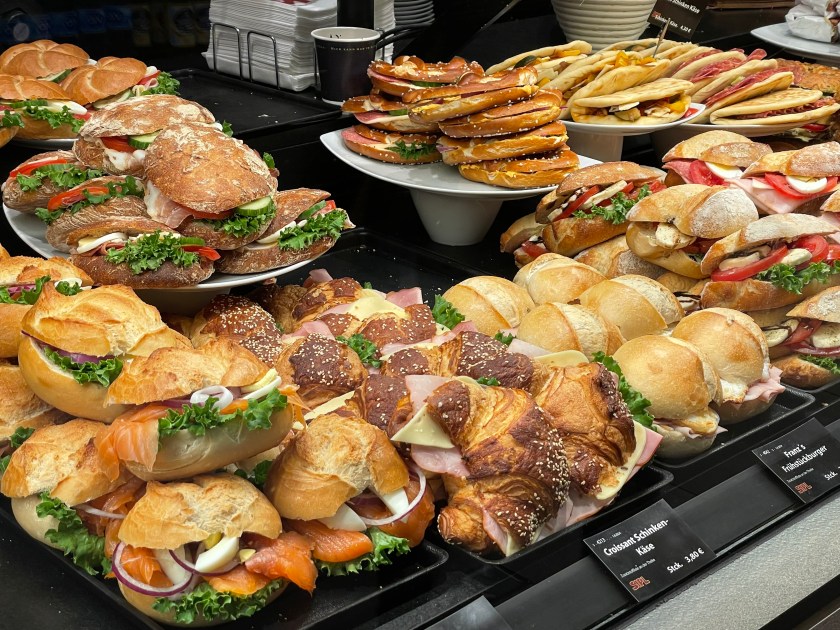
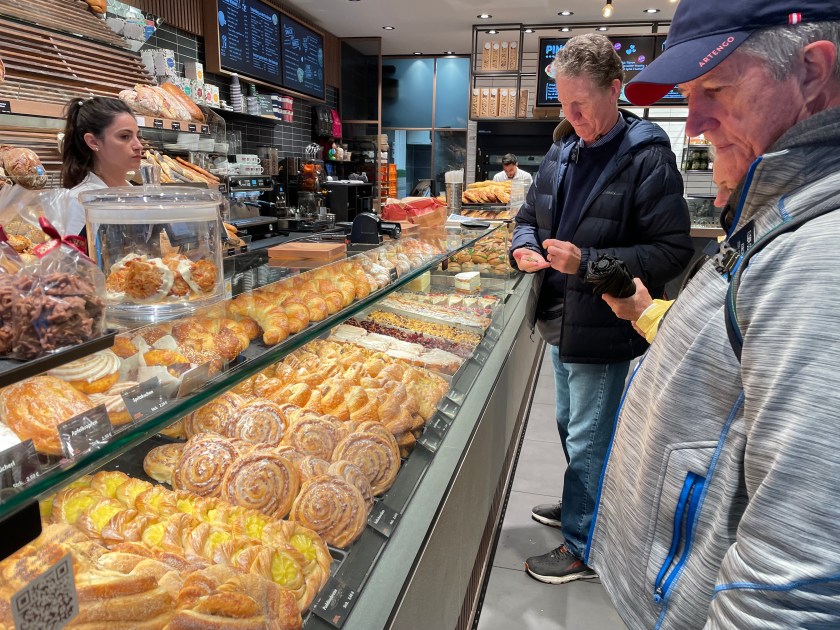
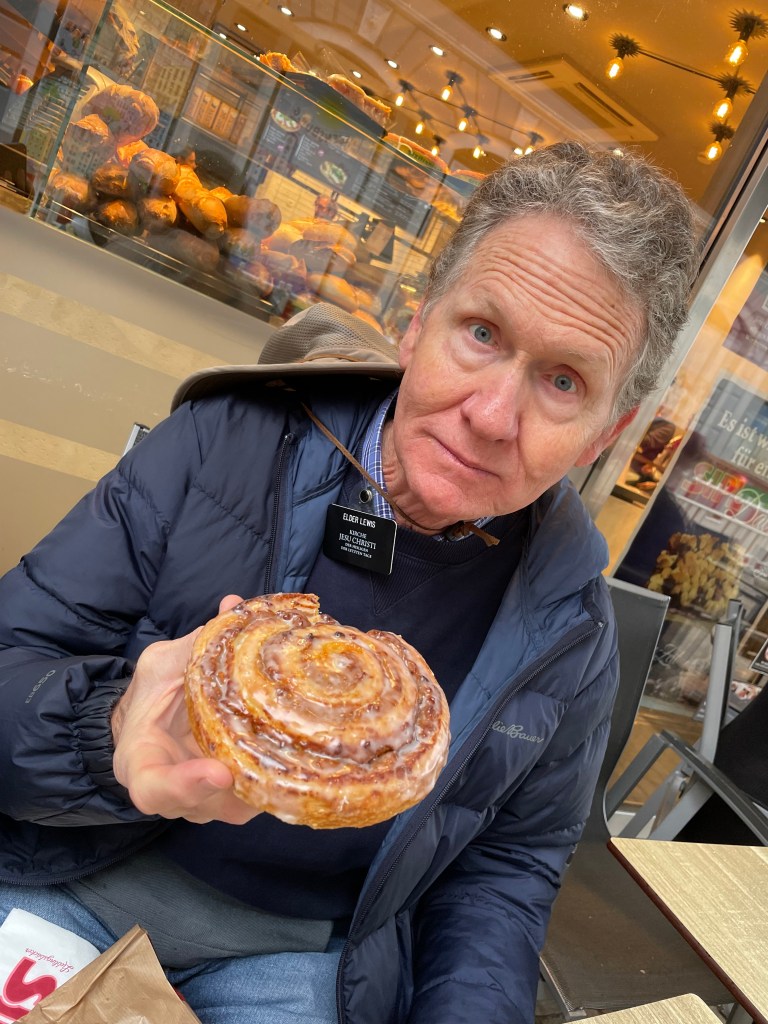
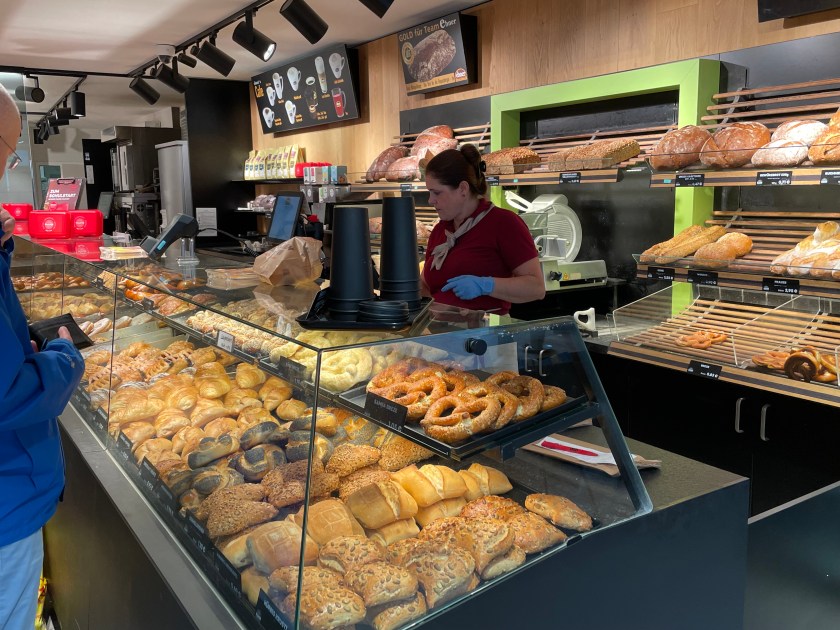
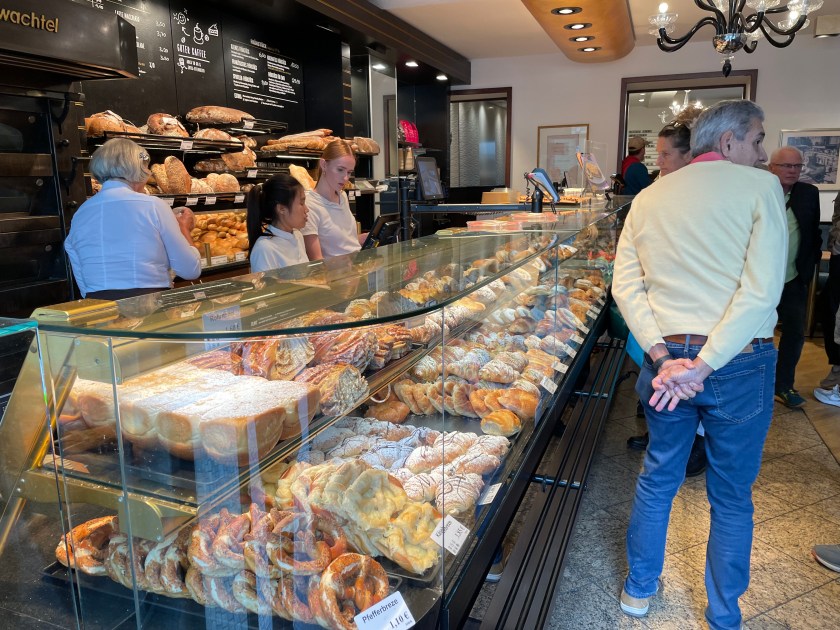
We continue our tradition of a pastry in every place we visit.

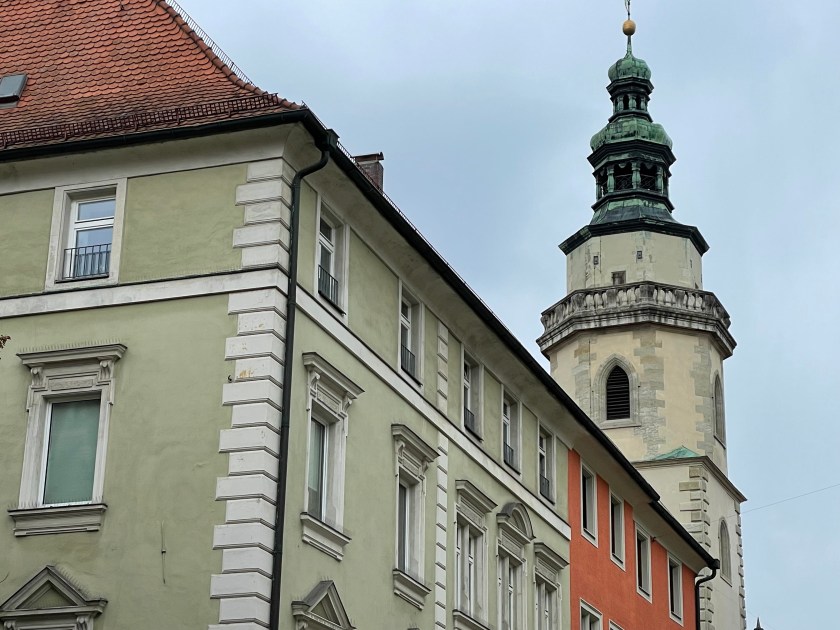
Another old church, not open yet.

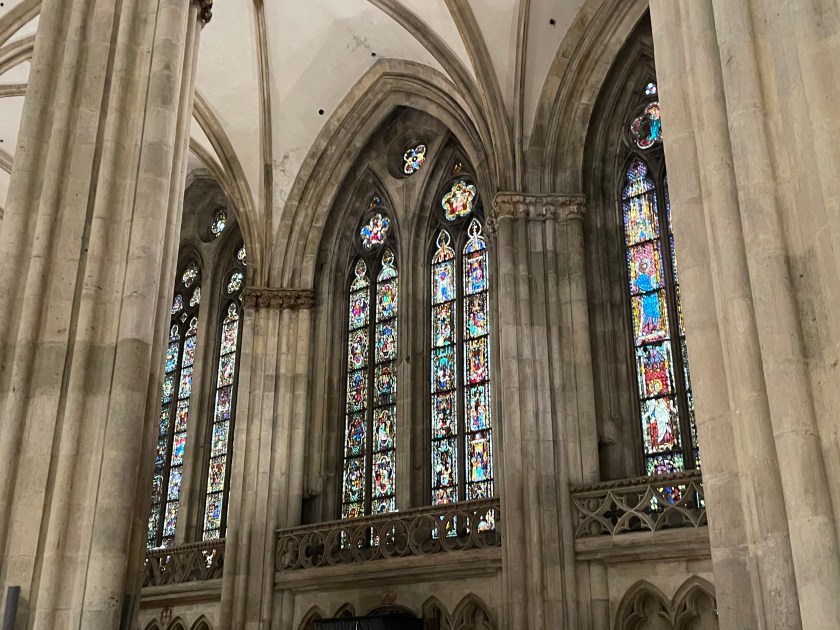
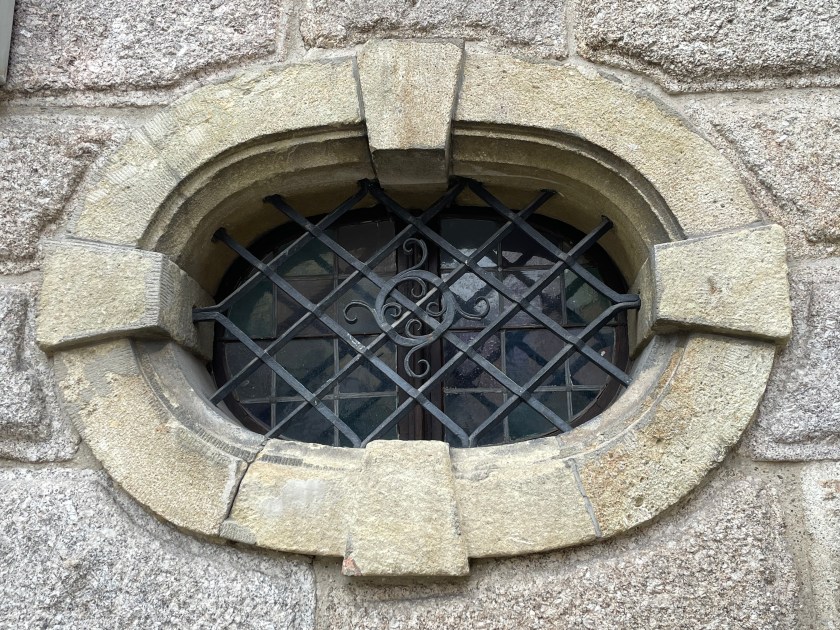
Love these interesting windows:

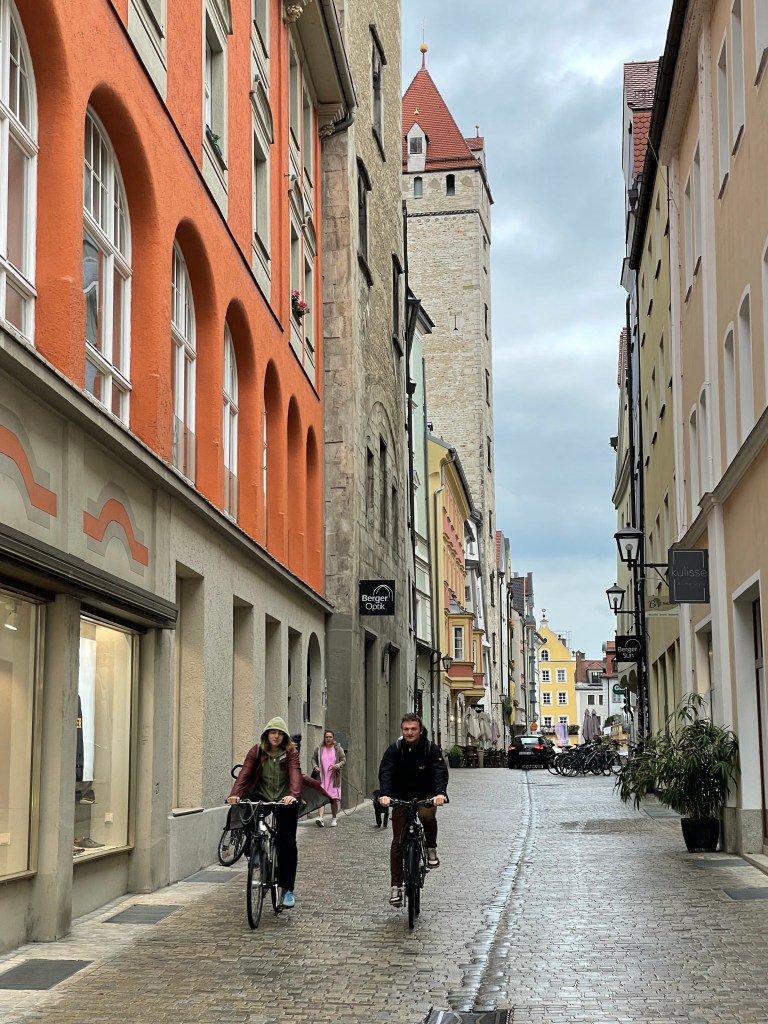
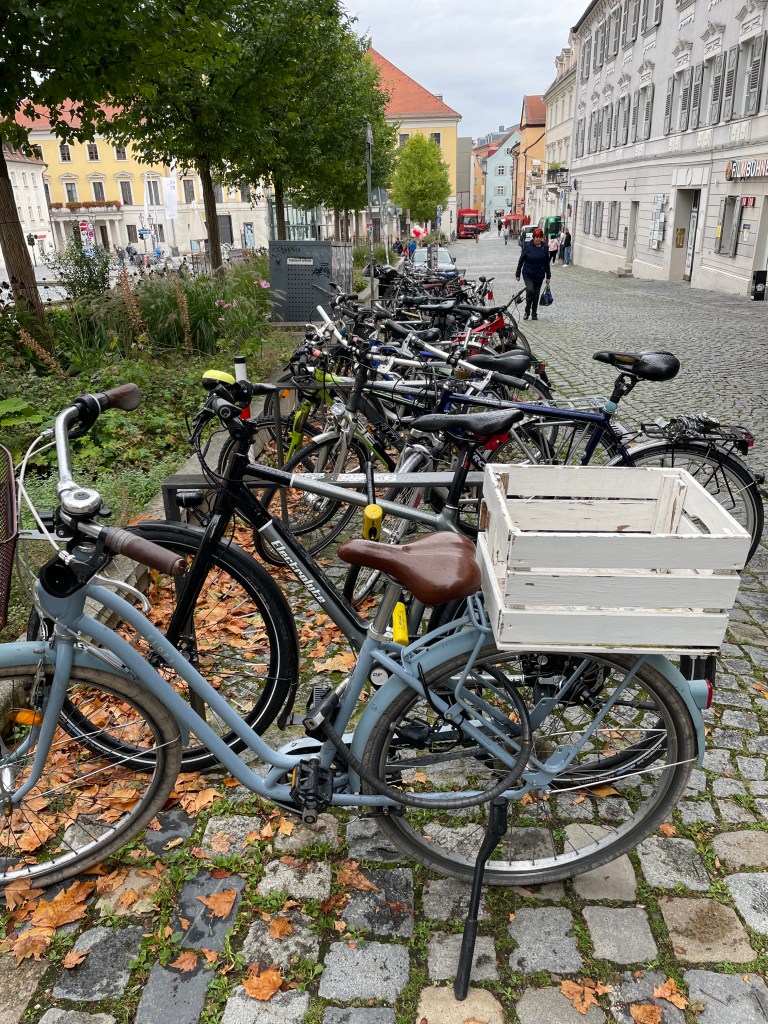
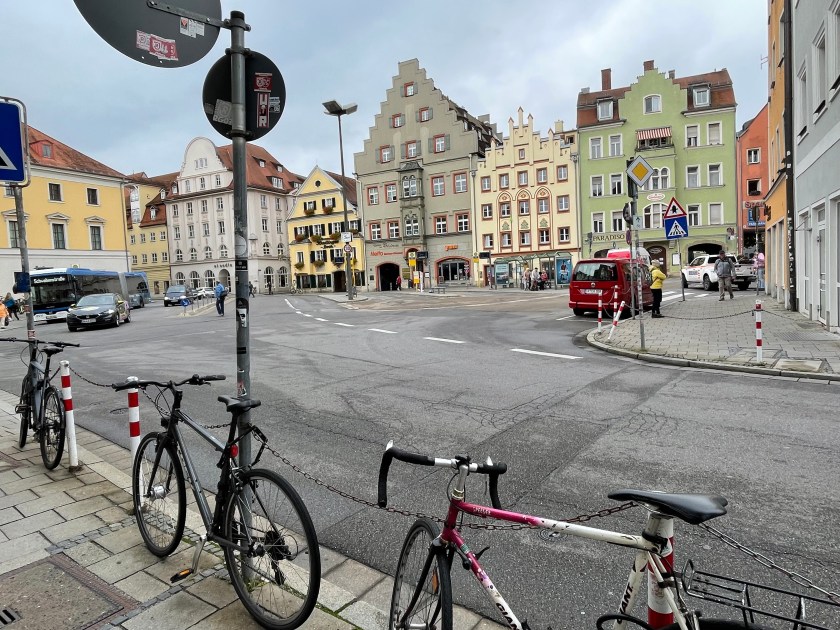
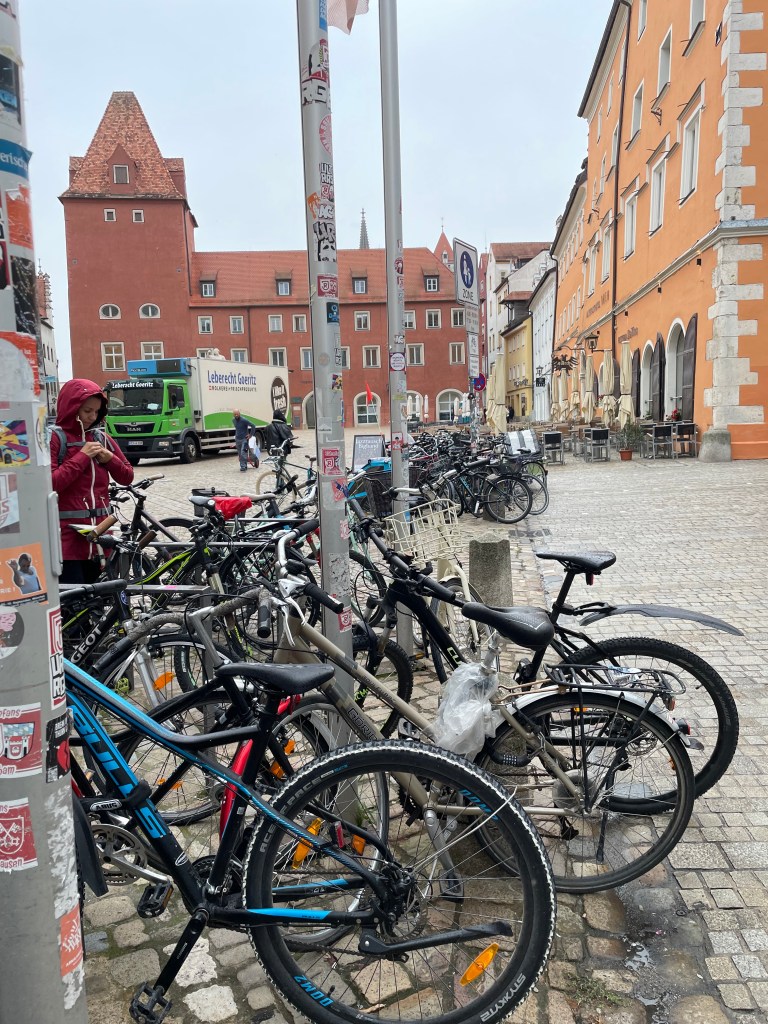
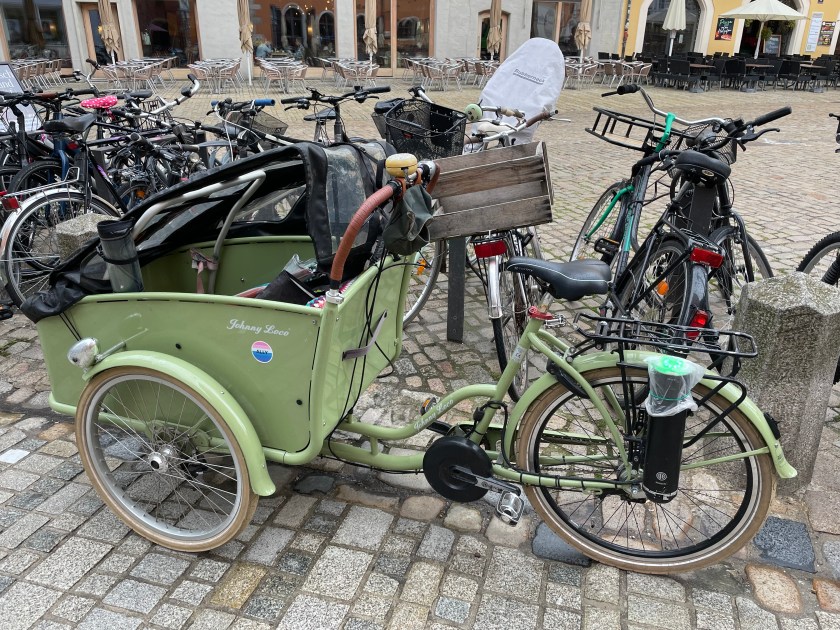
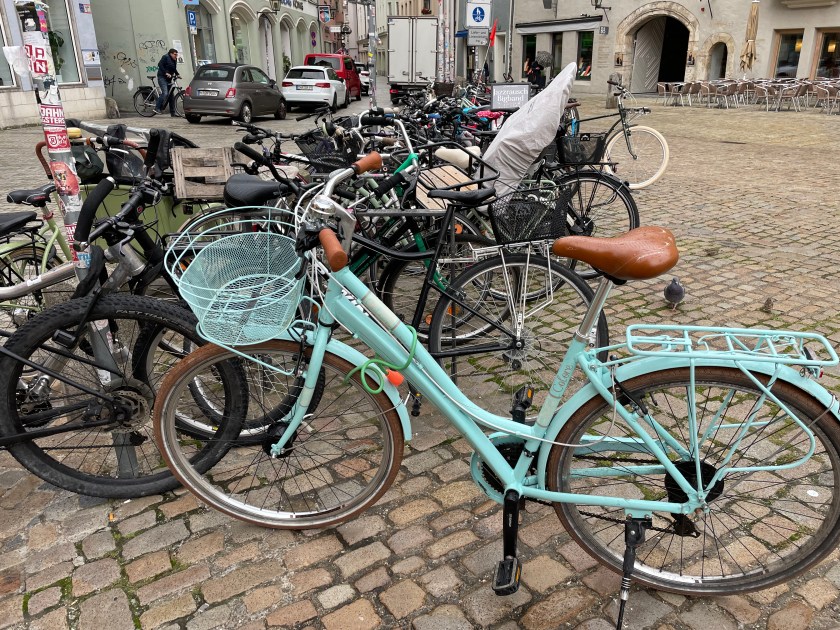
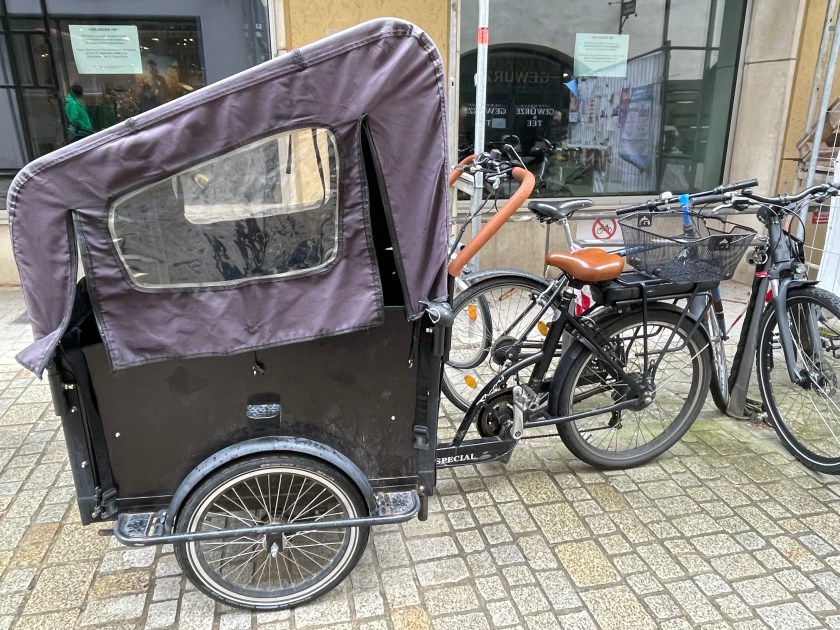
And I love all the bicycles in town!

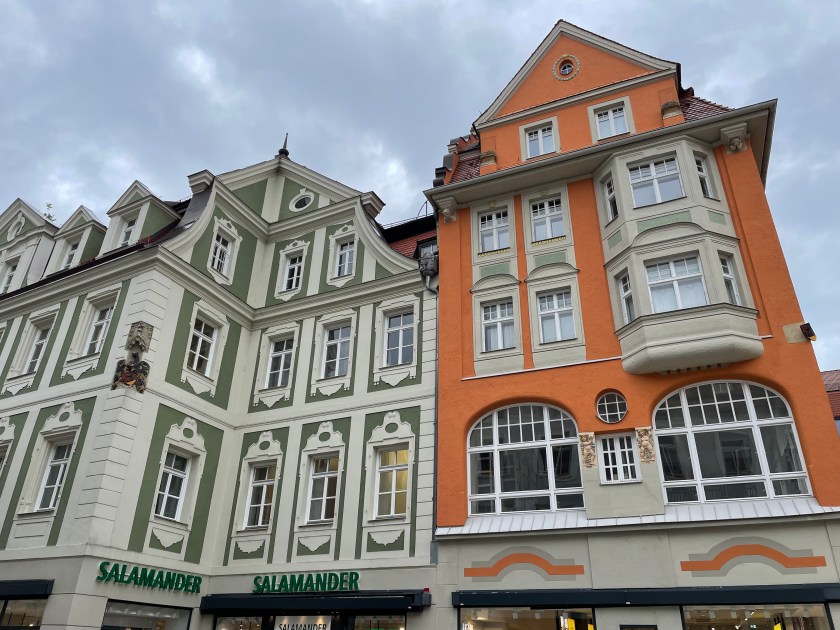
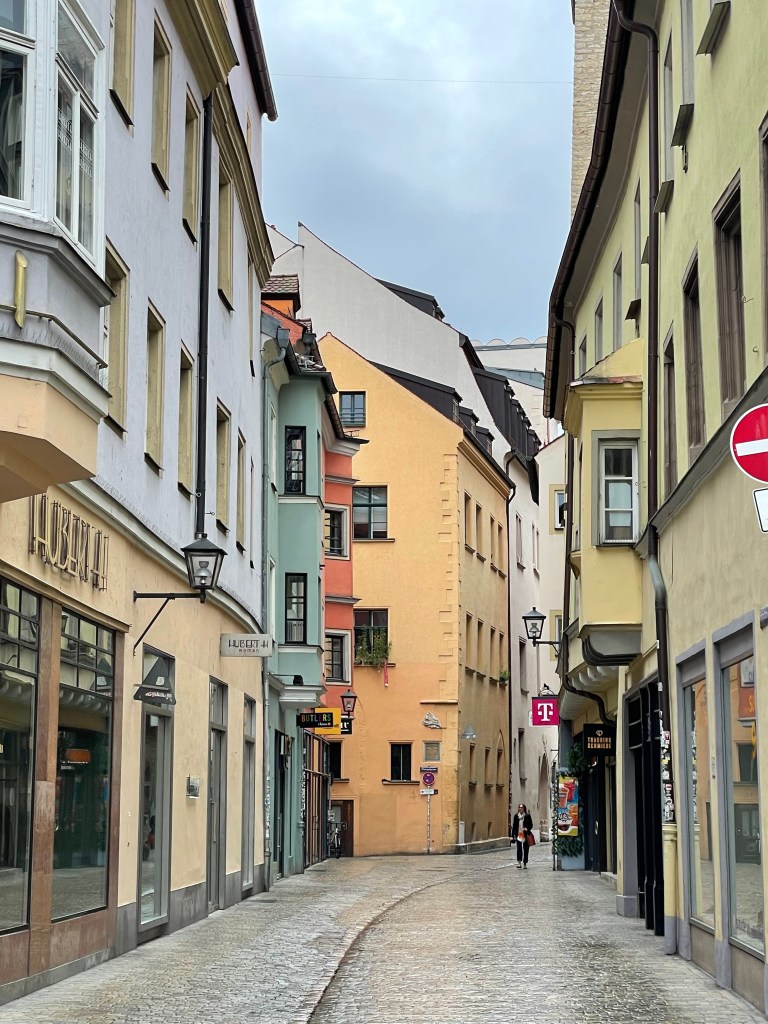
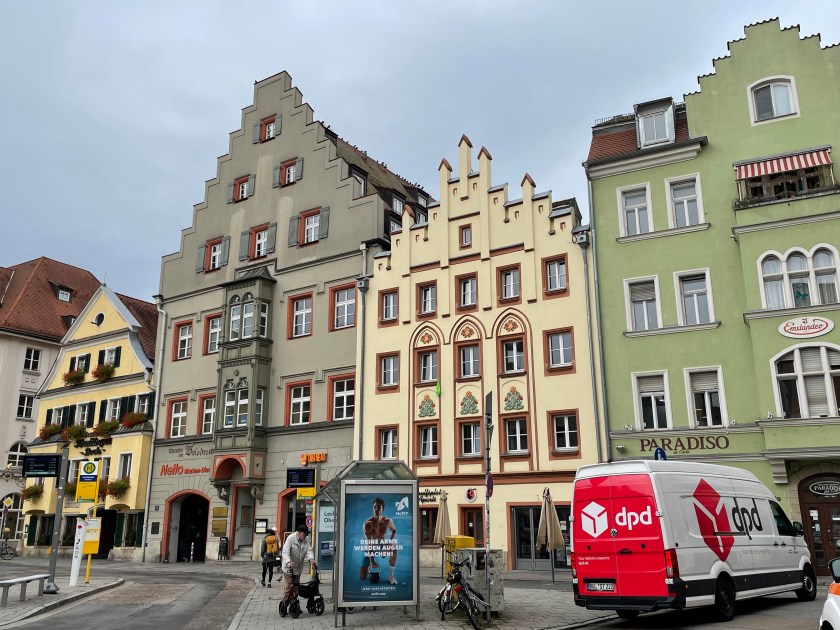
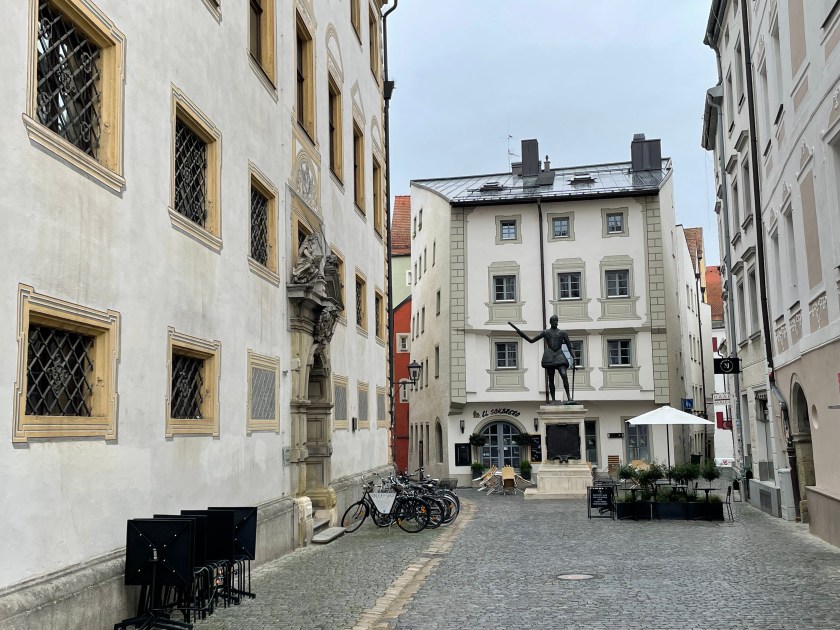
The pastel colors of the buildings seem just right.

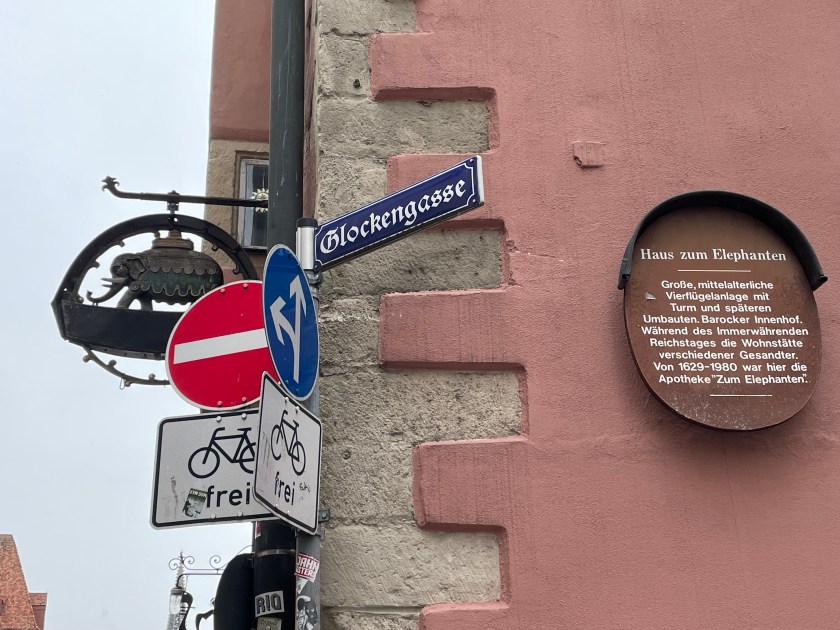
Many homes or former residences have historical markers on them telling us when the home was built and who lived there.

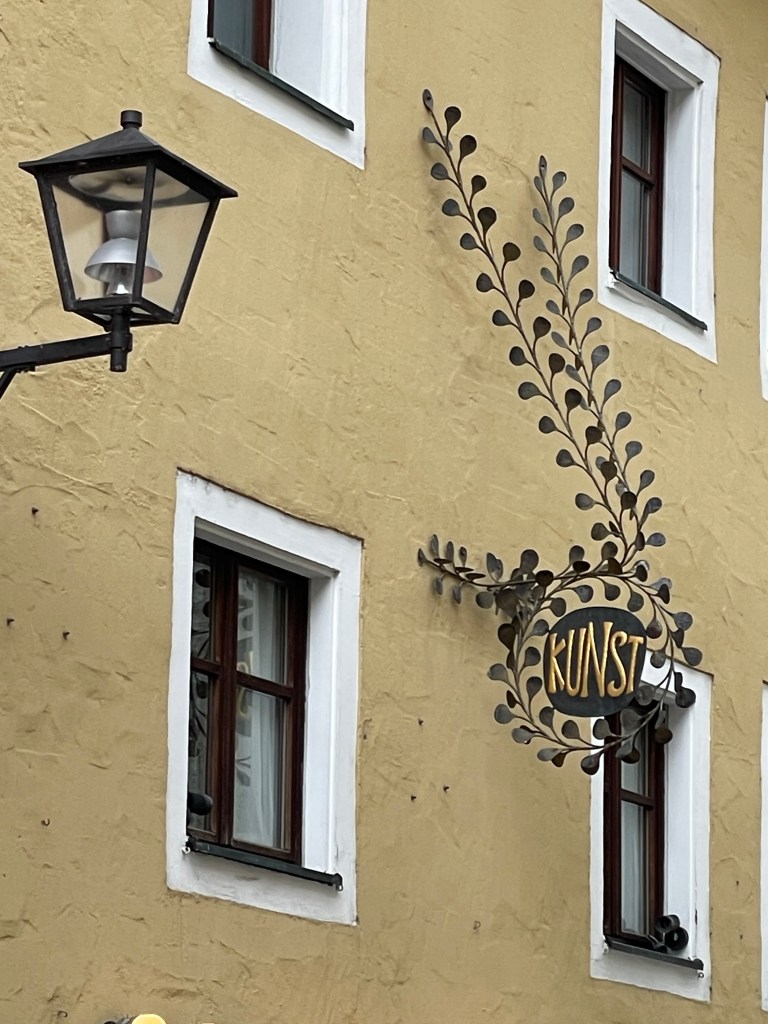
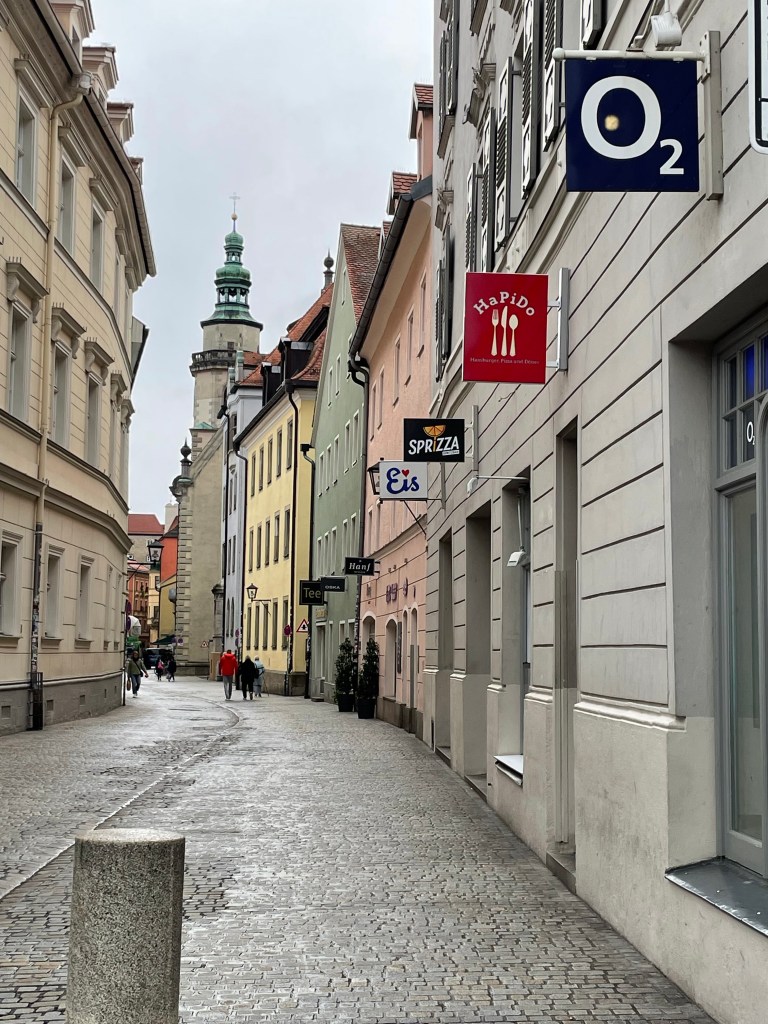
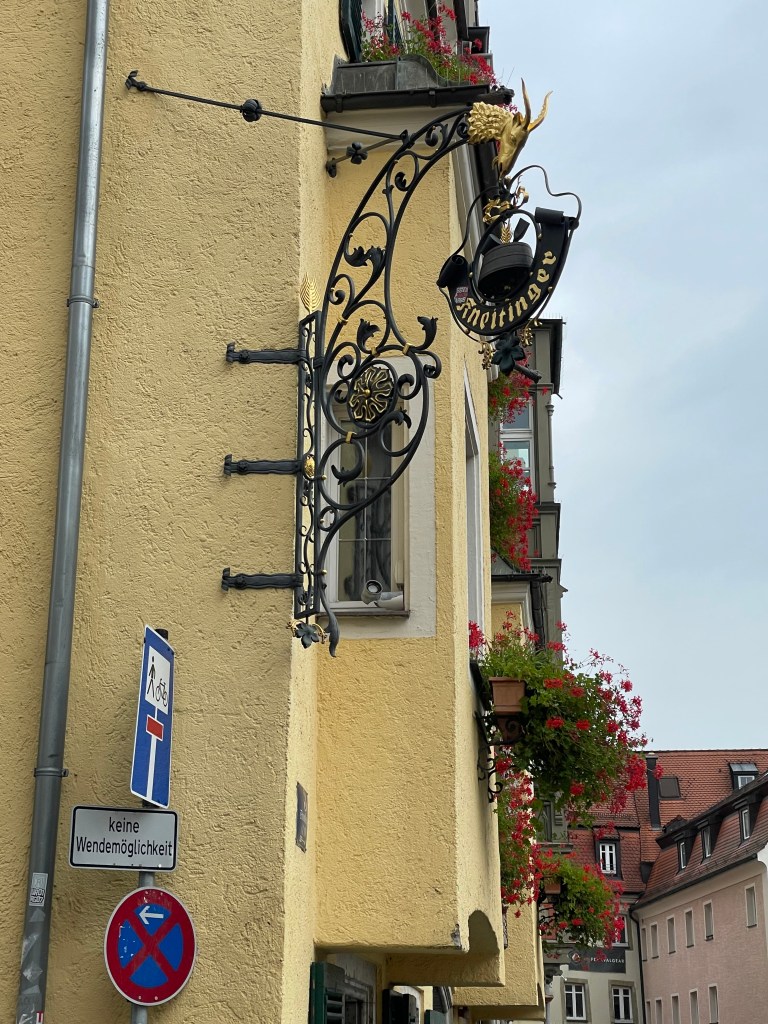
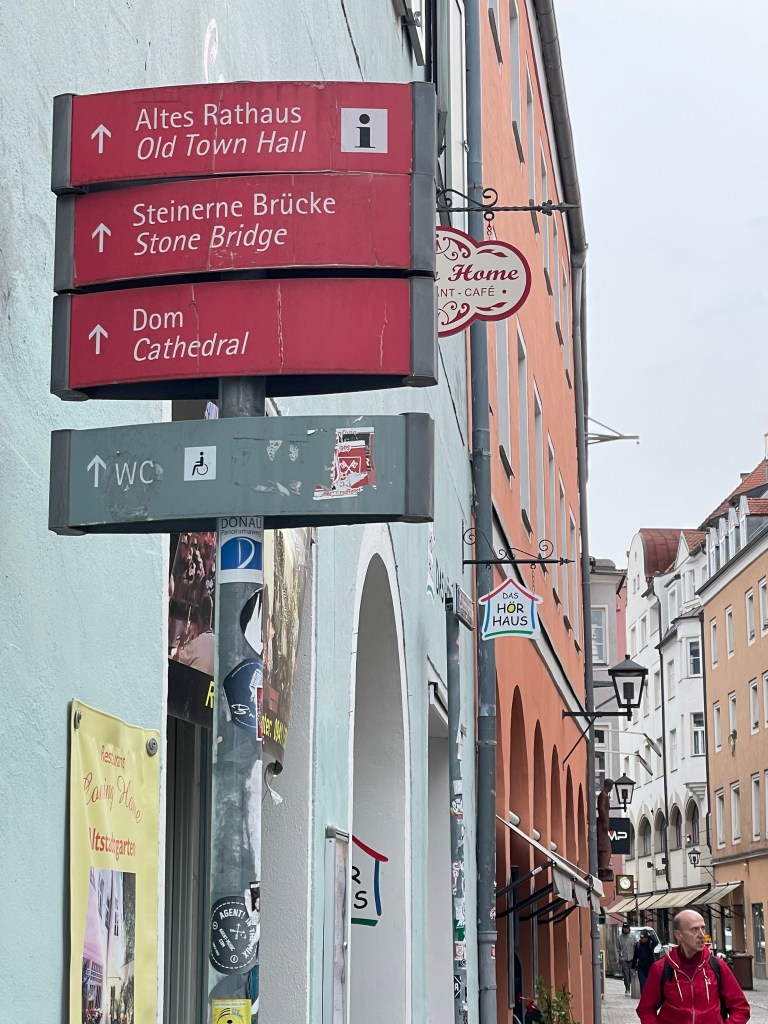
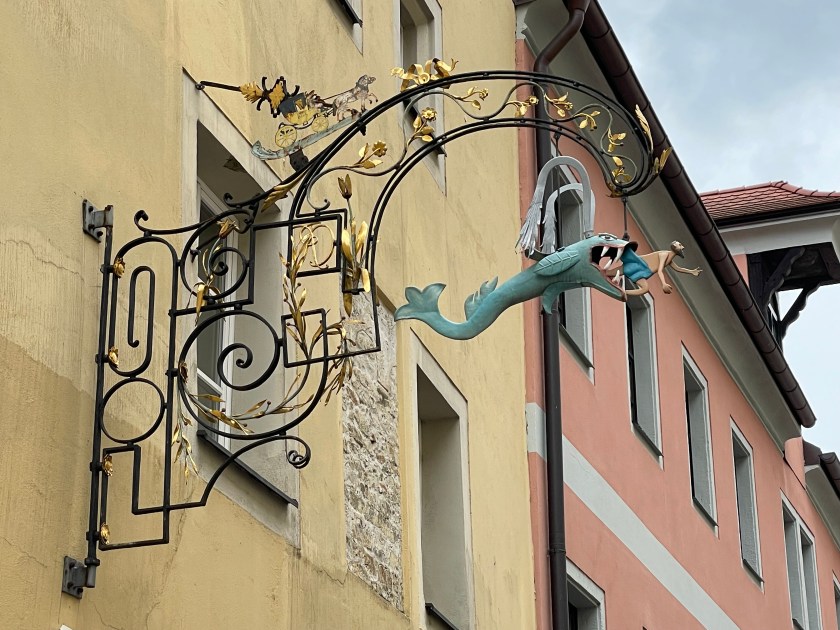
The shop signs are always interesting.

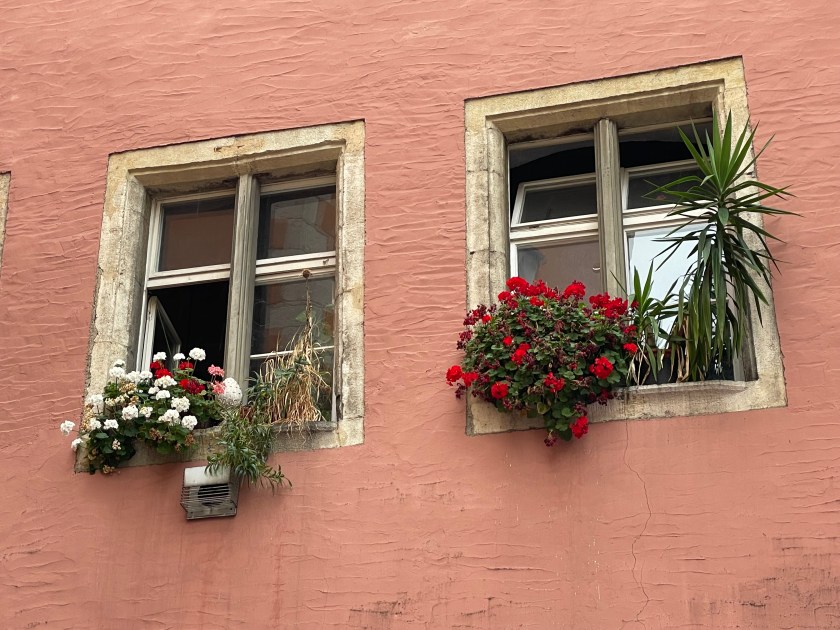
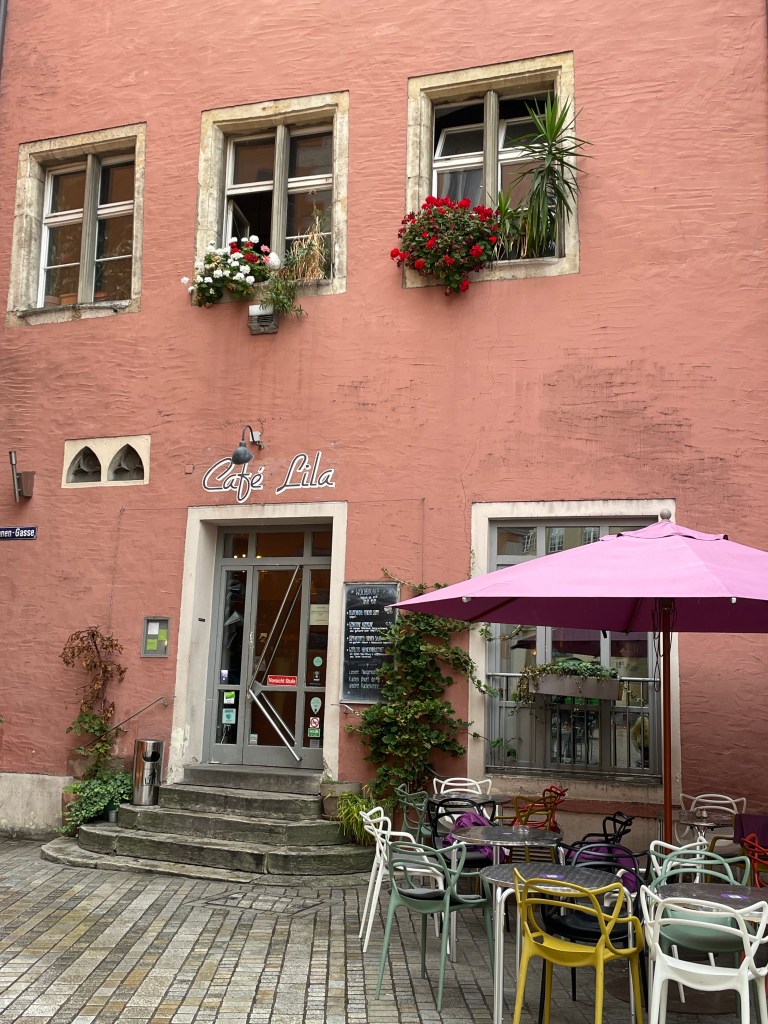
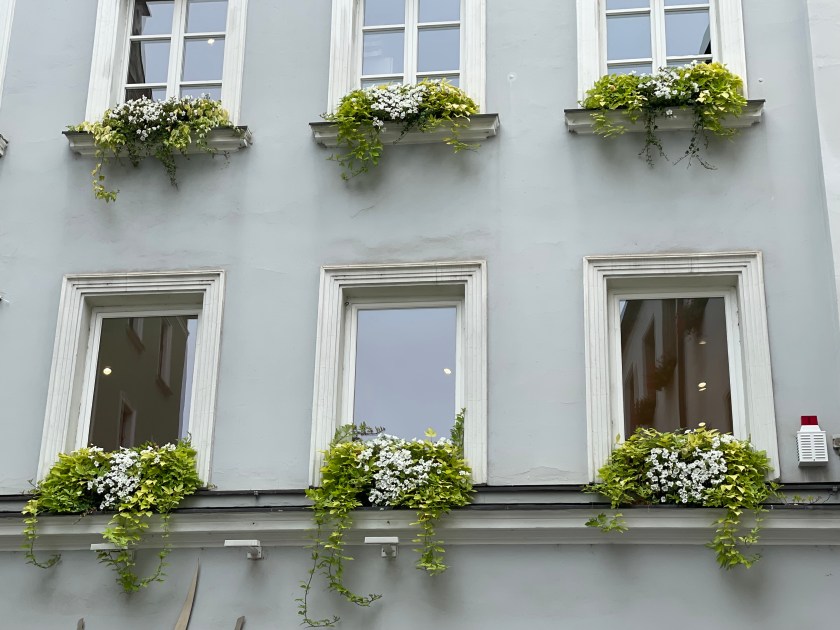
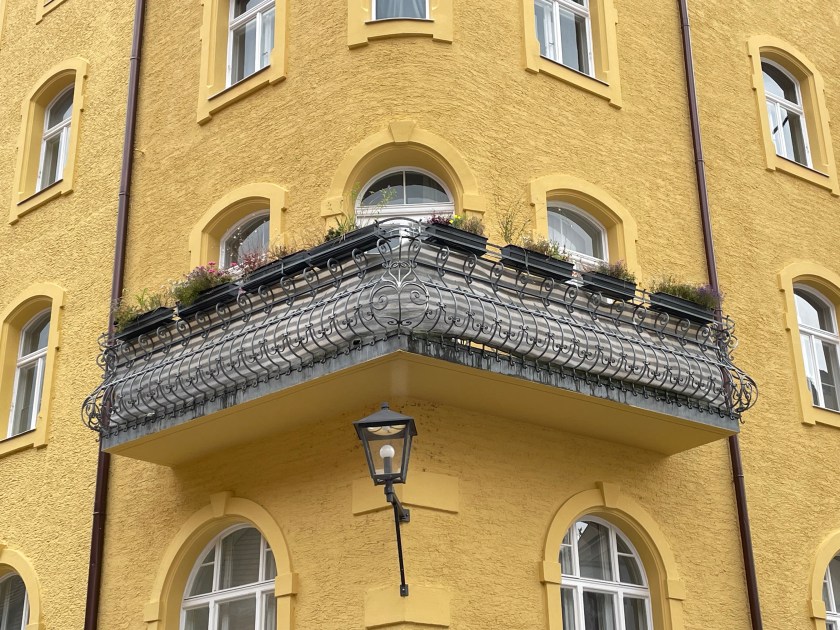
And the flower boxes and shutters are charming.

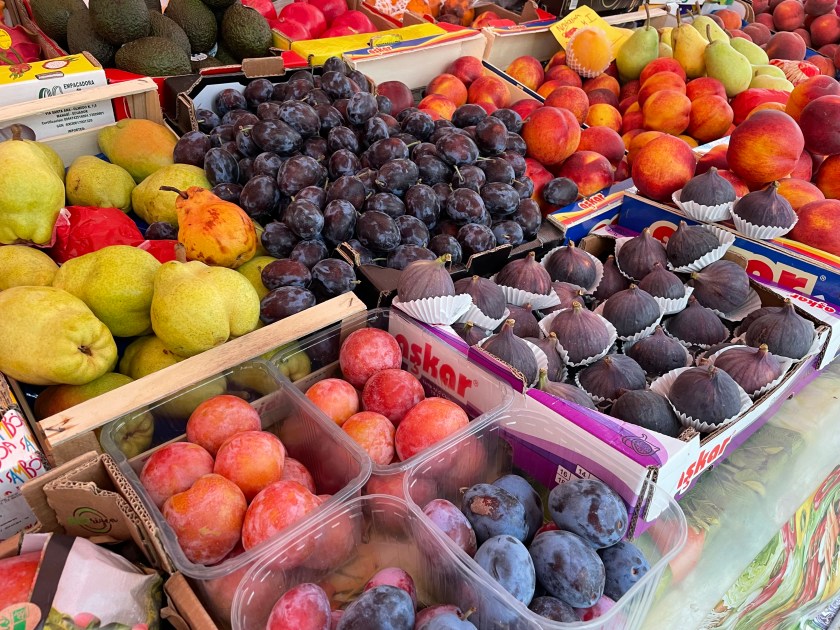
I usually pick some Pflaumenkuchen when it’s Zwetschgen season (Italian plums).  We had a tree at home when I was growing up.  Grandma Elsa always baked Pflaumenkuchen in the fall.

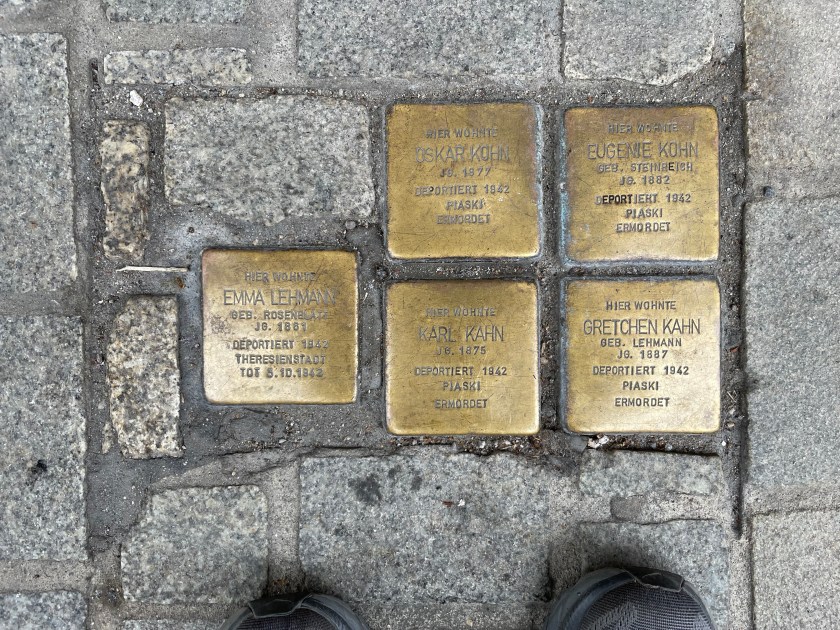
More Stolpersteine, and always a pause to REMEMBER.

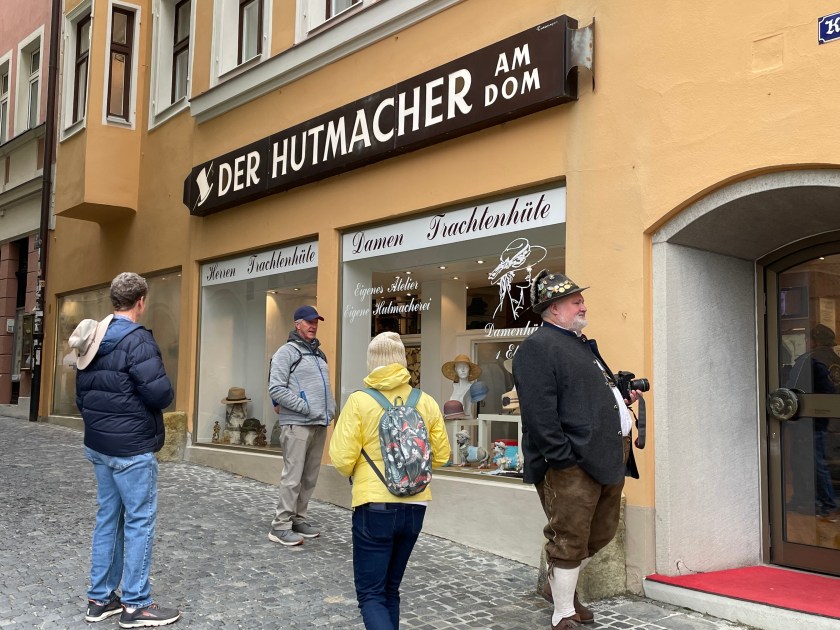
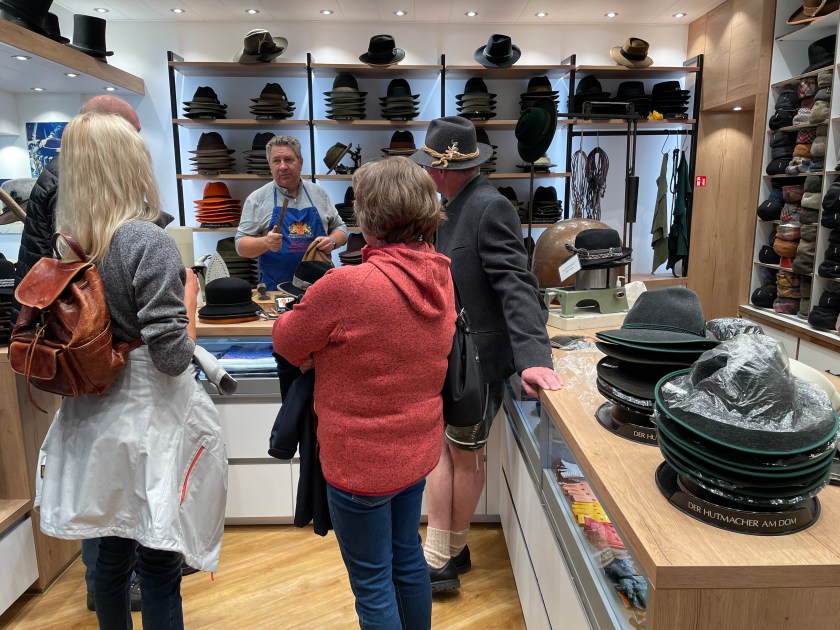
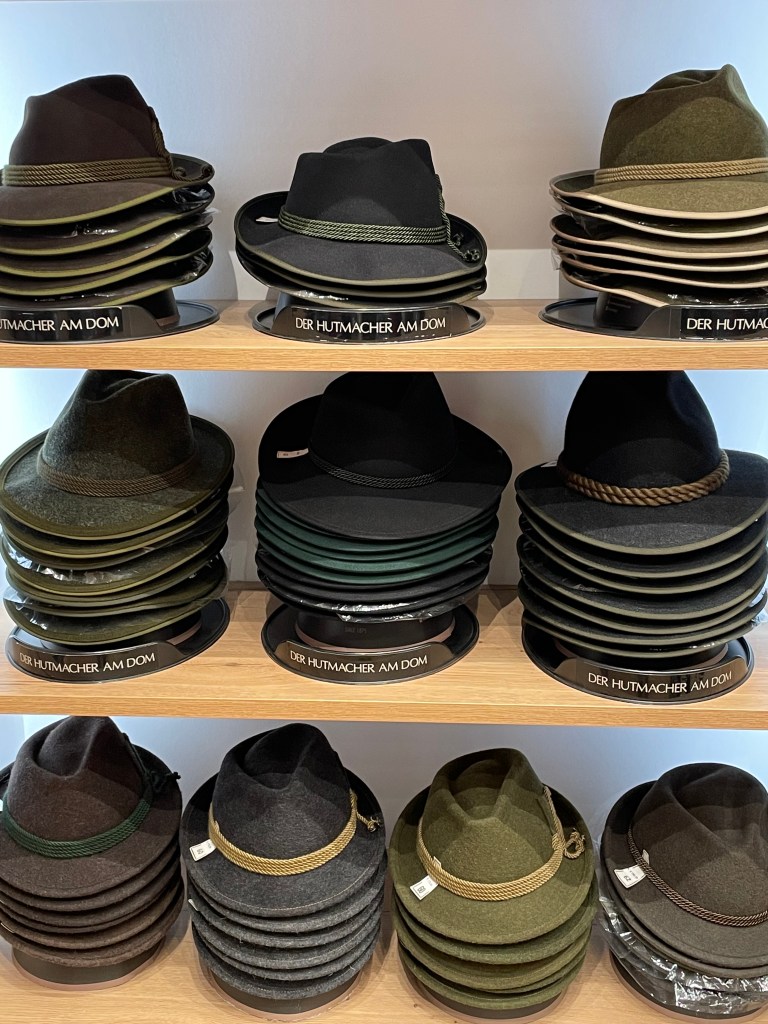
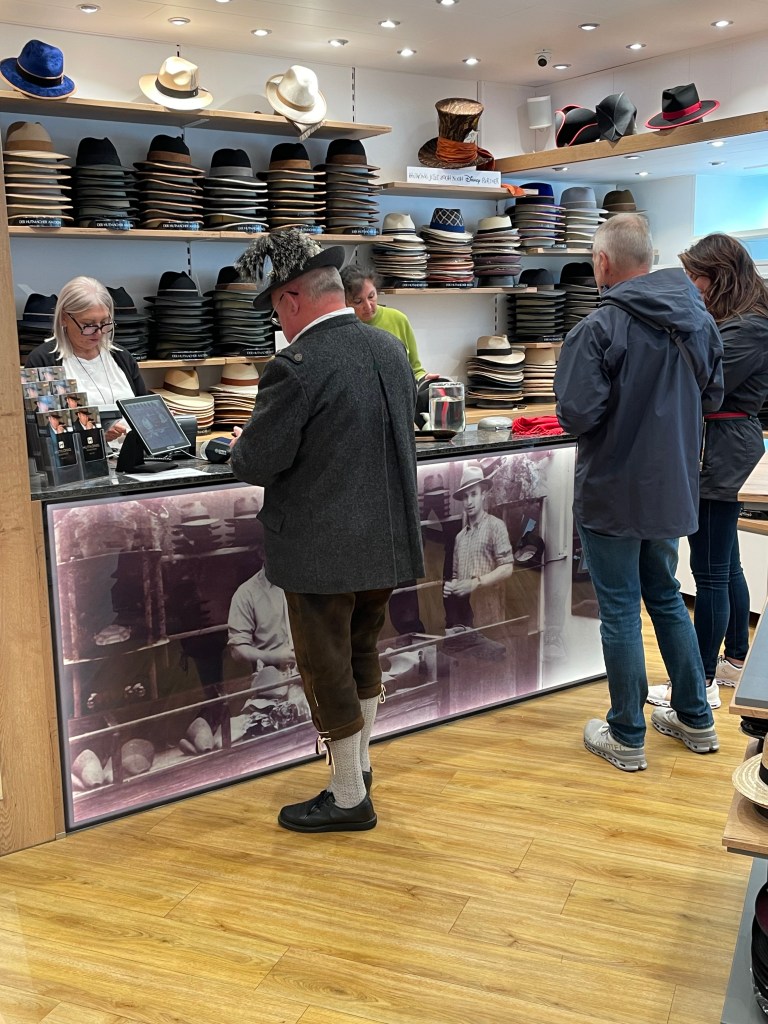
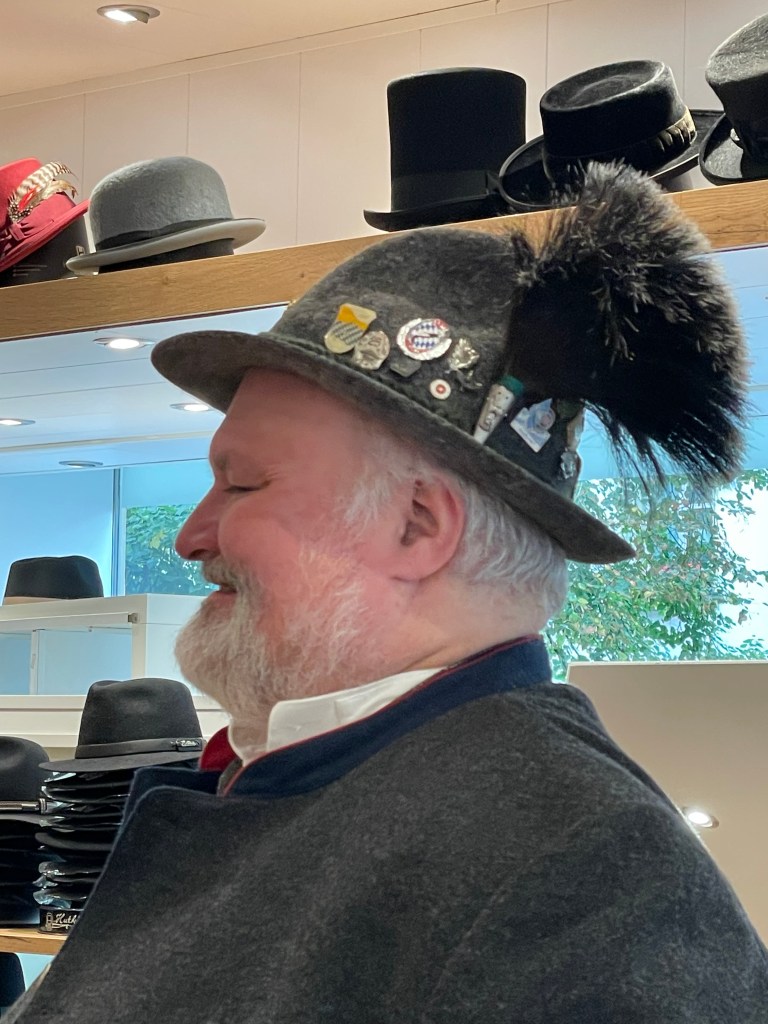
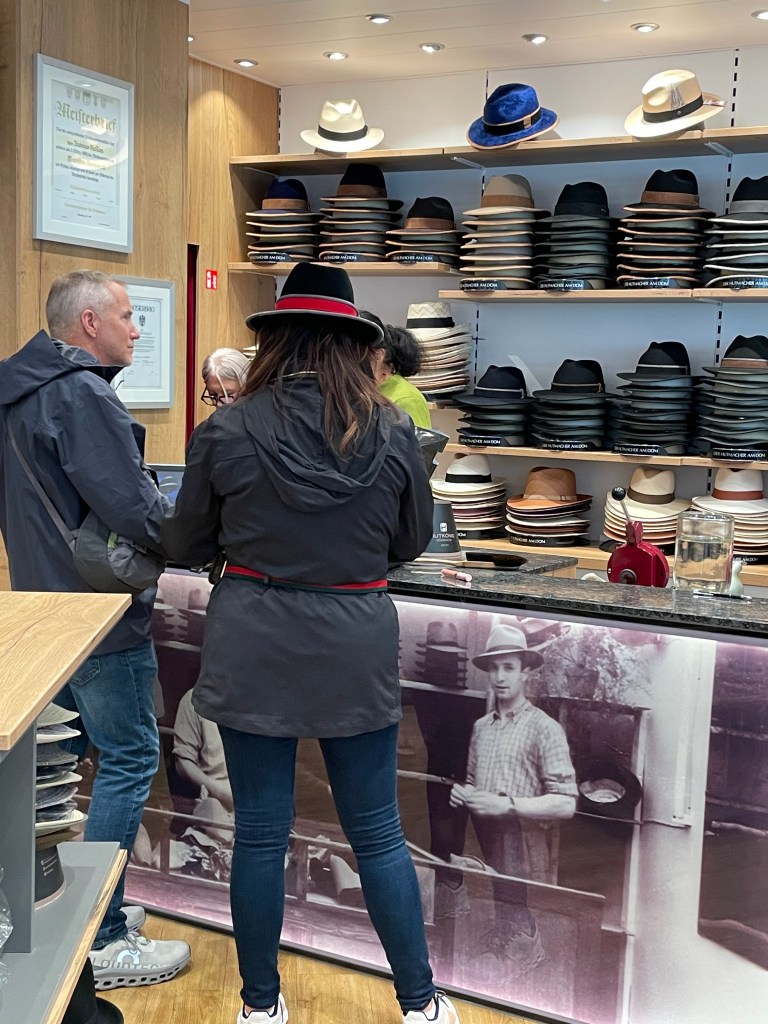
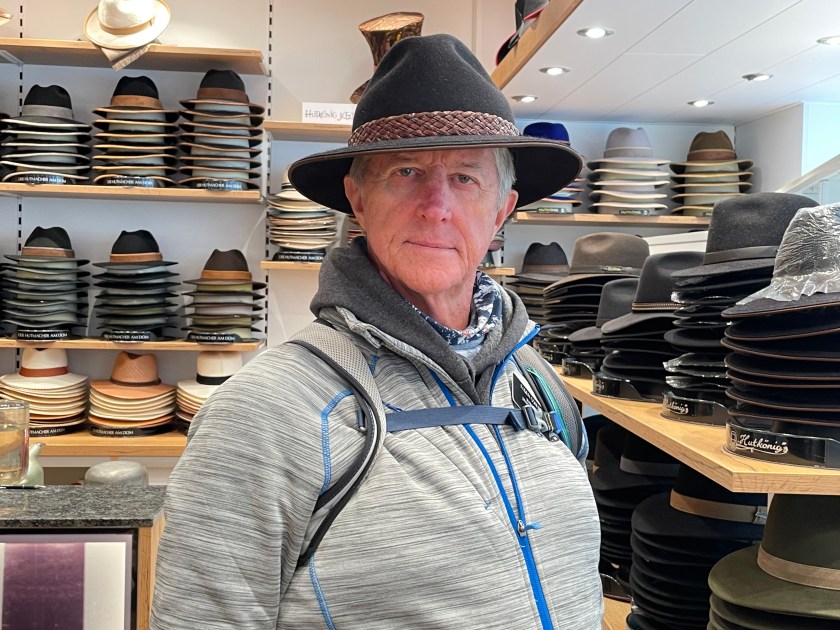
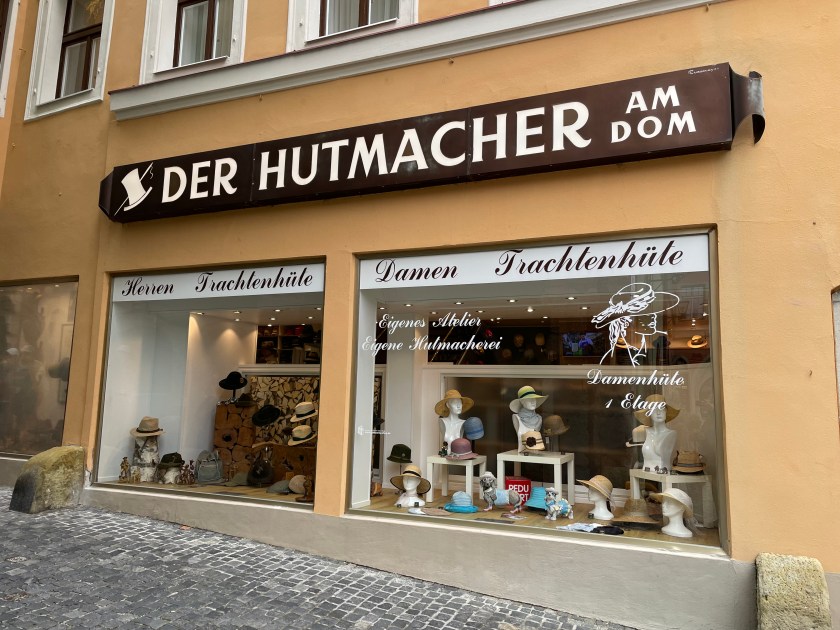
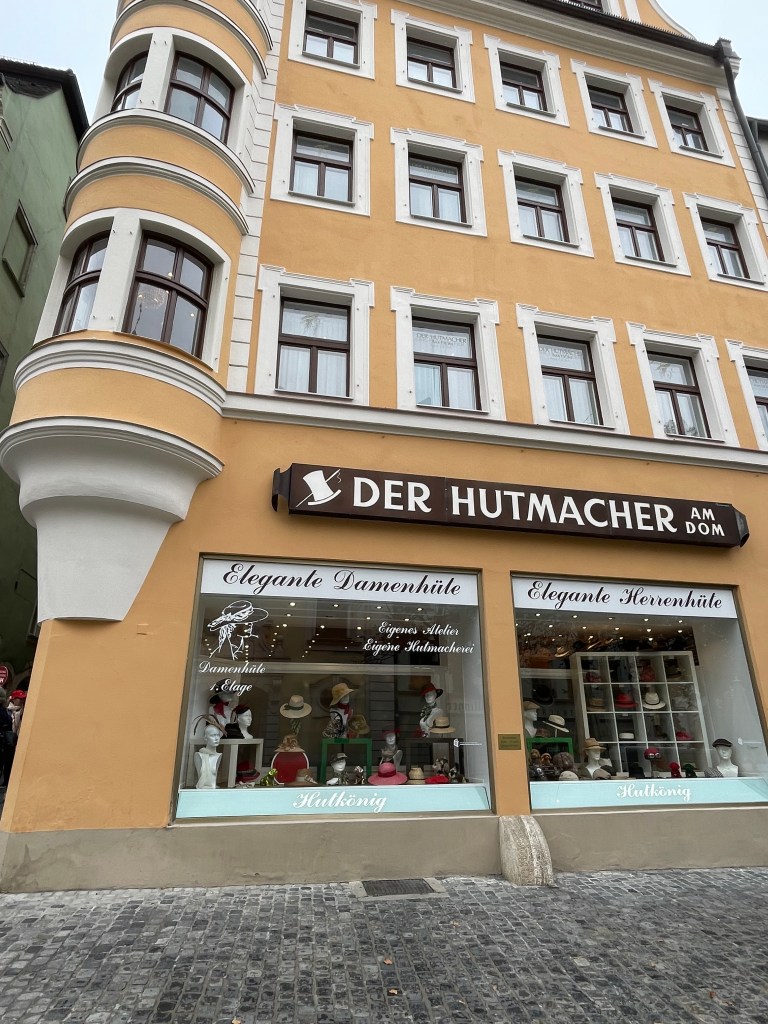
Across the cobblestone street from the Dom is this famous Hat Shop.  People come from all over to buy their hats here.  The Madhatter’s hat in Alice in Wonderland was made here.

On the shelf in the middle is the famous Alice in Wonderland hat.

We went into the Dom and the other grand churches here.  I’ll show those in the next post.

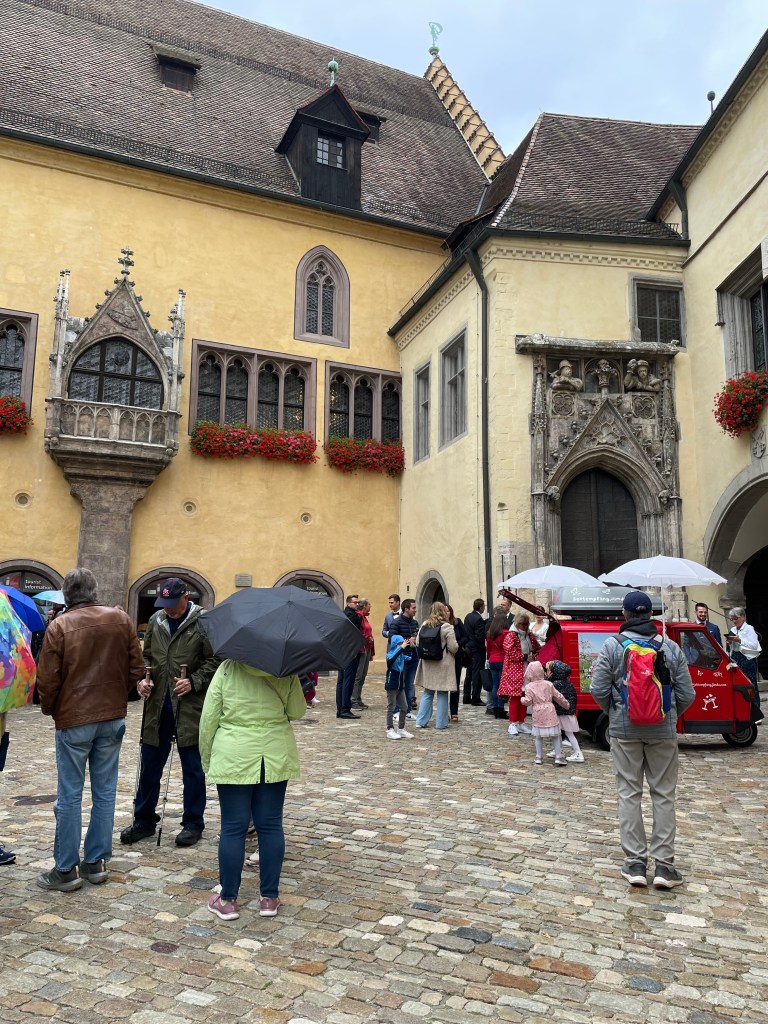
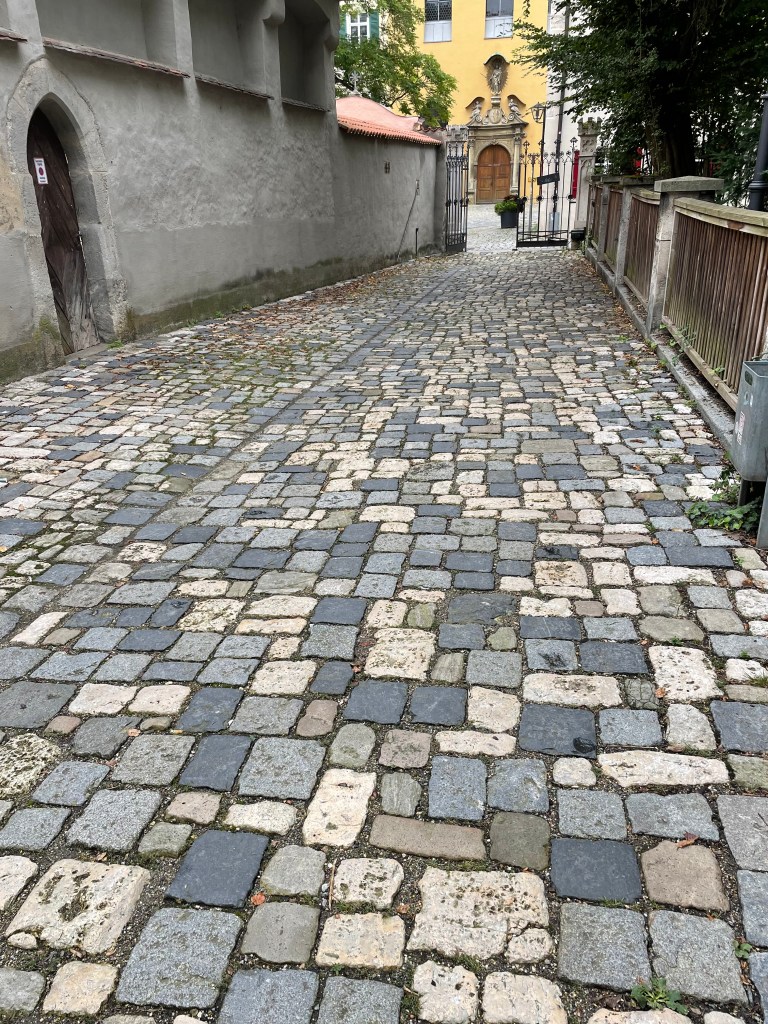
The cobblestones are like patch quilts.  I especially love it when the stones are unique and individual.

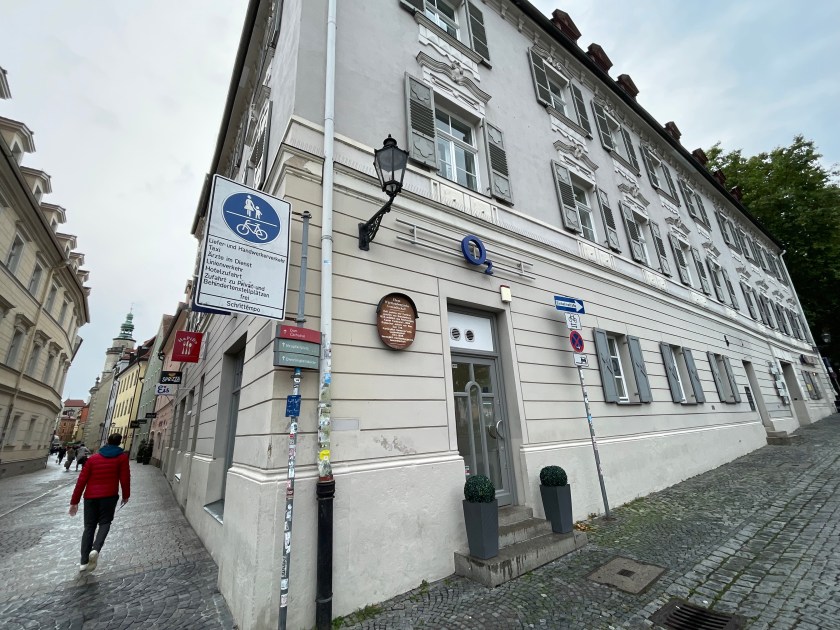
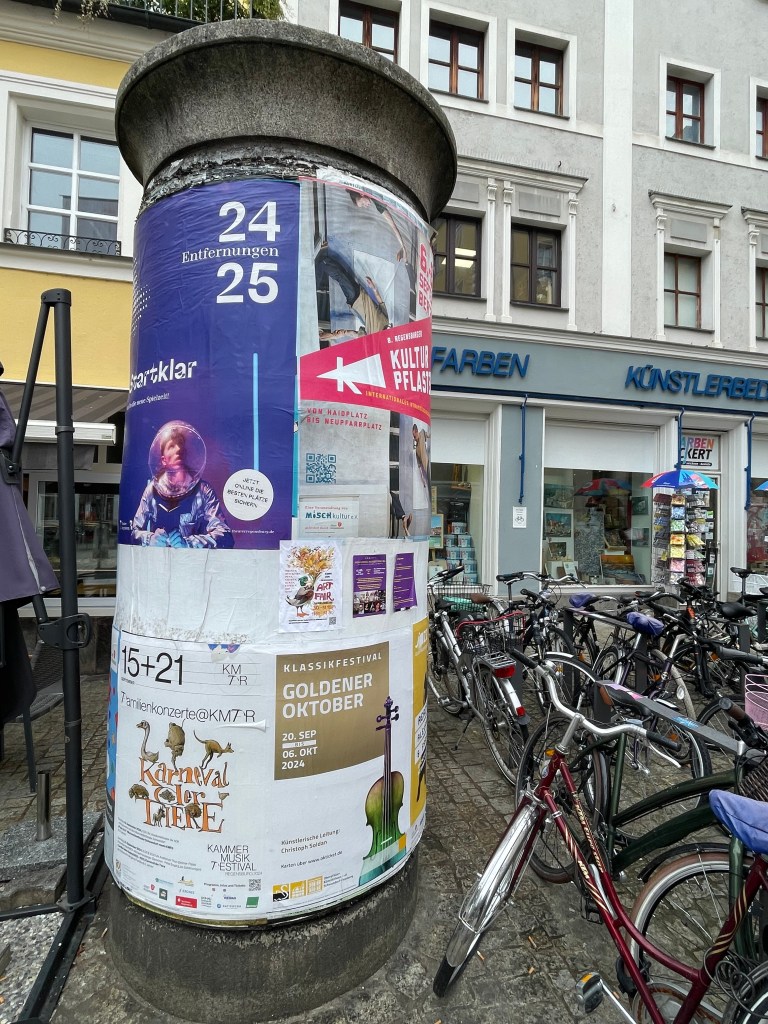
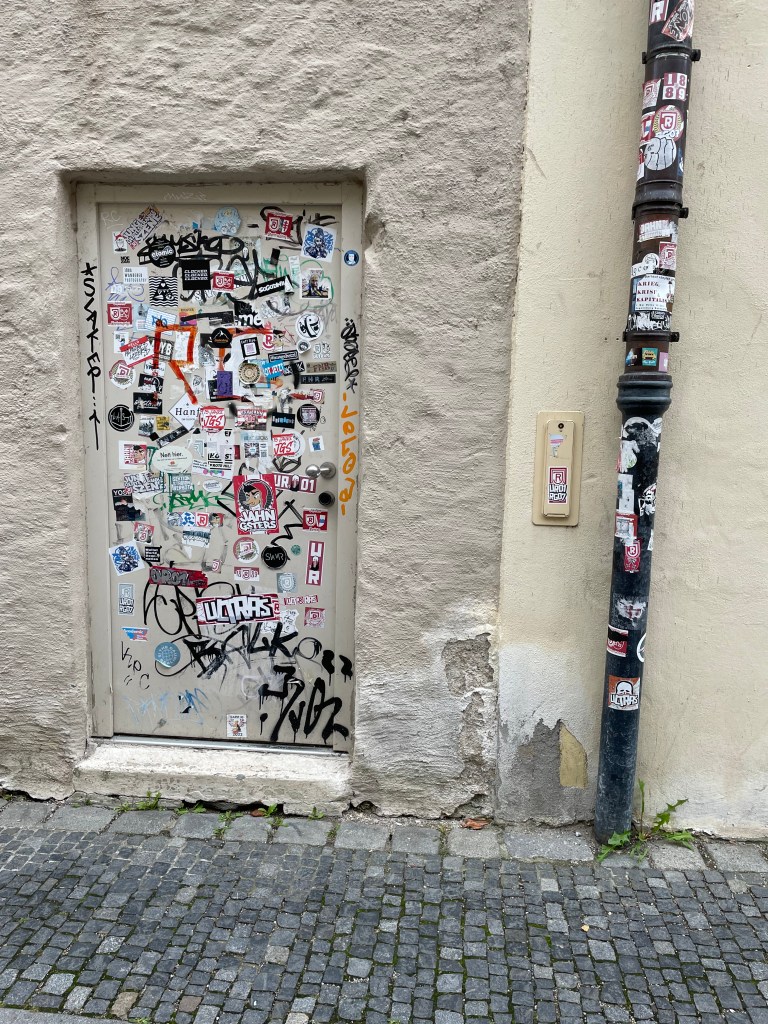
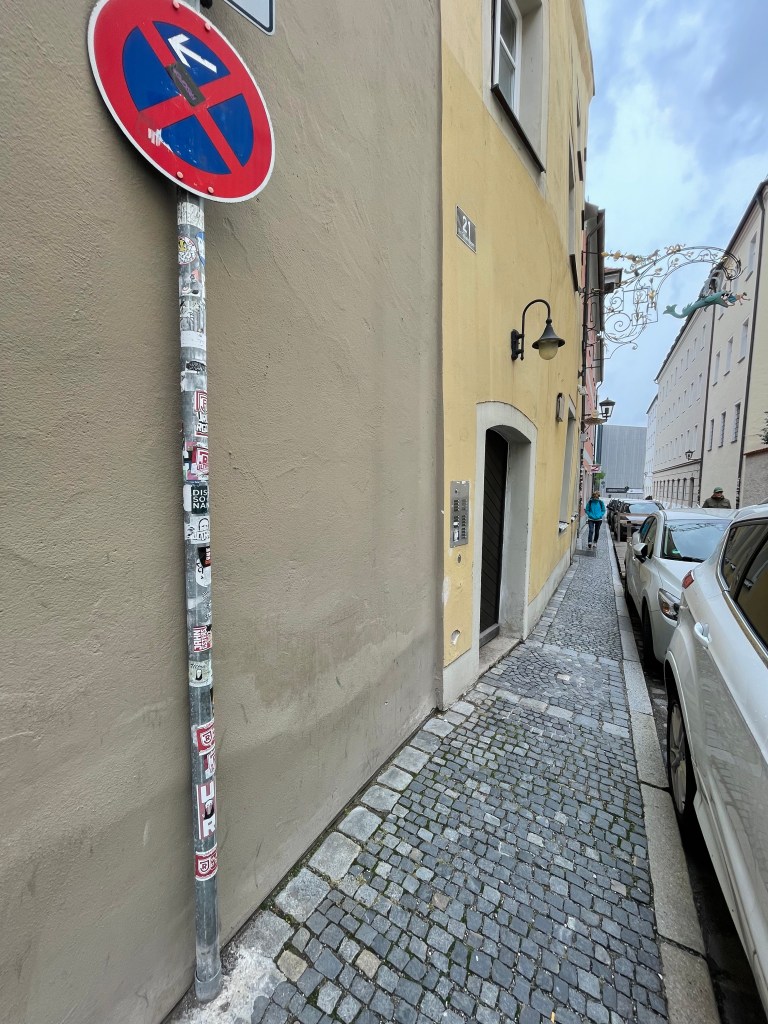
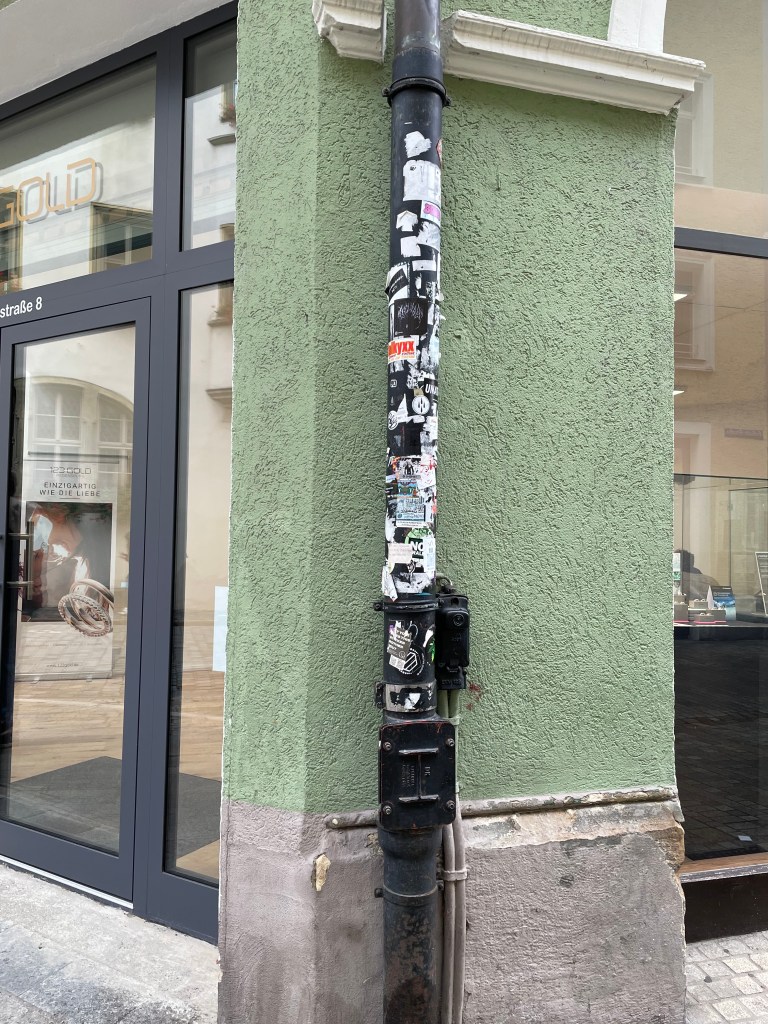
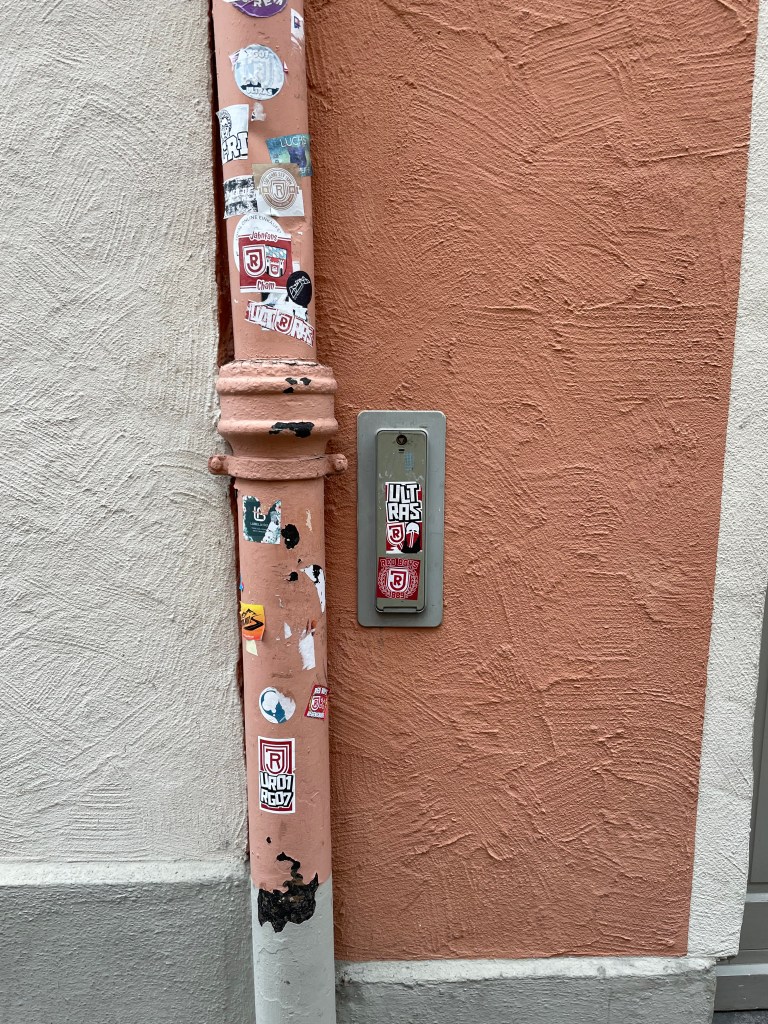
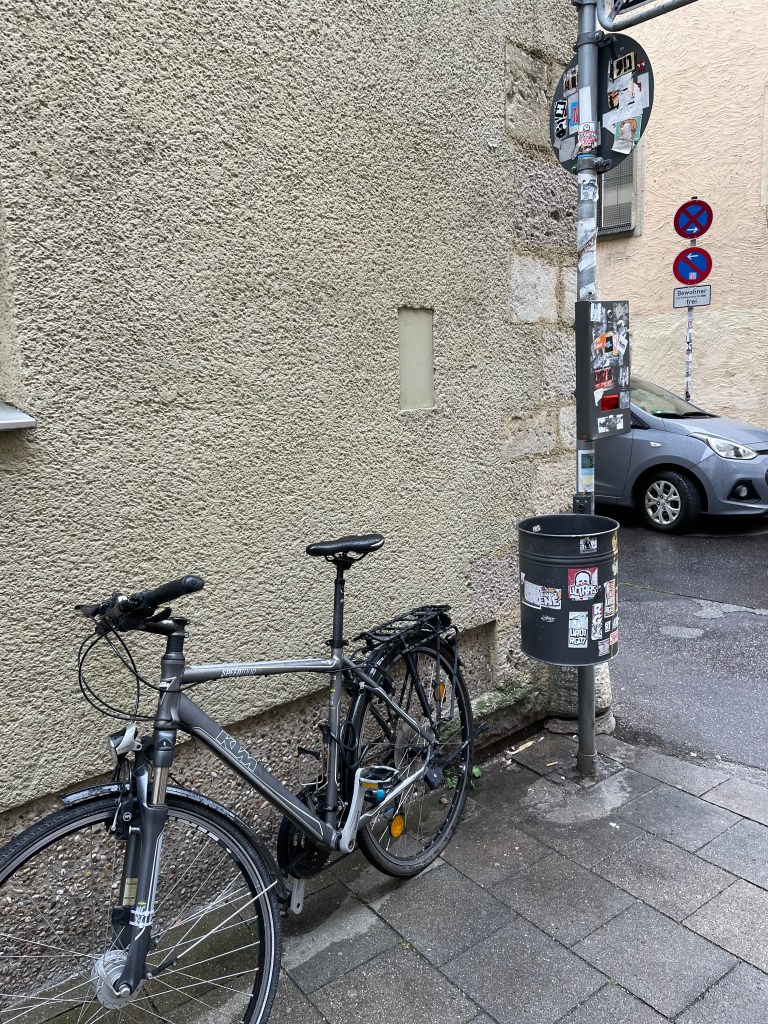
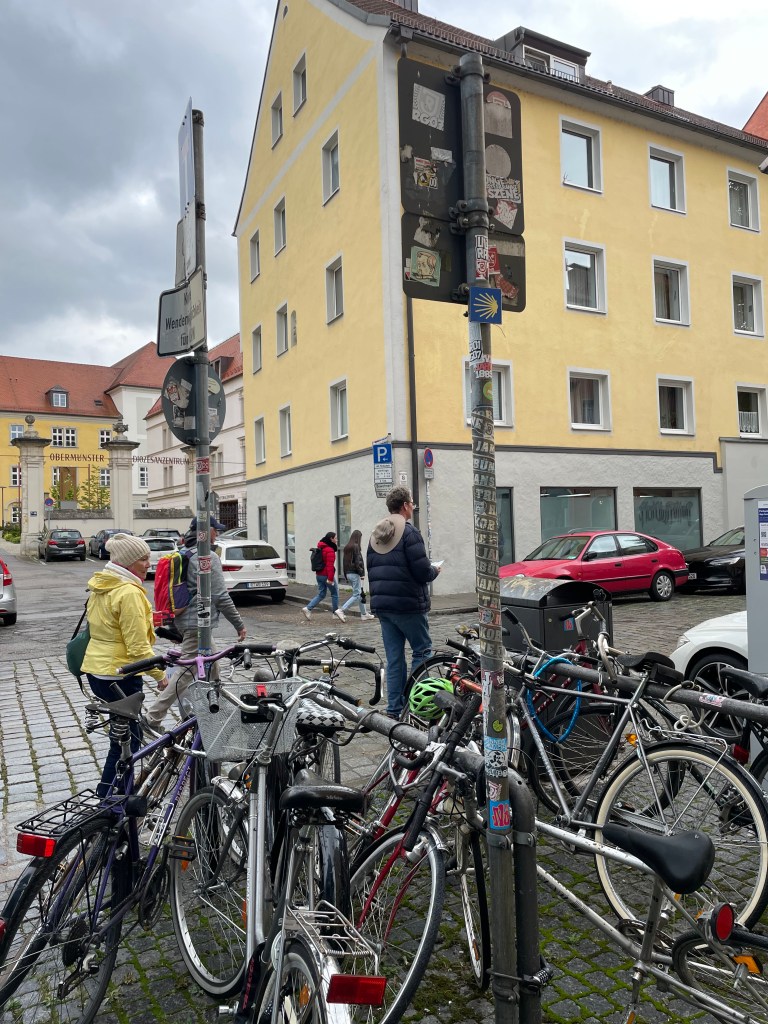
One thing Geri and I noticed here is how little graffiti we are seeing here.  Then we noticed the water pipes and sign poles.  All are plastered with stickers and messages.  There must be a rule about where you can put things.  We really enjoyed noticing the stickers after that.

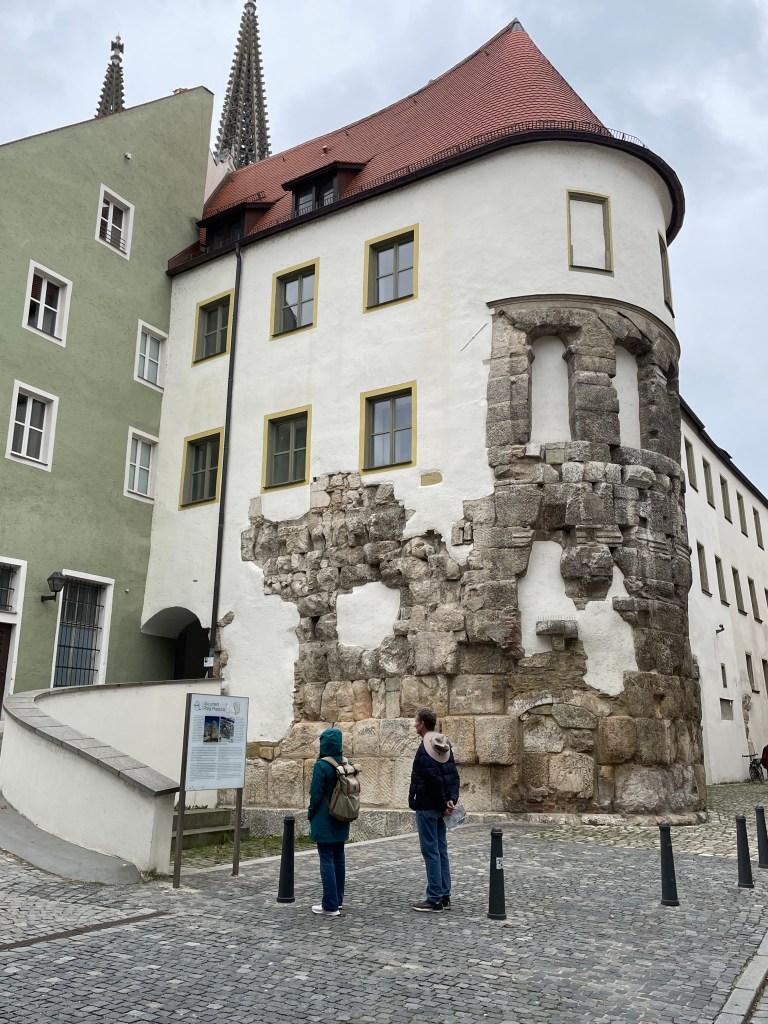
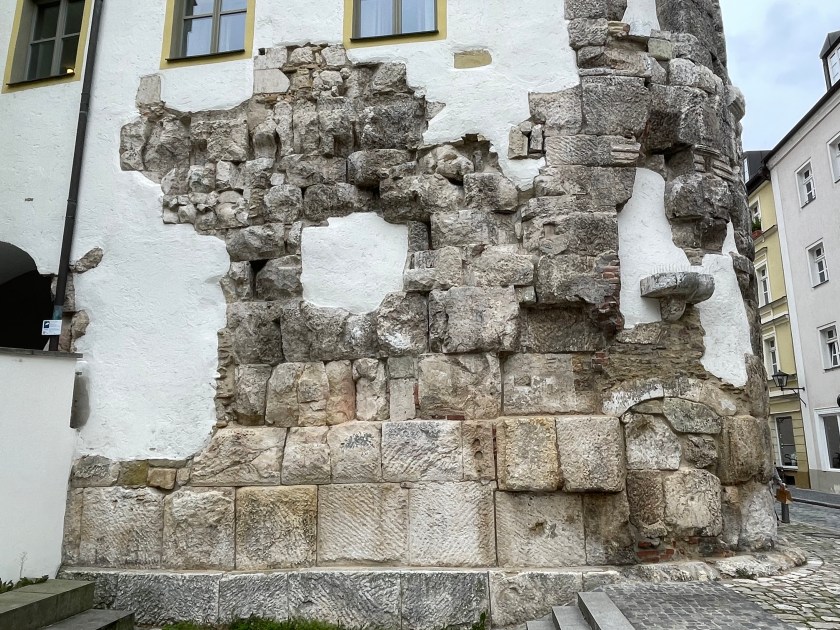
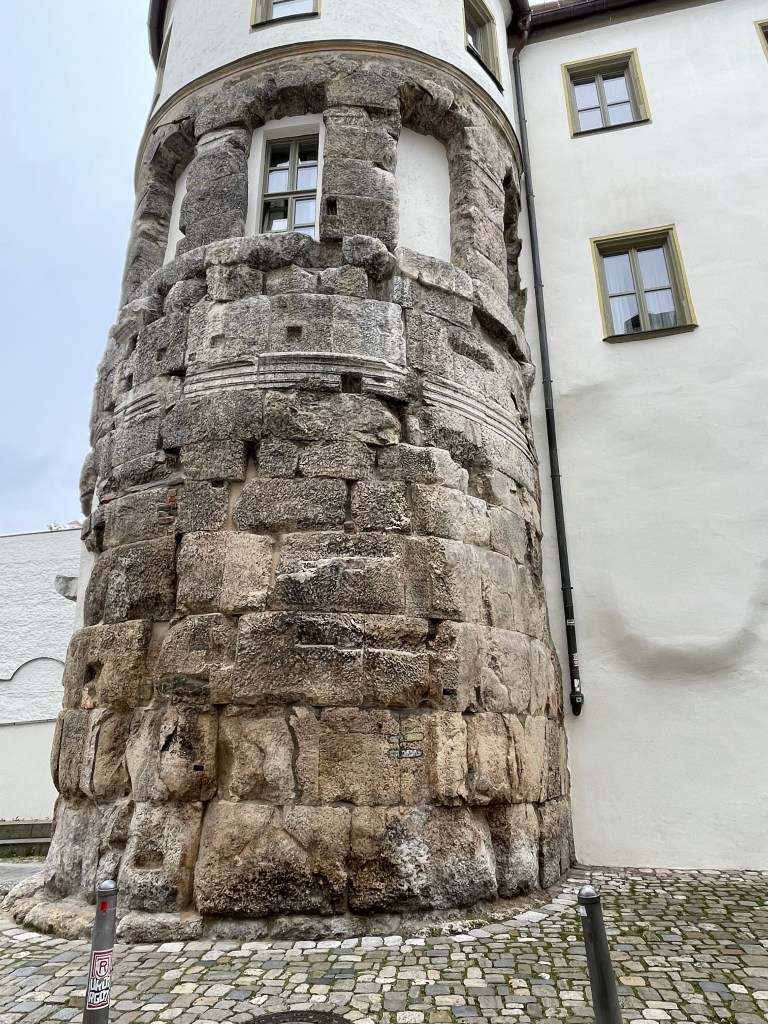
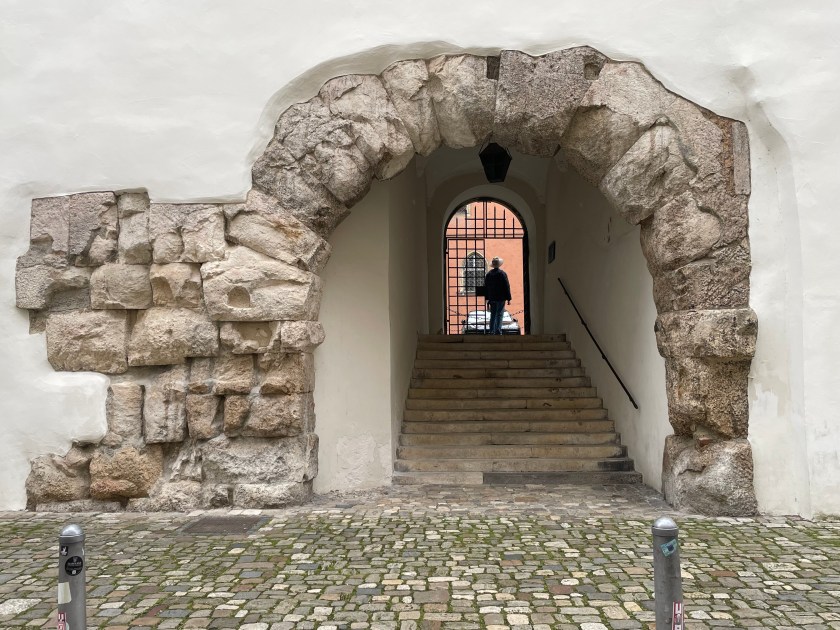
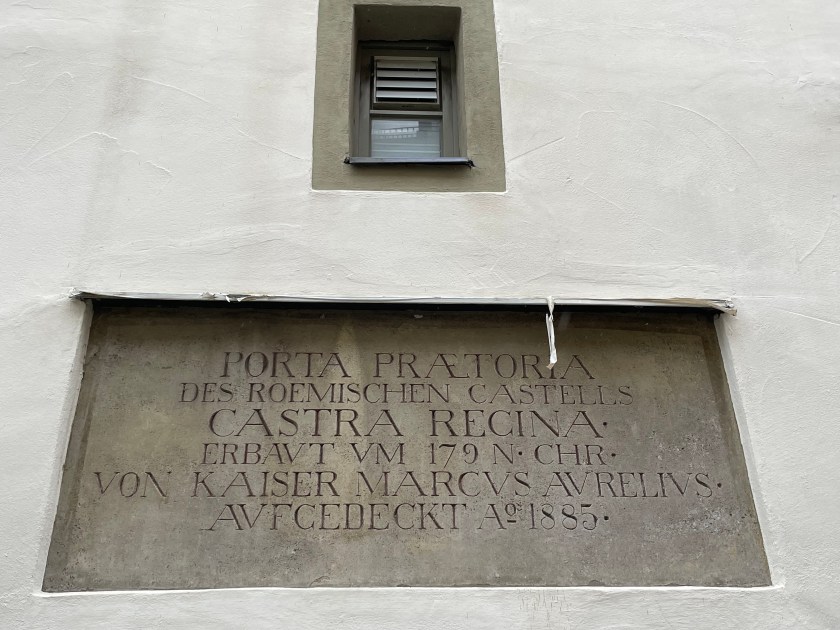
Here are the remains of a Roman Gate dating to 179 A. D.  The stonework was amazing.  Imagine all the eyes that have looked on these very stones!

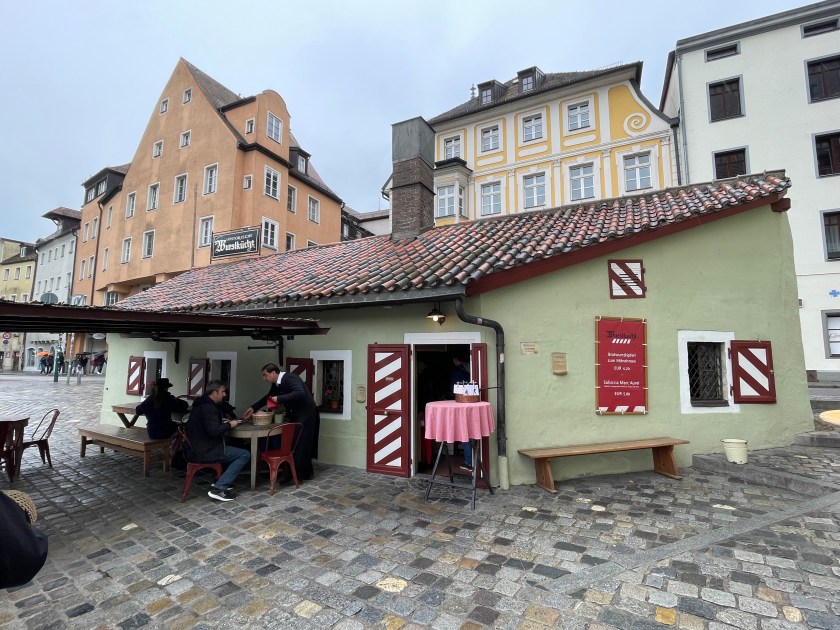
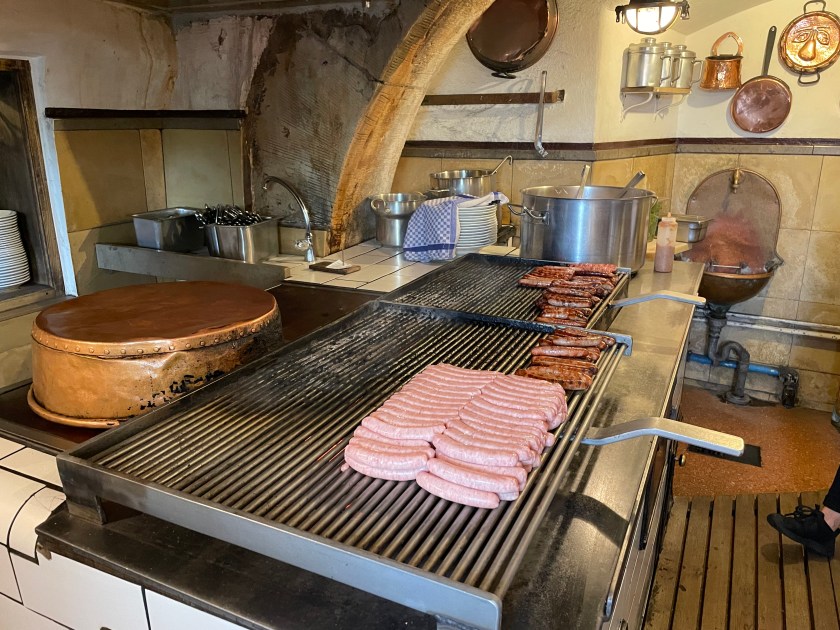
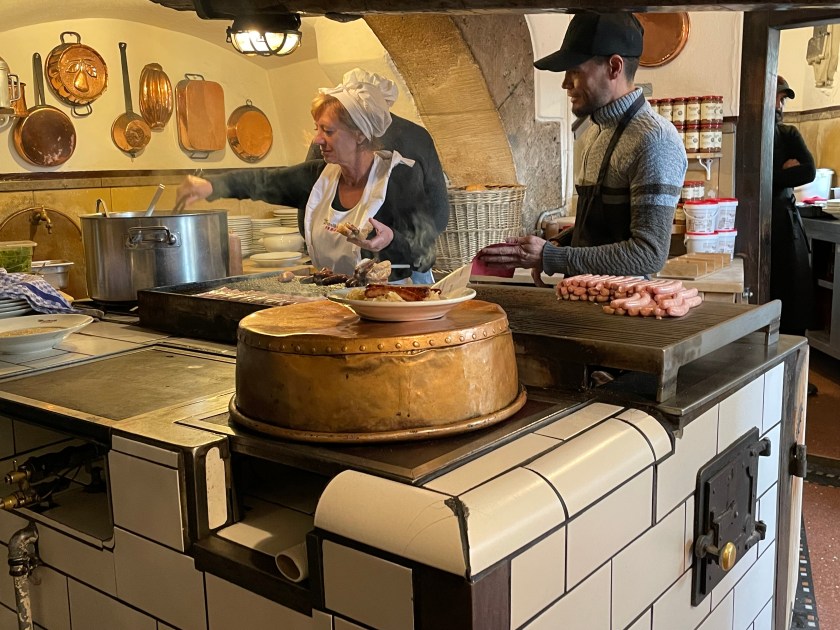
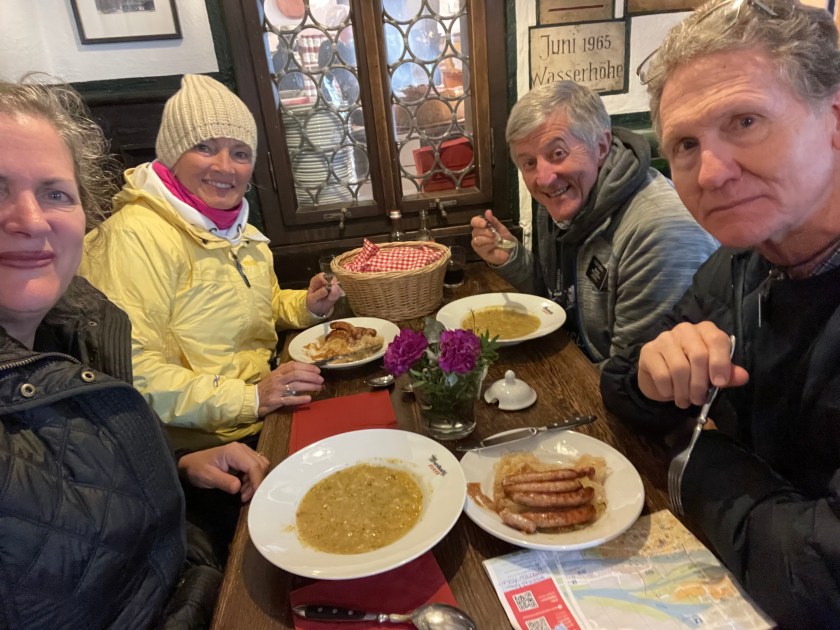
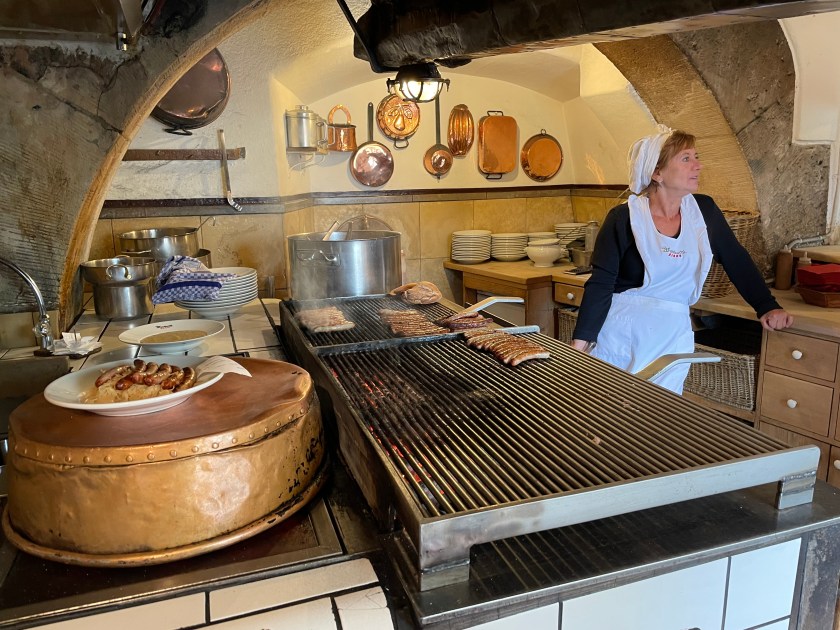
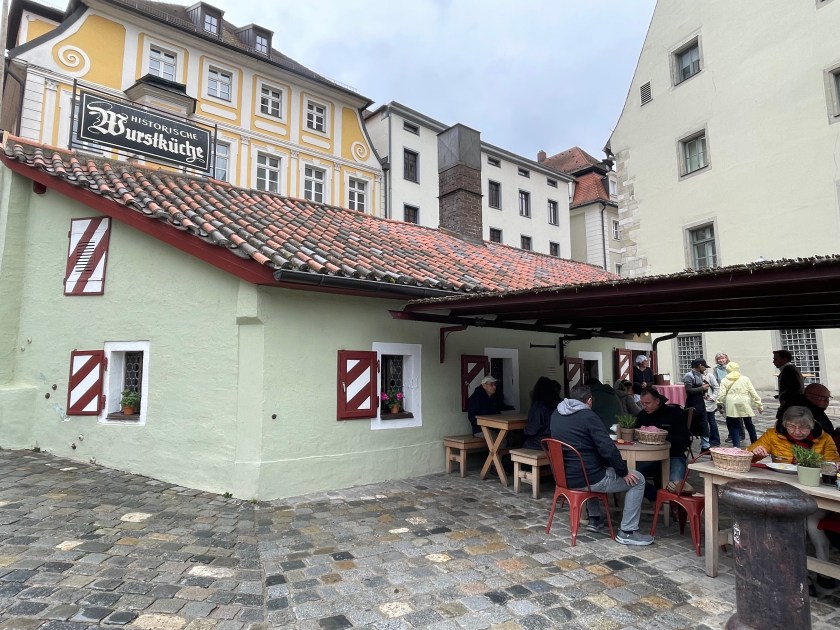
Our lunch at the 500 year-old Brat Haus was delicious. Homemade potato soup, a fresh salty buttery pretzel and then 6 little brats on a bed of sauerkraut. We shared both. The spicy Senf had brown sugar in it and was So Good.

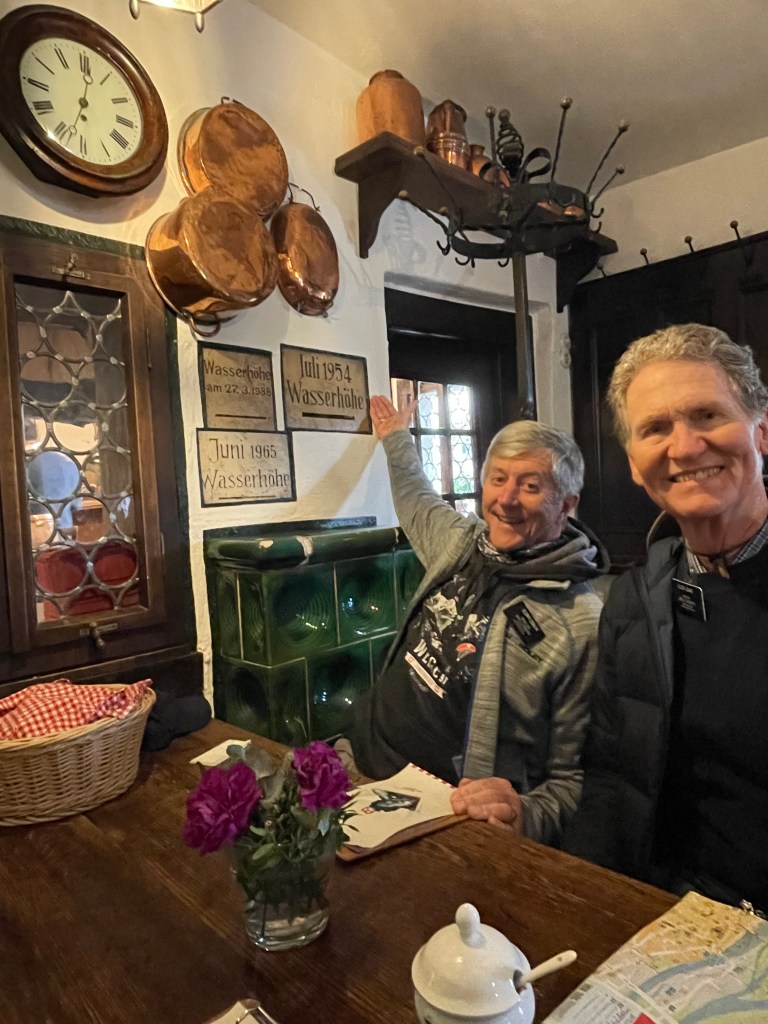
By our table inside you could see the watermarks from floods.  That seems to happen in many towns along Germany’s many rivers.

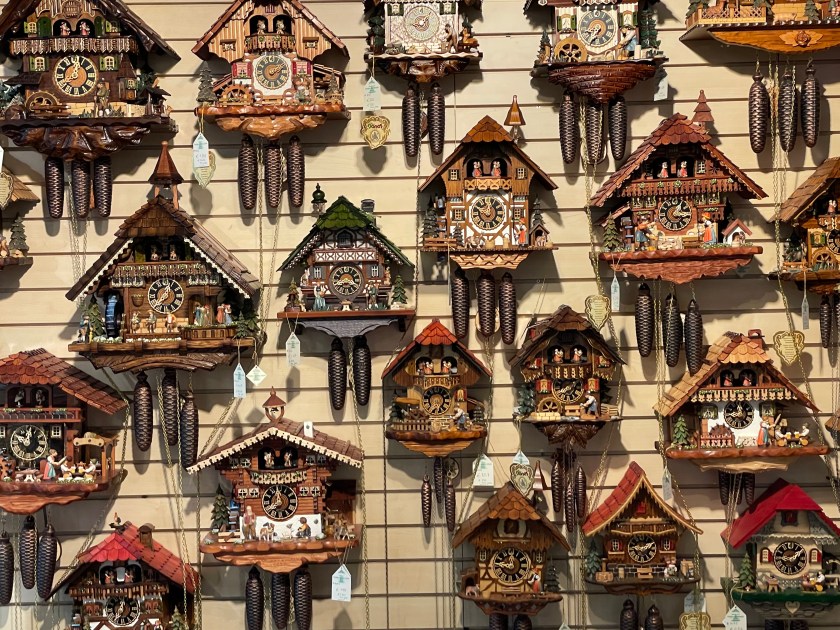
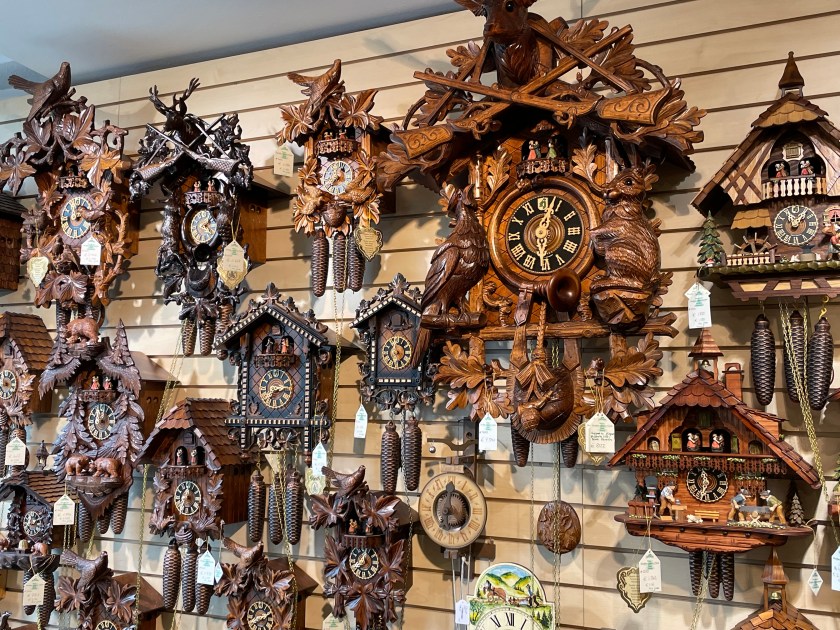
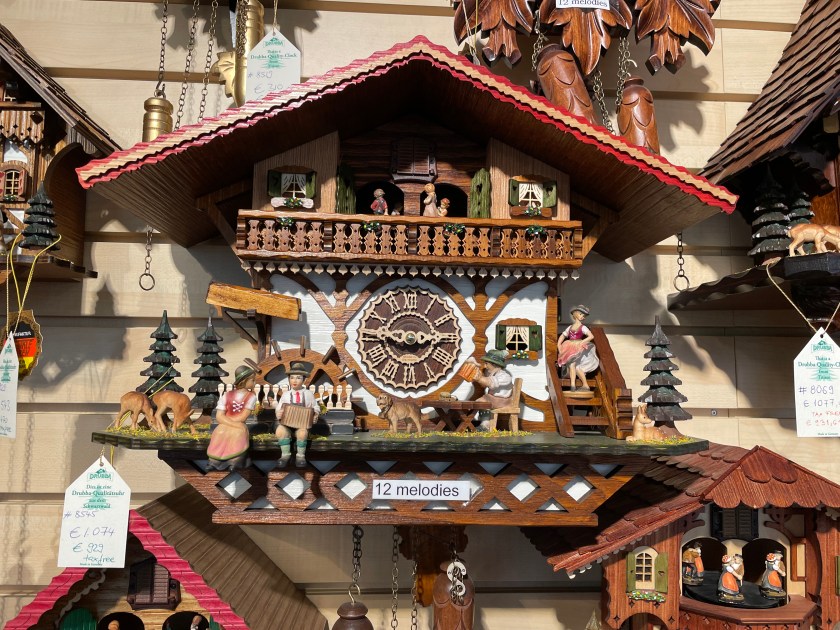
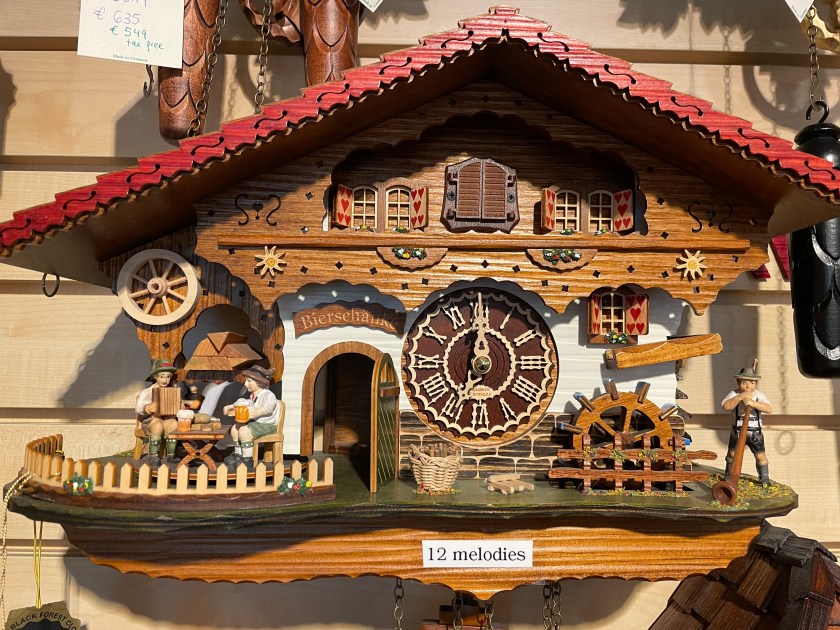
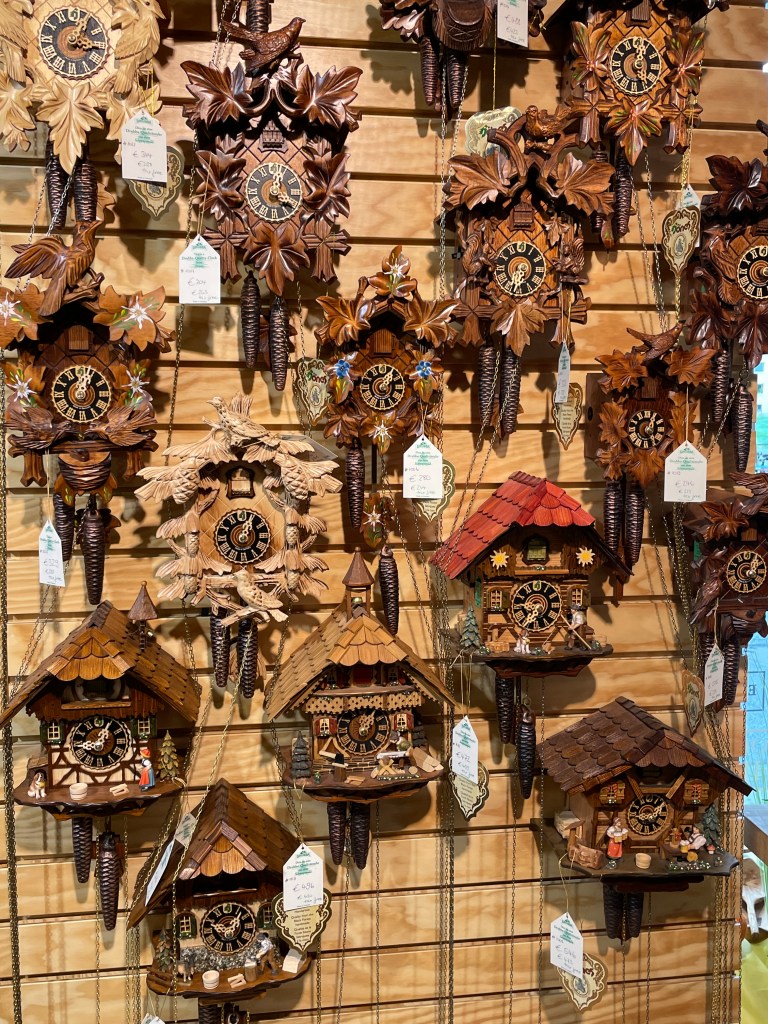
Across the street from the Brathaus was a cuckoo clock store.  I think these are mostly for tourists, but we had fun looking at the variety of clocks made here.  Each one tells a story.


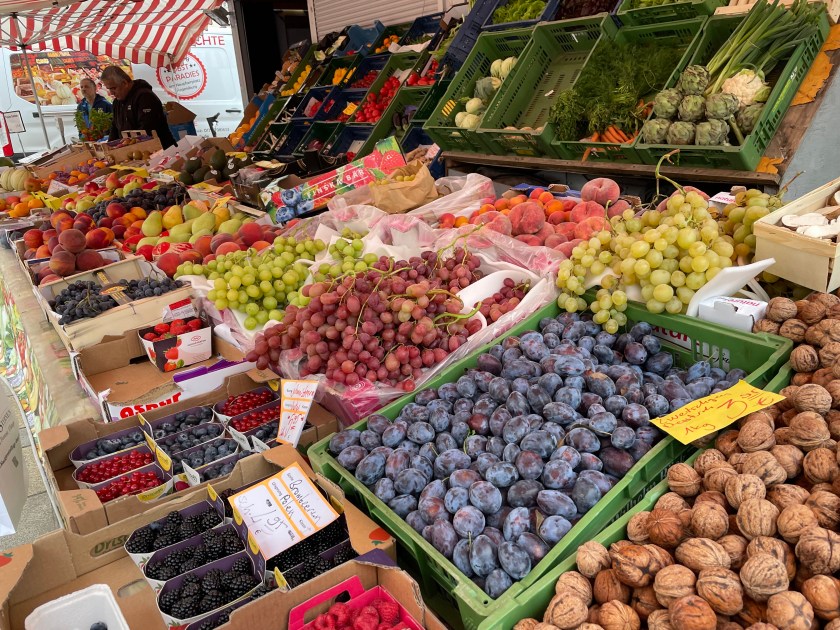
Geri shared a box of fresh raspberries with us as we enjoyed the local farmers’ market.

It’s mushroom season!

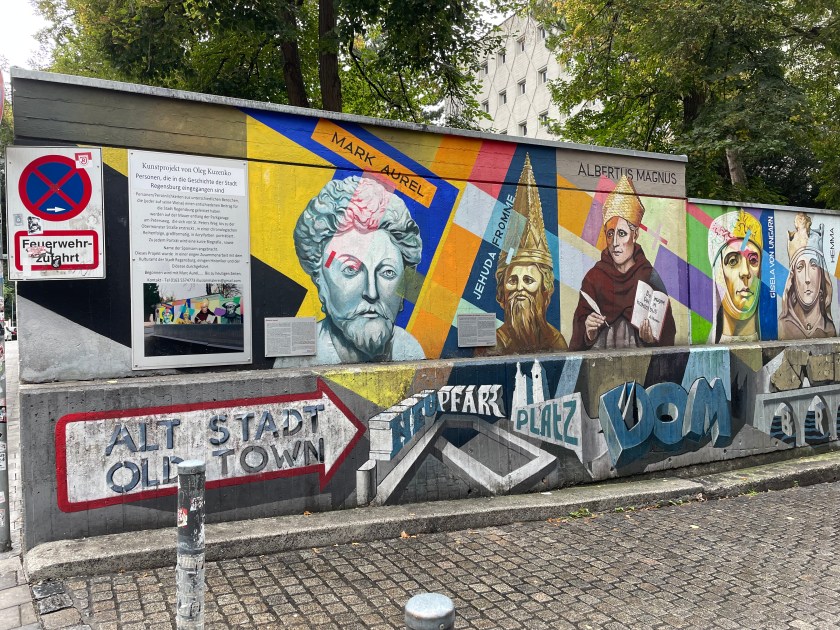
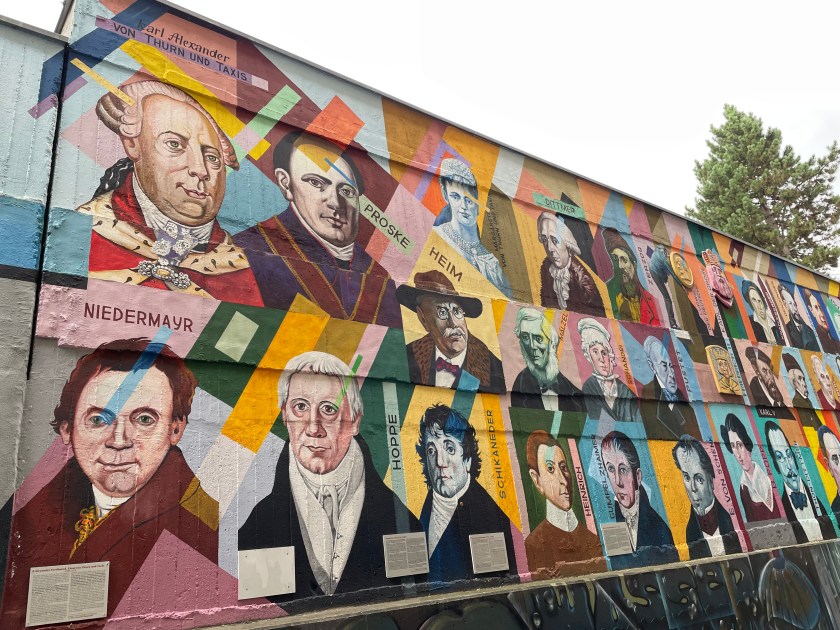
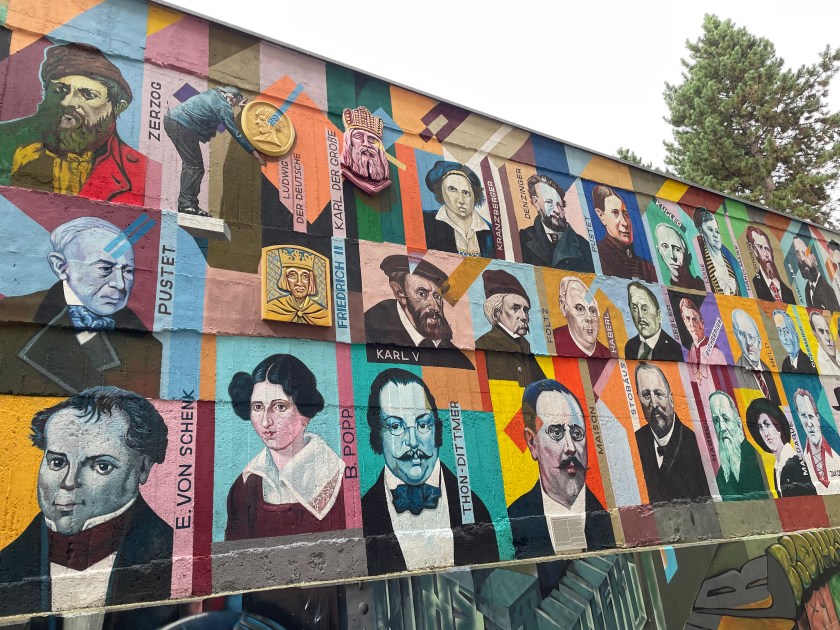
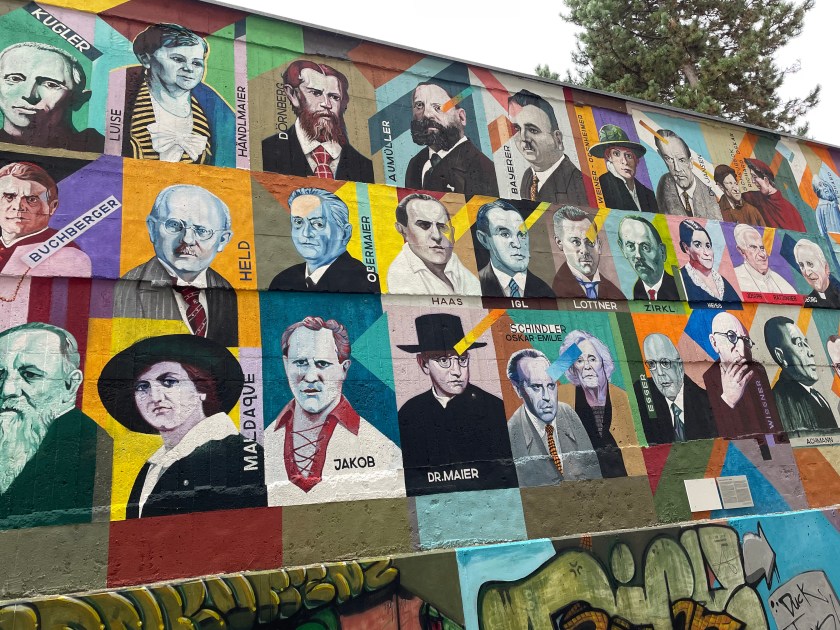
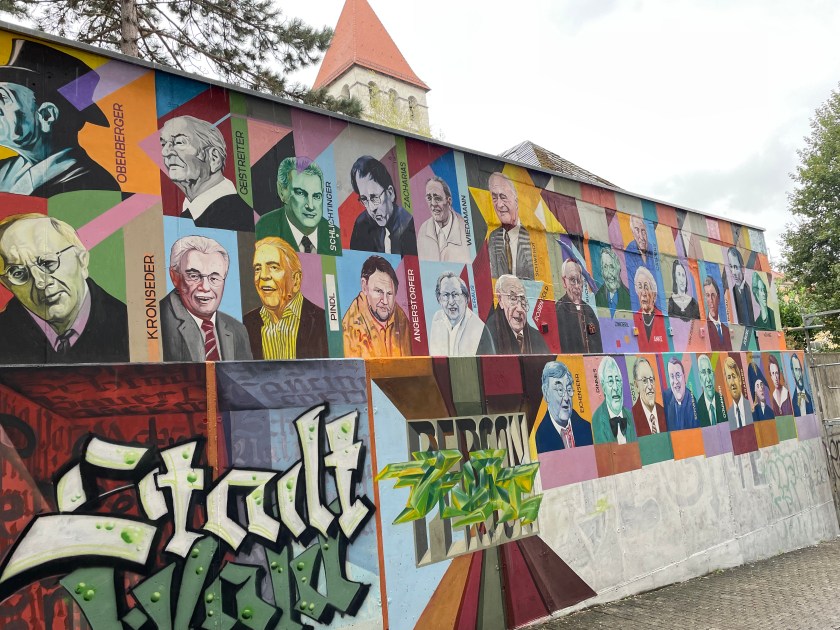
As we left town to go to our next adventure, we passed by this art wall featuring important people connected to Regensburg through the centuries.  It was pretty impressive!
In the next post, I’ll take you back to the churches.

Arriving in Regensburg

Our friends, Scott and Geri Conlin will be going home in December and they’re just about the busiest people we know (he’s the Executive Secretary to the Area Presidency).  We decided that while we had a weekend free, we’d take a trip together.  I’m so glad we did.  We left Thursday after work for Regensburg, spent the evening and Friday there, then drove to Munich Friday afternoon to spend the evening there, then Saturday we drove over to Dachau, where we spent a good part of the day.  Saturday on our way back, we stopped in Augsburg to see another interesting very old medieval town.  These next few posts will be about this trip.

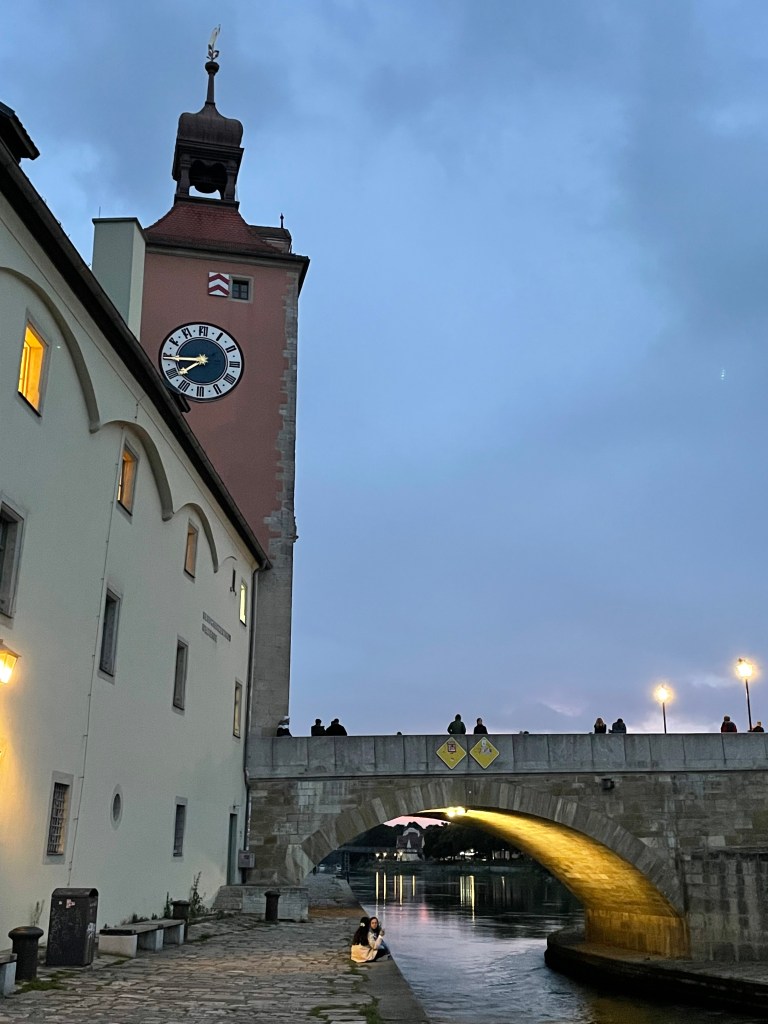
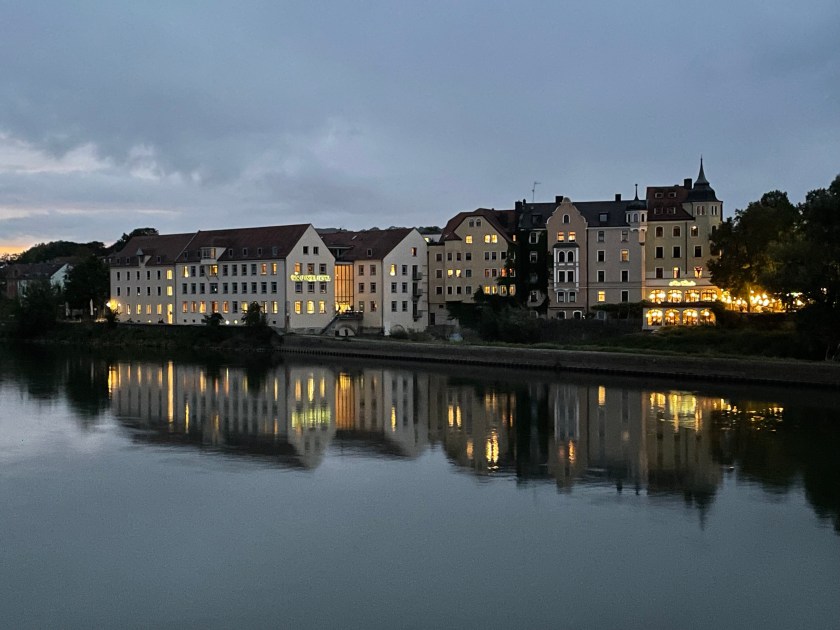
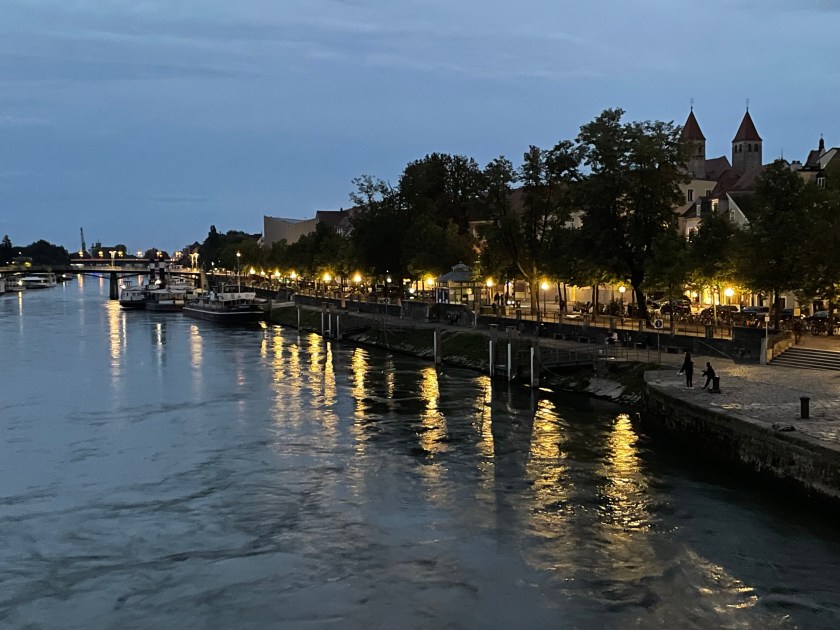
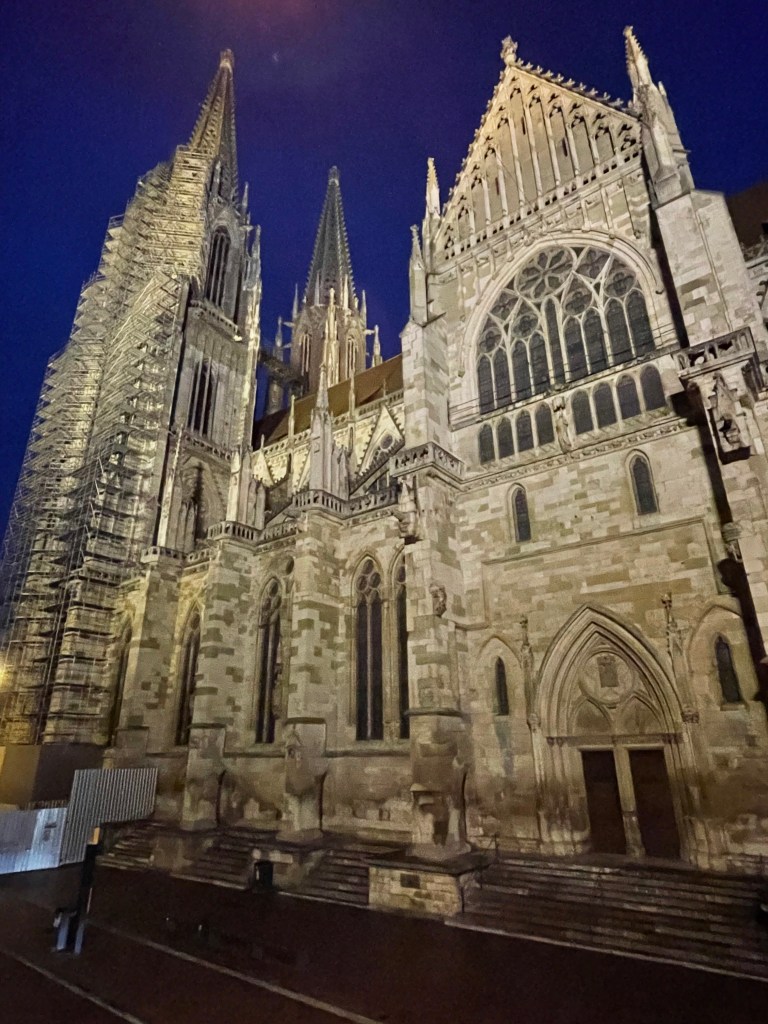
This evening we took a walk around Regensburg before it got dark.  What a beautiful town on the Danube River.

One of the first things we noticed on our wander was this particular Stolperstein for Dr. Johann Maier.  Friday, when we visited the big beautiful cathedral, we learned more about who he was.

Johann Maier was born on 23 June 1906 in Berghofen.  He was murdered by Nazis on 24 April 1945 in Regensburg.   From 1939 until his death, he was a Catholic priest at Regensburg Cathedral.  On 22 April 1945, Reich Defense Commissioner Ludwig Ruckdeschel took city defence to the extreme in Regensburg when United States Army tanks had already reached the Danube.
The next day, an excited crowd of people gathered at the Moltkeplatz – nowadays known as Dachauplatz. Johann Maier was there and bade the crowd be quiet as he had something to say. He called for the town’s peaceful handover. Even before he had finished his speech, he was seized by plainclothes police. Likewise, several other demonstrators were arrested. That evening, Maier was brought before a drumhead court and sentenced to death by hanging. Michael Buchberger, the Bishop of Regensburg, was frightened into silence and hid himself in a cellar.
On the morning of 24 April 1945 at 3:25, Maier was hanged at Moltkeplatz. About his neck, he wore a sign that said “I am a saboteur.” Later the Wehrmacht and the SS both fled southwards out of town; Regensburg fell without a fight.
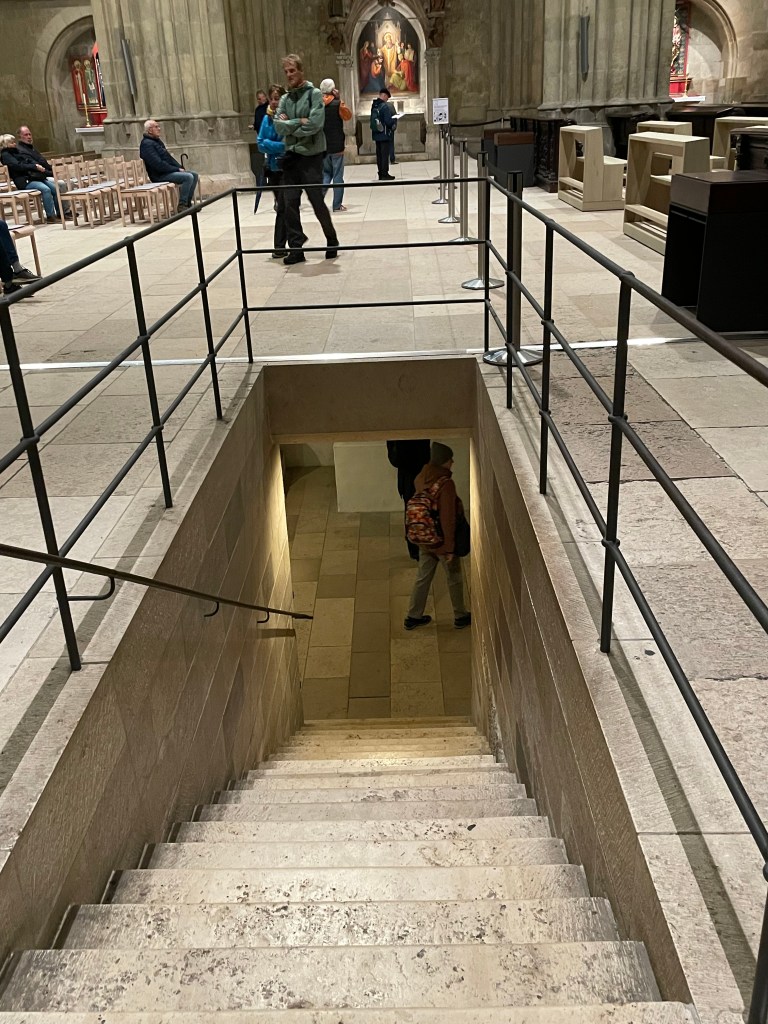
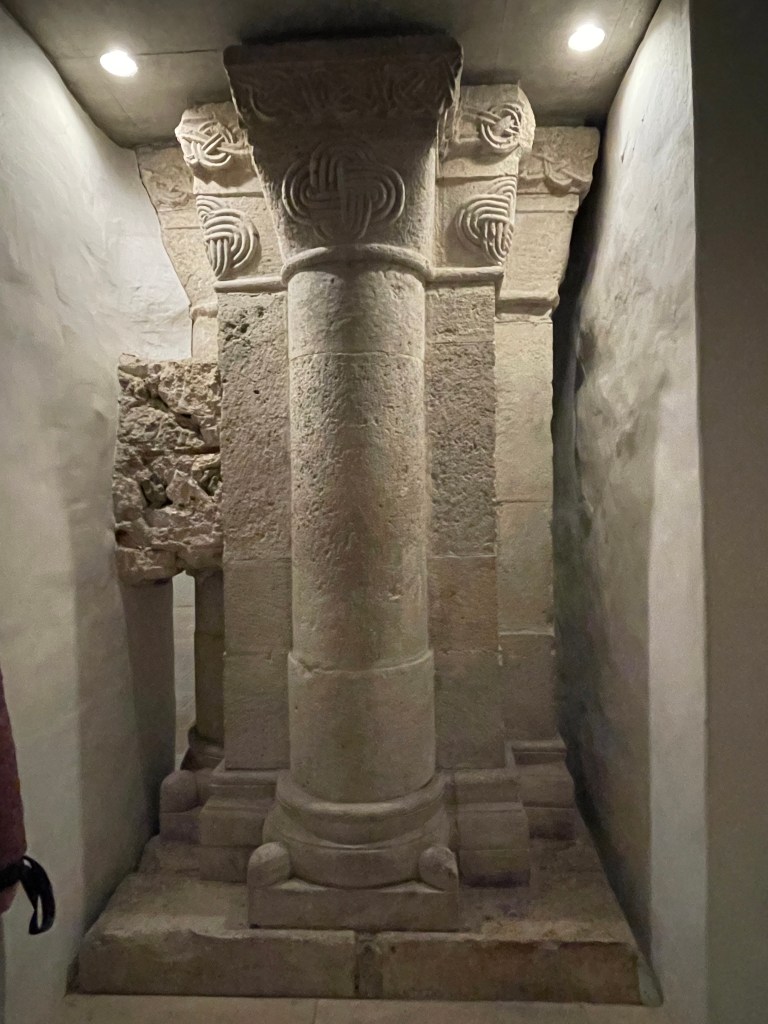
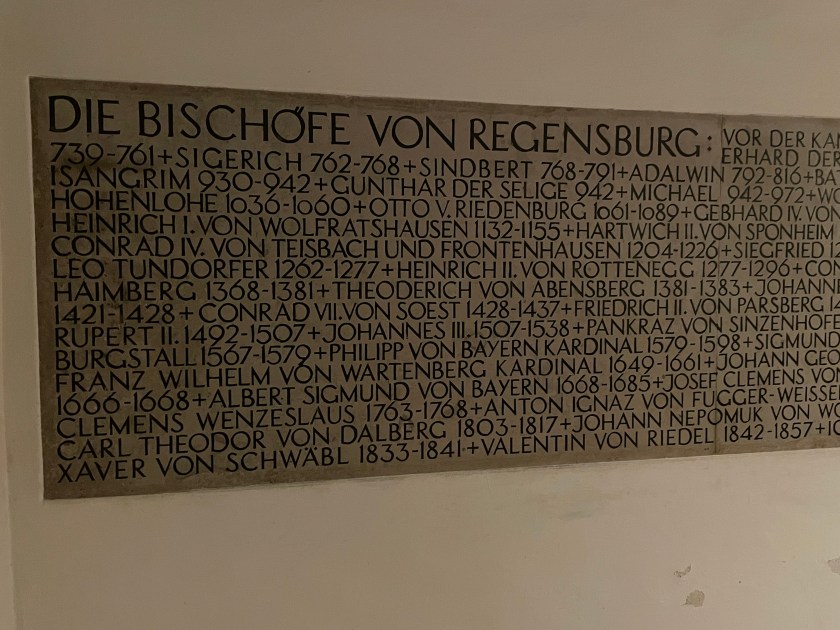
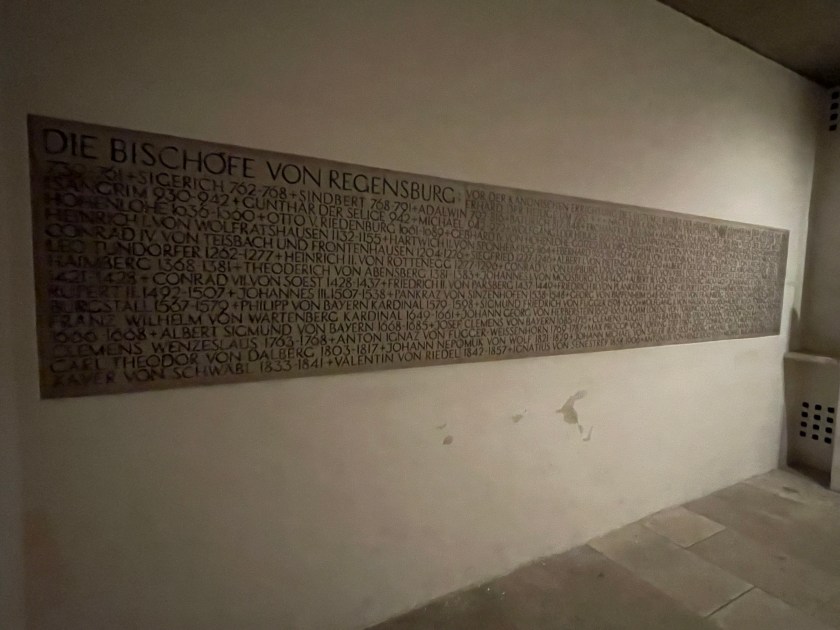
Maier’s grave can be found in the Cathedral among the bishops’ graves. There is also a memorial plaque at the Cathedral.

Can you see his stone above in front of this German clothing store?  Below is a google translation of his memorial stone and below that is where he’s buried in the cathedral crypt.

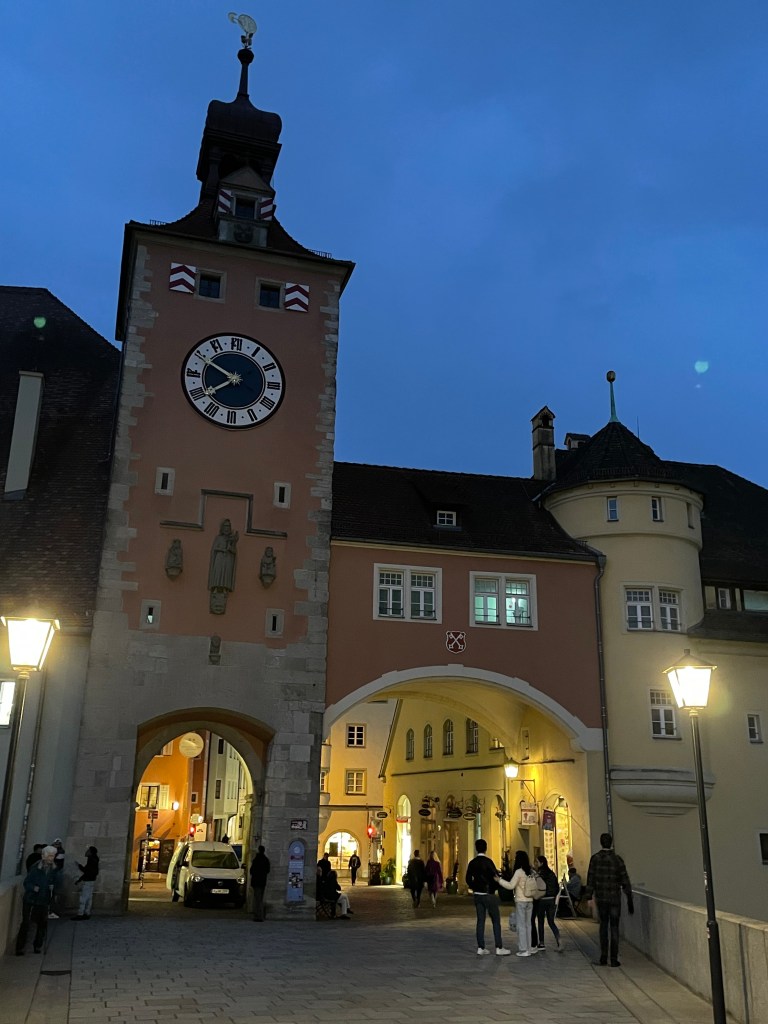
We walked to the old Stone Bridge.  With construction beginning in 1135, the Stone Bridge is considered a masterpiece of medieval architecture and is the oldest preserved bridge in Germany.  We walked out onto it, just to feel the strength and staying power.  For 800 years, until the 1930s, it was the only bridge crossing the river here.

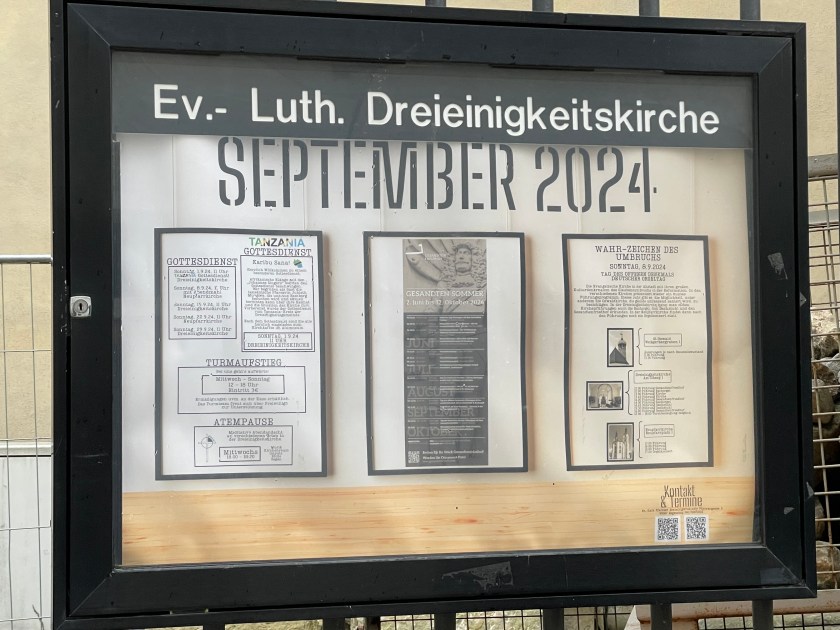
We happened on a special free concert happening in the church below.

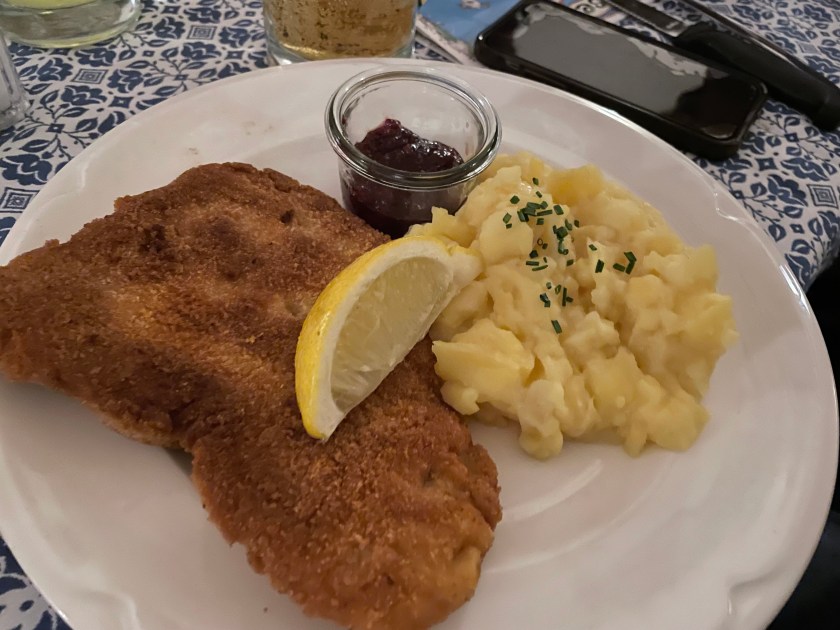
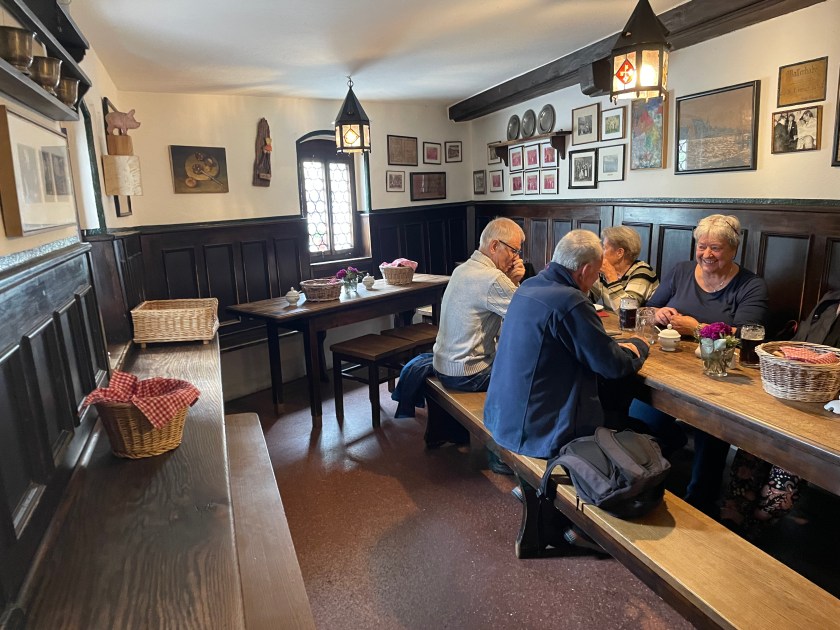
We wandered the streets a bit and found the restaurant the deskman most highly recommended for good Bavarian food. It was a fun old place full of people. Home cooking, home brewed beer, cozy setting with lots of sayings on the walls.  John got Käsespätzle. I had pork medallions and Käsespätzle. Scott had goulash and Geri had Schnitzel. It was all delicious.

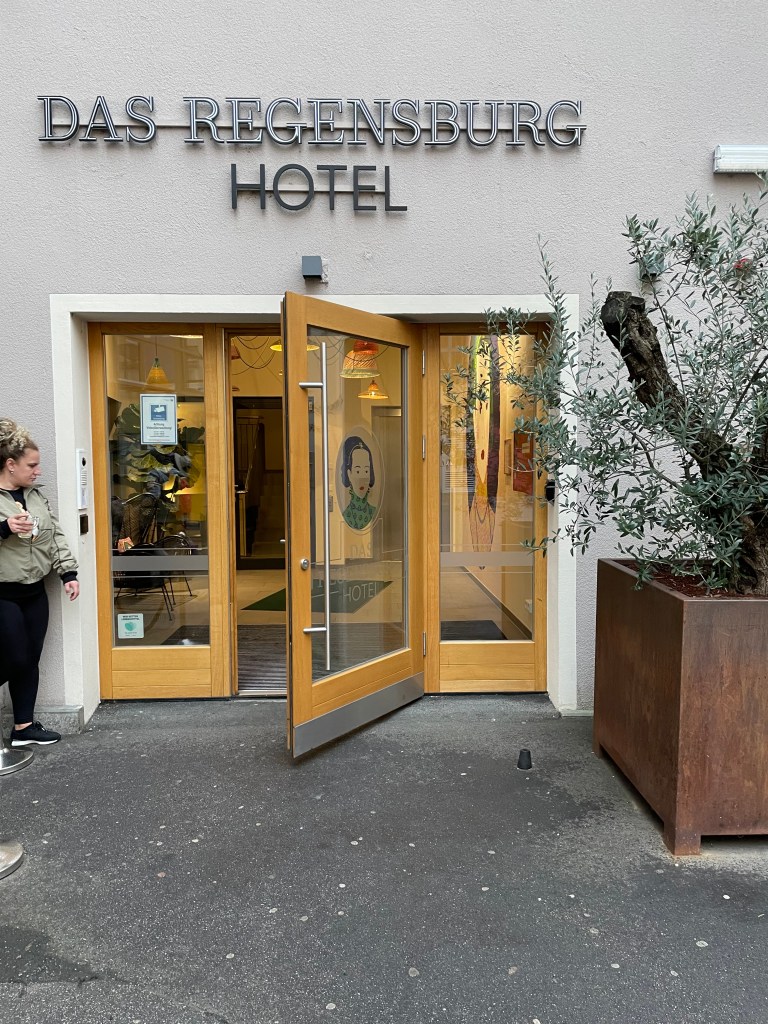
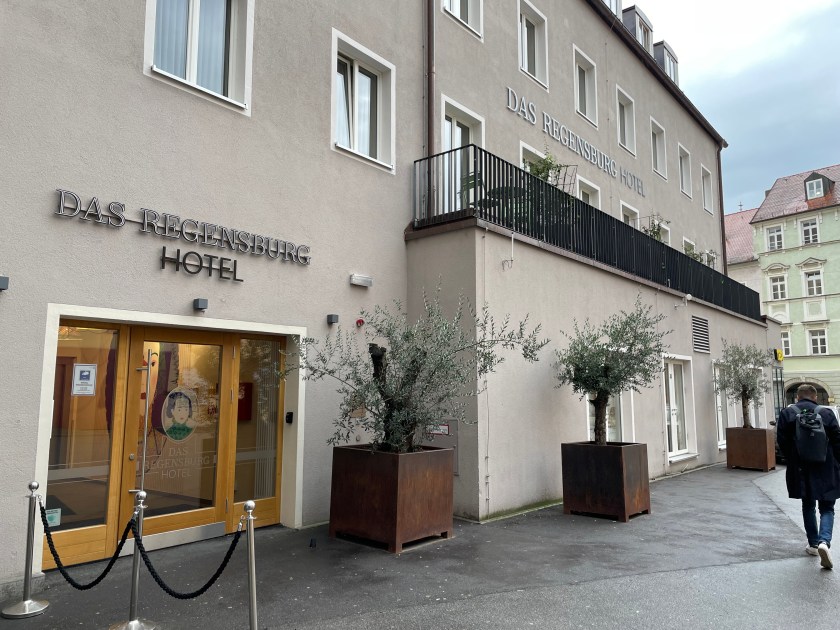
This was our hotel:

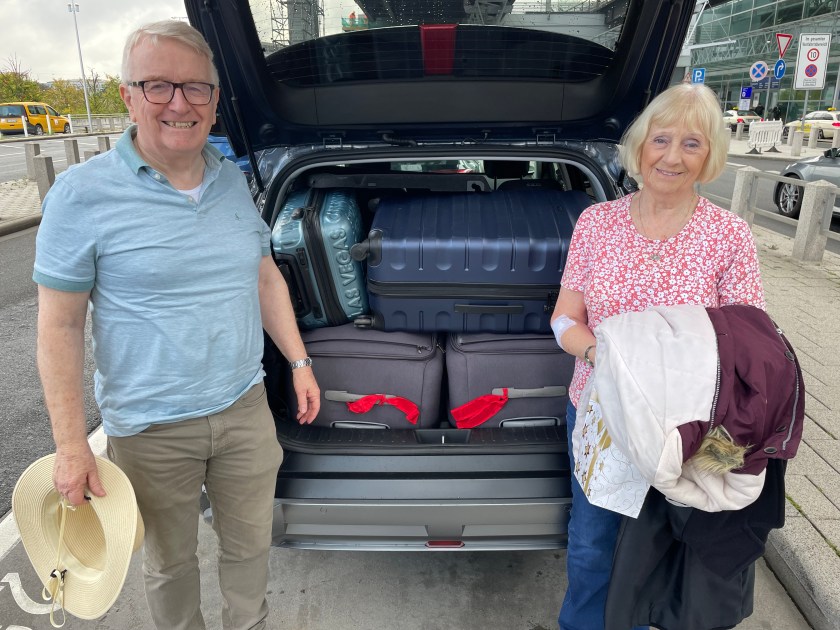
Dave and Lyn Irwin’s Transfer to Uzbekistan!
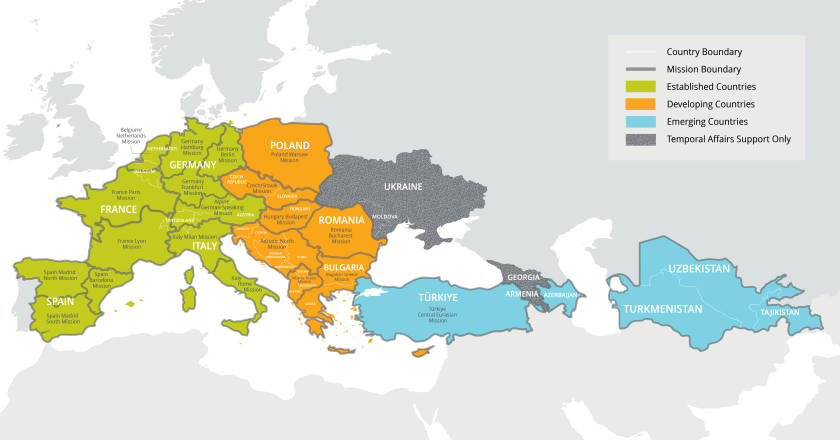
This morning we helped the Irwins pack up and move out.  They’ve received a new assignment–in UZBEKISTAN!!!  That’s really far away–on the outer edge in a nethermost part of the vineyard (as far to the right on the map as you can go).

They will be teaching English in 2 different high schools there.  They have no place to stay (yet) and they don’t know anyone there (yet).  It’s going to be a grand adventure.  The government asked for helpers to come teach English in the schools.  The high school kids need to be fairly proficient in English to get into a university.  The Irwins will go help that to happen.  They will be the first members of the Church living there.  Pioneers.

What an adventure!  We wish them well (and kind of wish we could go help too!).