It was our last night in Vienna and our last concert, this time at the Schönborn Palace (built 1699). Don’t confuse this with Schönbrunn Palace on the other side of town.
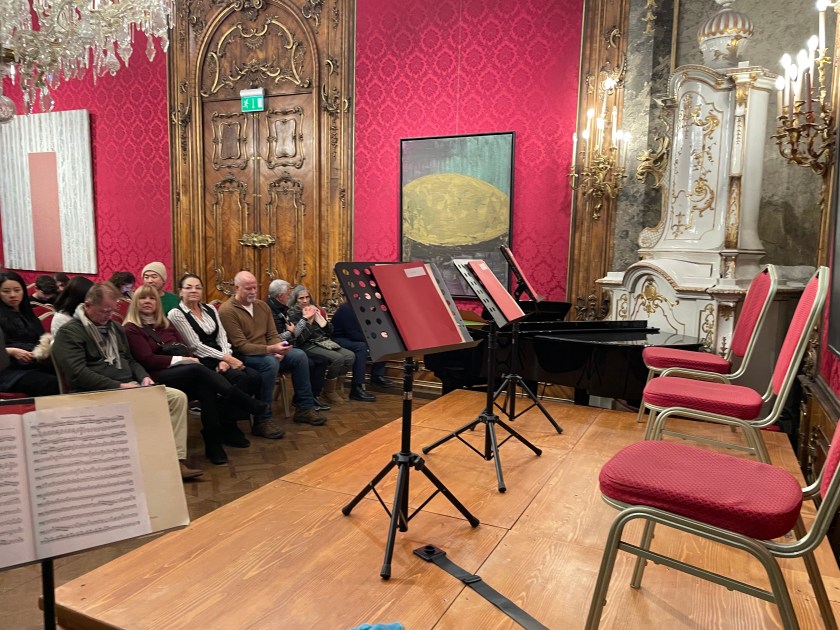
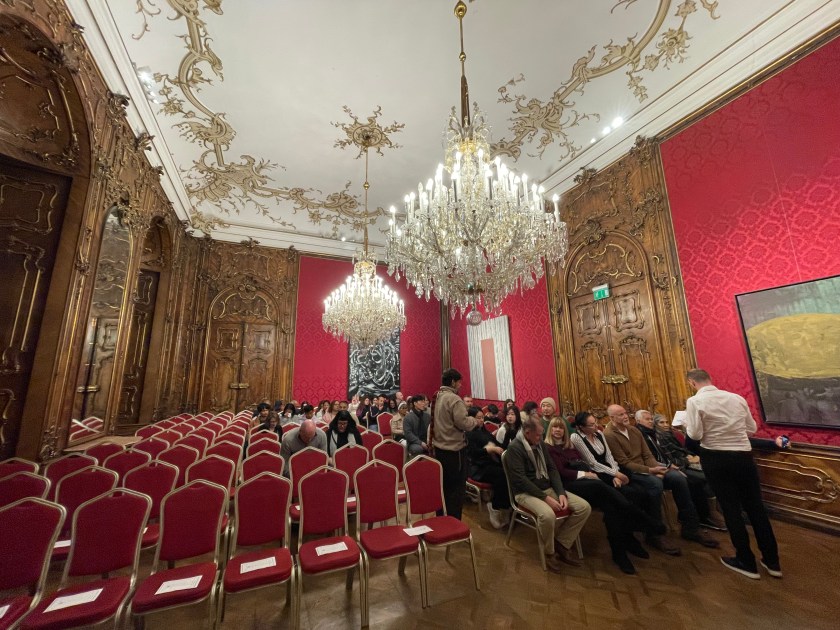
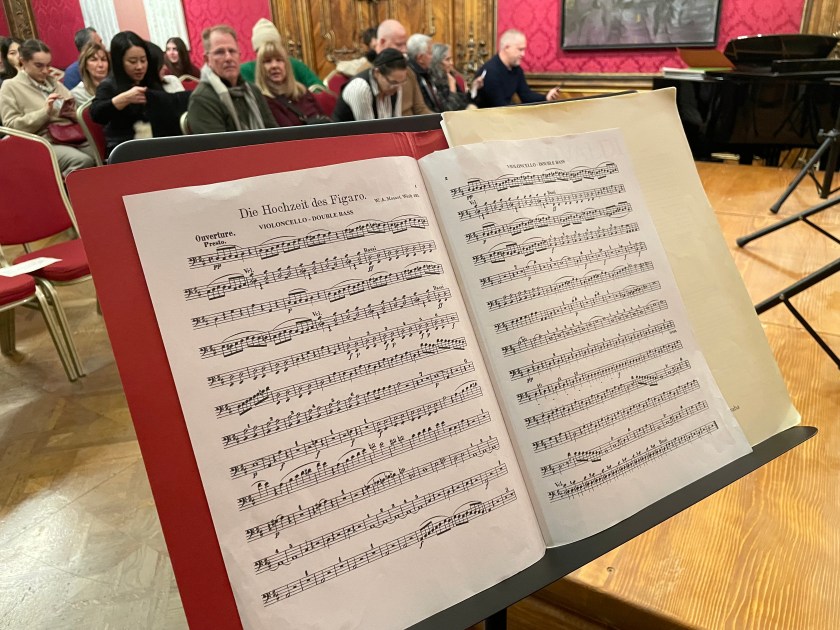
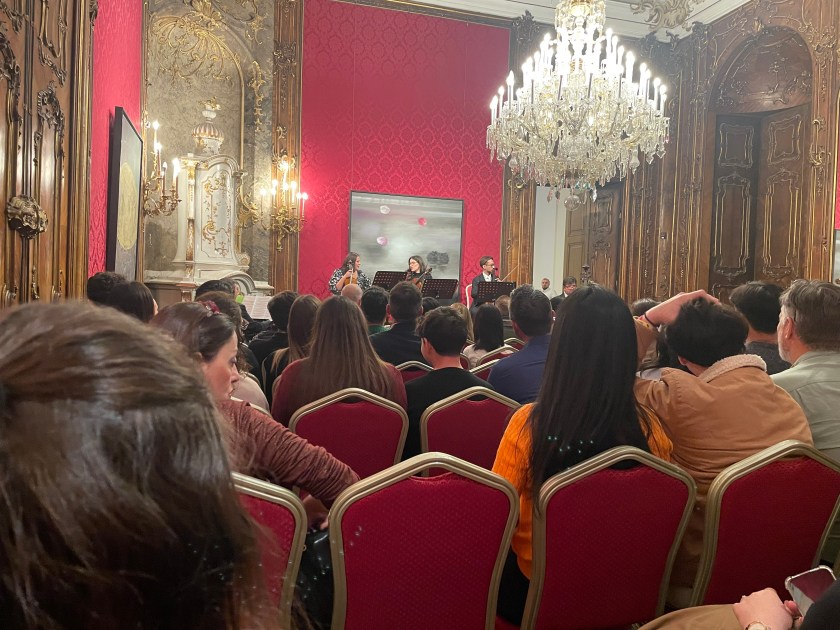
This evening we eventually found the venue in the at the Hofkapelle and we were ushered in to the Barock Hall. It was much smaller than the photo they showed us led us to believe. I think there were about 130 people seated and a very small area for the 5 musicians and the piano.
There are lots of men in front of tourist attraction places here who are dressed in old red or black cloaks and robes and hats. They are there to sell tourists tickets to the many concerts going on all over town. They carry a big binder full of sheet-protected pages of concert venues and available seating. They have a credit card machine in their pocket and a big billfold for cash. And they are persistent, to the edge of annoying. They are also pretty sure that there are ONLY TWO seats left in any given concert, and if you don’t buy those two seats, the opportunity is lost forever.
We purchased our other 5 concert tickets weeks ago, online, but this time we were sucked in by a rather convincing ticket salesman in a cloak as he told us tonight’s venue is where Beethoven first played his 9th Symphony and he had to be turned around to see (he was deaf) the people cheering and applauding afterwards. (Not sure that happened here.) He also told us they’d play a selection from La Traviata (one of my favorites). (That didn’t happen.) Oh well.
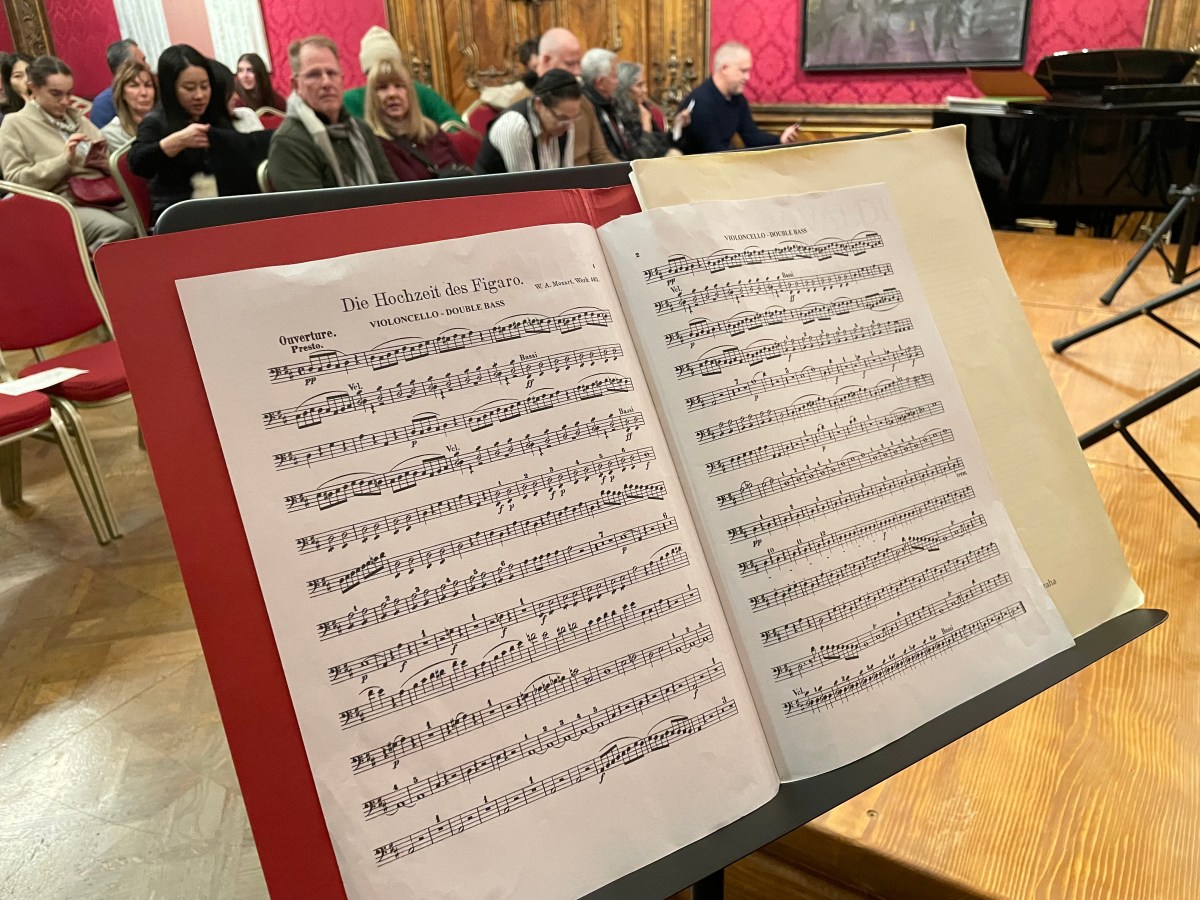
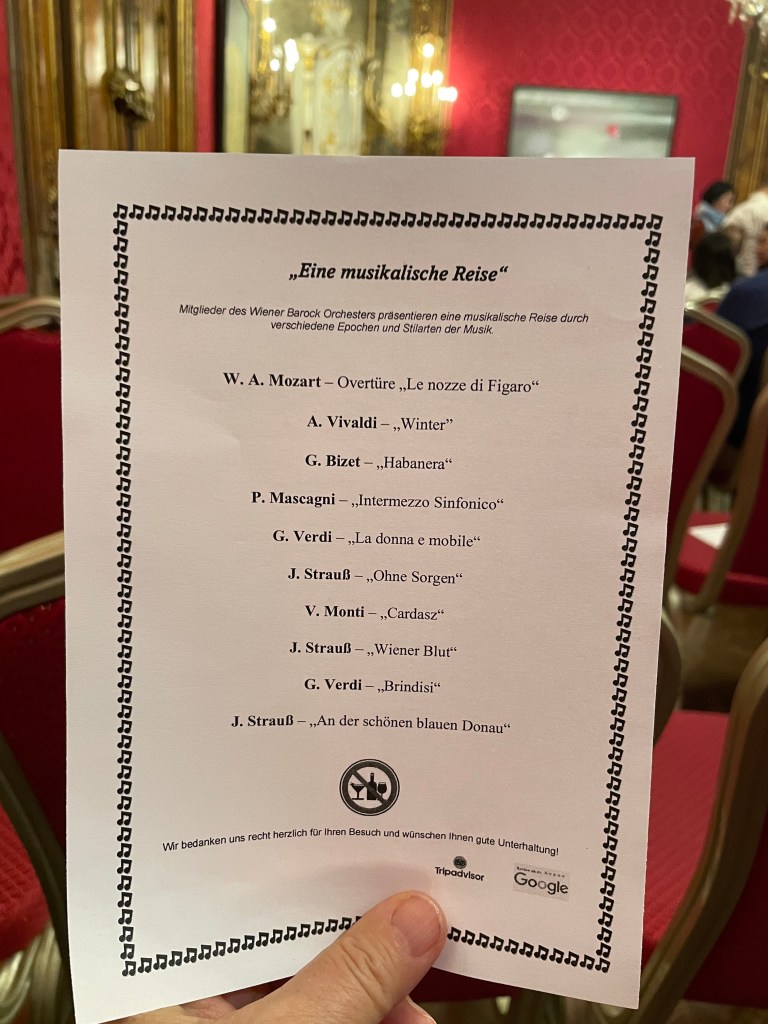
The concert featured Beethoven, Strauss, Vivaldi, and Mozart and had a few opera numbers in the mix. At the end they sang Adestes Fideles and Silent Night. It was a nice concert. Those few musicians put out a lot of sound and seemed to enjoy themselves.
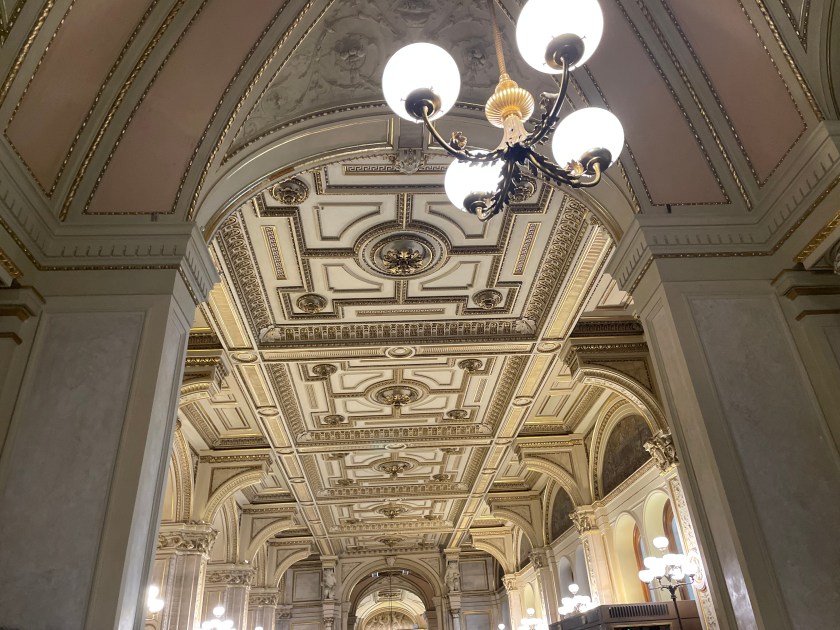
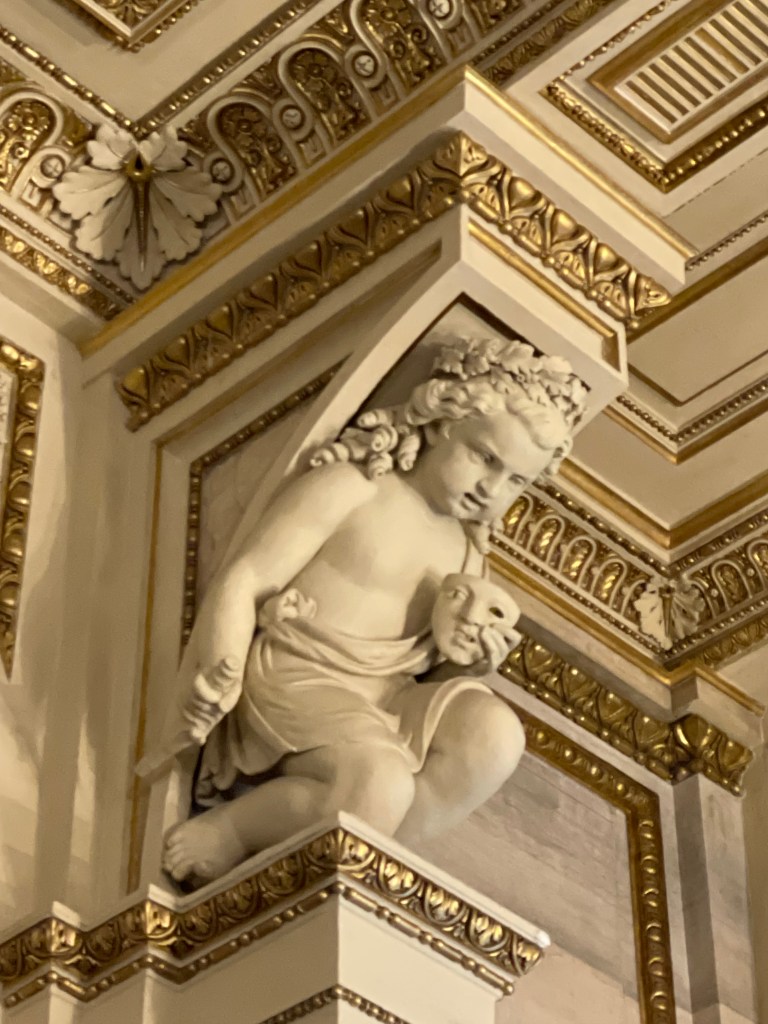
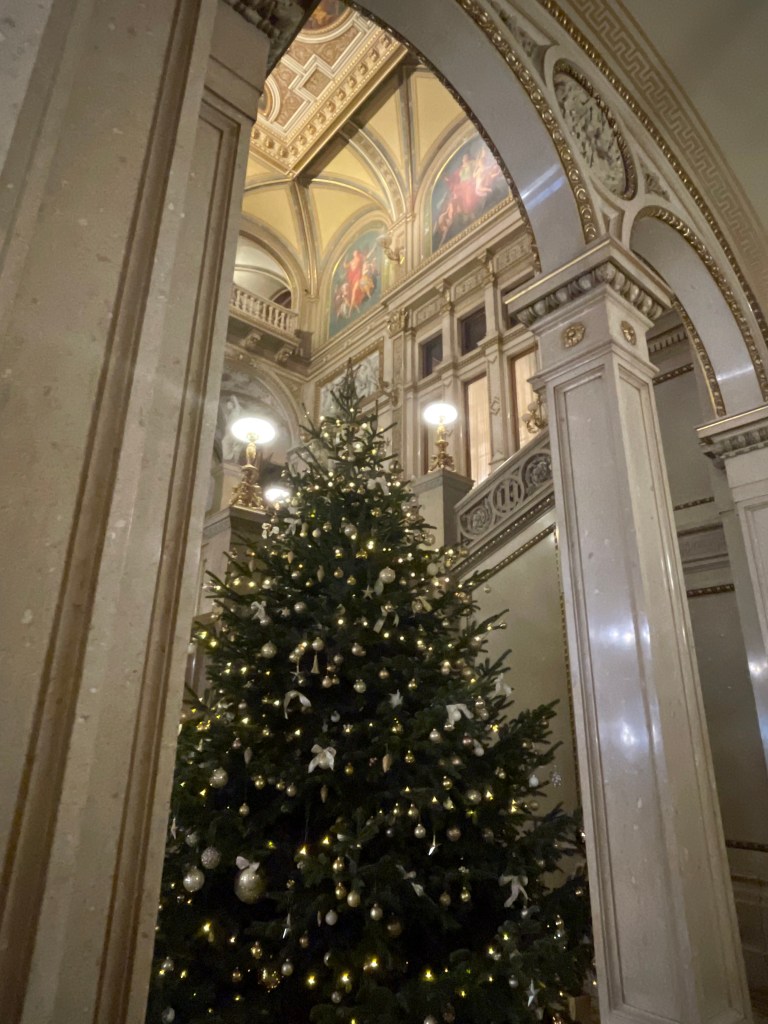
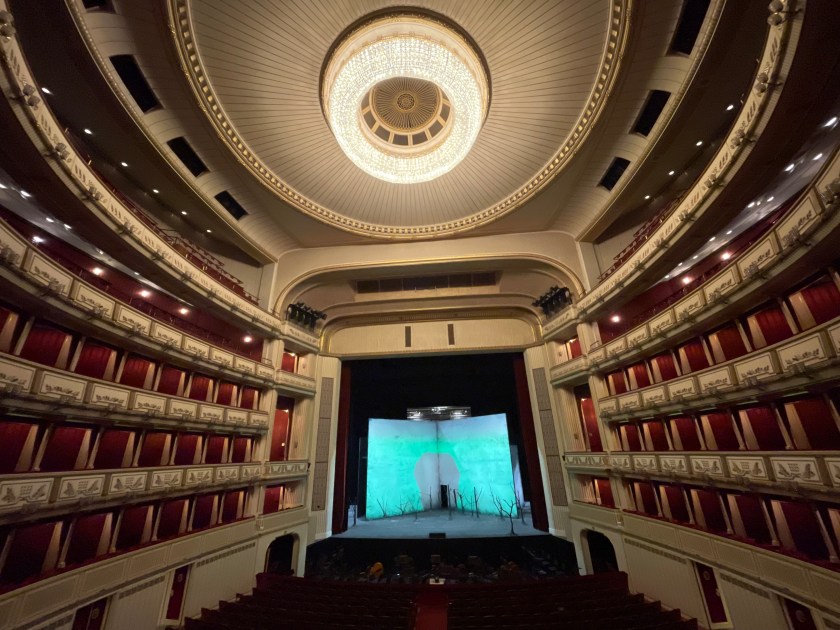
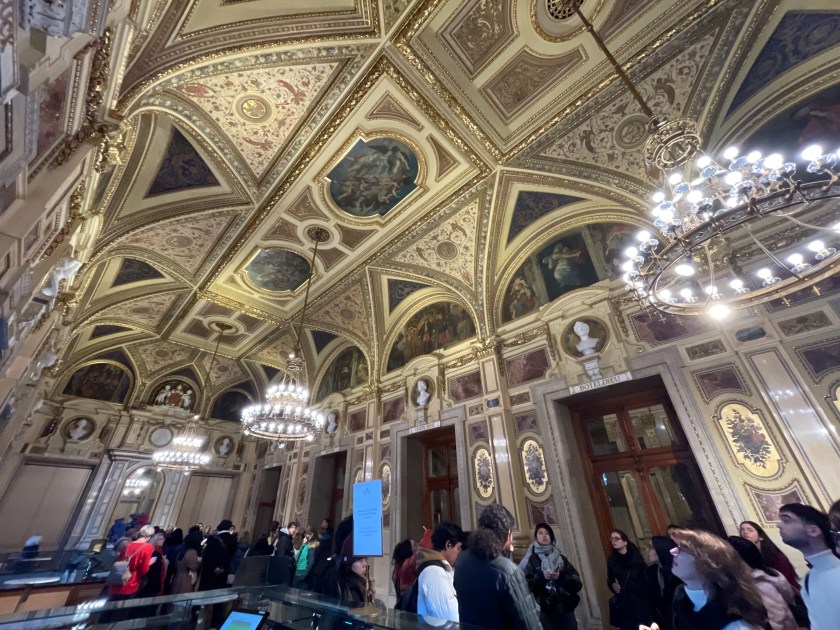
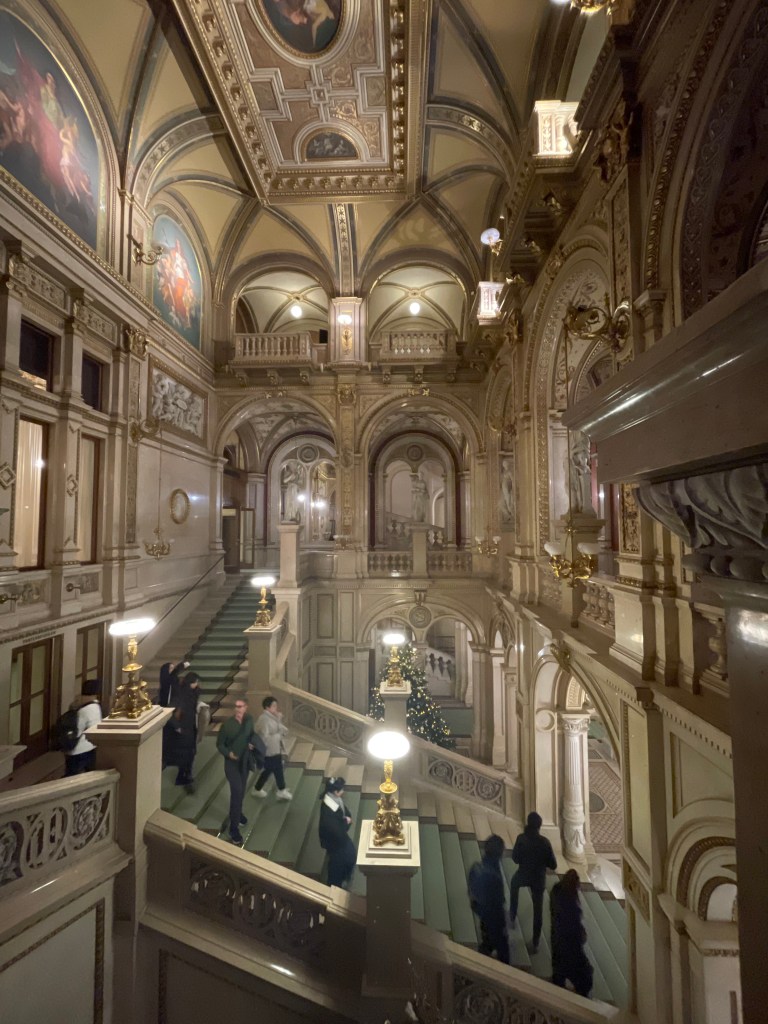
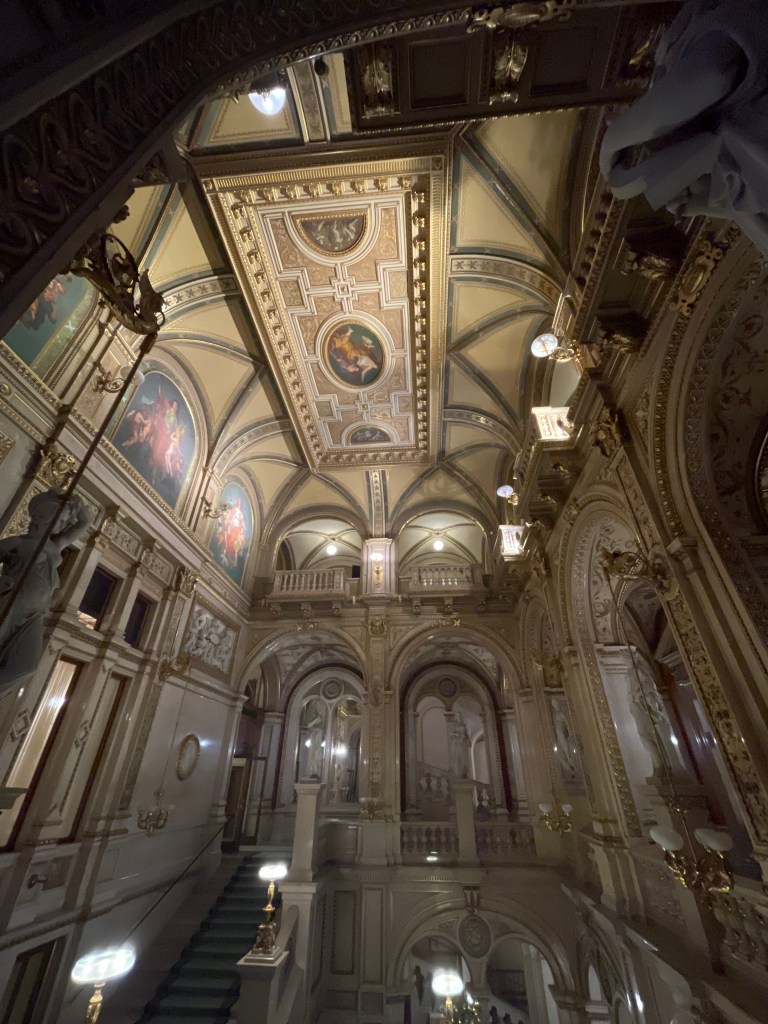
We had reservations for a 3:00 p.m. tour of the famous grand Vienna Opera House. The tour was pretty quick–just over 40 minutes. There are lots of tours that go through the large Opera House in lots of languages. They manage the groups pretty well.
We learned how they manage the stage and opera companies. Every night a different Opera plays, so they have to change the sets and rotate everything EVERY DAY. That’s done so the tourists can see something different every night, and also so the singers can rest and let their voices recover (no microphones used).
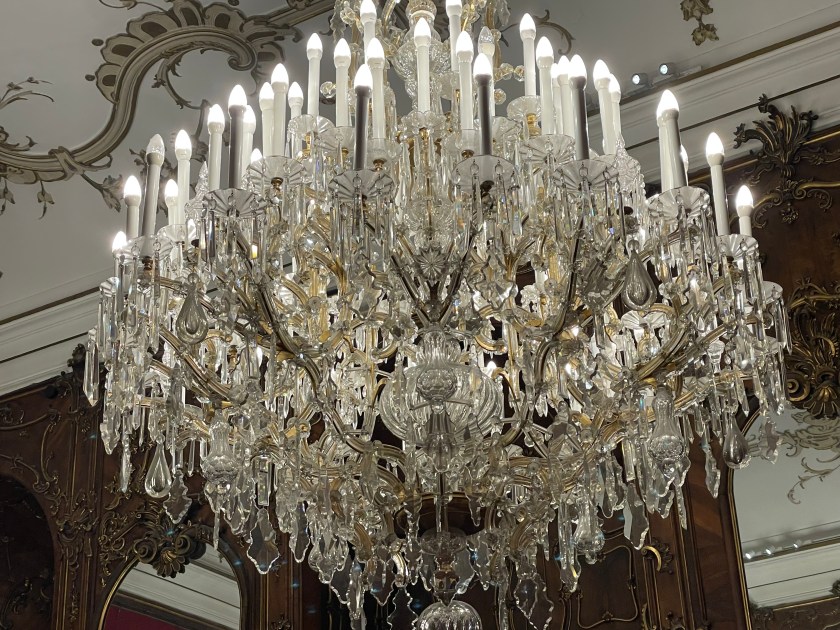
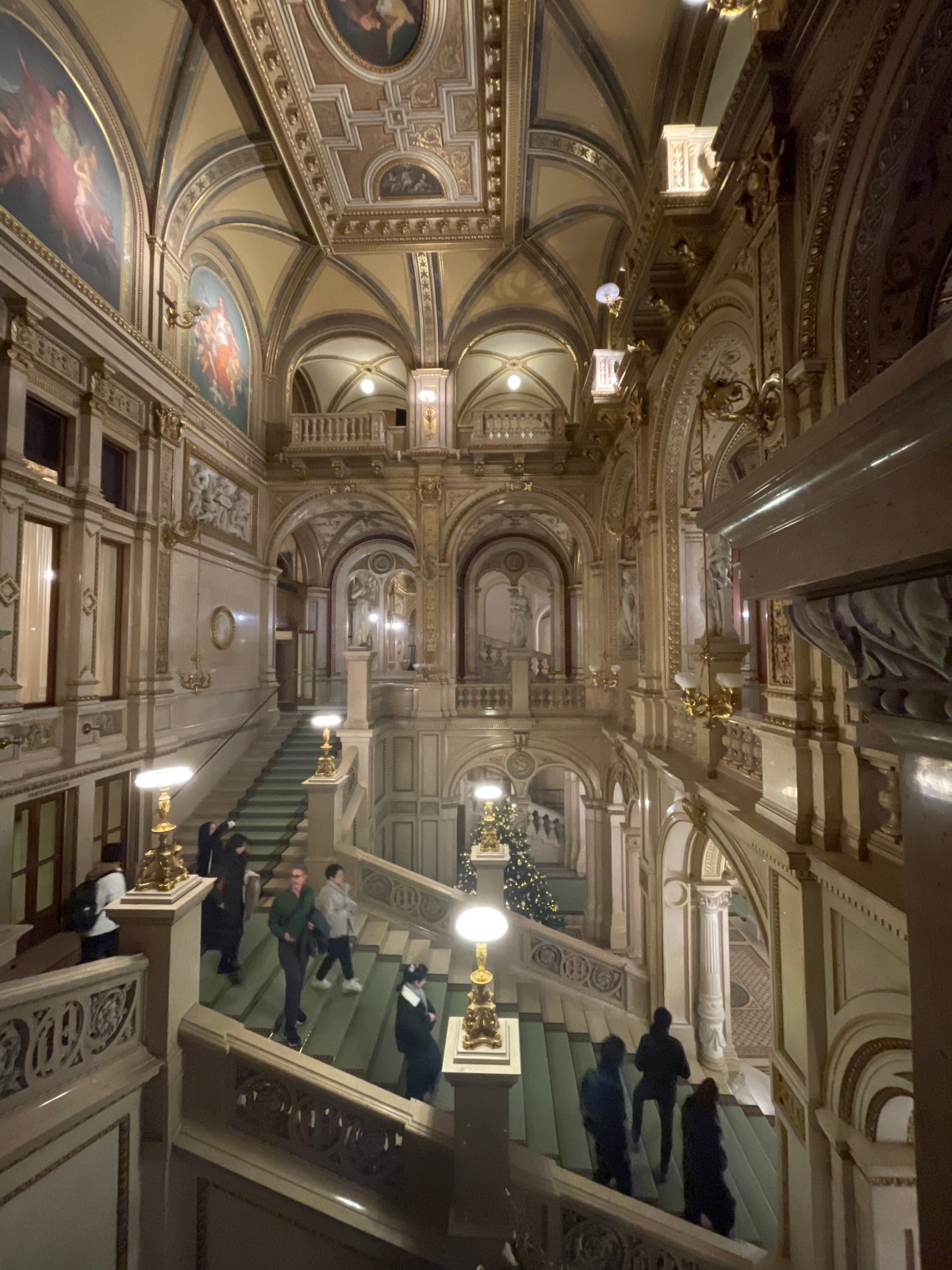
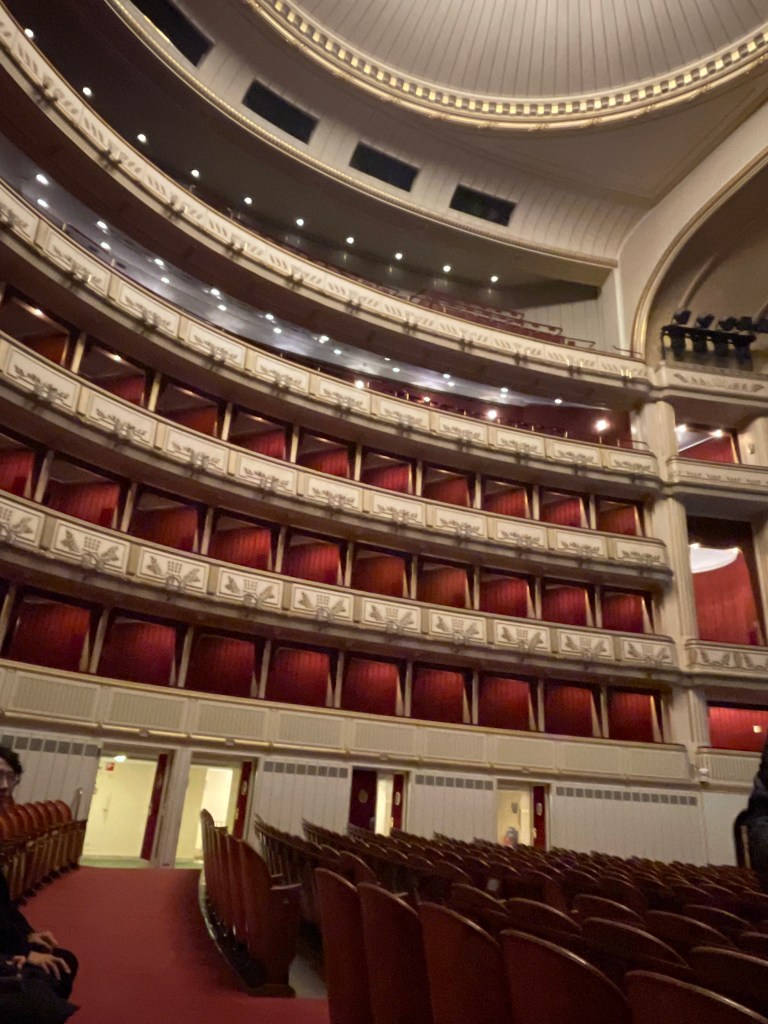
The hall seats more than 1,700 with 400 standing places (with inexpensive tickets). There were 5 levels of balcony seats in 7 tiers. The Opera House was bombed during the war and rebuilt in the 1950s, still beautiful, but not extravagant, except for the huge chandelier high in the ceiling that takes 2 weeks to clean once/year.
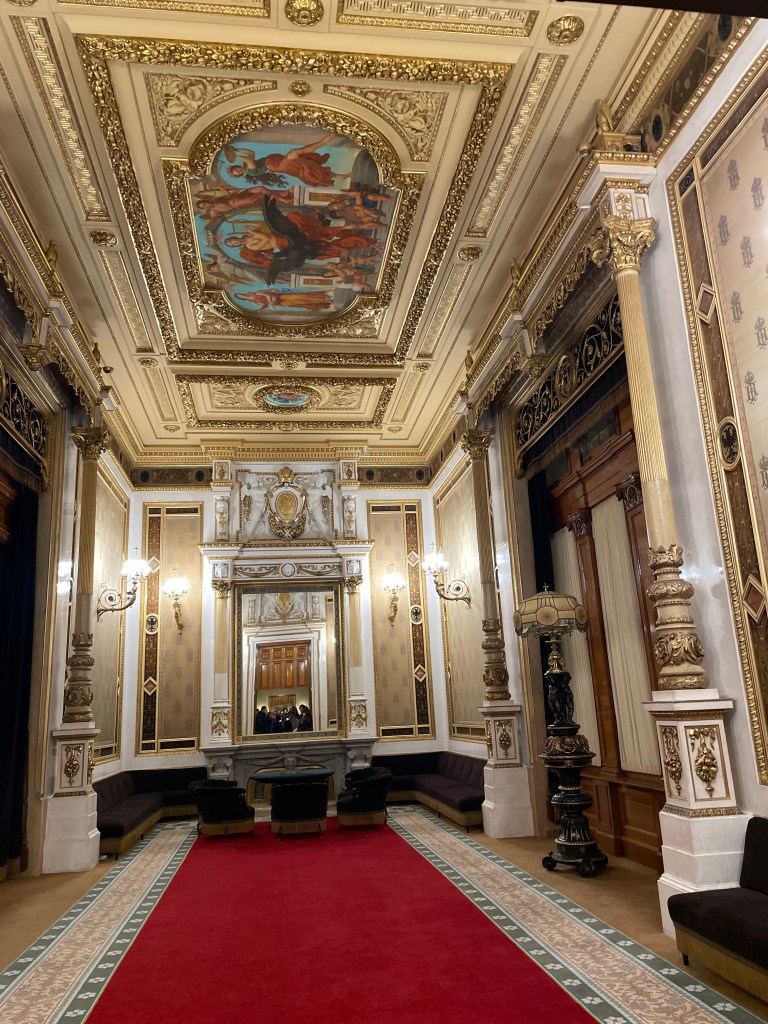
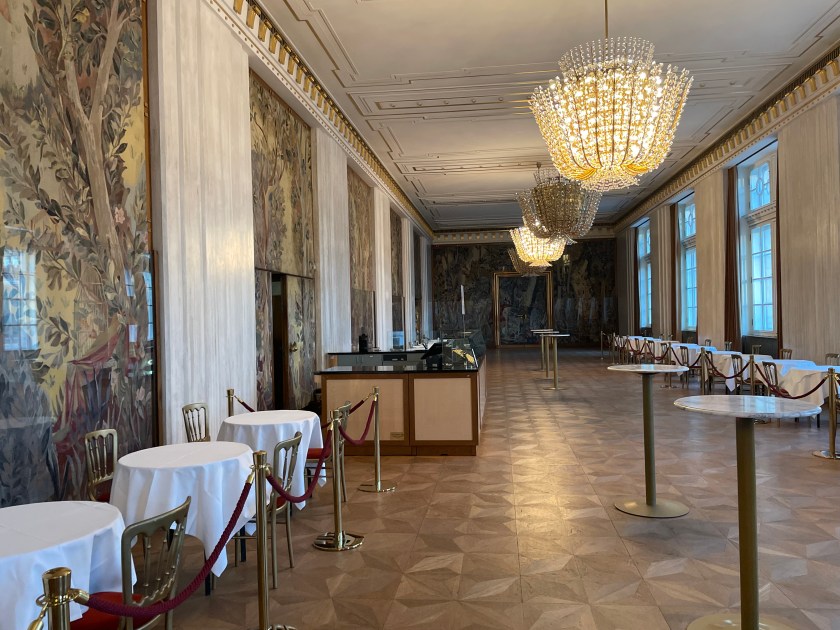
We walked through reception areas and special rooms for important people and went up into the presidential box. It was an interesting visit. Works from all of Vienna’s famous composers and musicians has been performed here. You could almost feel them!
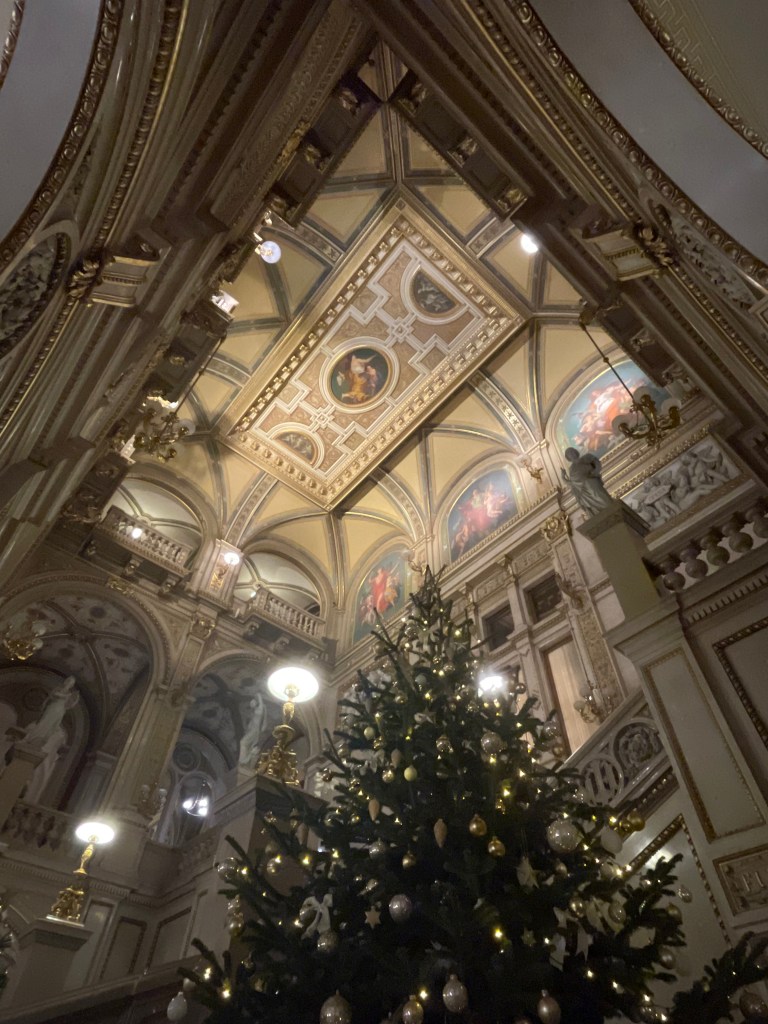
Above is the famous chandelier that takes 2 weeks to clean every year.
Remembrances of the famous composers are showcased in the reception areas.
What a grand and spectacular home for musicians through the years!
The power of tour guide books (think Rick Steves and others) is evident by the number of tourists standing in lines at various cafes, coffee shops and hotels. These guides encourage visitors by recommending they not leave a place without tasting this or that. We saw several lines of people, winding wound around a block, just to buy a piece of chocolate Sachertorte cake. (Which the locals told us is a bit dry, anyway.)
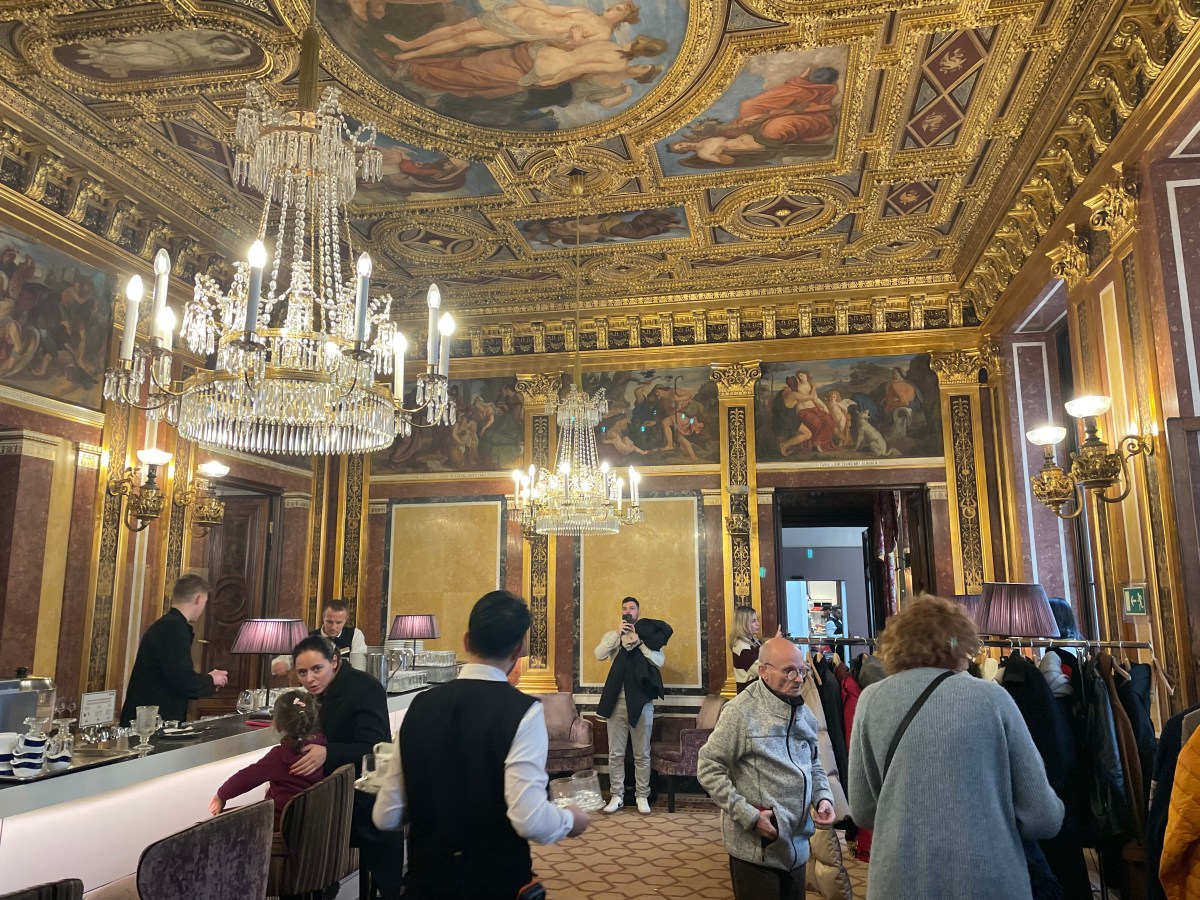
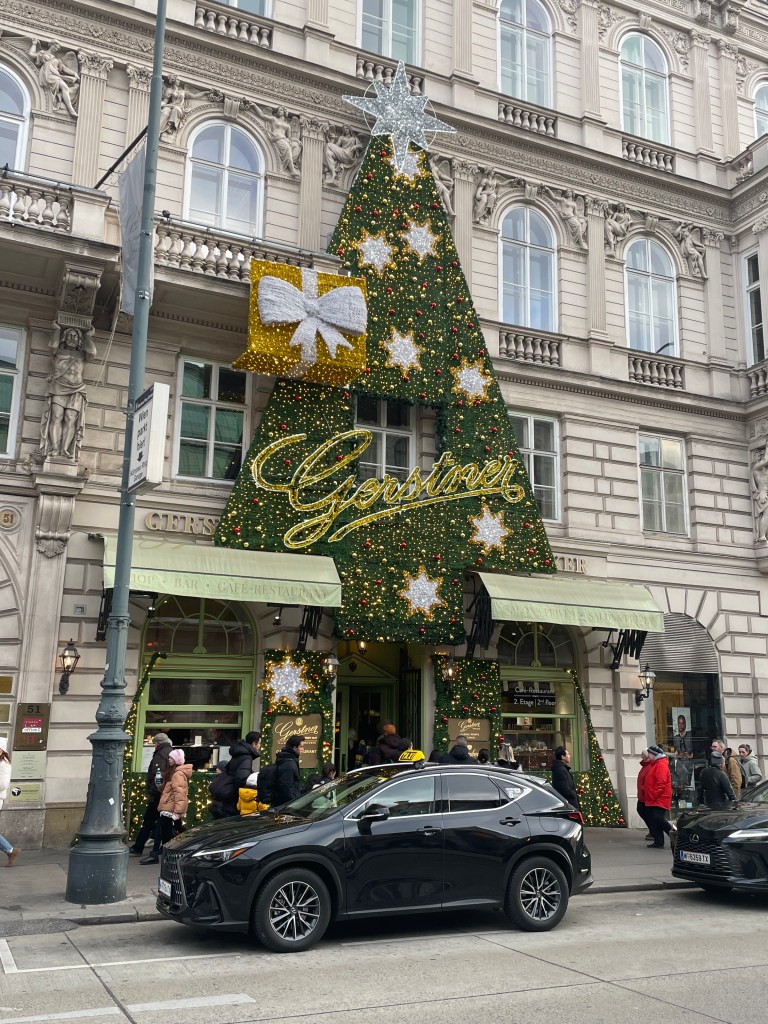
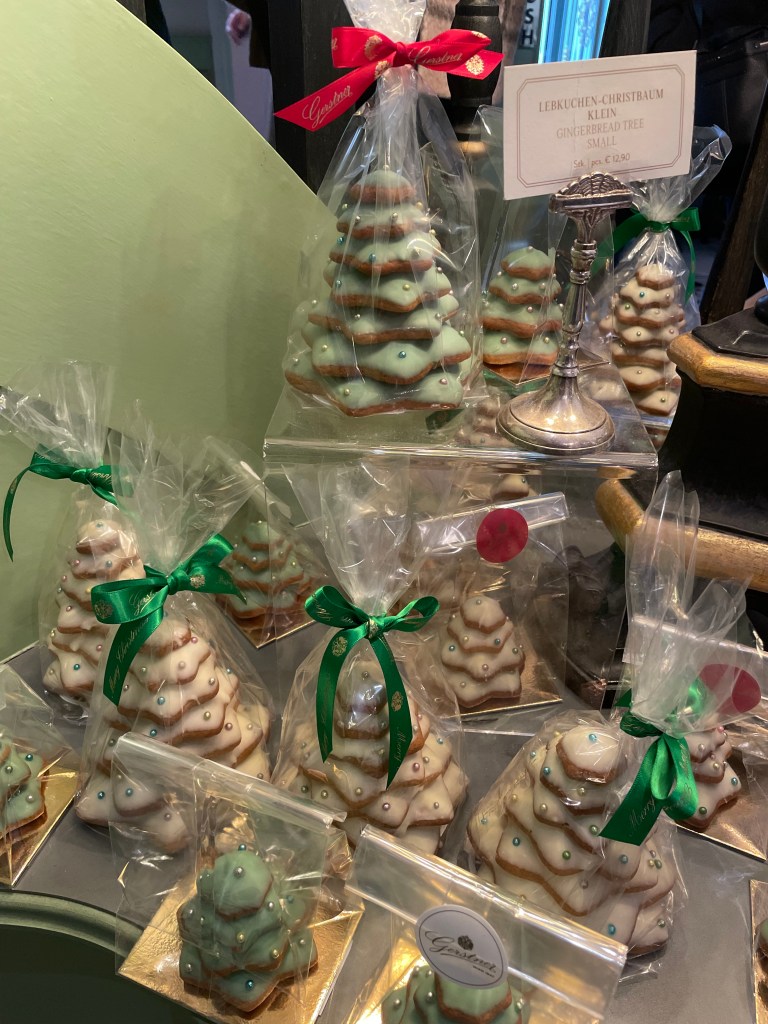
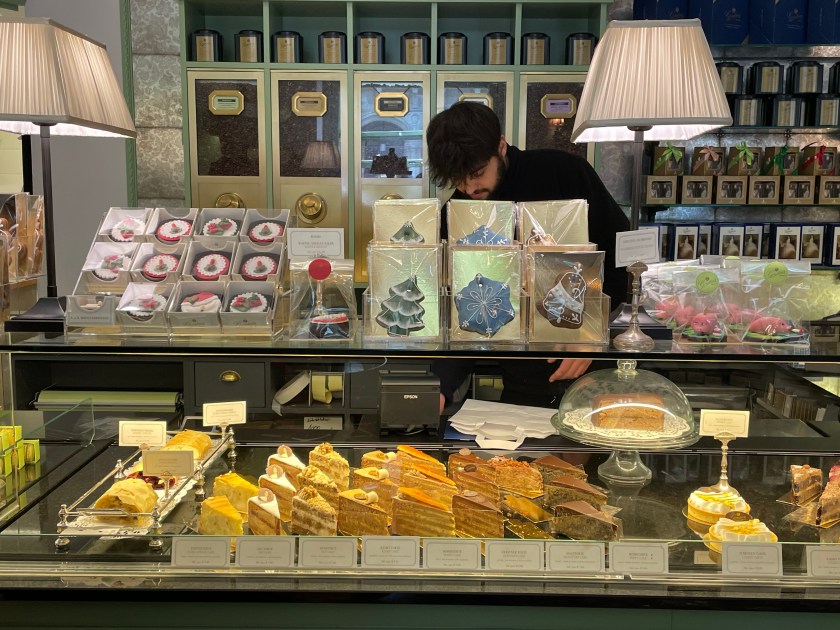
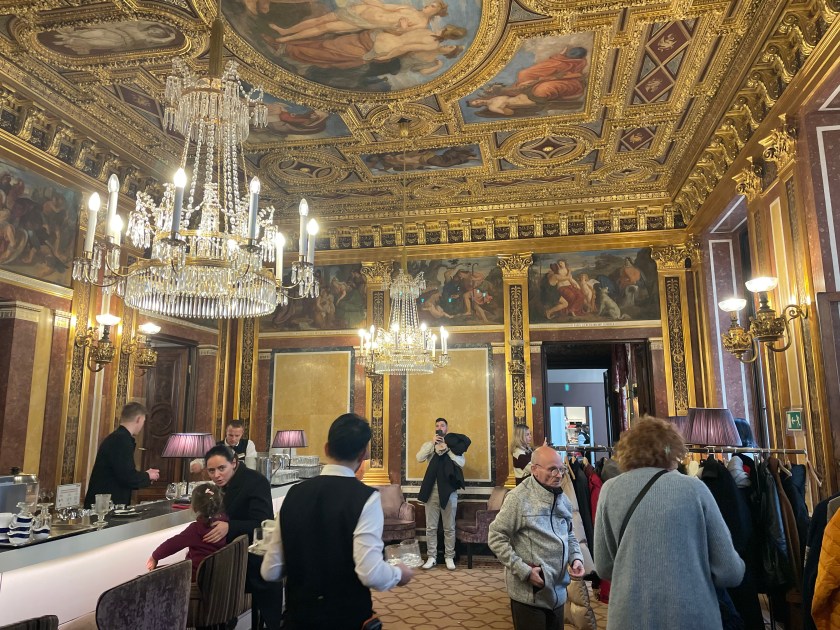
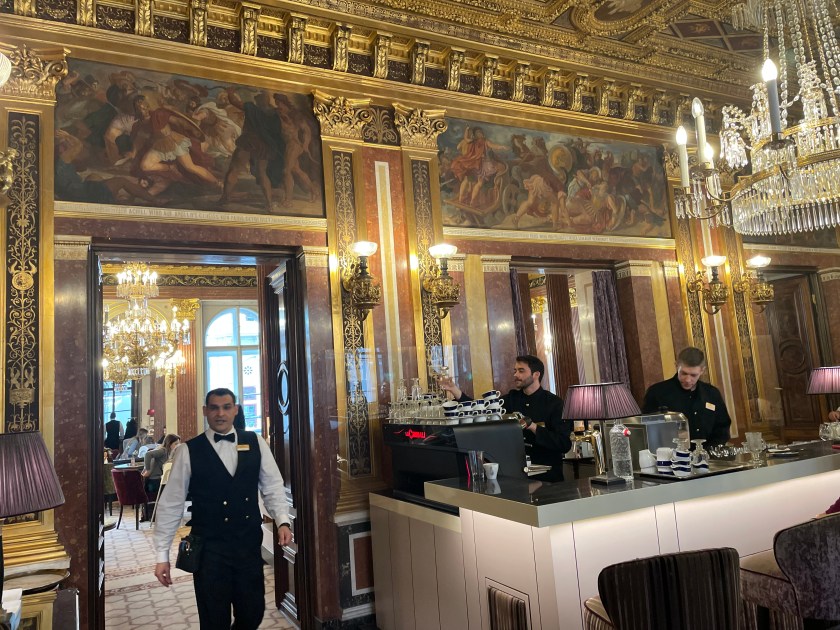
Gerster’s coffee shop is one of those kinds of places. A “must visit” according to the tourist books. Austria is known for its coffee house or cafe culture. We decided to pop our heads into Gerster’s, a very historic coffee house, just to have a look around. We were told these historic cafes are beautiful inside.
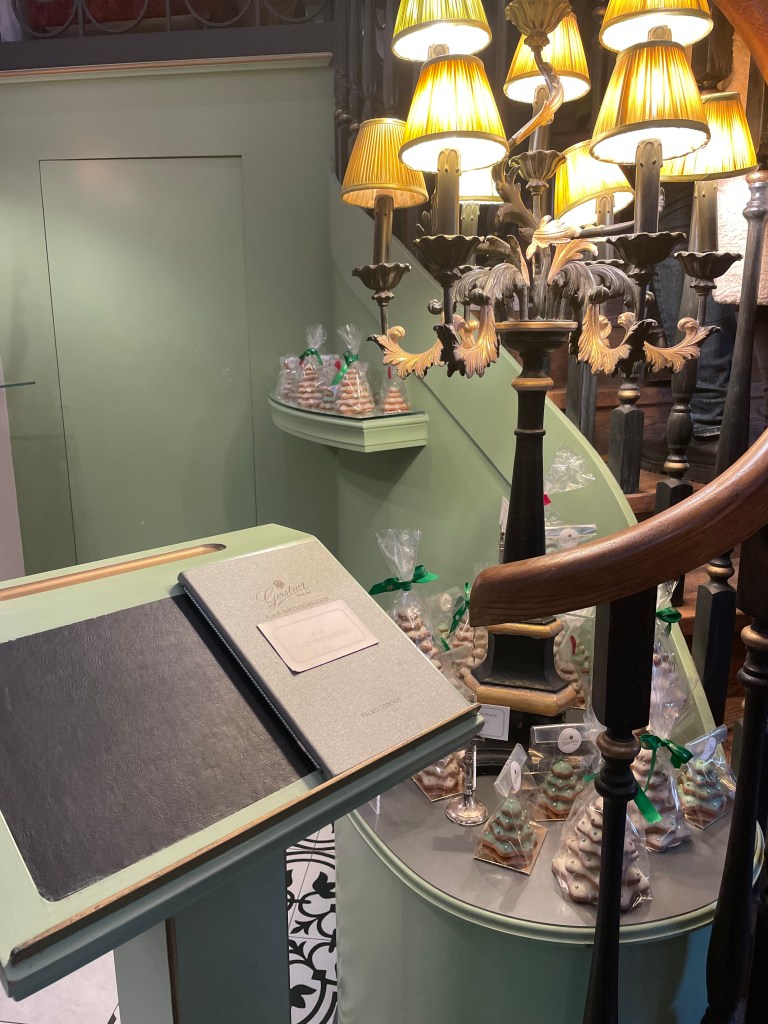
We had to squeeze past the line of people (telling them we were only looking, not staying to be seated). On the lower level was a small gift shop with pastries, cookies and treats. We went up the elevator and got a quick look around before we were asked to leave because we had no reservation. The place was full of traditional Austrians having a traditional Christmas afternoon tea.
The gift shop.
The upstairs parlor.
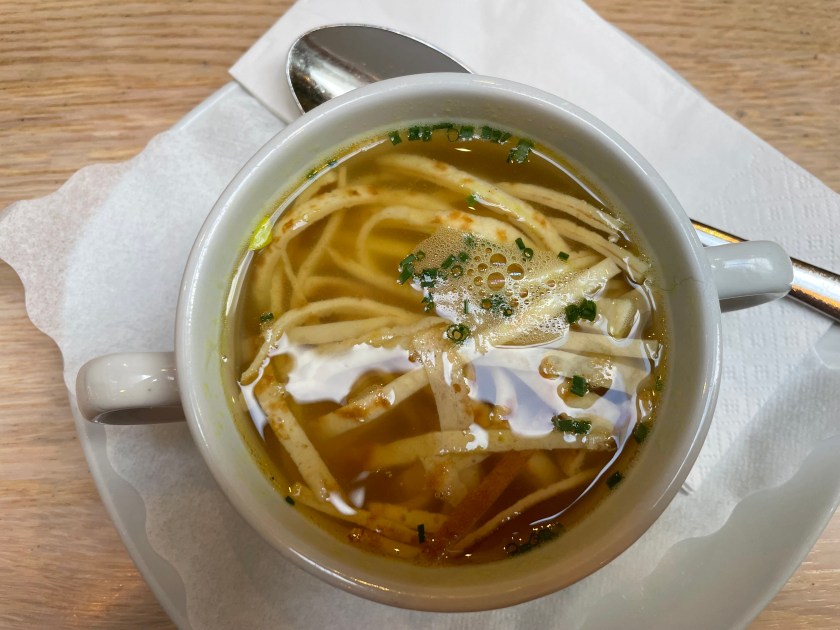
Instead of this hoity toity cafe house, we found a little local restaurant and we each had a bowl of soup. I had chicken broth with a cut pancake (my Grandma used to make this) and it was delicious.
Many of the families around us were celebrating Christmas with a traditional roast duck dinner. It was festive and fun.
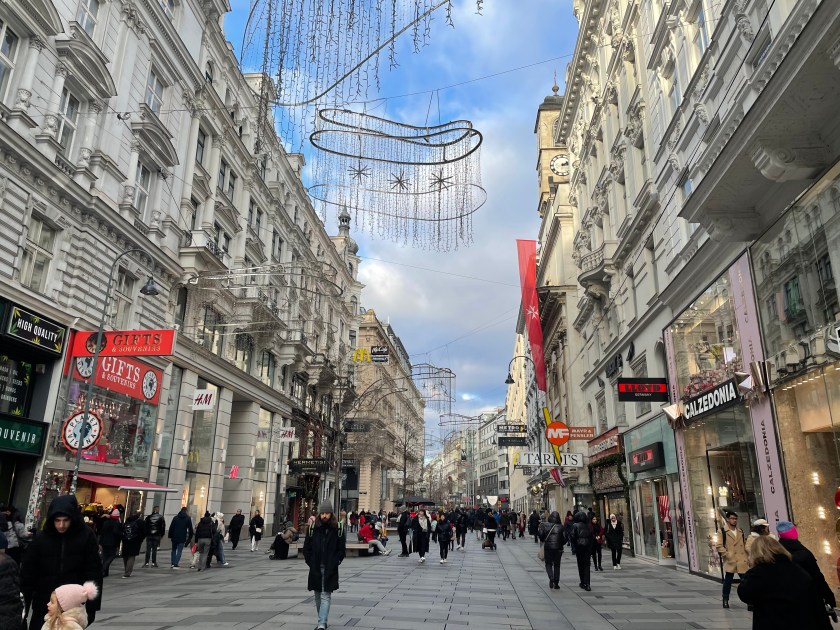
After lunch, there were more and more people in the streets, coming out of their apartments after their late Christmas Eve celebrating. And I suppose many of the people out and about were tourists like us. The many hotels certainly seem to be full of visitors.
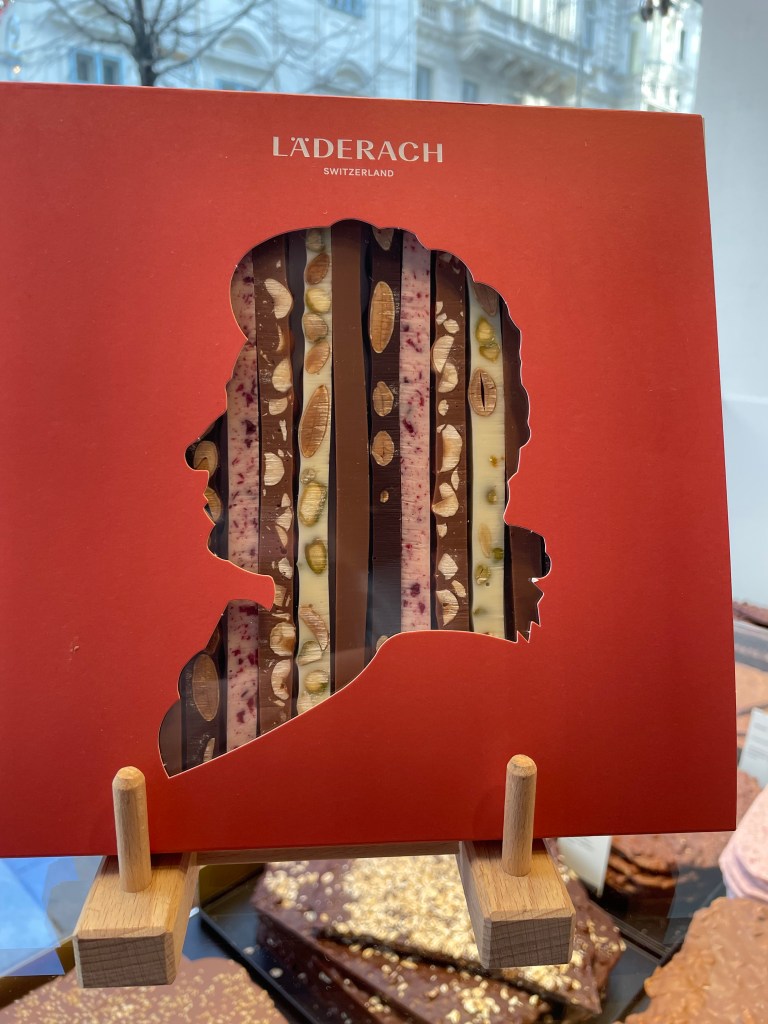
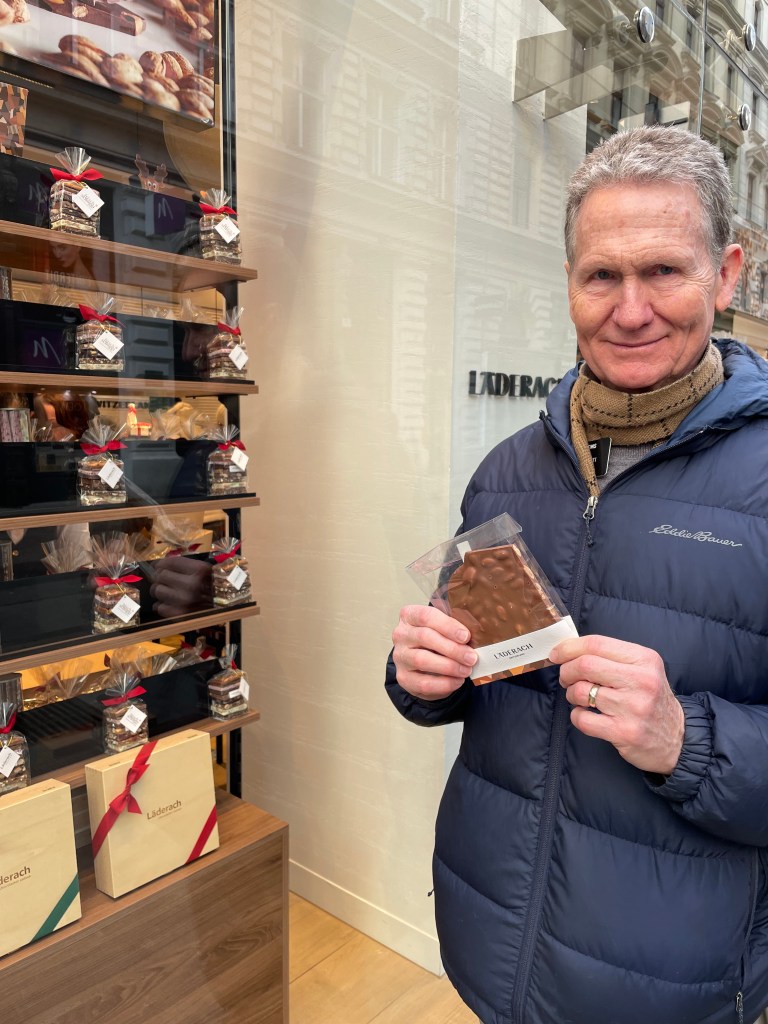
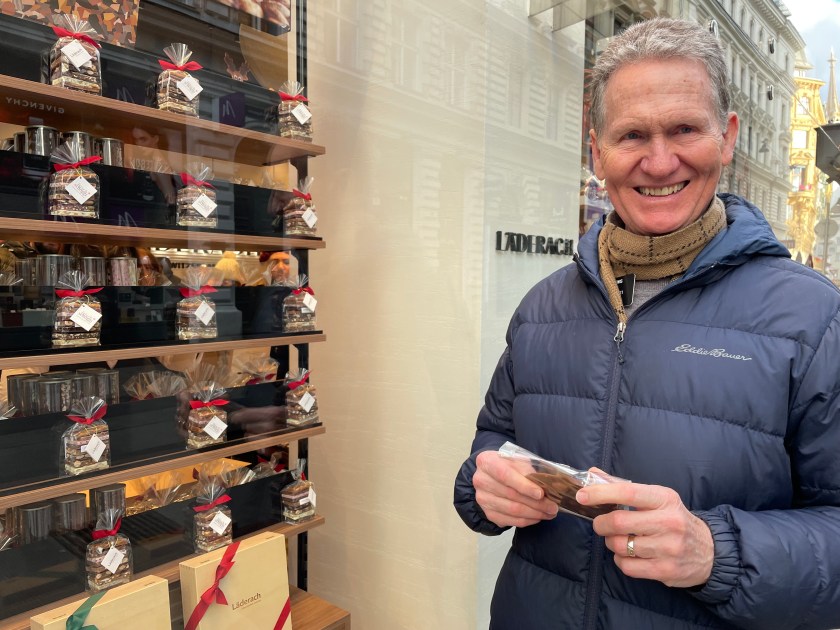
John will not walk quickly by a chocolate shop. This shop has some of his favorite Swiss chocolate.
He wanted the 25 Euro (small) box, but exercised restraint.
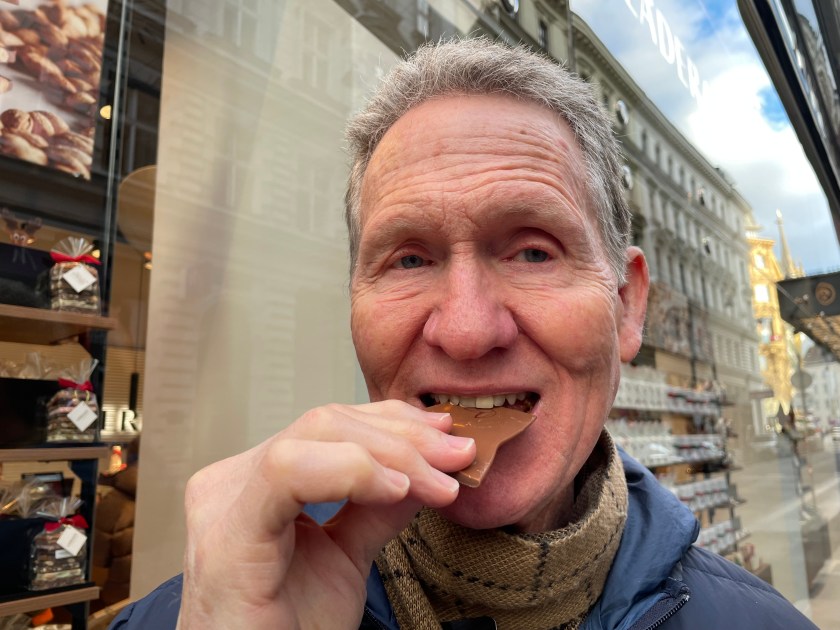
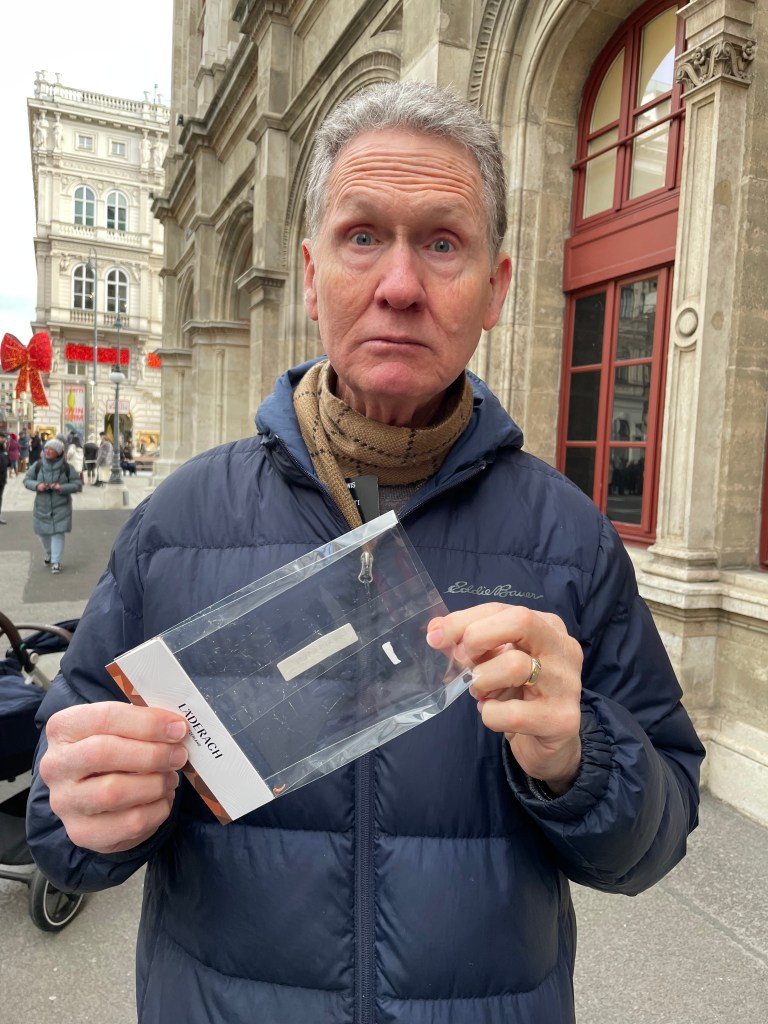
Instead, he got a 8,50 Euro slab of milk chocolate with almonds. It didn’t last long.
Next we were off to the Opera House for a 3:00 tour.
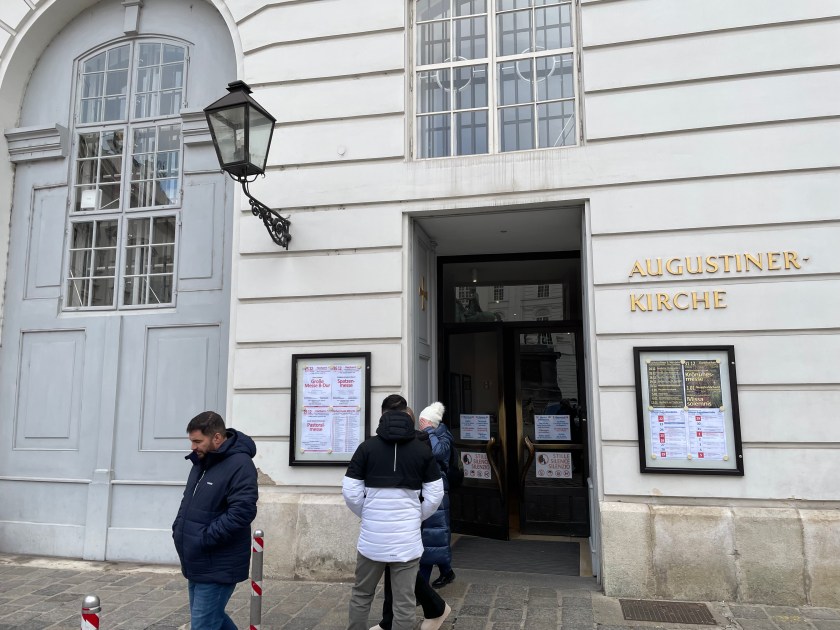
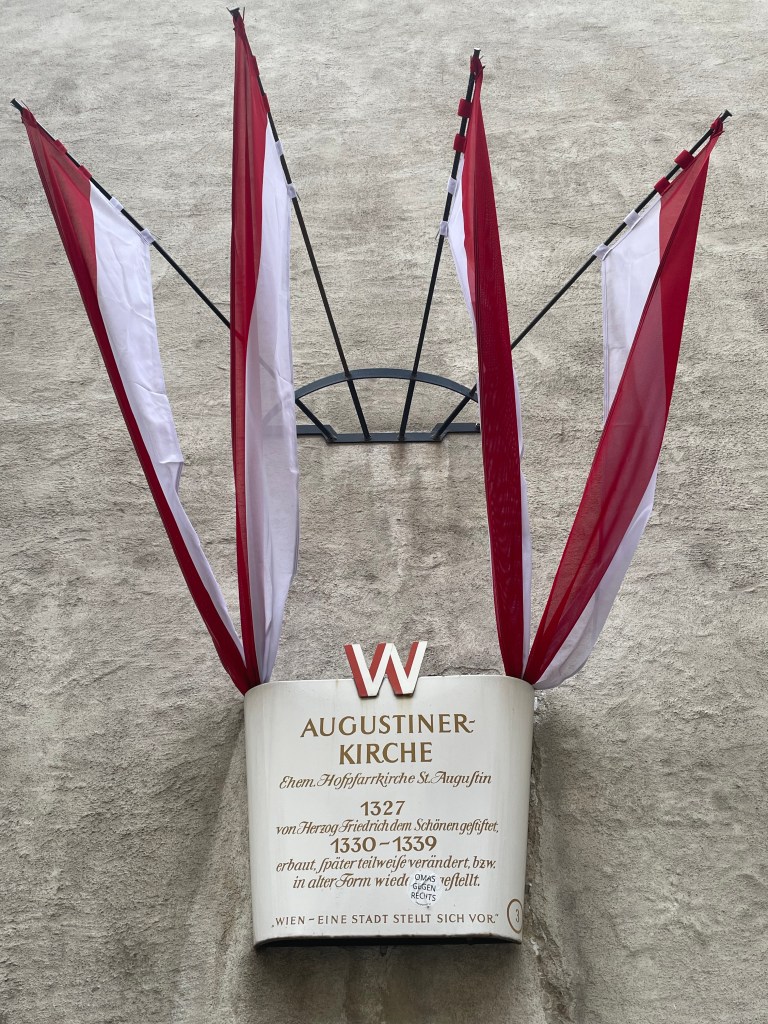
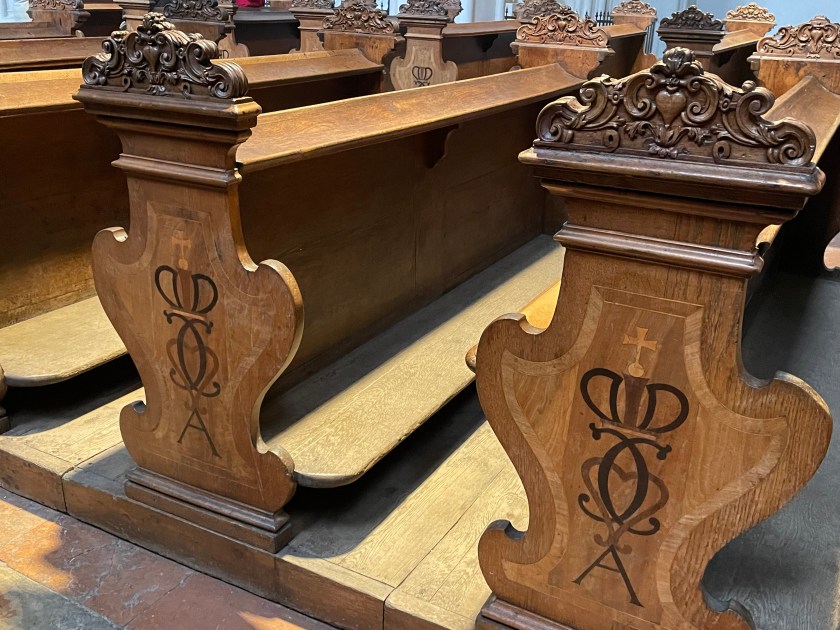
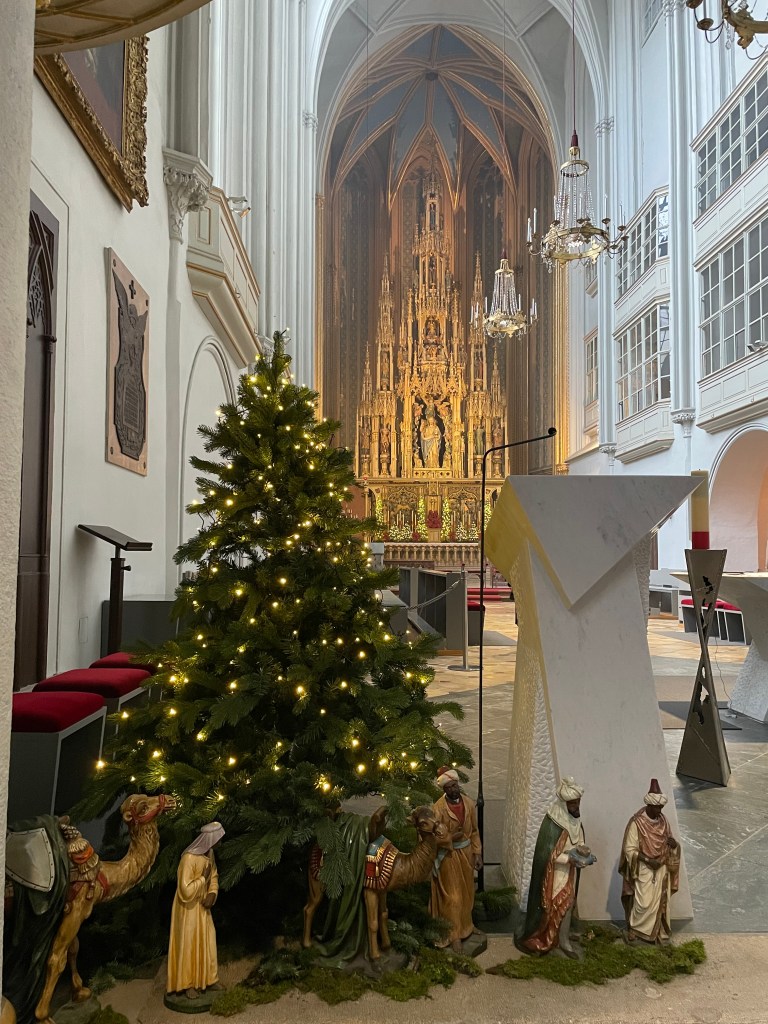
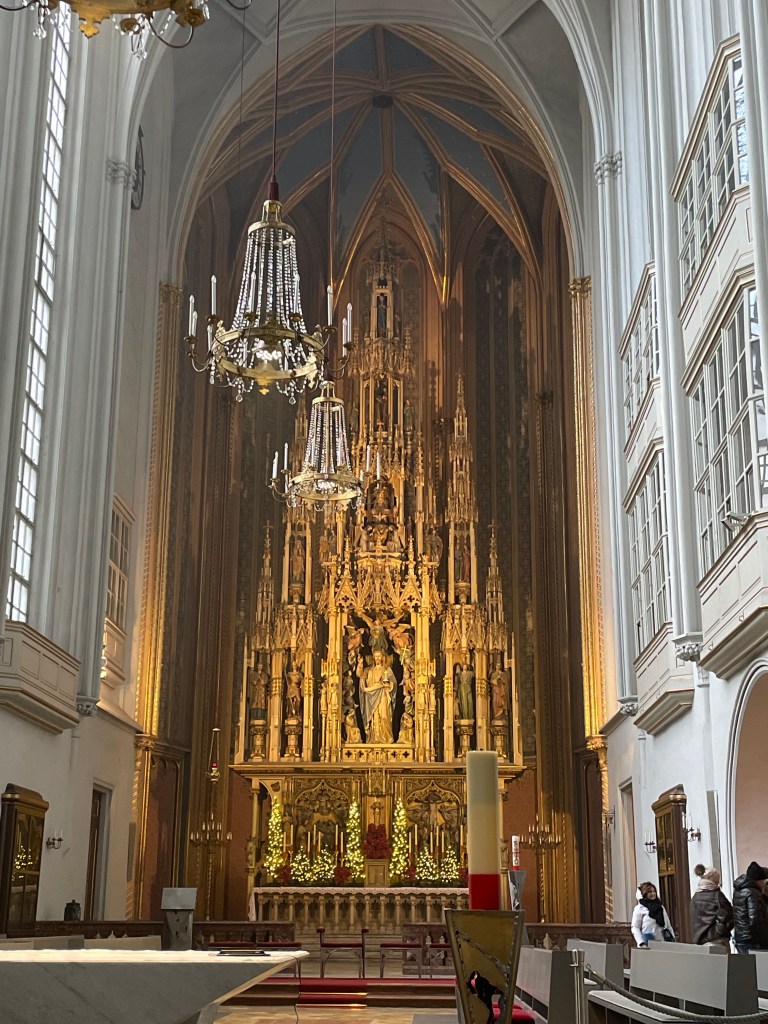
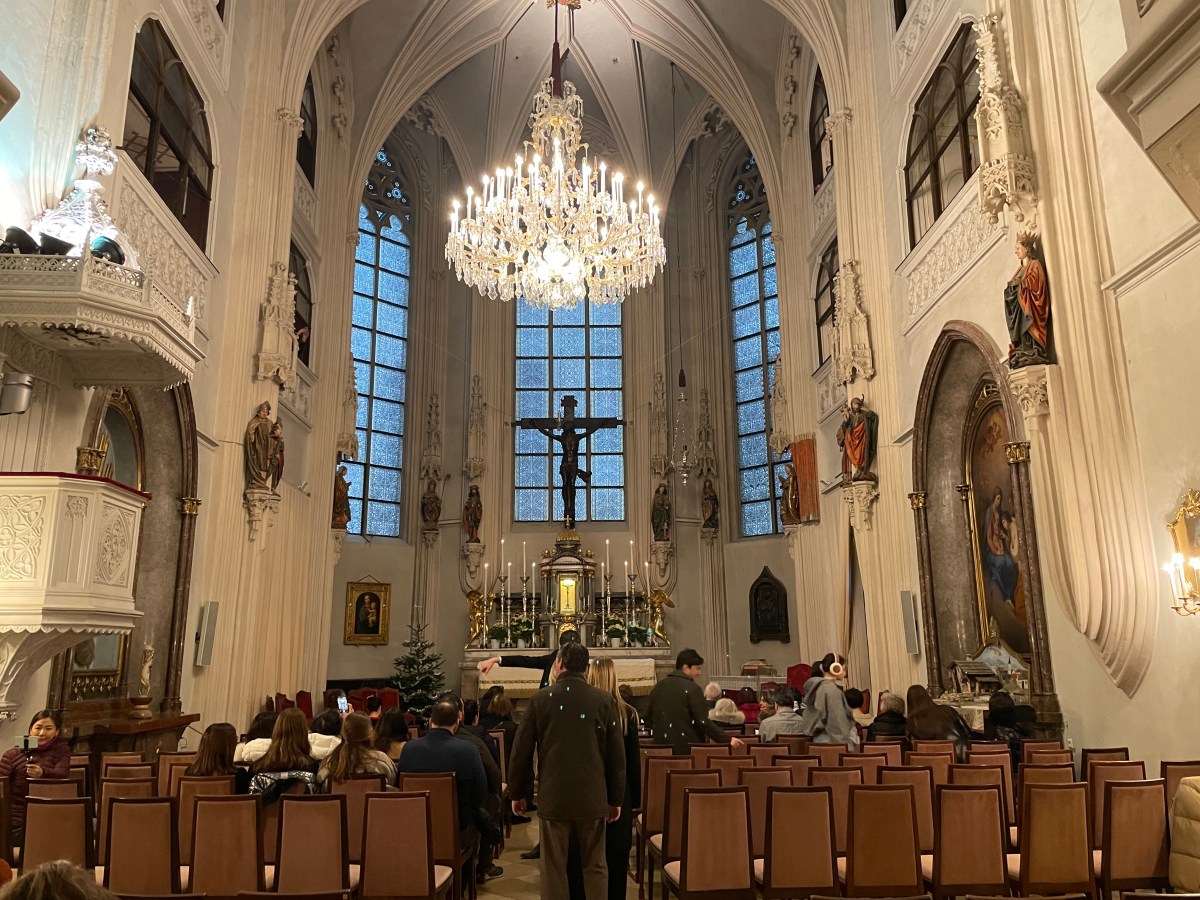
Whenever we see a church, we enter it and feel it. This is the Augustinerkirche in Vienna, a beautiful haven for us on this Christmas afternoon. This church was the Habsburg monarchy’s court church for almost 300 years, built in 1327.
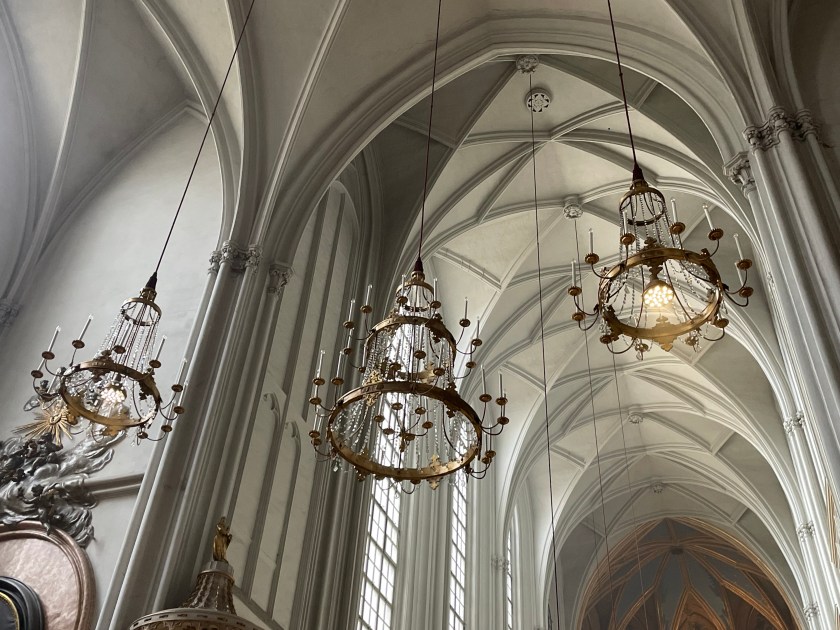
A church service here had just ended. We sat and took it all in. I especially loved the graceful bell-shaped chandeliers hanging overhead with candles (now electric). Everything about this church was graceful.
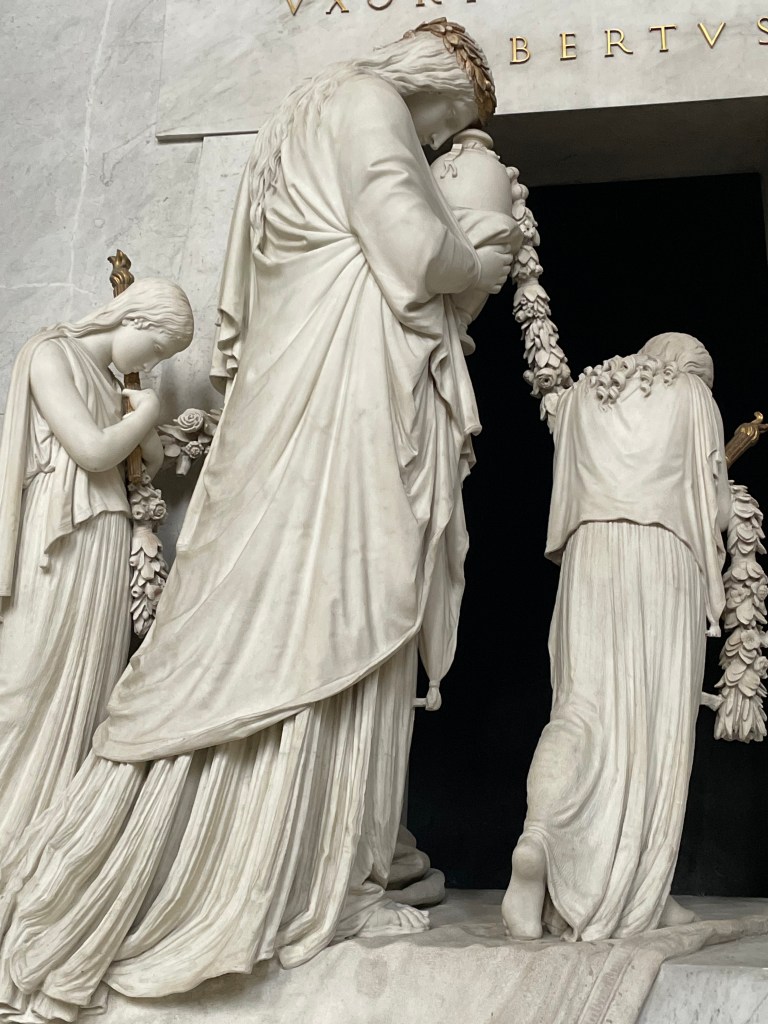
Below is a marble memorial to Archduchess Marie Christine (1742-1798), sculpted by Antonio Canova and commissioned by her husband (Albert of Albertina fame), and completed in 1805.
Various symbolic figures form a funeral procession that seems to enter a darkened gateway to the underworld.
The Augustinerkirche is not a self-contained landmark like Stephansdom cathedral.
(The Augustinerkirche in a 1724 copperplate drawn by Salomon Kleiner, engraved by Hieronymus Sperling and published by Johann Andreas d. Ä. Pfeffel; Wien Museum Inv.-Nr. 105765/14; excerpt reproduced with permission under the terms of the CC0 licence).
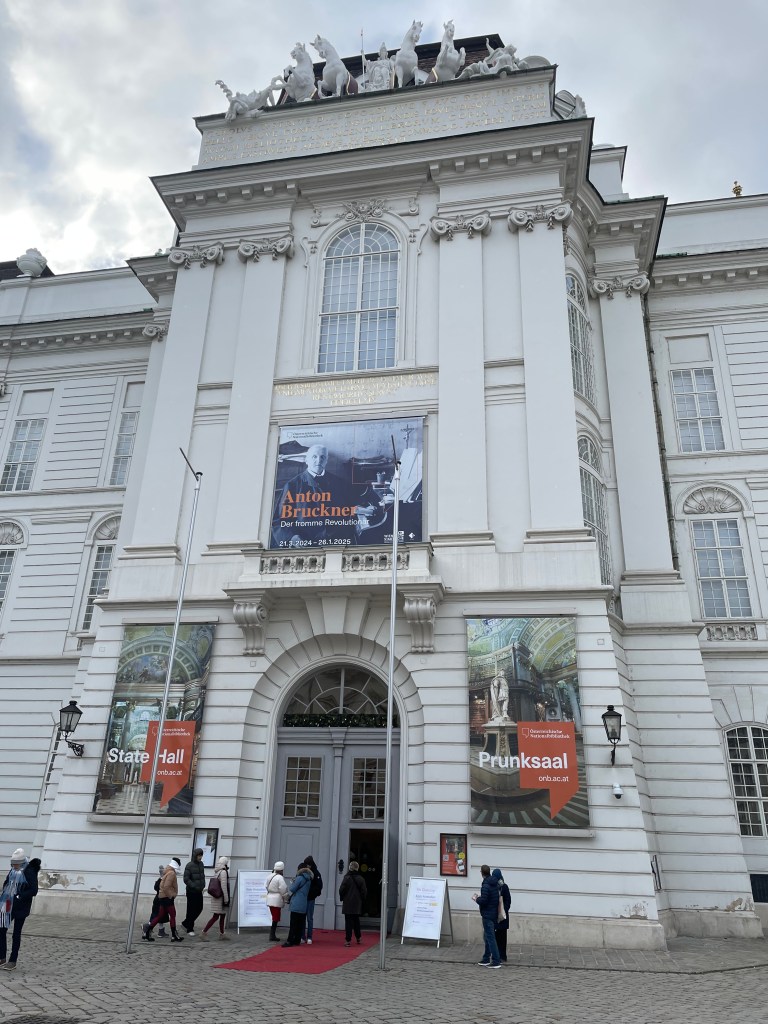
Instead, the building shares a near-continuous façade with the Albertina on one side and the extraordinary state hall and other offices of the National Library on the other.
The modest, unassuming appearance can mislead visitors, since the church is redolent with history.
From 1634 to 1918, for example, it served as the official court church for the Habsburg monarchs. The hearts of many of them rest in a crypt within the church walls.
Most famously, perhaps, the church played host to various royal weddings. Among the couples joined together beneath its roof:
Emperor Franz Joseph and Elisabeth of Bavaria (1854)
Crown Prince Rudolf and Stephanie of Belgium (1881)
Empress Maria Theresa and Franz Stephan of Lorraine (1736)
Archduchess Marie Louise and Napoleon Bonaparte (1810)
Maria Antonia (Marie Antoinette) and King Louis XVI of France (1770)
The last two weddings mentioned took place in the absence of the bridegroom (which was a thing in those days). For example, Napoleon asked Marie Louise’s uncle, Archduke Karl, to represent him.
—————
The crypt with the hearts of the Habsburgers is also found in a nave in this church (we did not see it today). Some very interesting information is below.
From Wikipedia:
private chapel of the Habsburgs
Over time, the Loreto Chapel in the Augustinian Church became the most important pilgrimage center for the Viennese and the nobility. The Augustinian Church itself was elevated to the status of an imperial court parish church in 1634 and the Loreto Chapel was given the status of a public private chapel of the imperial family. Emperor Ferdinand II used to pray here for the victorious outcome of his military campaigns. As a result, the custom became established of dedicating battlefields, flags and victory trophies taken from the enemy to the “Mother of Loreto” and placing them in the chapel.
The first court wedding that took place in the small chapel was that of the future Emperor Ferdinand III with the Infanta Maria Anna of Spain in 1631. His wedding and that of his sister Cecilia Renata are the only weddings that took place in this small chapel. But even subsequently, no court wedding took place in the Augustinian Church without prior devotions in the Loreto Chapel.
The women of the House of Habsburg prayed for offspring in the chapel, and the first devotions of the imperial mothers after the birth of their children were held here. In 1756, Maria Theresa had the weight of her youngest son Maximilian Franz weighed in gold and placed on the altar of the “House Mother of the Arch-House of Austria” in the Loreto Chapel.
burial place of the Habsburg
The Loreto Chapel became the burial place of the Habsburgs when Ferdinand IV (1633–1654) had his heart buried here. During his lifetime, he had particularly venerated the Mother of God Mary and stipulated in his will that his “ heart should be laid under the feet of our beloved Fawen Maria in Loreto and buried . ”
Until then, the hearts of the deceased Habsburgs had usually been buried next to the body in the same coffin or in St. Stephen’s Cathedral . When Ferdinand IV died, his body was dissected that same evening, his heart was placed in a cup and displayed next to the body on the display bed during the solemn laying in state . One day after his death, at nine o’clock in the evening, the heart was transferred to the Augustinian Church, where it was buried in a simple ceremony next to the statue of the Virgin Mary in the Loreto Chapel.
The later Austrian Habsburgs kept this custom until the 19th century. In a court decree from 1754, the custom of “distributing the body for burial at different locations ” is described as follows: “ In the Archducal House of Austria, three churches in Vienna always have a share in the body of a ruling lord .”
The bodies of the deceased monarchs and their closest relatives were buried in the Capuchin Crypt , the hearts in the Loreto Chapel of the Augustinian Church and the entrails in the Duke’s Crypt in St. Stephen’s Cathedral . The organs were wrapped in silk cloths, placed in spirit and the containers were soldered shut.
Until 1784, the heart crypt consisted of a small marble-lined chamber in the floor behind the altar and the wall niche with the statue of the Virgin Mary. The chamber in which the heart urns were placed was about 40 cm deep. An iron plate and a marble plate above it formed the closure. The sacristy chronicle of the Augustinian Church gives the following description of this old sepulchre: “ The little chamber where the hearts of the emperors and all of the House of Austria are located is in the Loreto Chapel under Our Lady in front of the fireplace. Under the pavement there is a slab, 3 shoes 6 inches long and 3 shoes 4 inches wide, under which is the little stone chamber, like a little dagger, a shoe and a half deep, two shoes 10 and a half inches long in width and two and a half shoes wide in width, in which the boxes with the hearts are located. ”
Until the Loreto Chapel was moved to its current location, 21 hearts of members of the House of Habsburg were buried in the Heart Crypt.
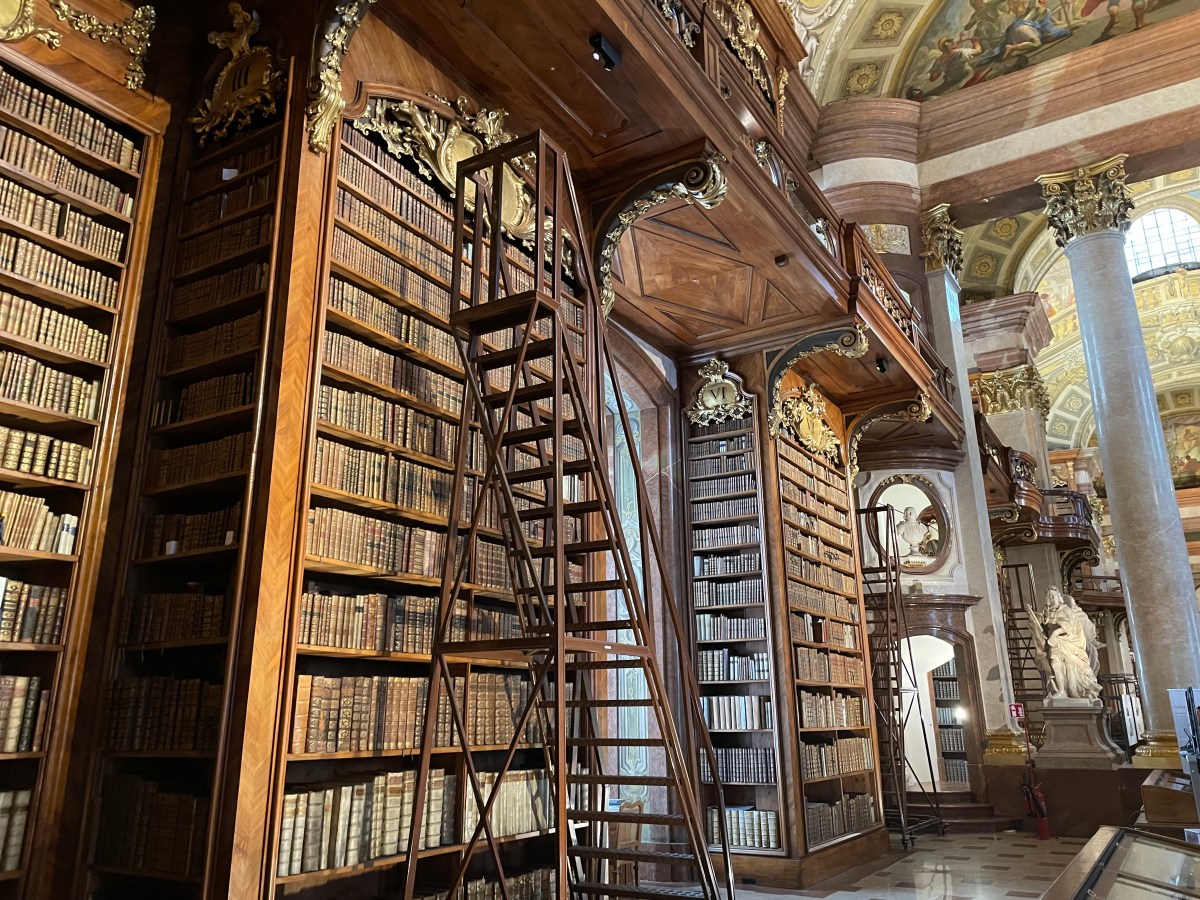
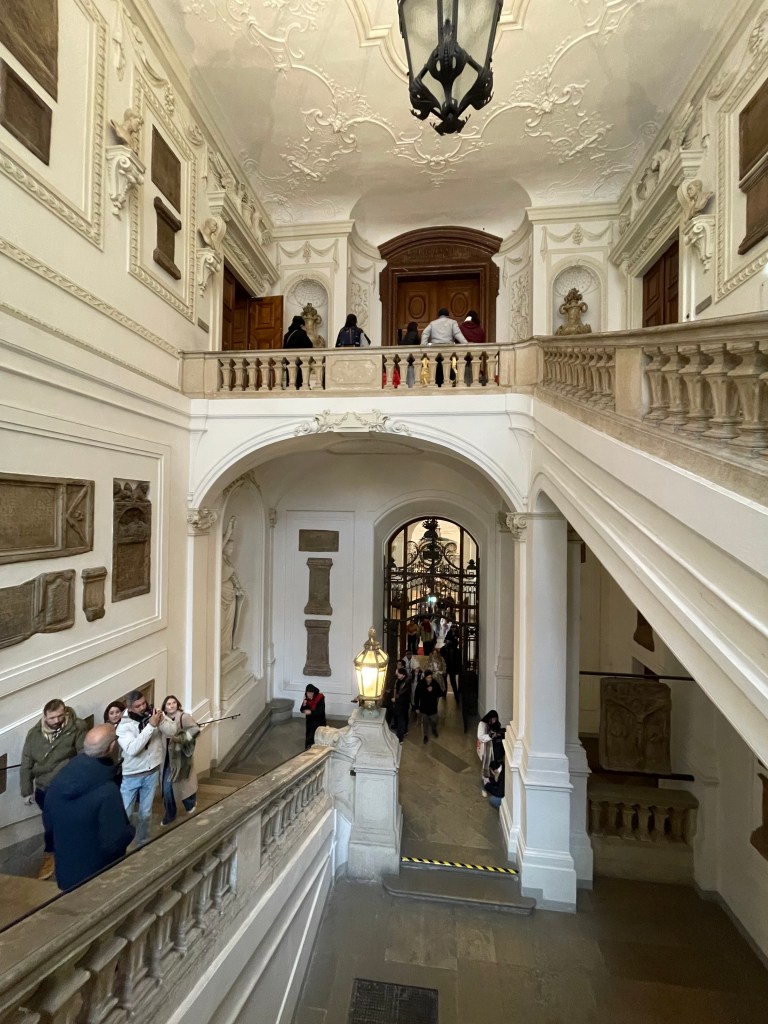
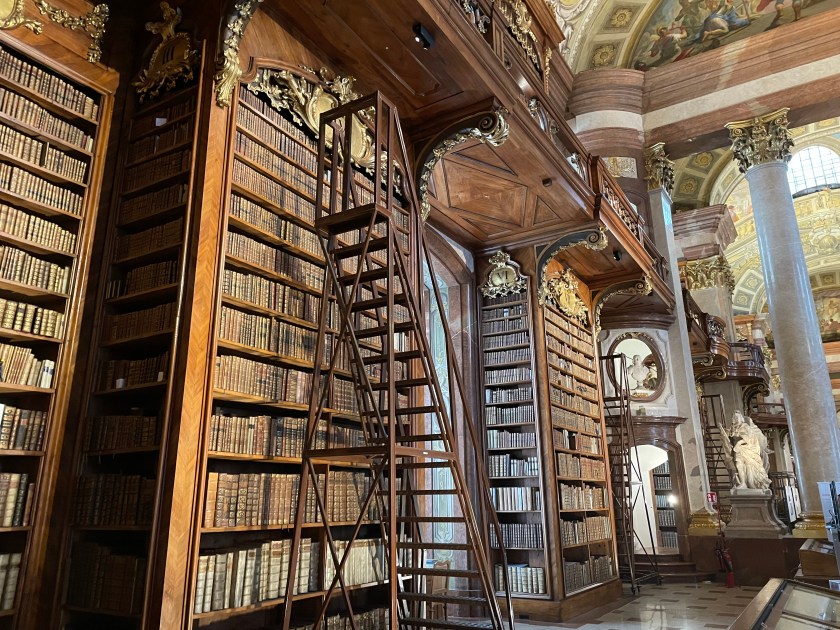
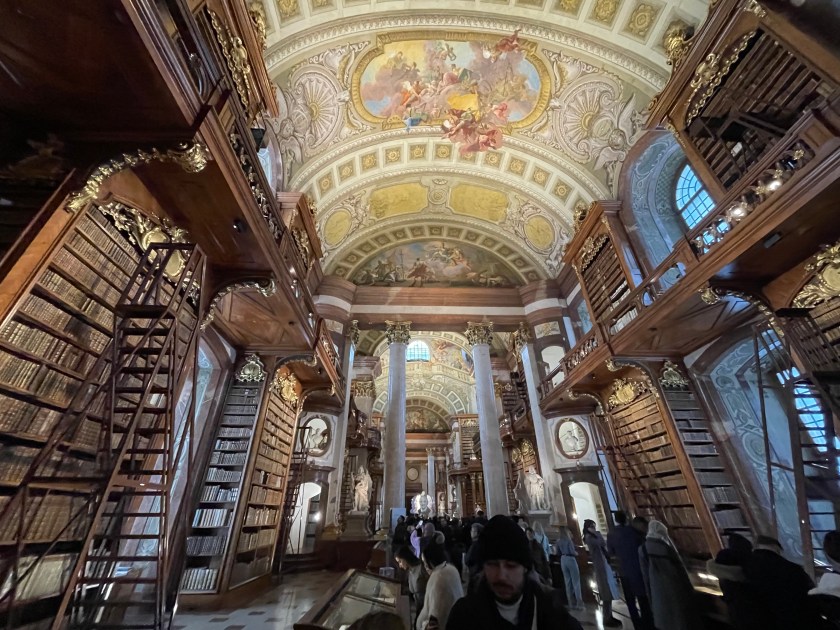
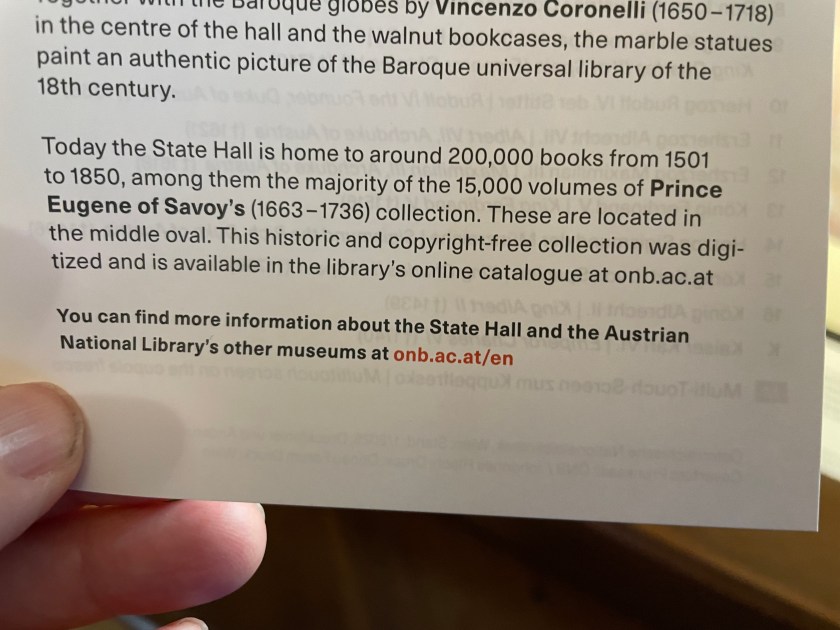
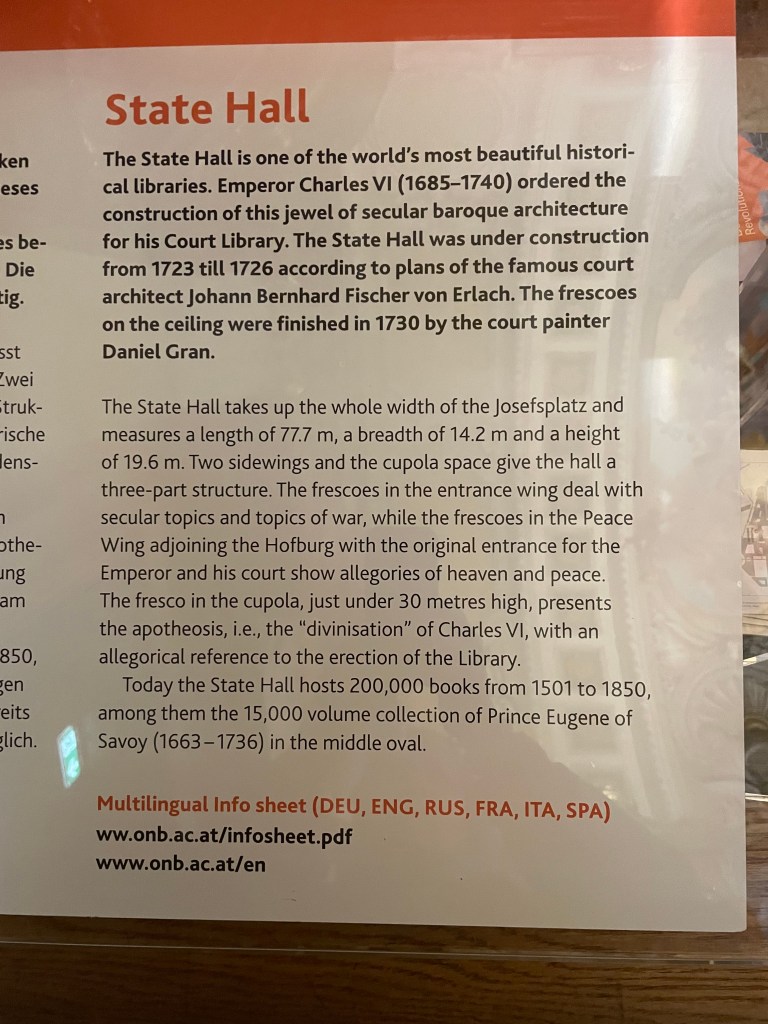
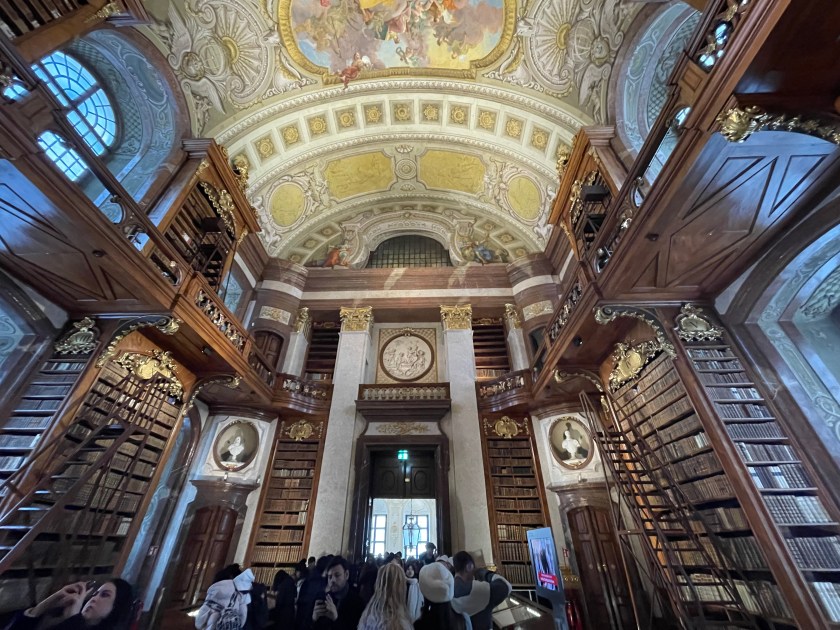
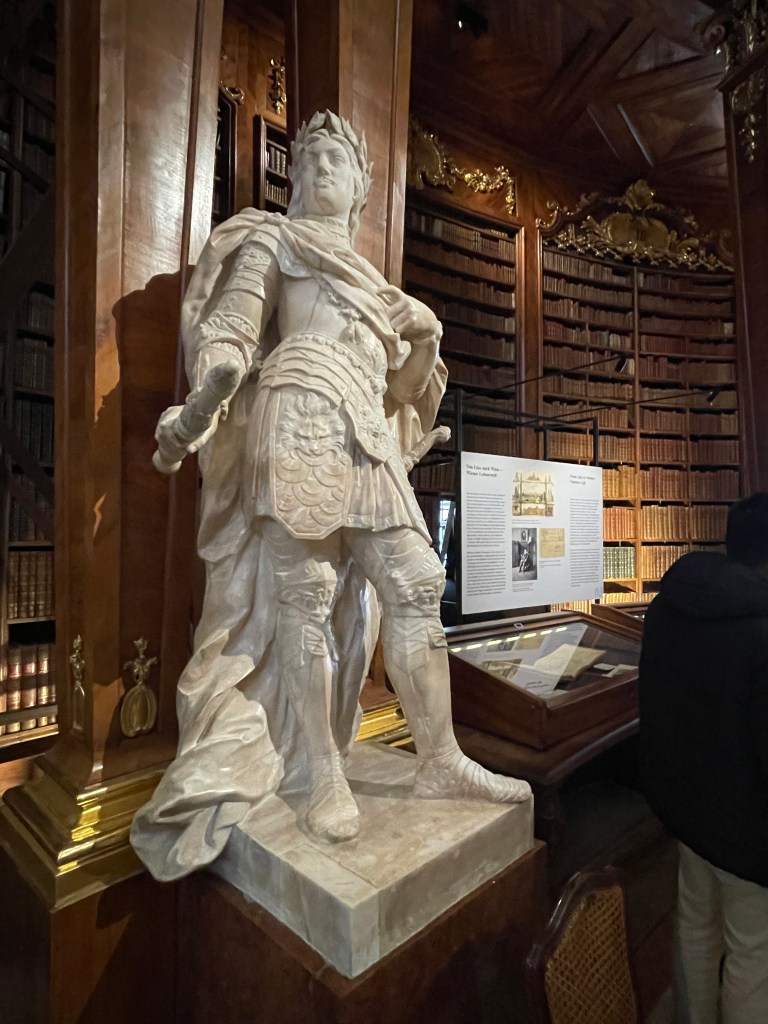
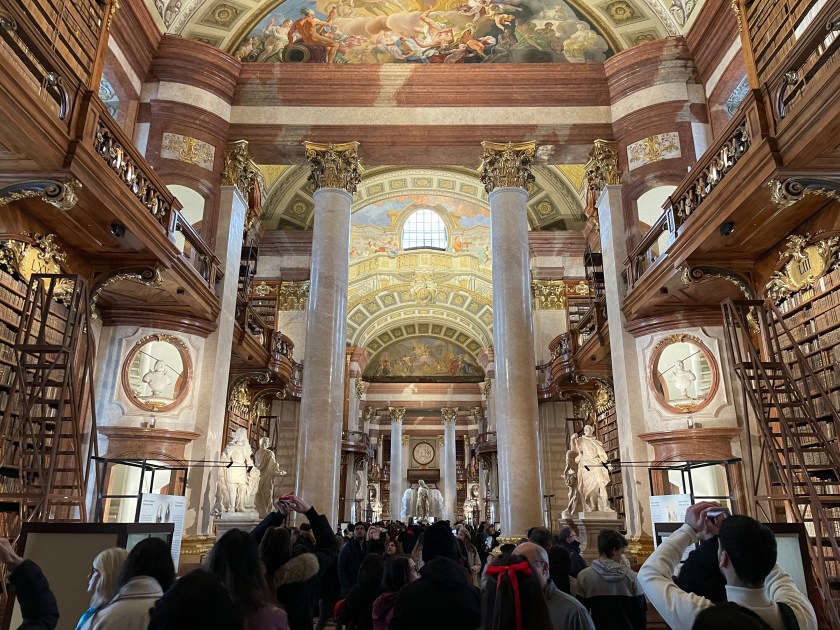
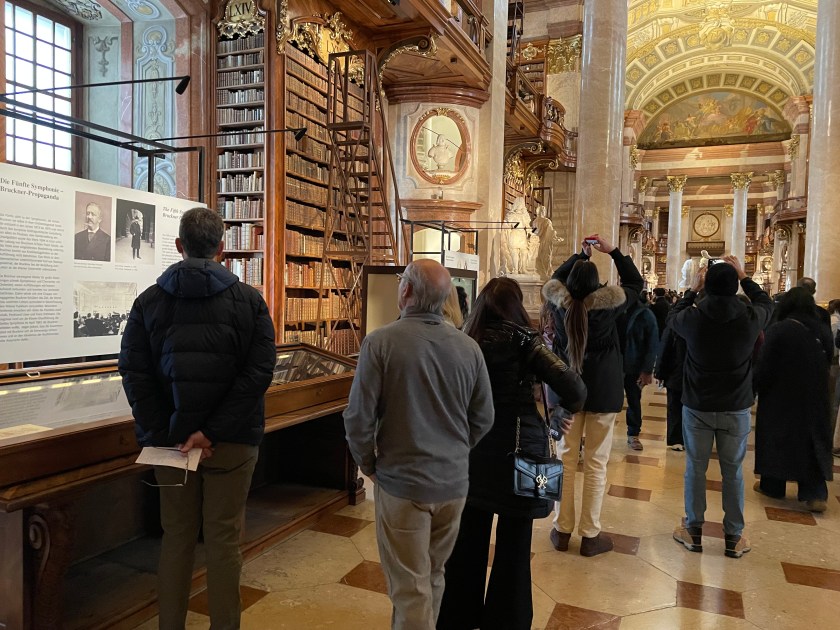
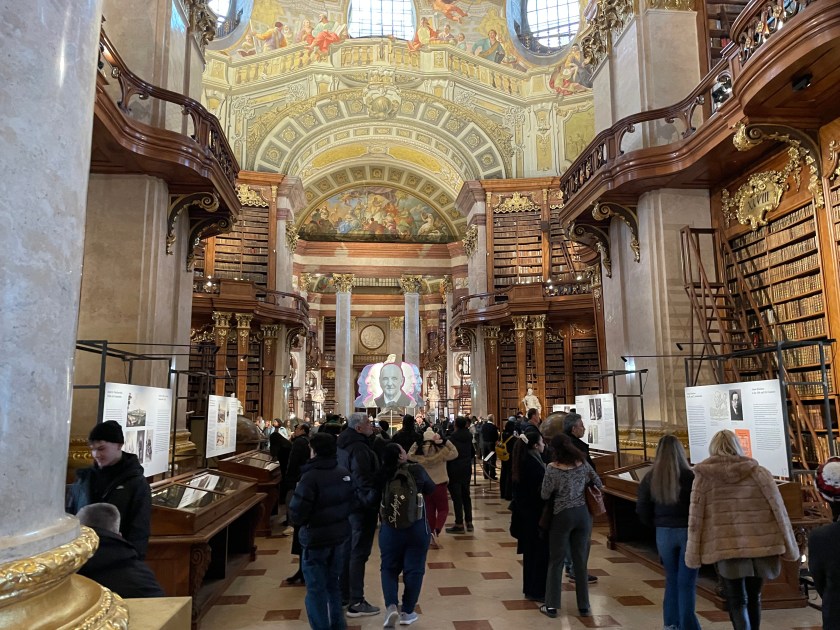
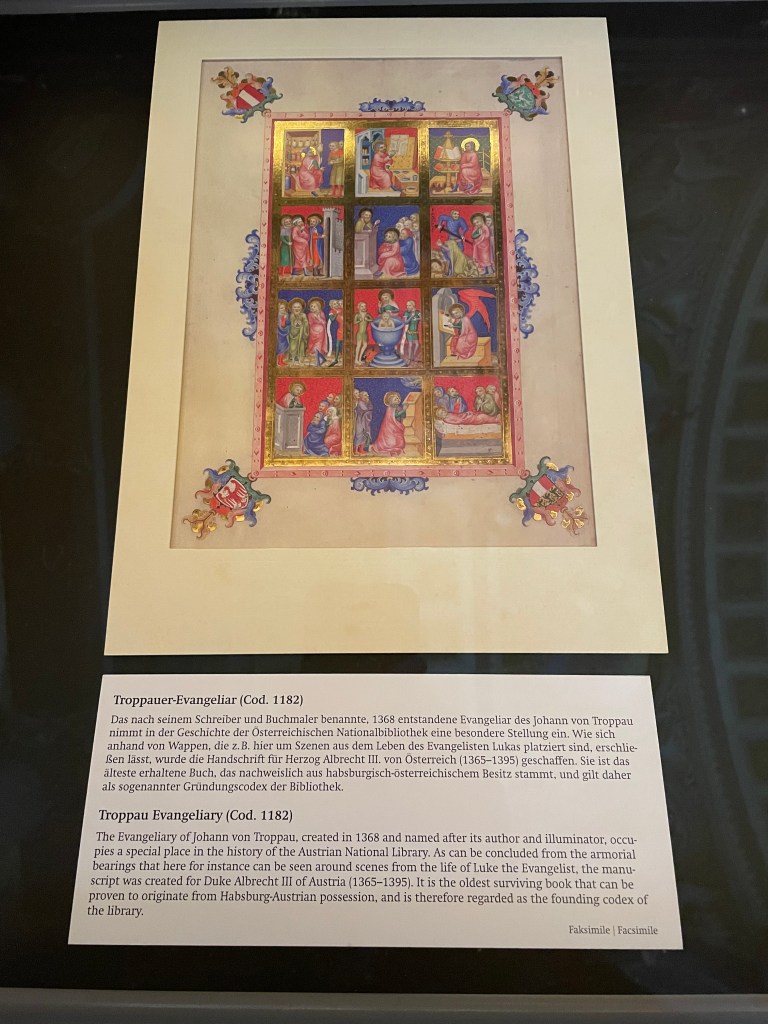
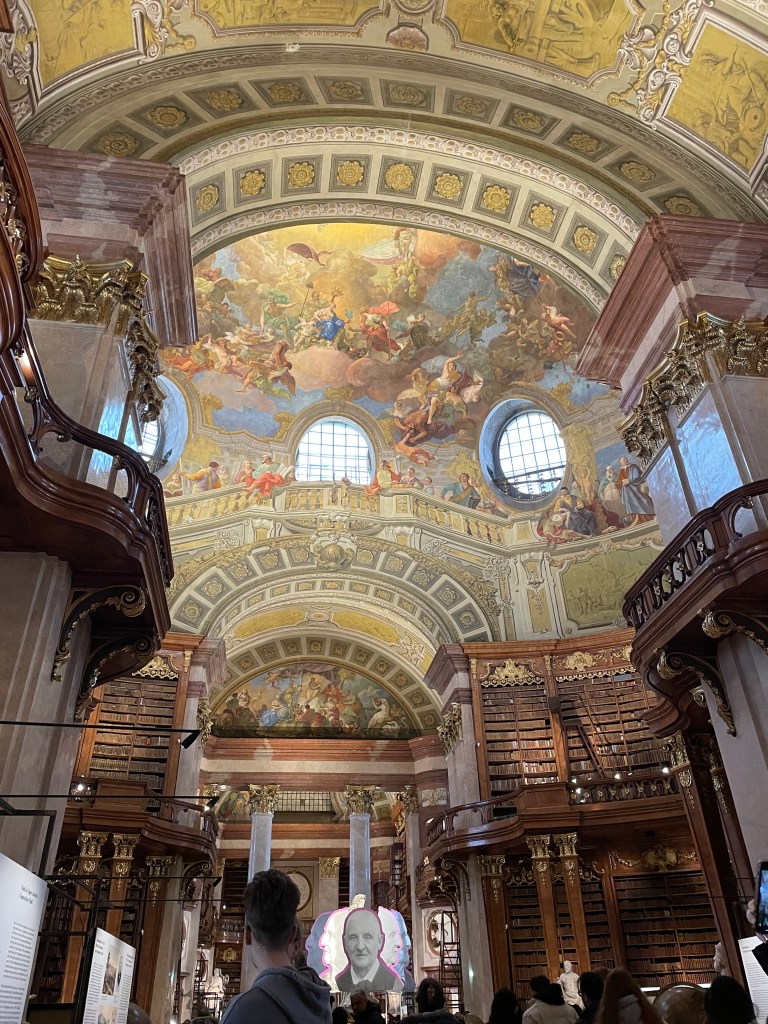
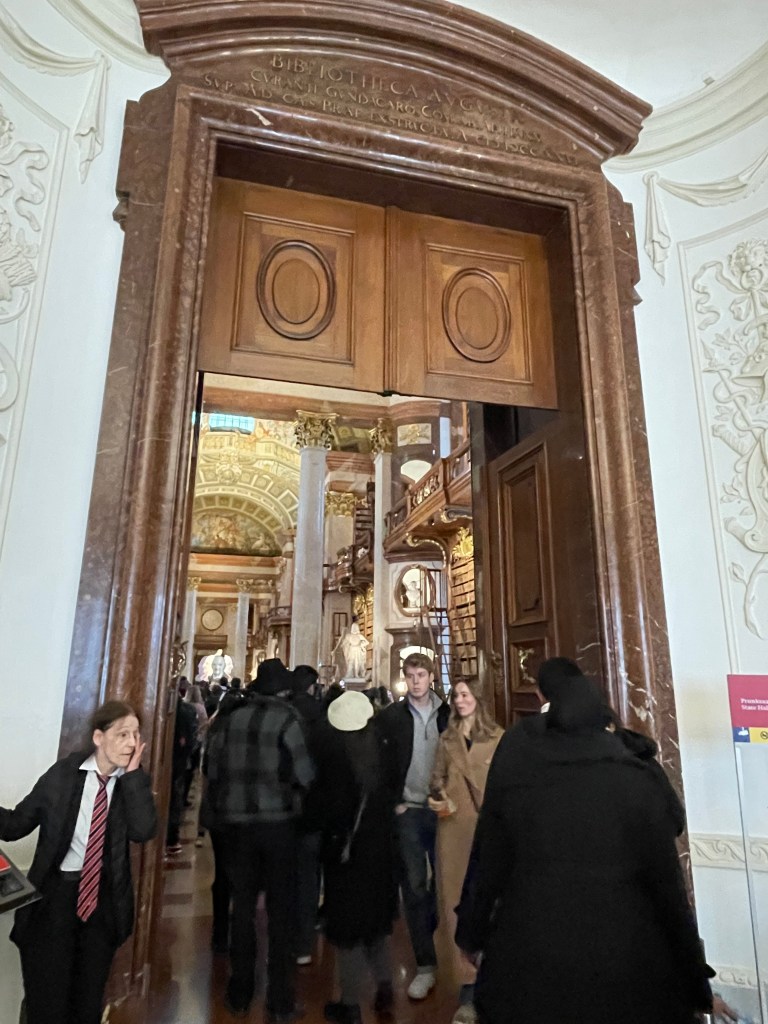
After attending Christmas Mass, we went to the National Bibliotek (library). We were told not to miss it. (8 Euro Sr Citizen price.) We went up a floor and then into a huge hall that ran the length of the building. It looked like the library in Beauty and the Beast. It was incredible, floor to ceiling OLD large brown books. The Library was built by Emporer Karl VI. Built from 1723-1726.
We spent about an hour there, mostly reading about the composer Anton Bruckner, who was born here and lived 200 years ago. This library has all of his papers and works and he was highlighted throughout the library–his story was told with artifacts and music from his life.
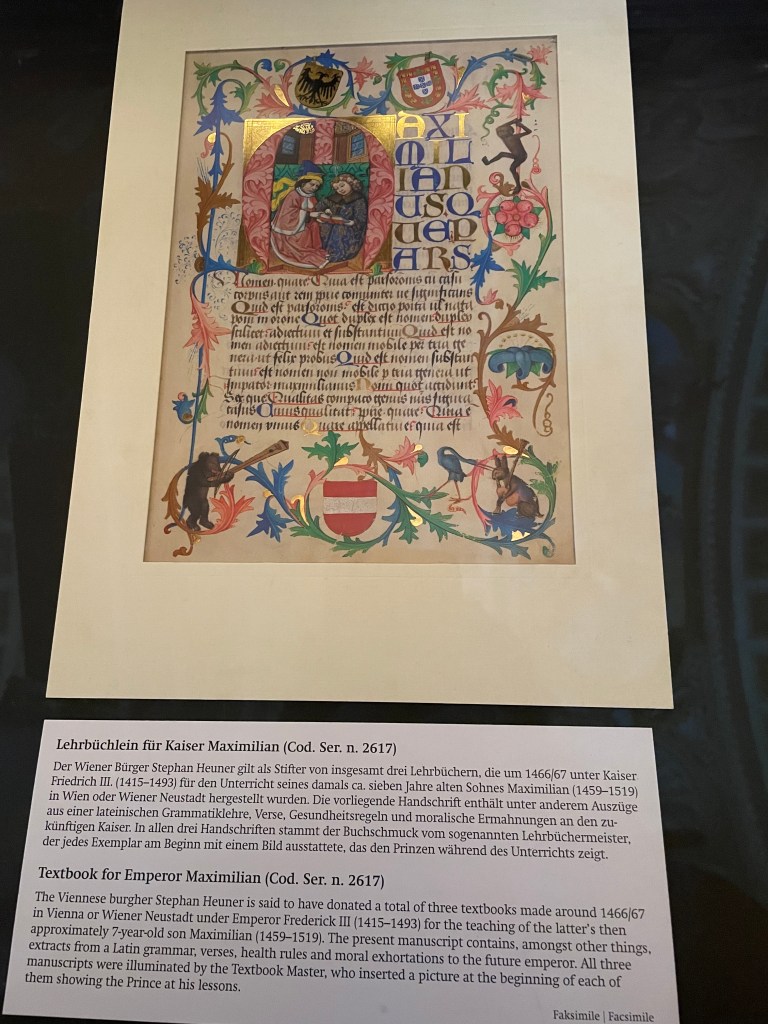
This made me especially happy:
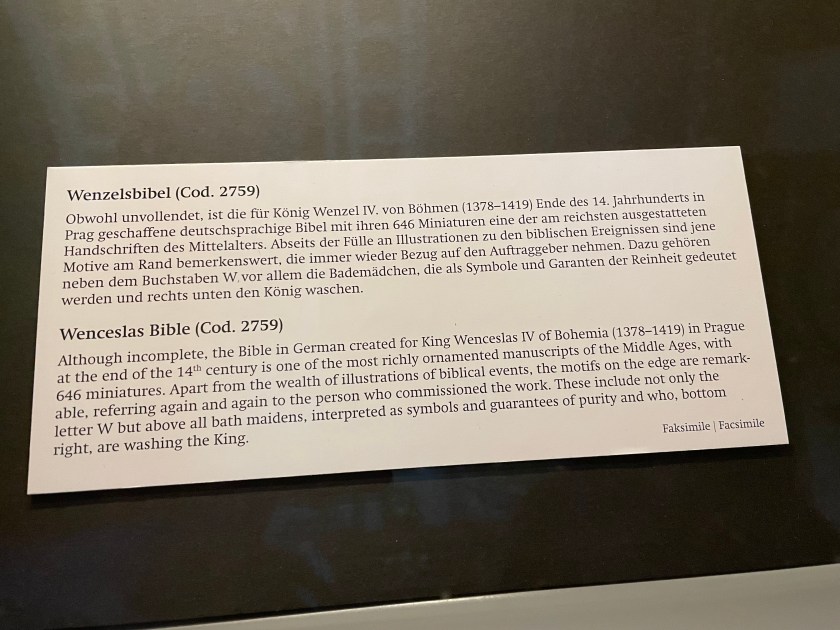
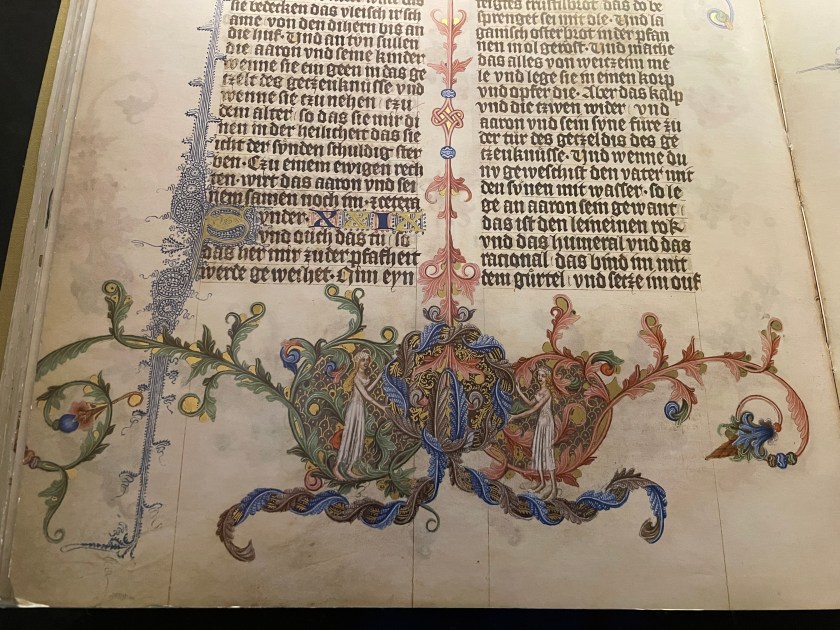
From the beautifully illuminated Wenceslas Bible:
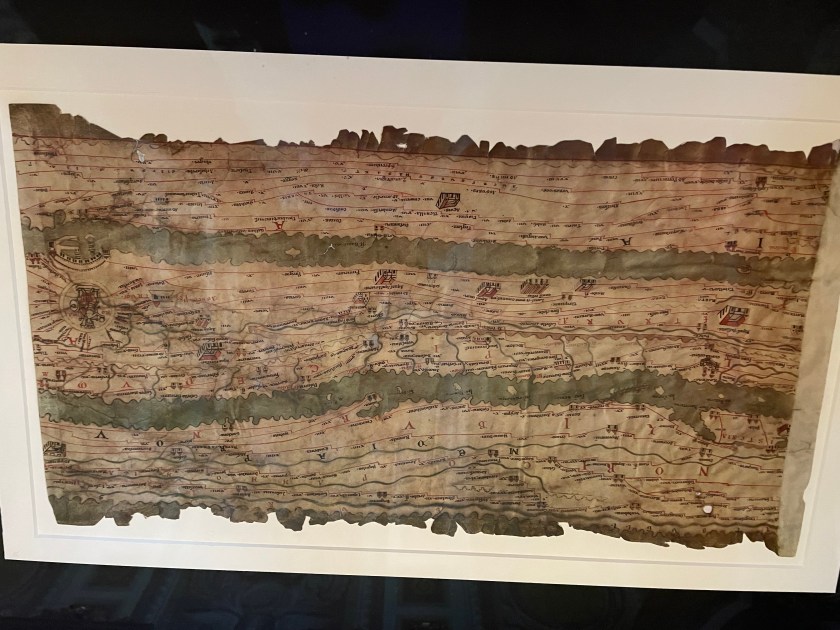
A fascinating ancient road map:
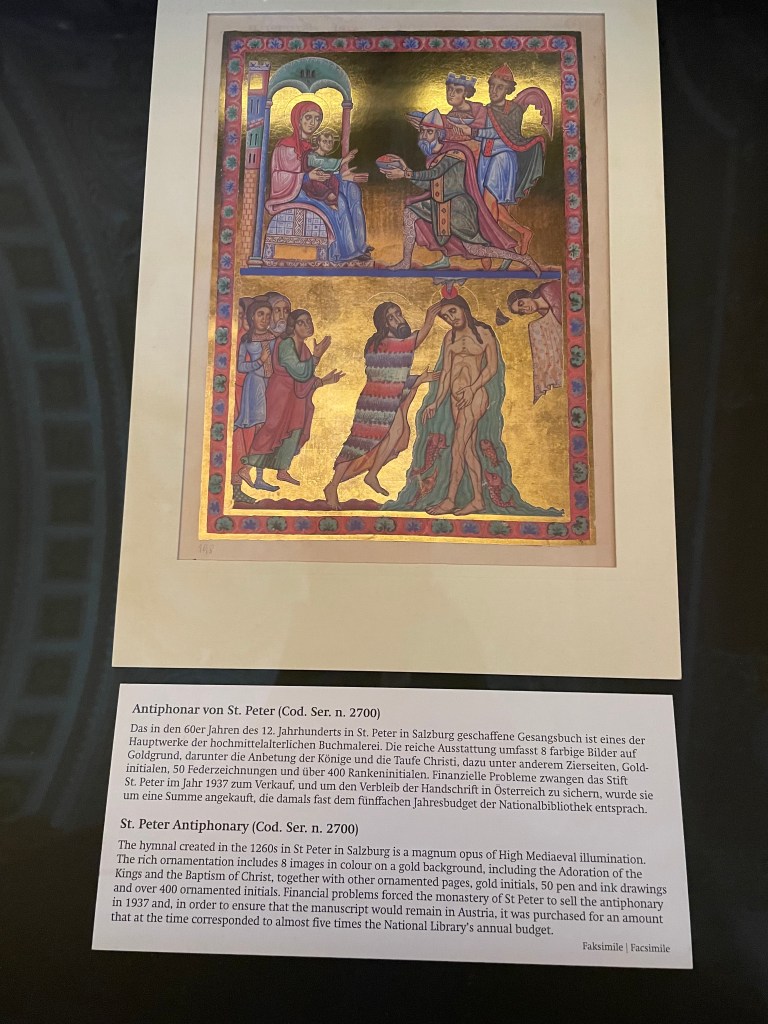
From a 1260 hymn book:
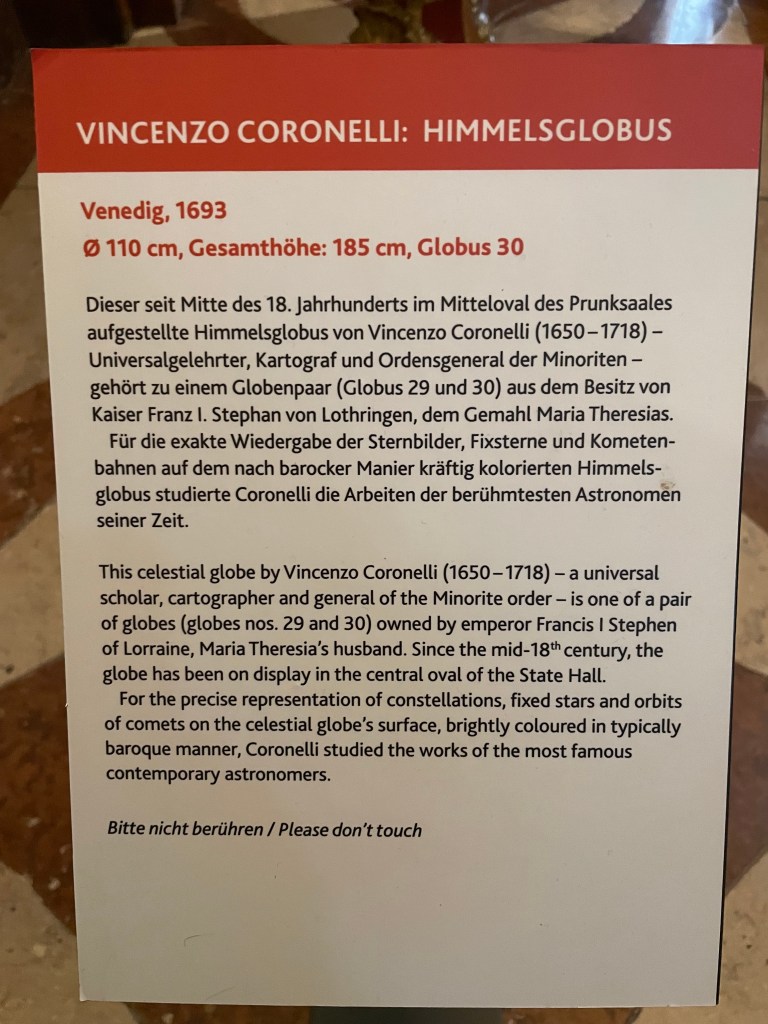
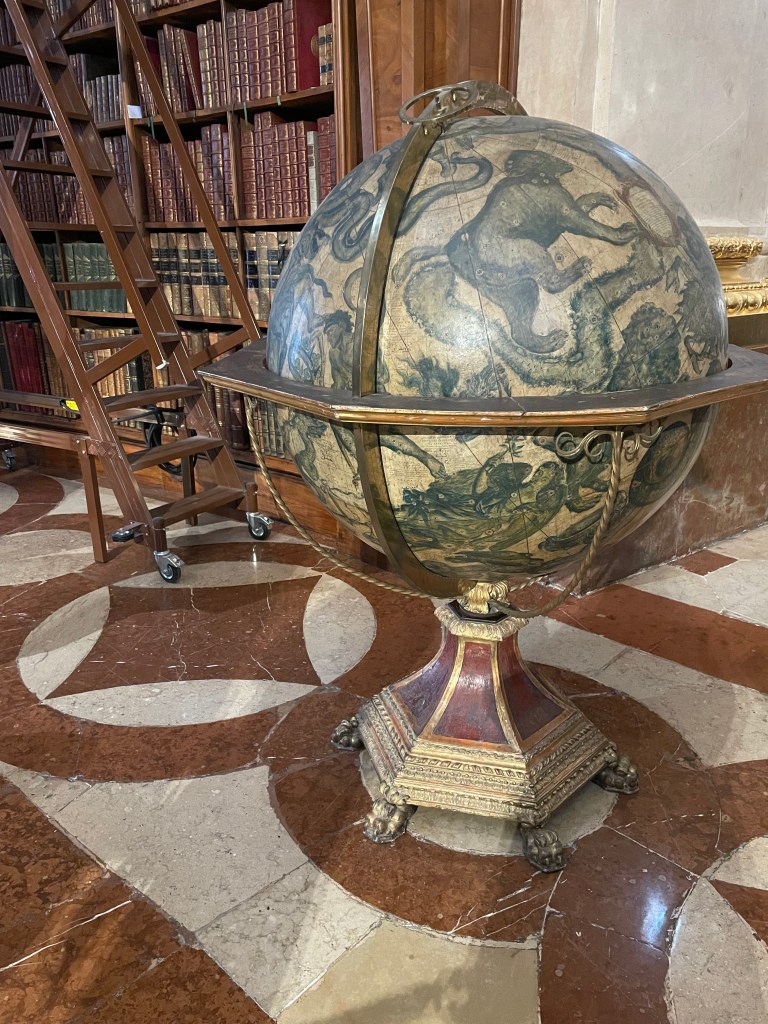
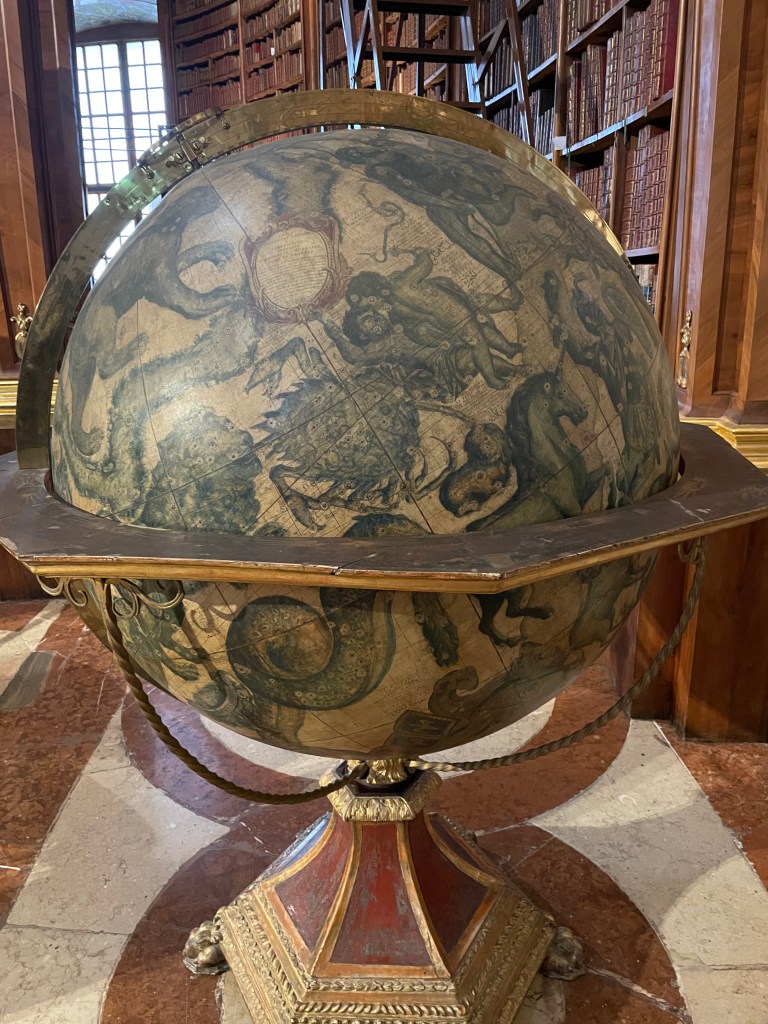
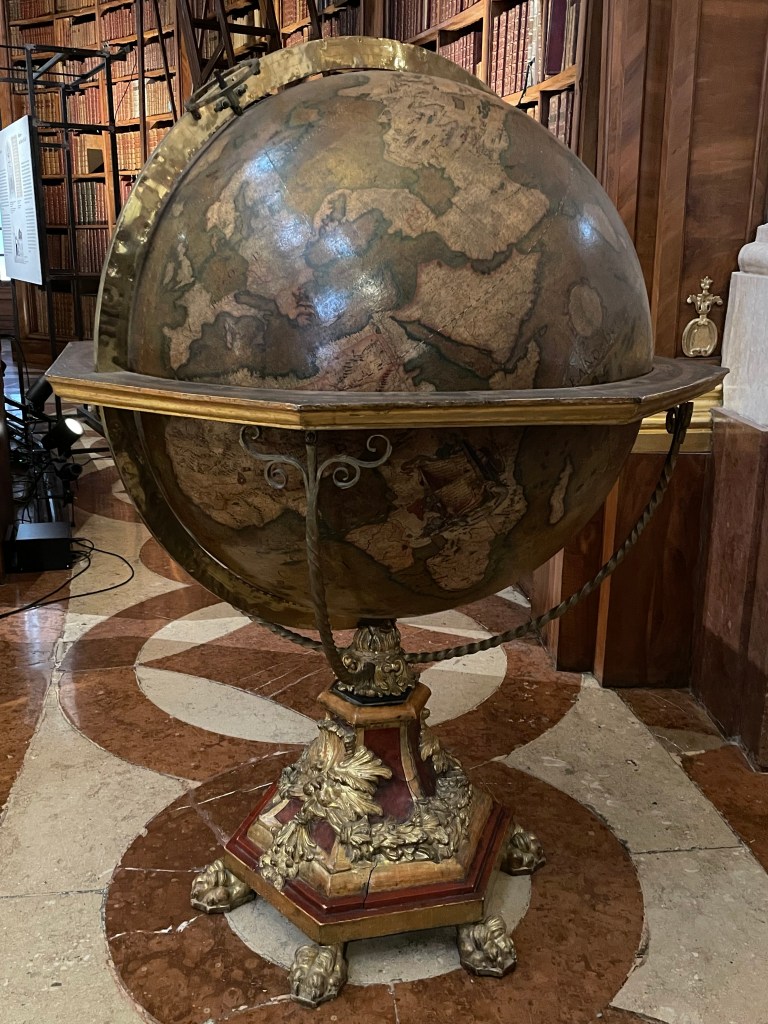
There are 4 large world globes in the library. They are a really fascinating look at how our world was seen in the 1600s.
A globe of constellations:
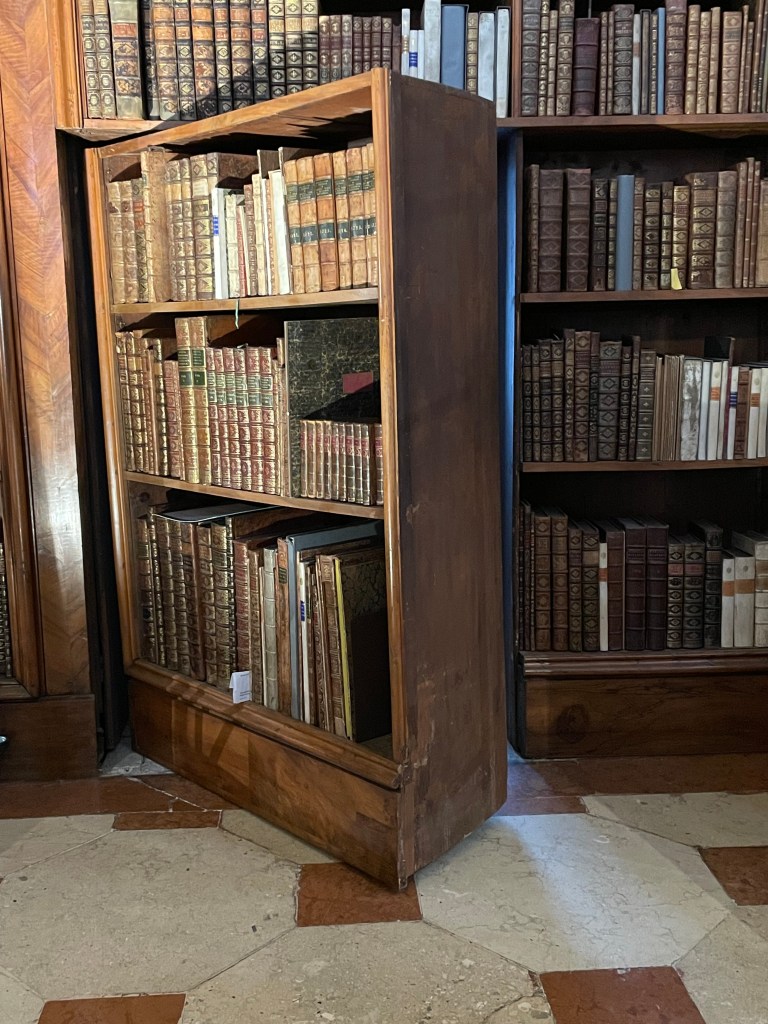
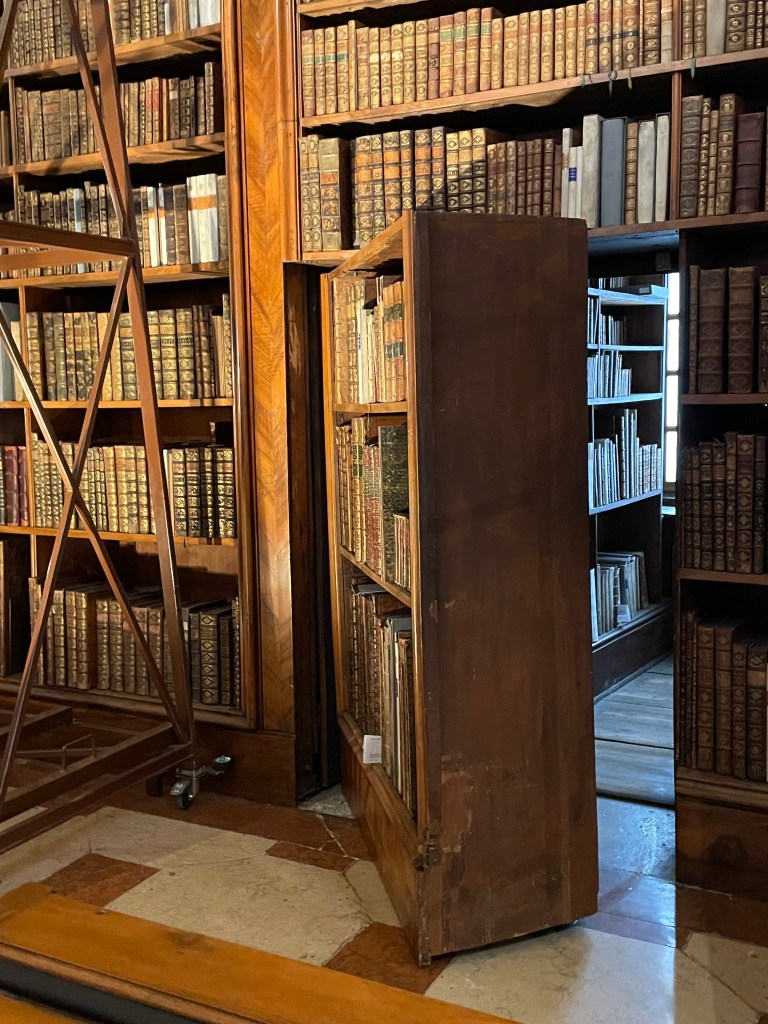
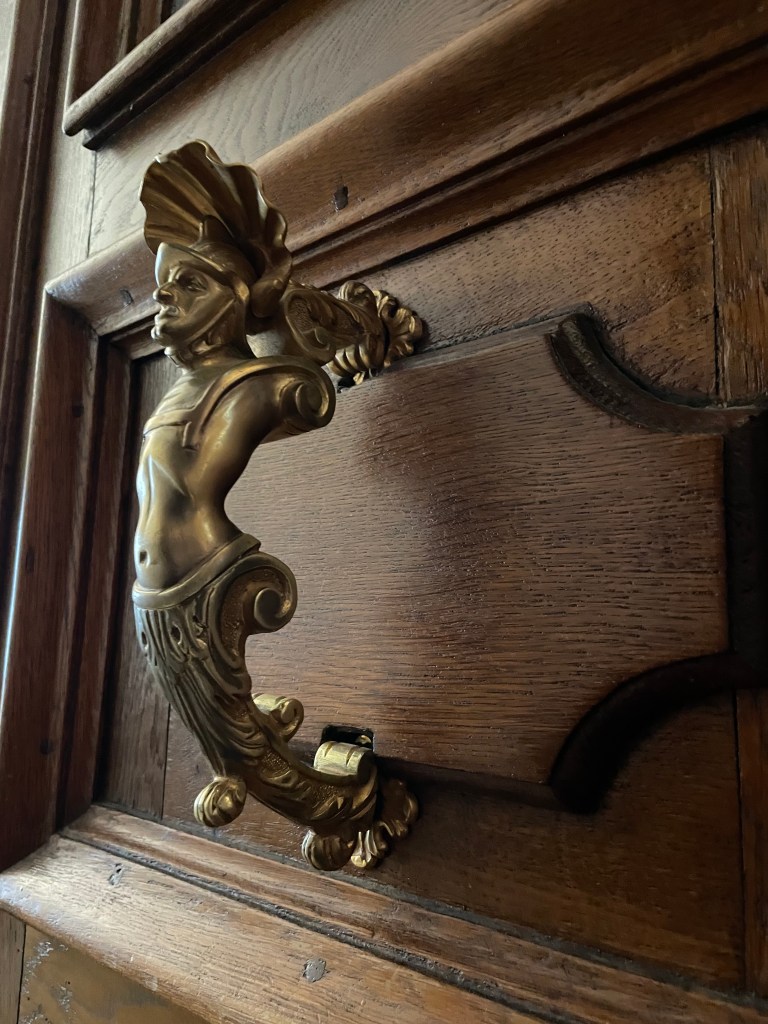
Loving the hidden passages!
From the Bruckner exhibits throughout the library:
What a treat to walk among such treasures. Just imagine the amount of knowledge found in this room, and what has been added to is since the time of this collection!
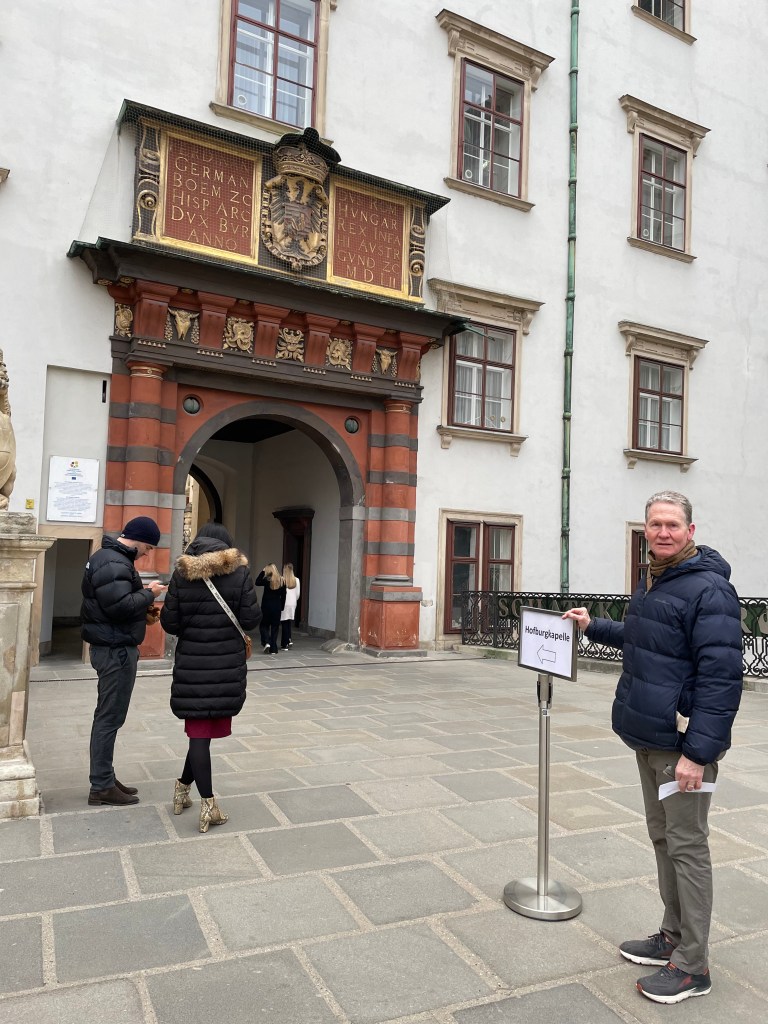
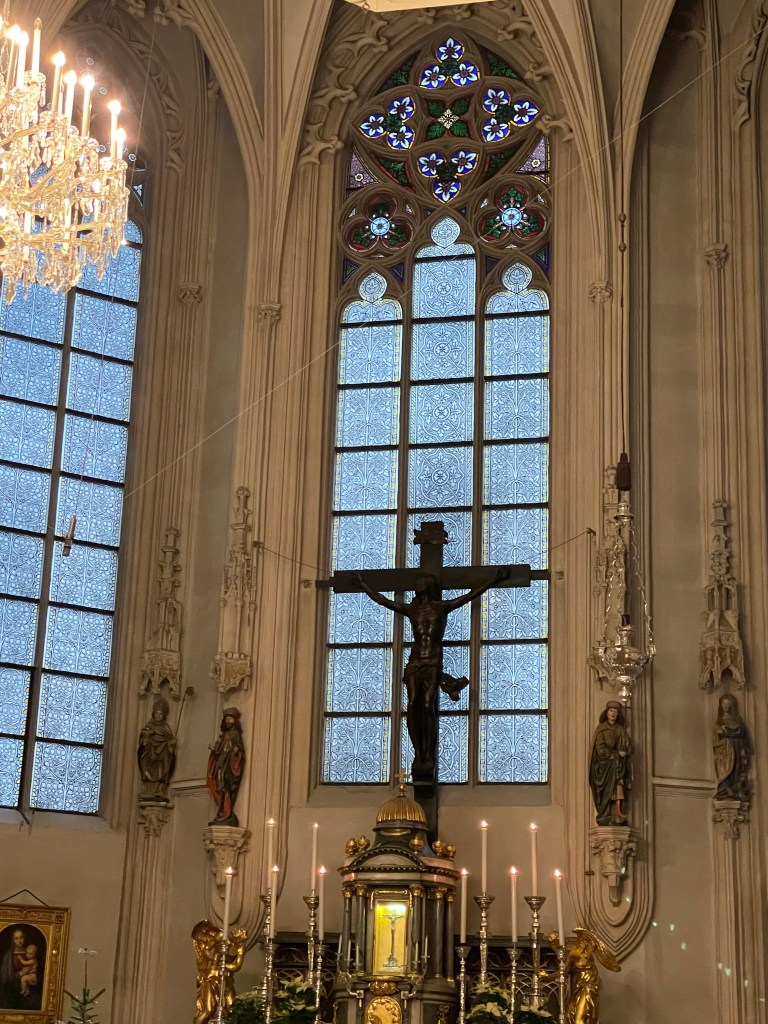
On this Christmas morning of 2024, we got up early and went out into a silent city to go to the Hofburgkapelle, which is the chapel in the Hofburg Palace where the royals worshipped. We walked through totally empty streets–no one was out yet. It was still and quiet. No cars, no people, no shops open. I was imagining the people of Vienna snug in their apartments, enjoying the aftermath of their Christmas Eve celebrations and food.
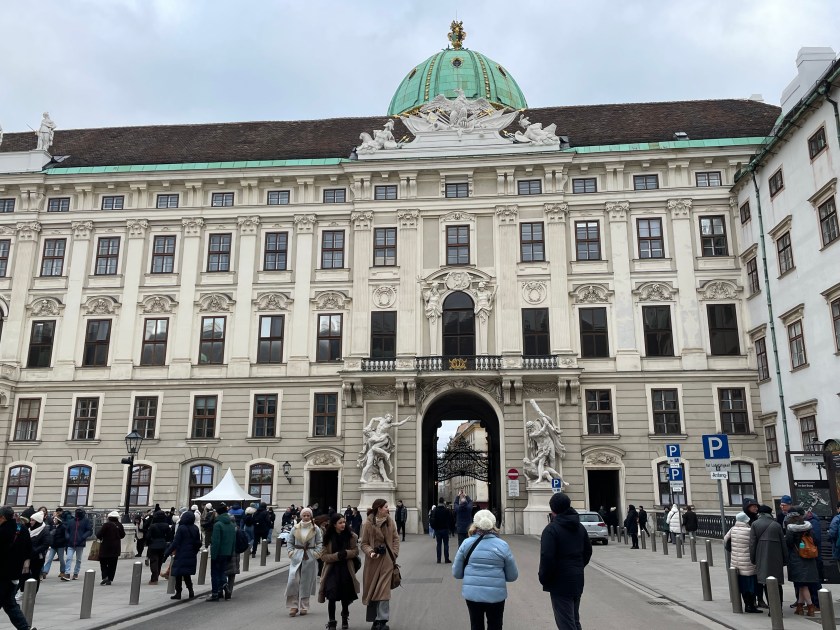
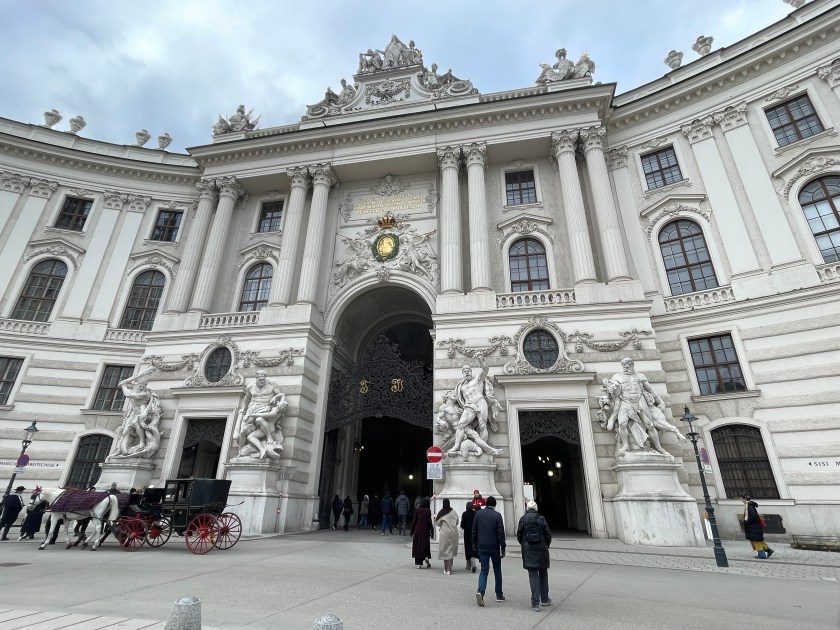
We walked through this rotunda and into the courtyard of the palace.
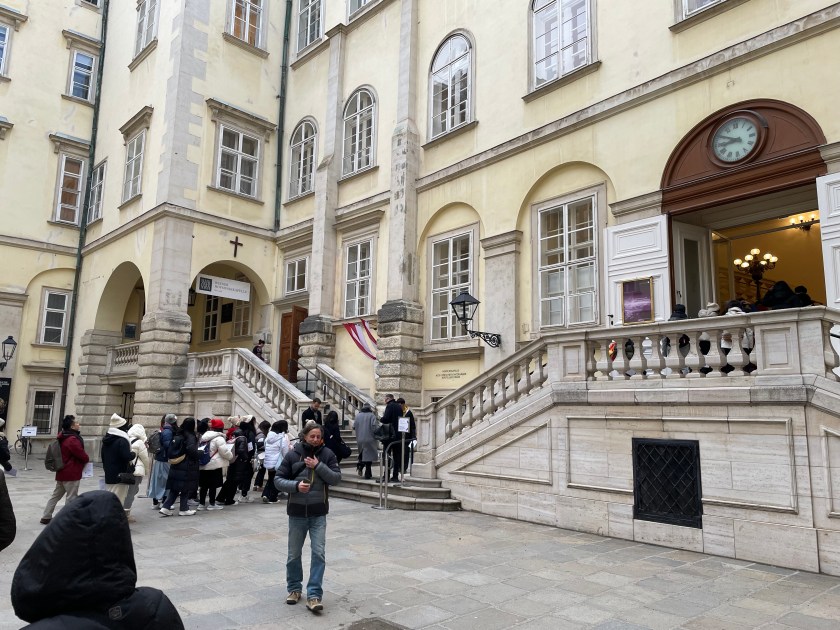
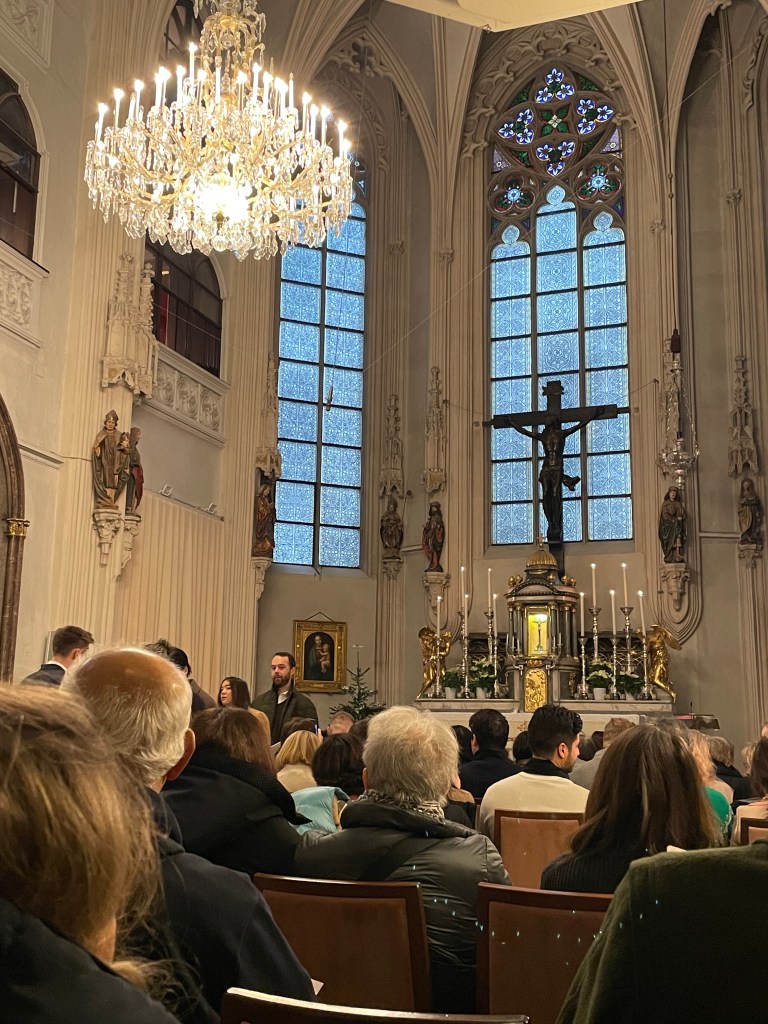
The church entrance was in the courtyard (you couldn’t tell it was a church from the outside). We waited in line to go into the chapel, then waited in our seats for the service to begin. We were there early enough to hear the choir and a men’s chorus warming up.
We were there early and could hear the boys warming up. We were a little disappointed to learn that the Vienna Boys’ Choir, the men’s choir and the orchestra would not be where we could see them–they were up in the organ loft behind us. There were about 20 boys, 20 instrumentalists and 10 men performing the music. We never saw any of them.
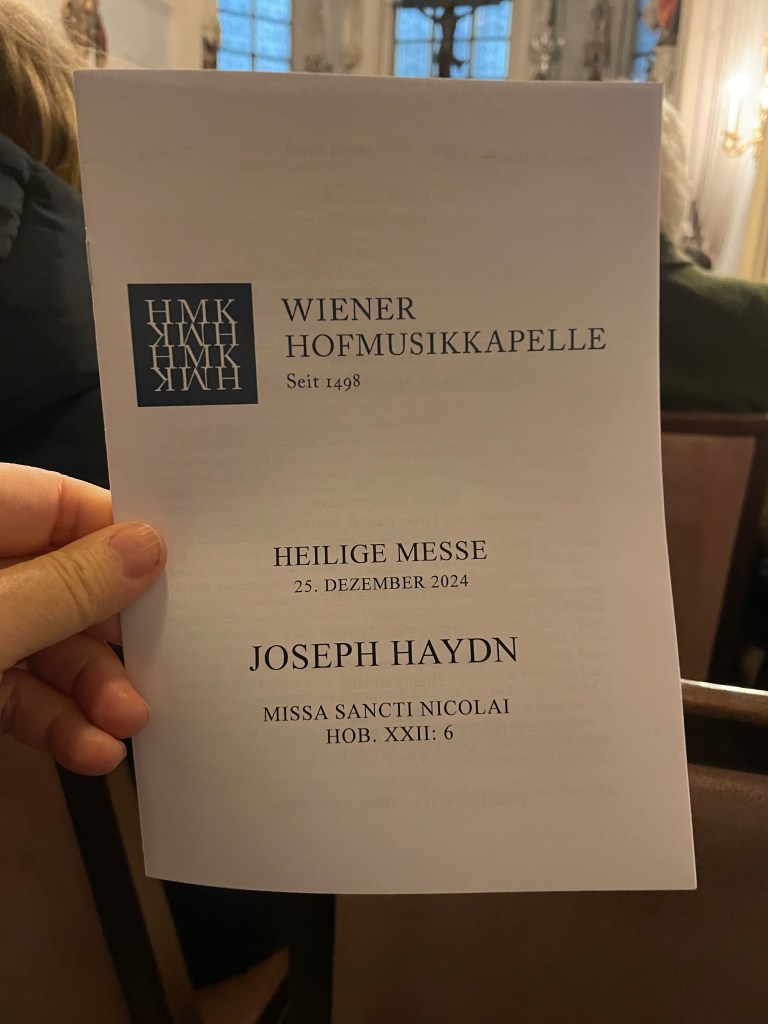
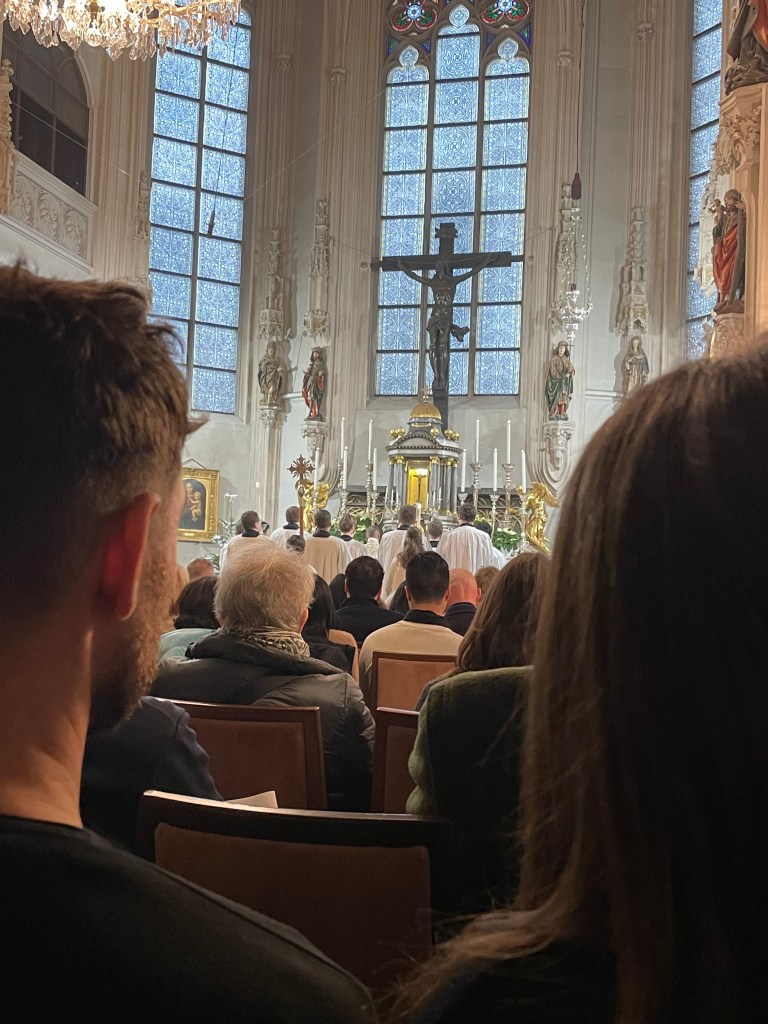
Then the service began. The mass was done in Latin with a bit of German. We had a program with all the words and translations to German so we were able to follow along. It was a small chapel similar in size to the other 2 chapels where we’ve enjoyed evening concerts. It was very beautiful. We were asked not to record any of the music or take photos during the mass.
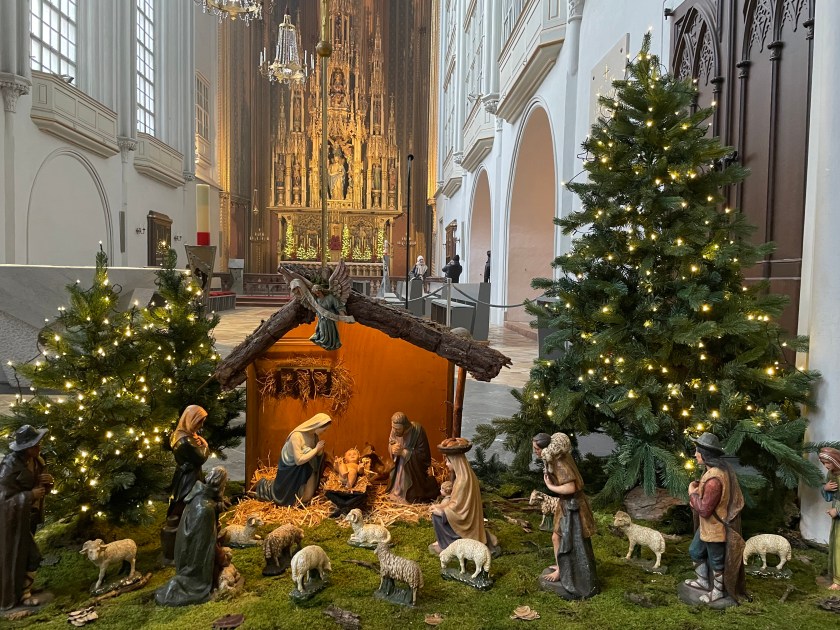
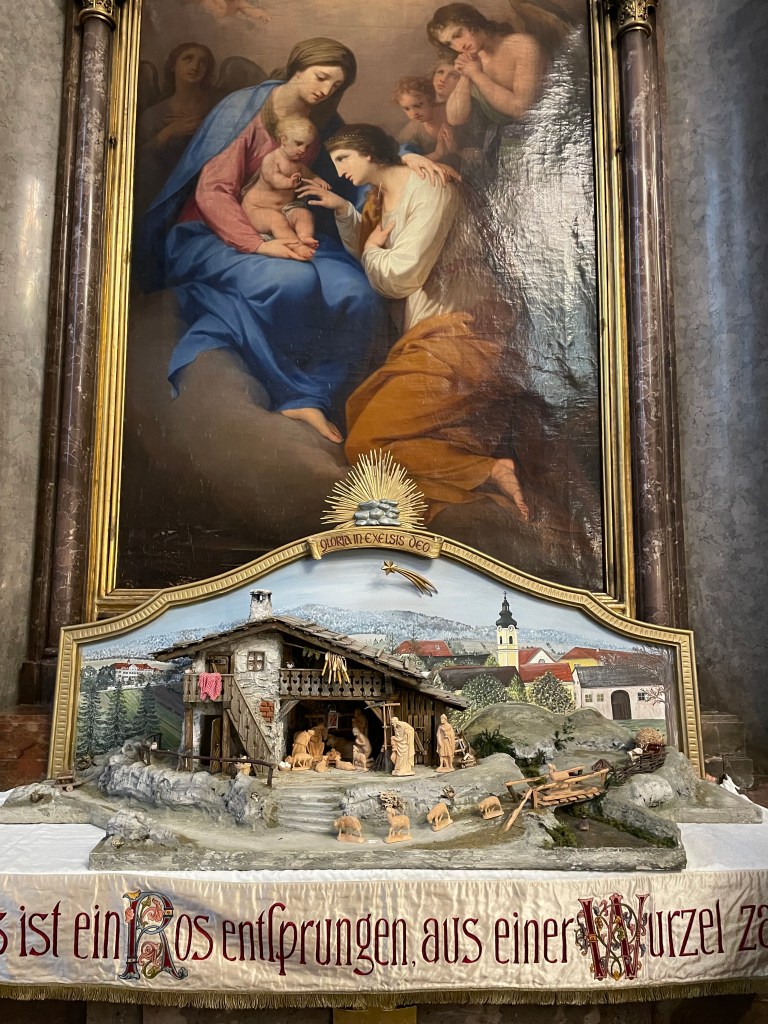
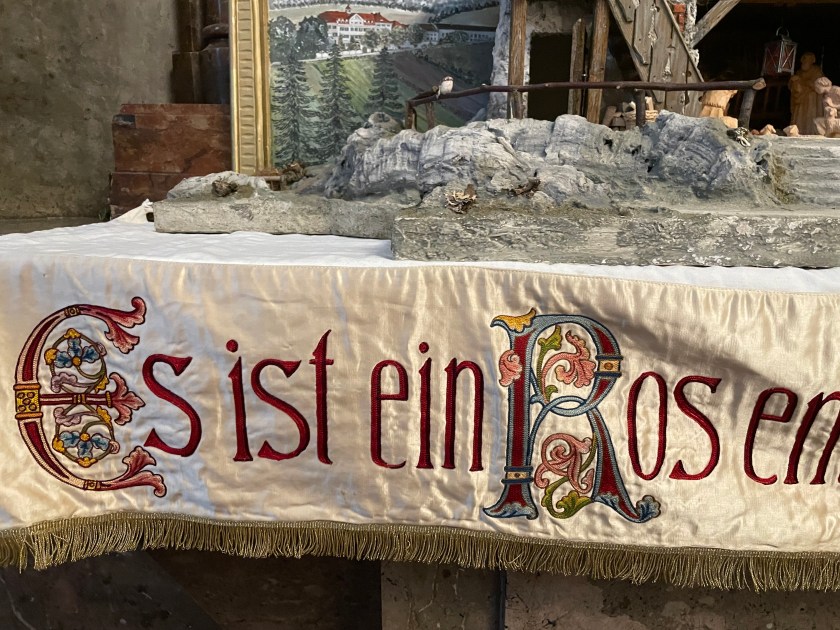
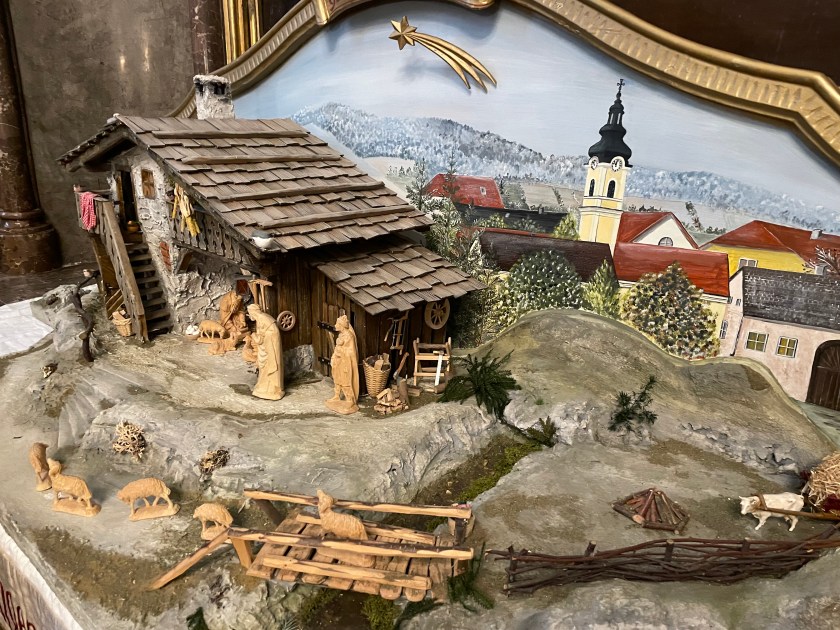
The music for the mass was from Haydn–his St Nicholai written for Dec 6th in 1772. It was really beautiful. After the mass and sacrament had ended (about an hour), the choir above sang Stille Nacht and then the organist played a beautiful arrangement of O Come All Ye Faithful (Adeste Fideles). Then we were excused. We lingered to enjoy looking more closely at the church and the Nativity there. It was a really beautiful chapel.
After the service:
This is the loft where the performers were located.
What a beautiful start to our Christmas Day in Vienna. The music was heavenly.
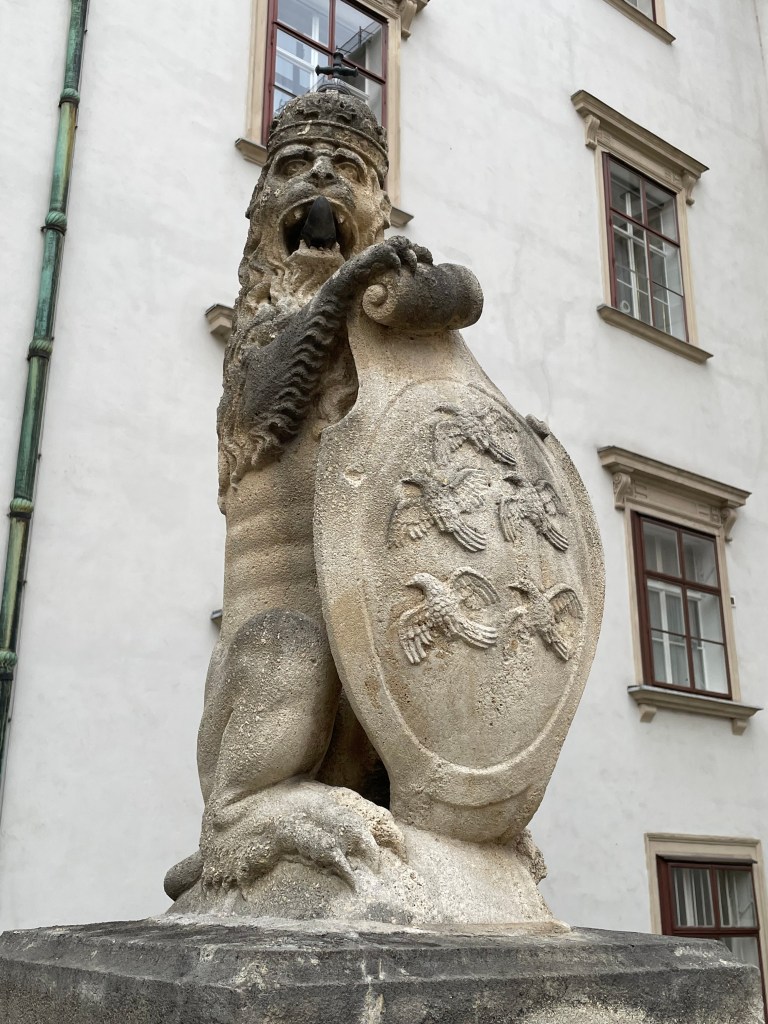
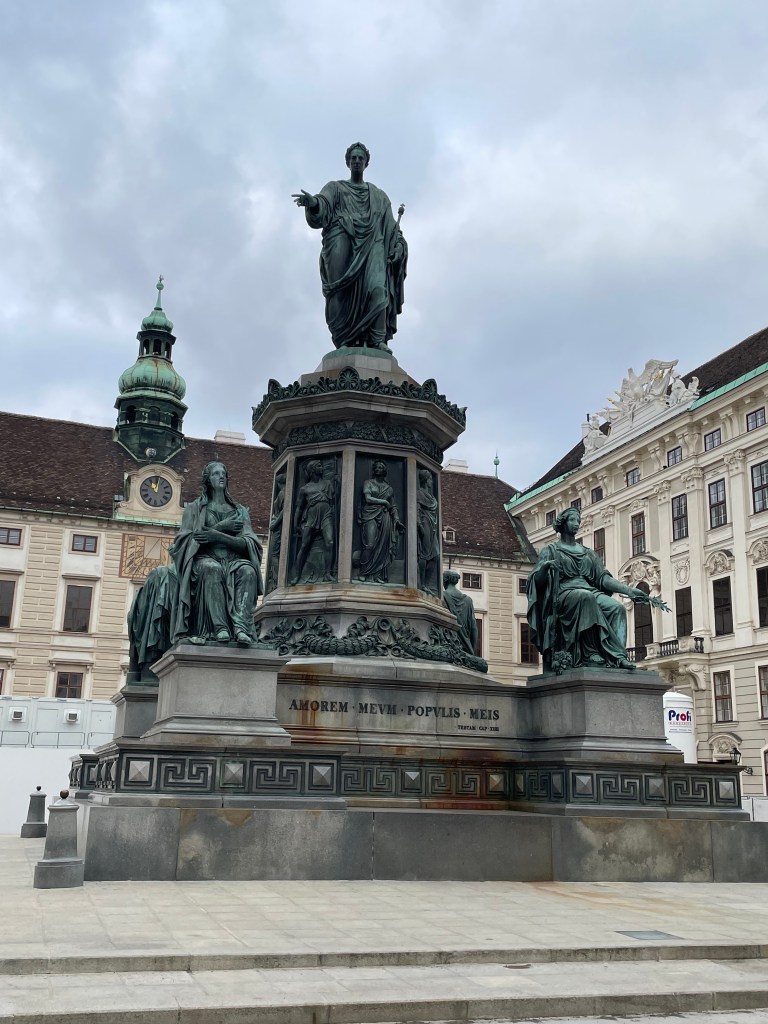
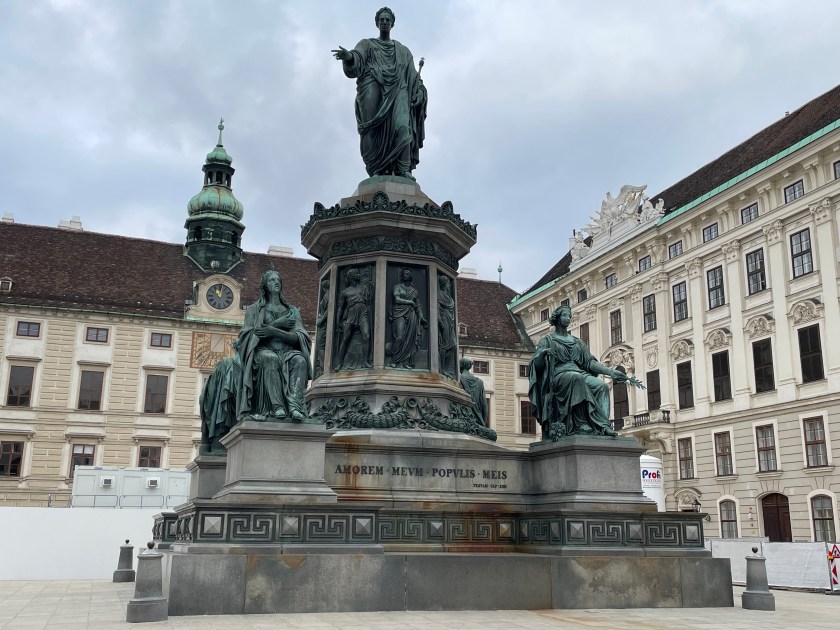
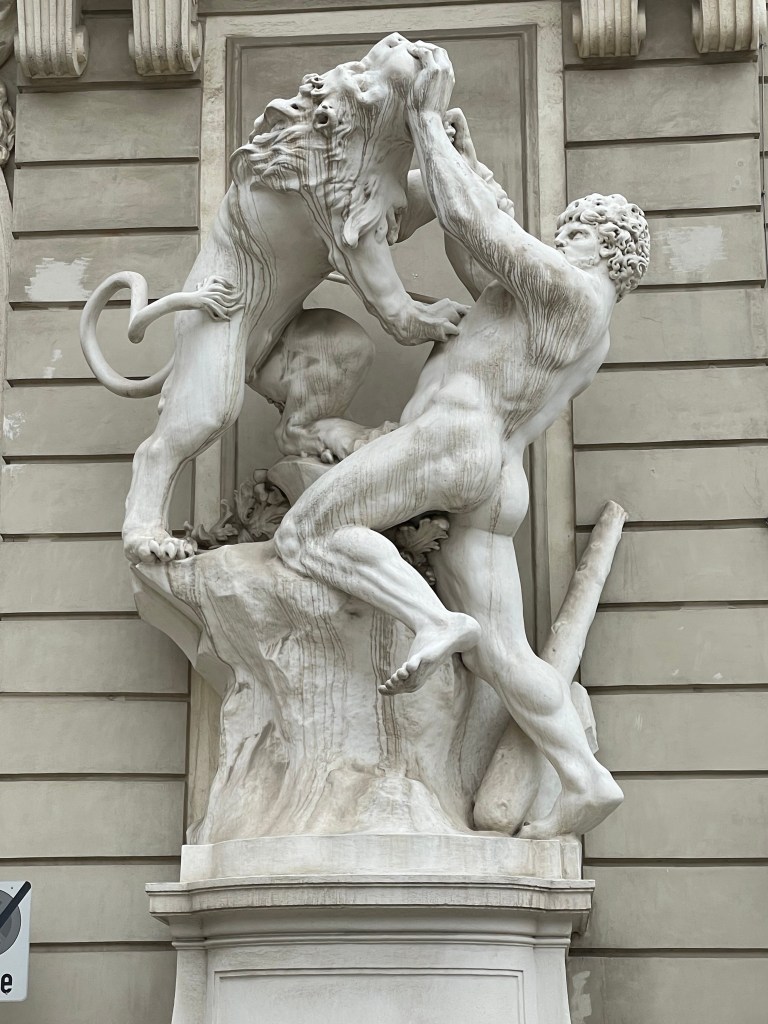
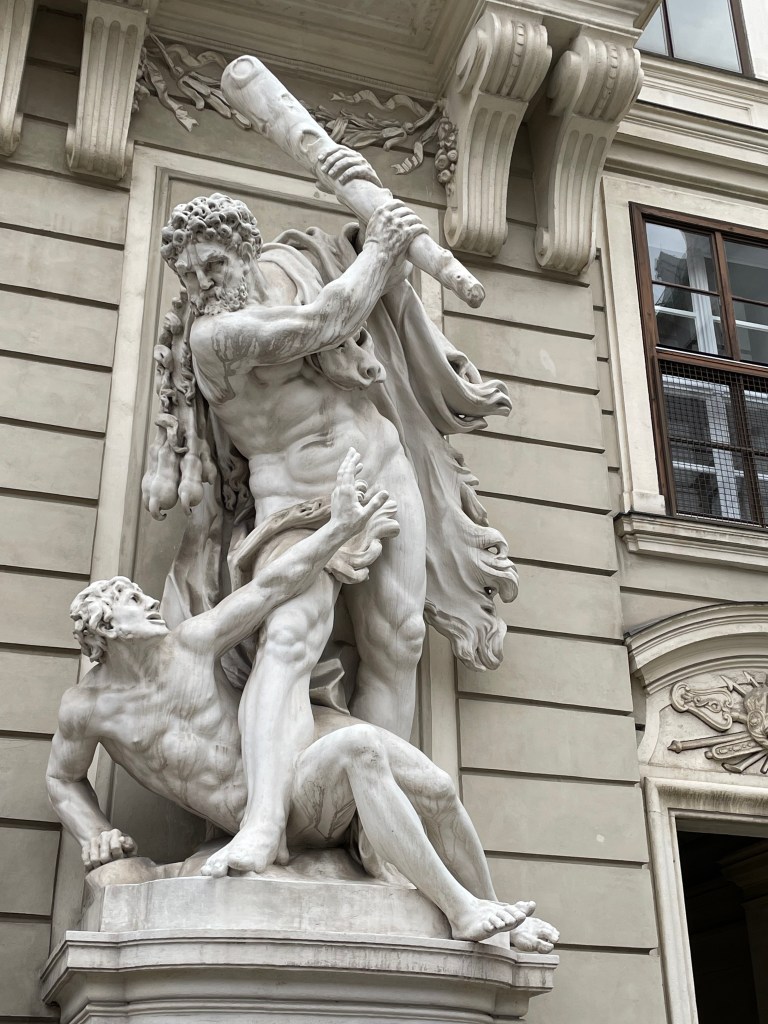
Here are a few pics taken in the Hofburg Palace inner courtyard.
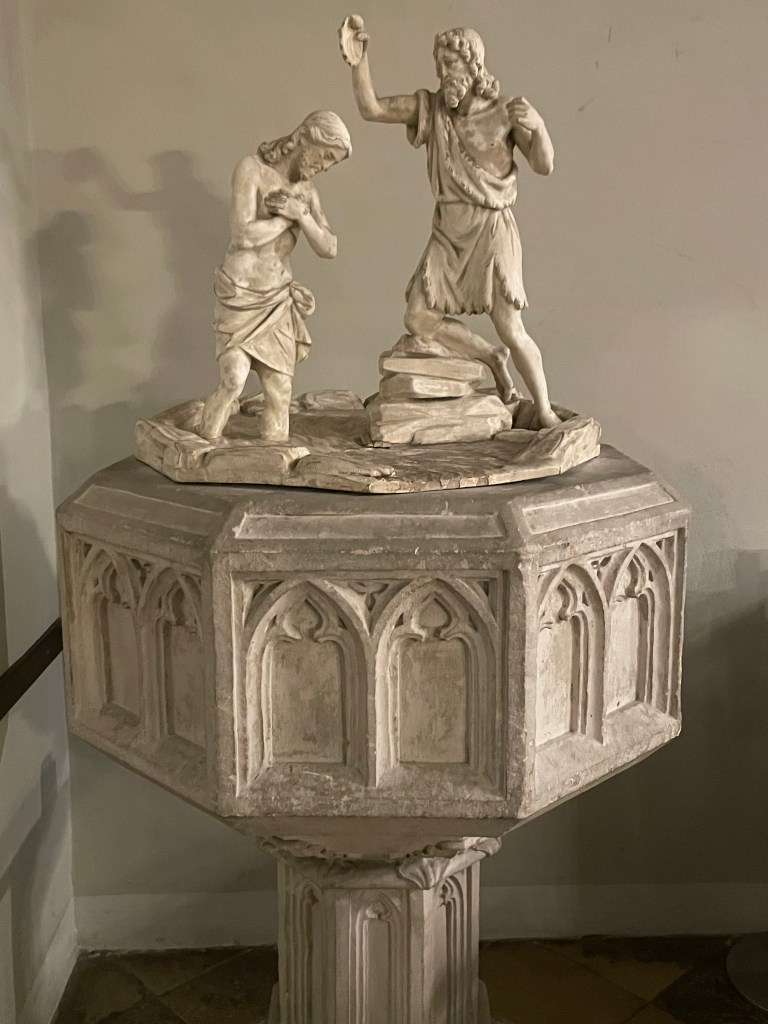
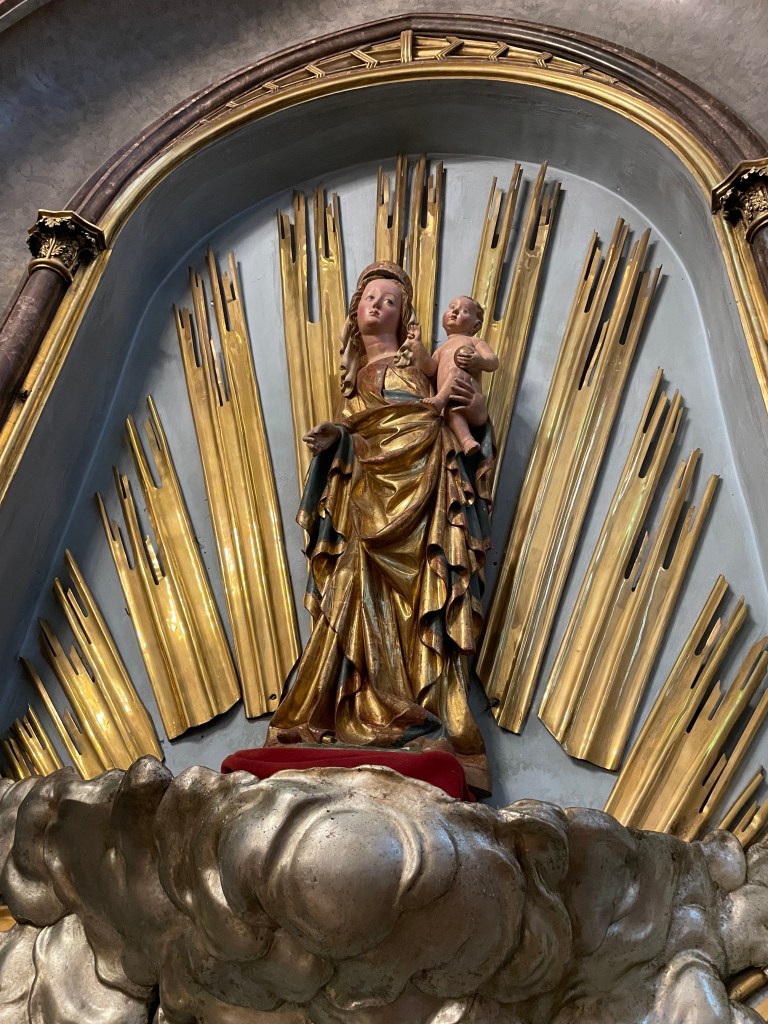
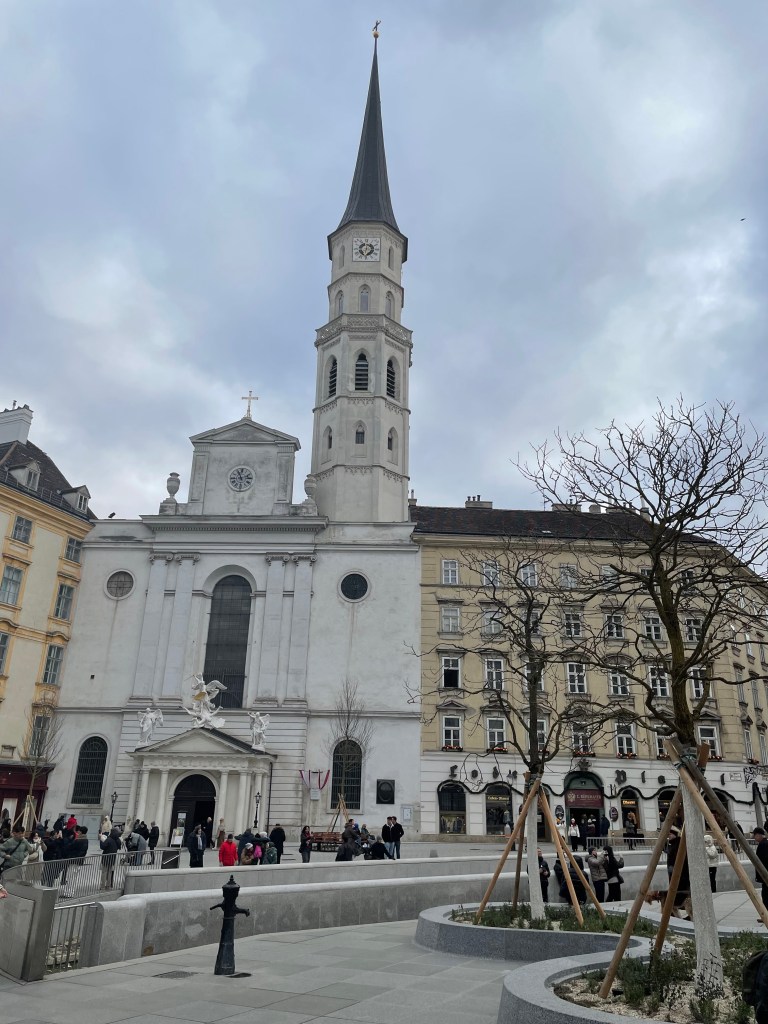
We stopped in at another church as we left the Hofburg Palace area. What a lovely way to start our day.




















































 Our Frankfurt Germany Mission