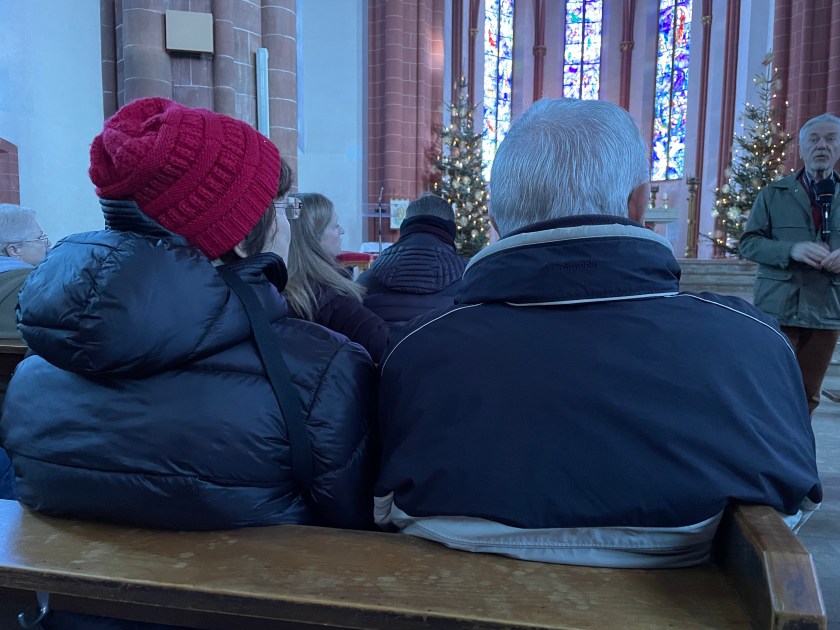
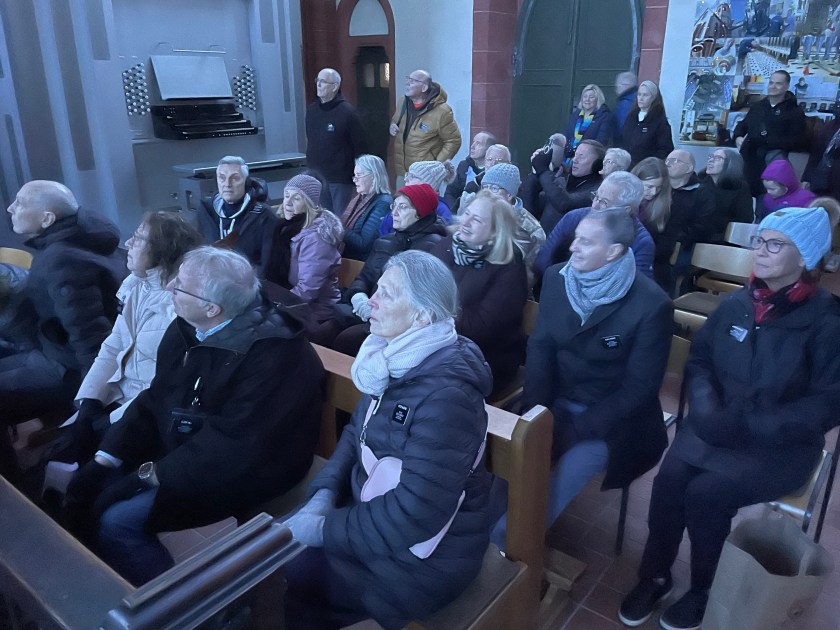
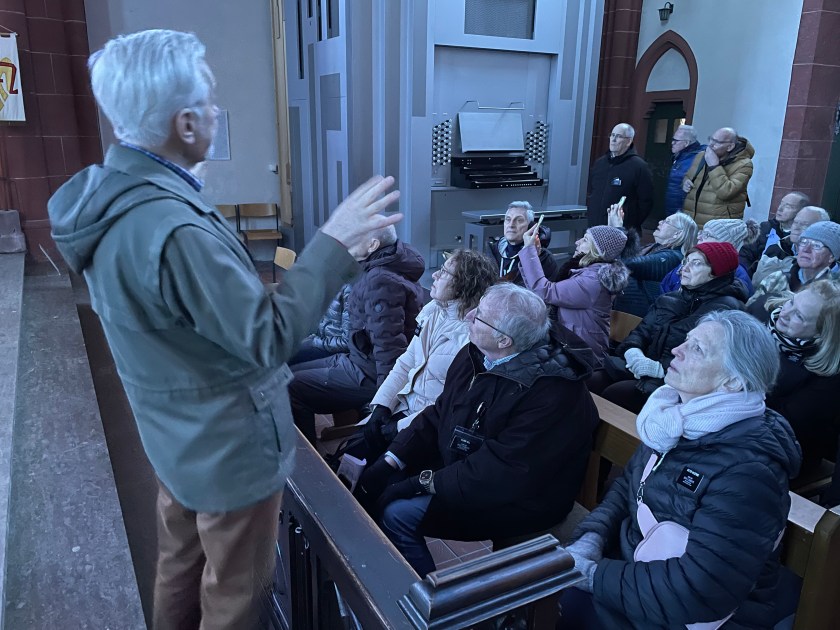
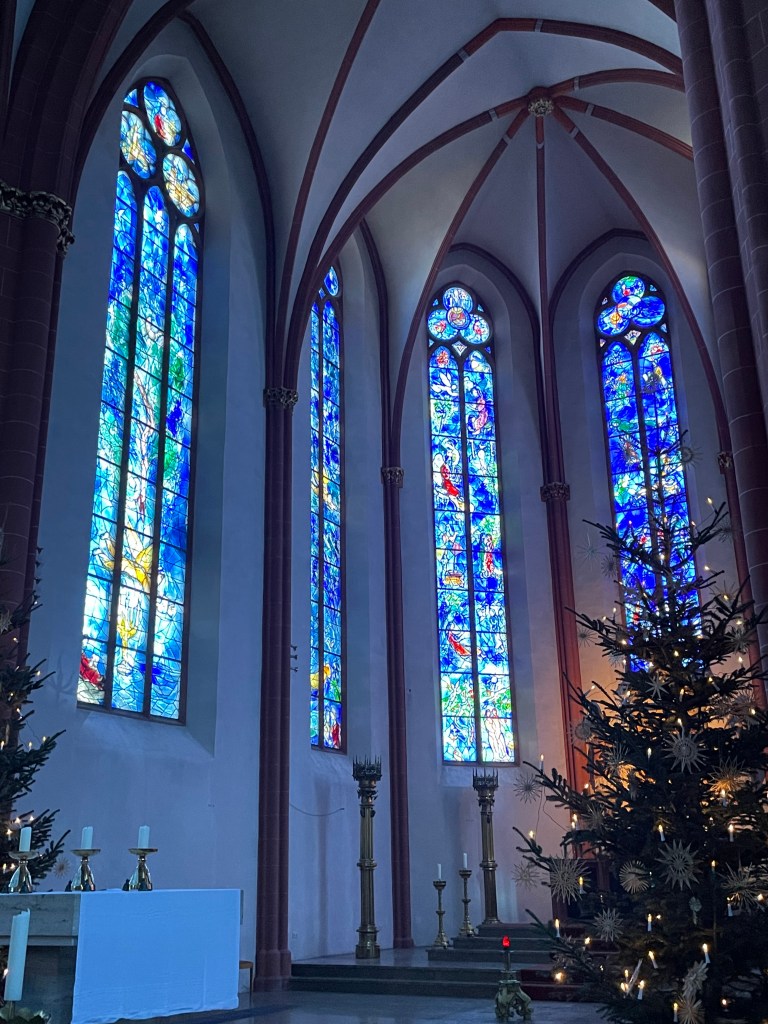
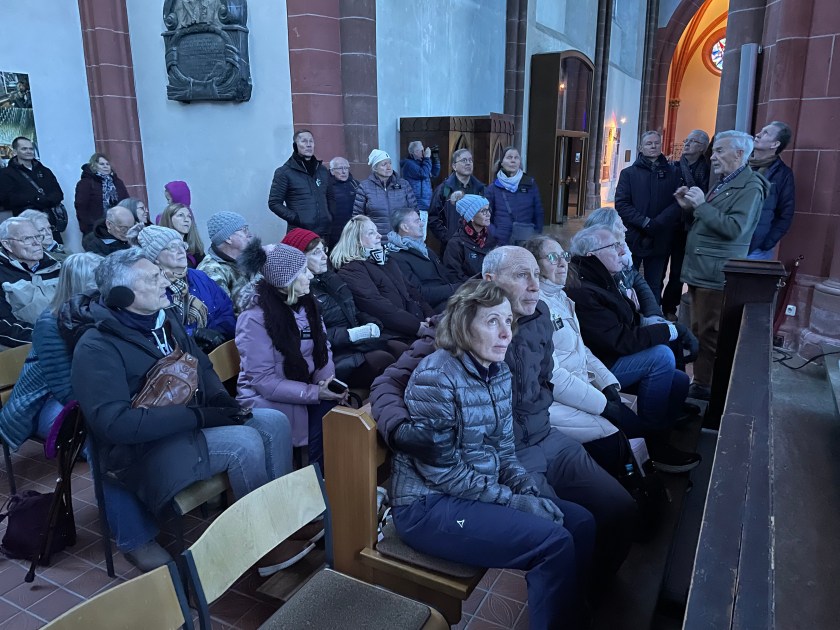
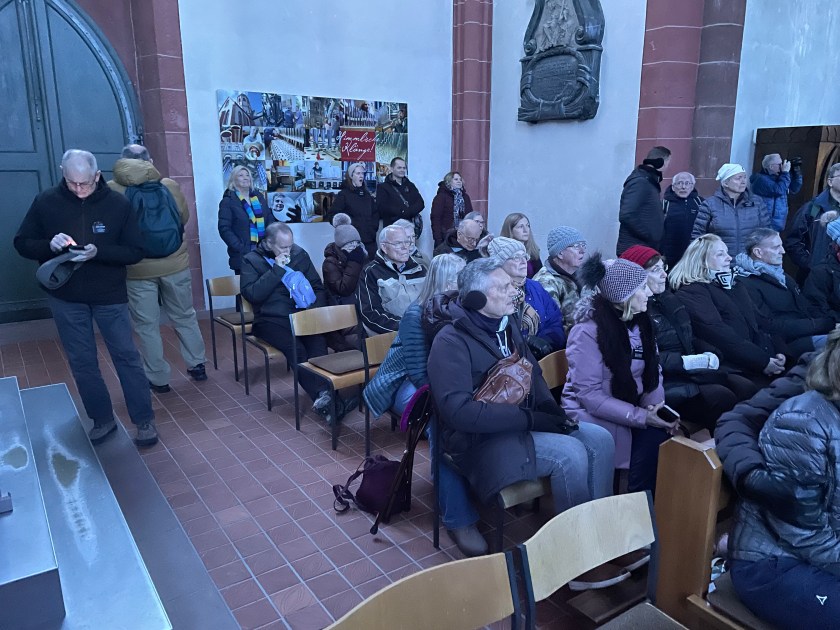
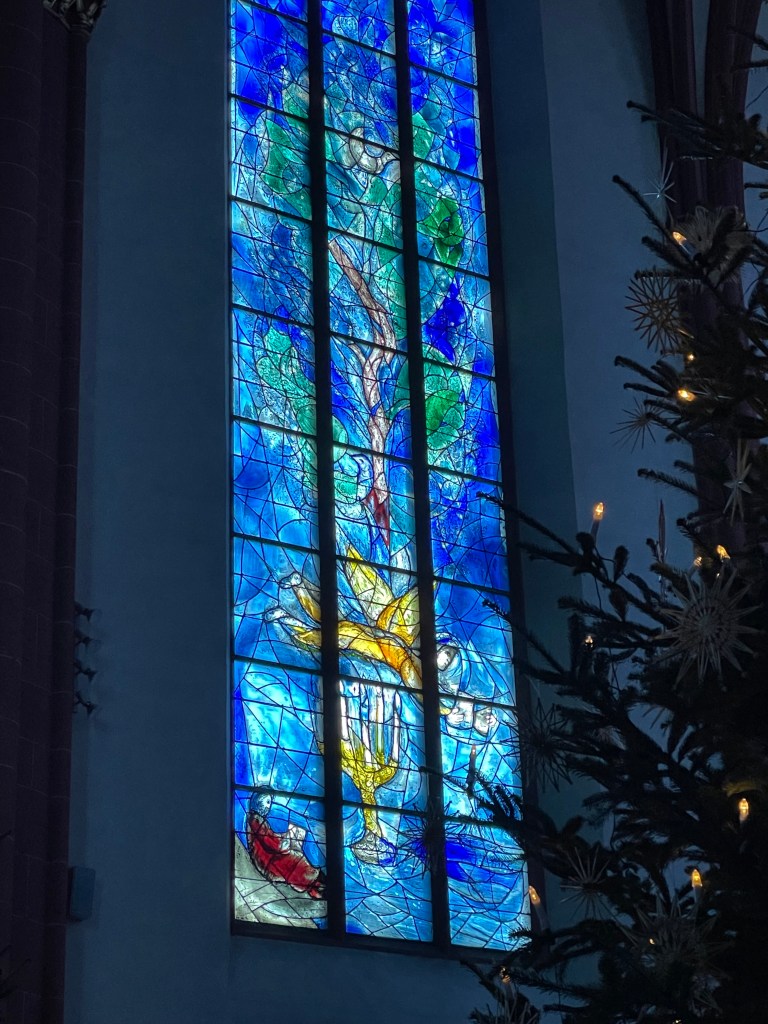
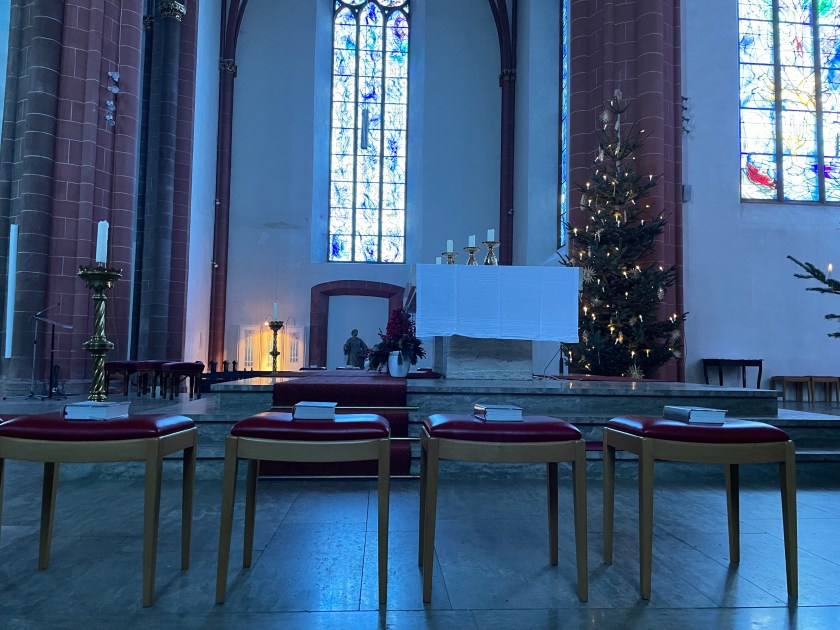
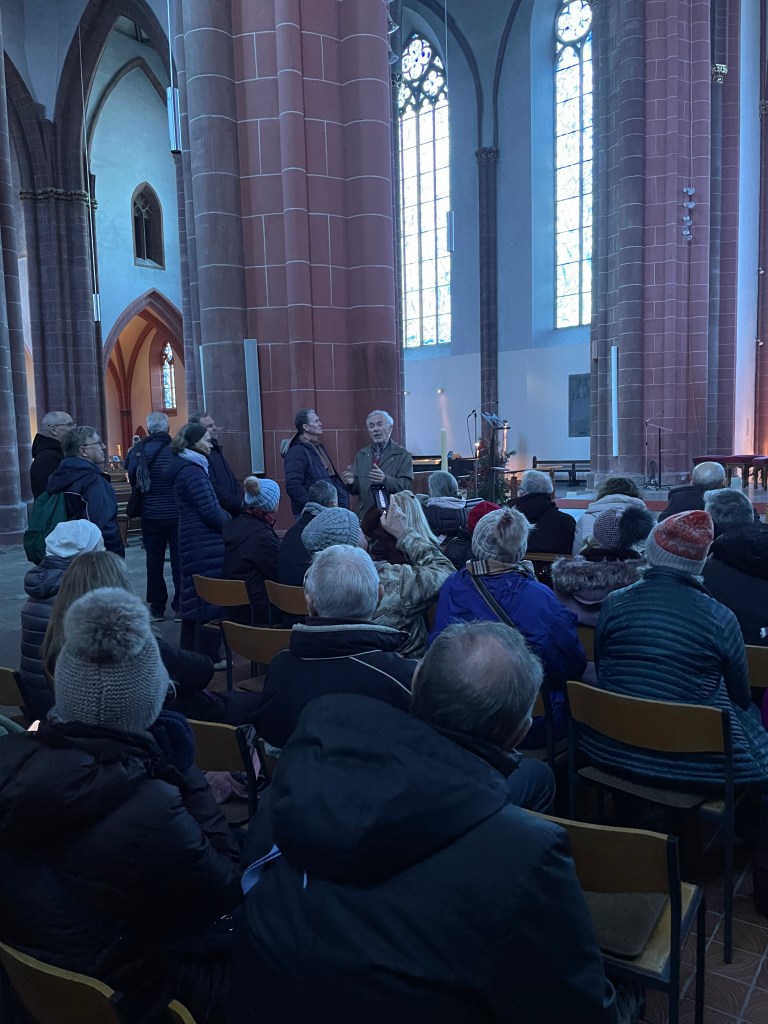
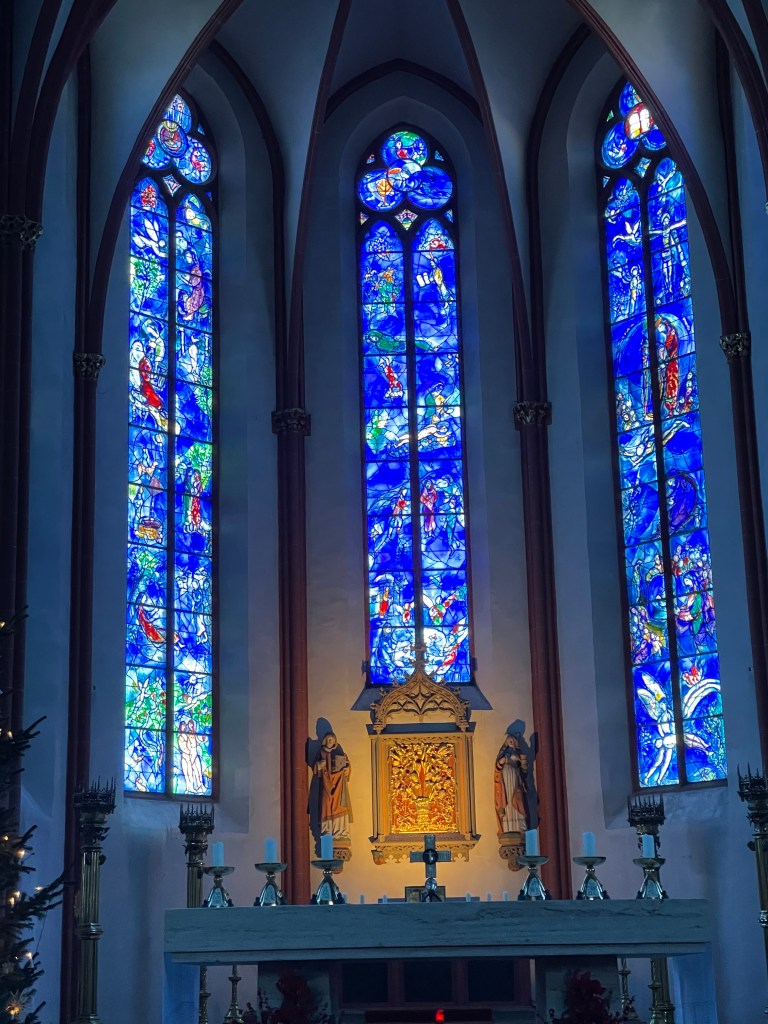
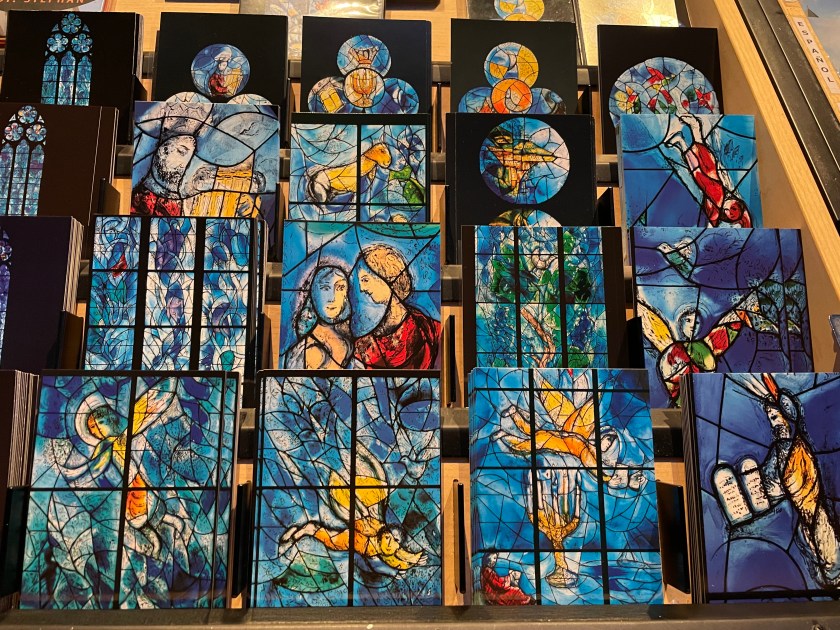
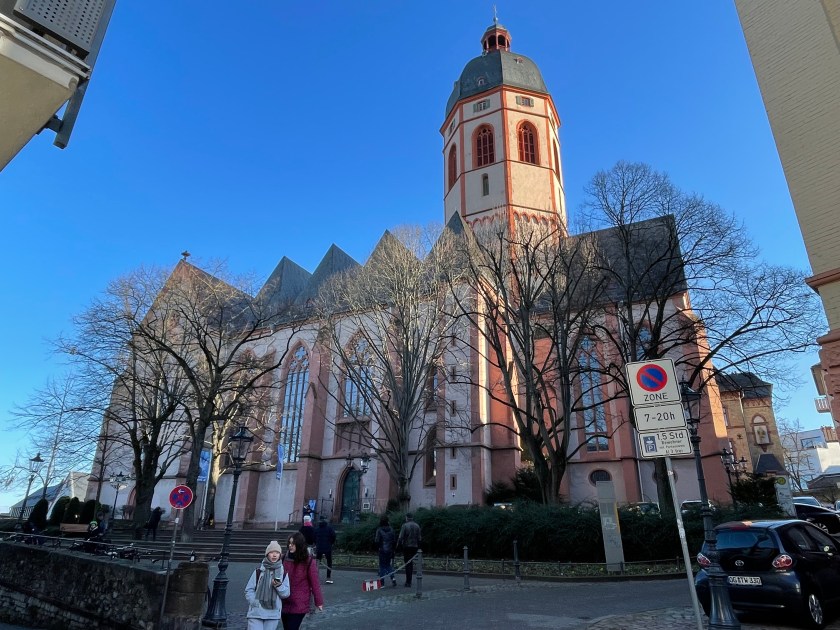
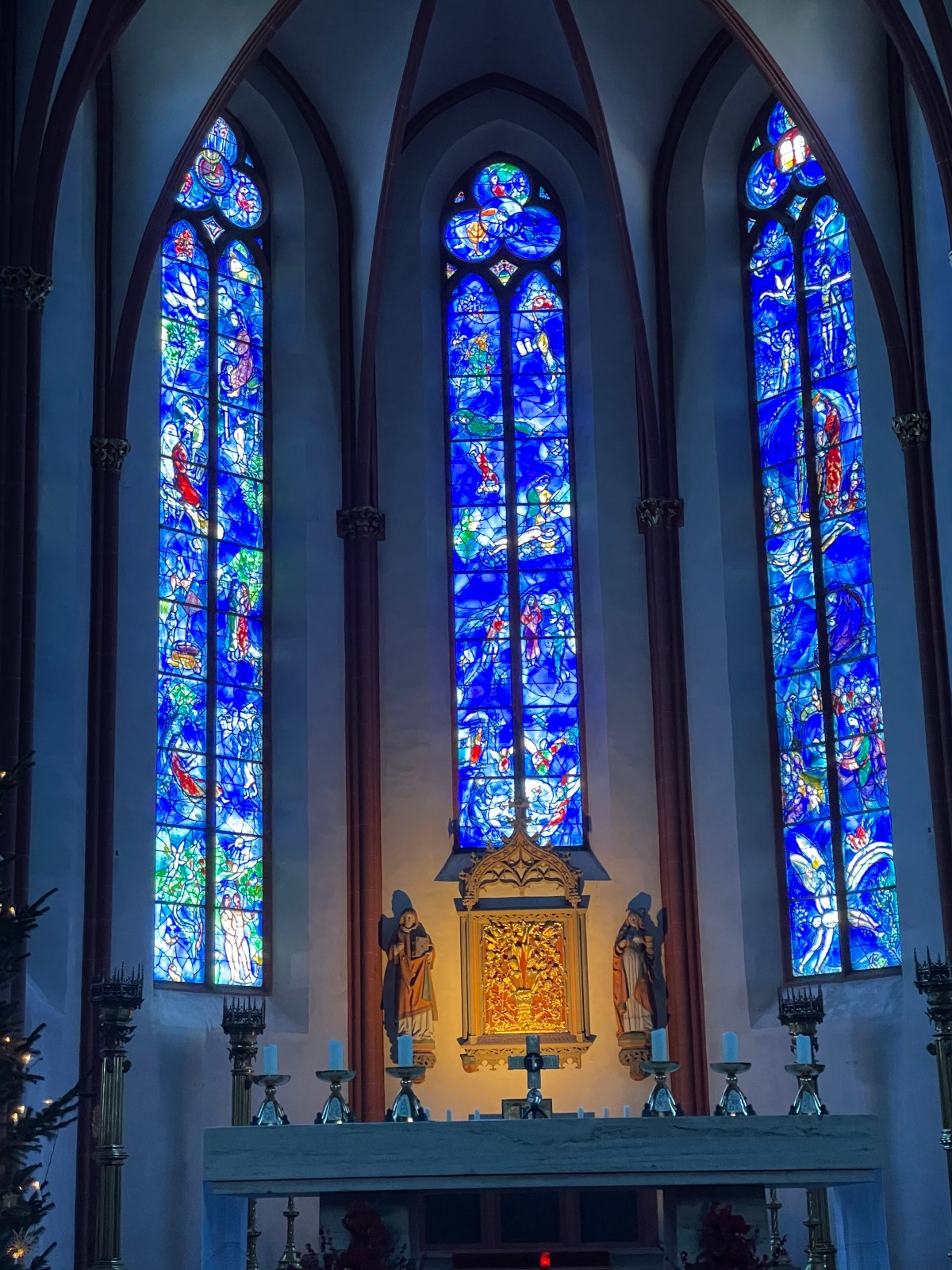
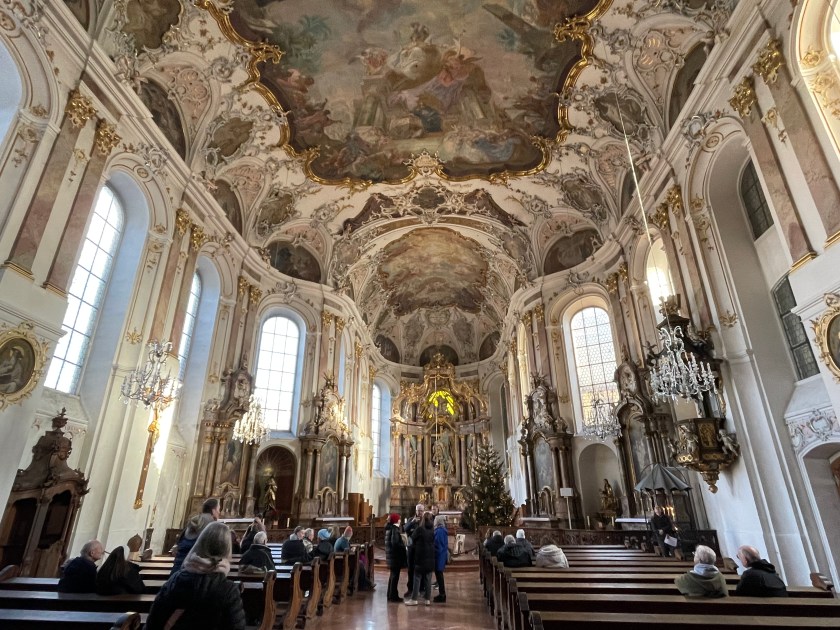
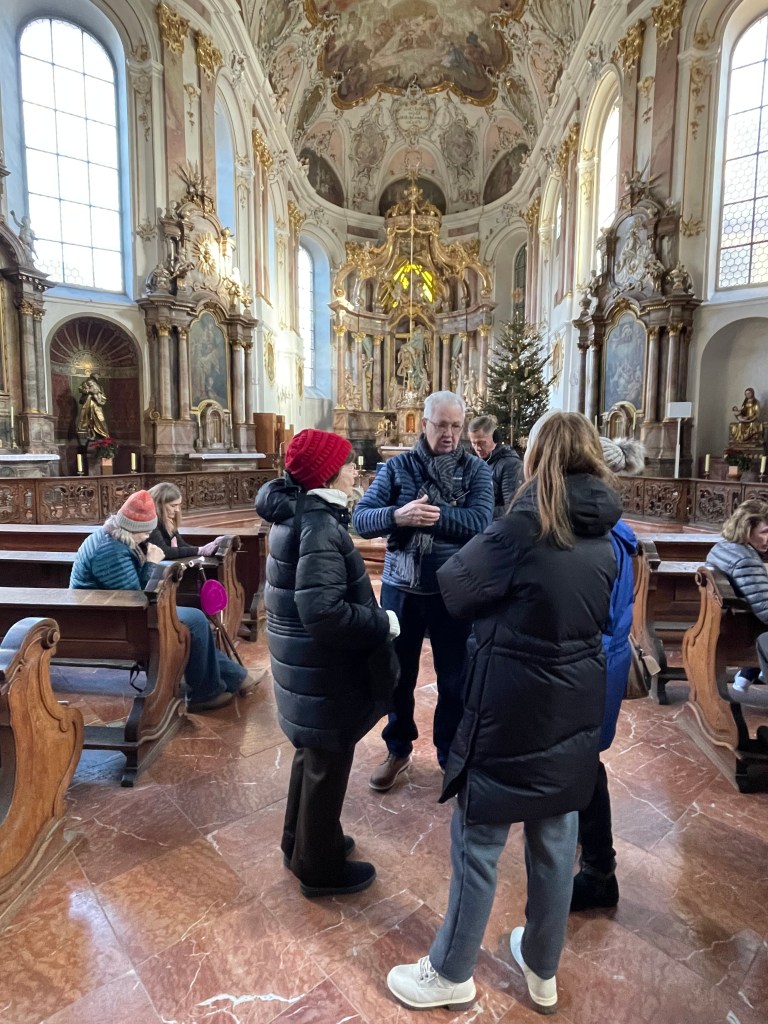
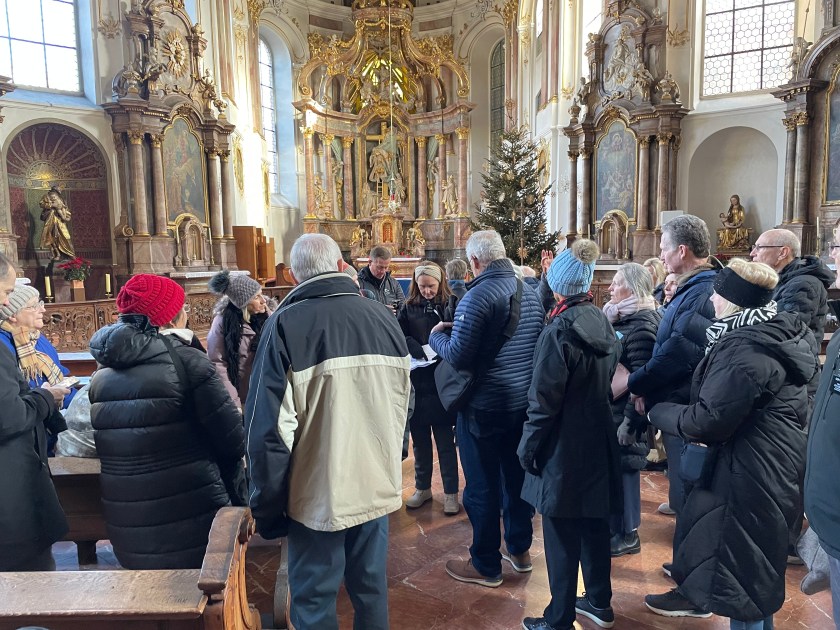
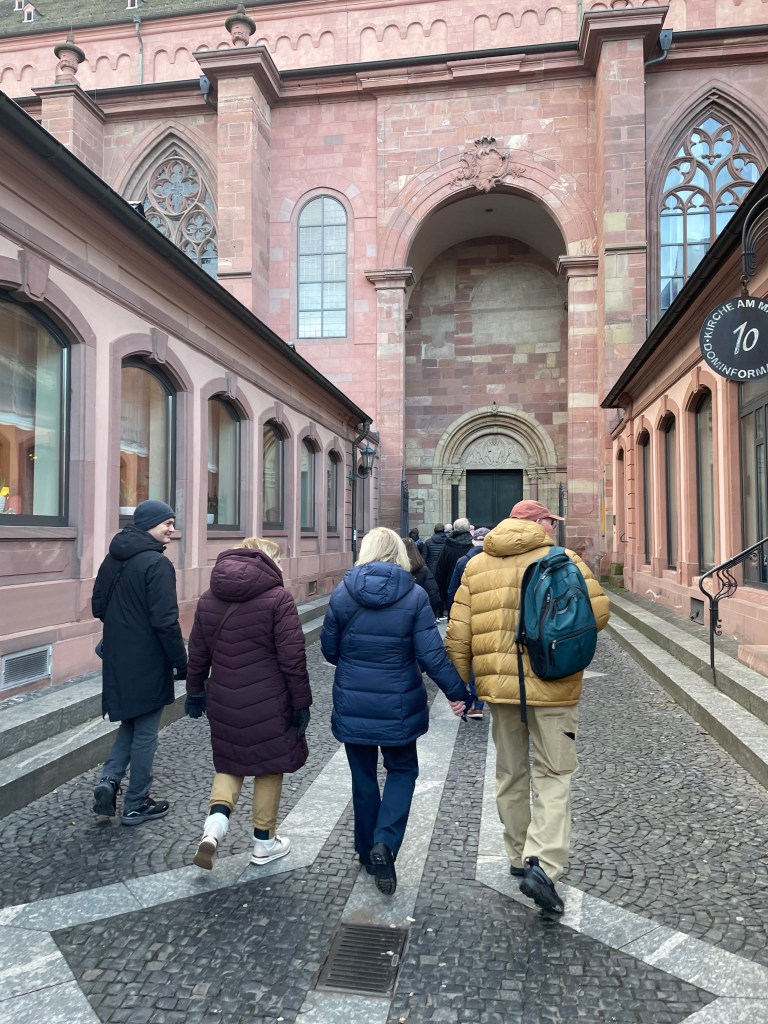
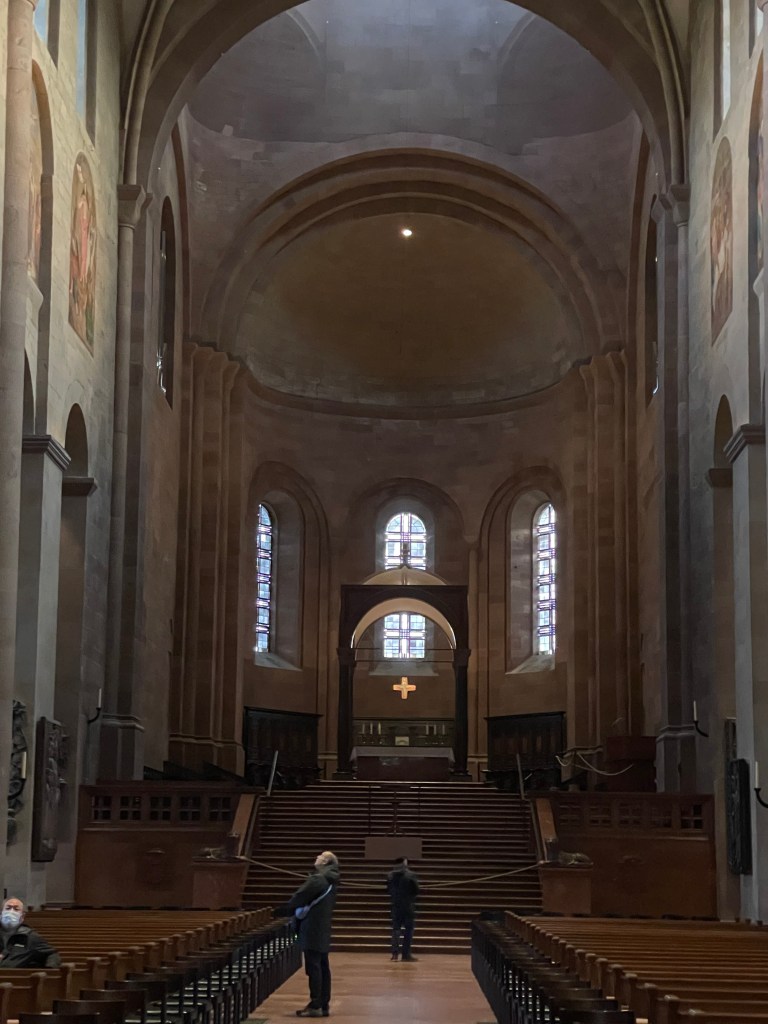
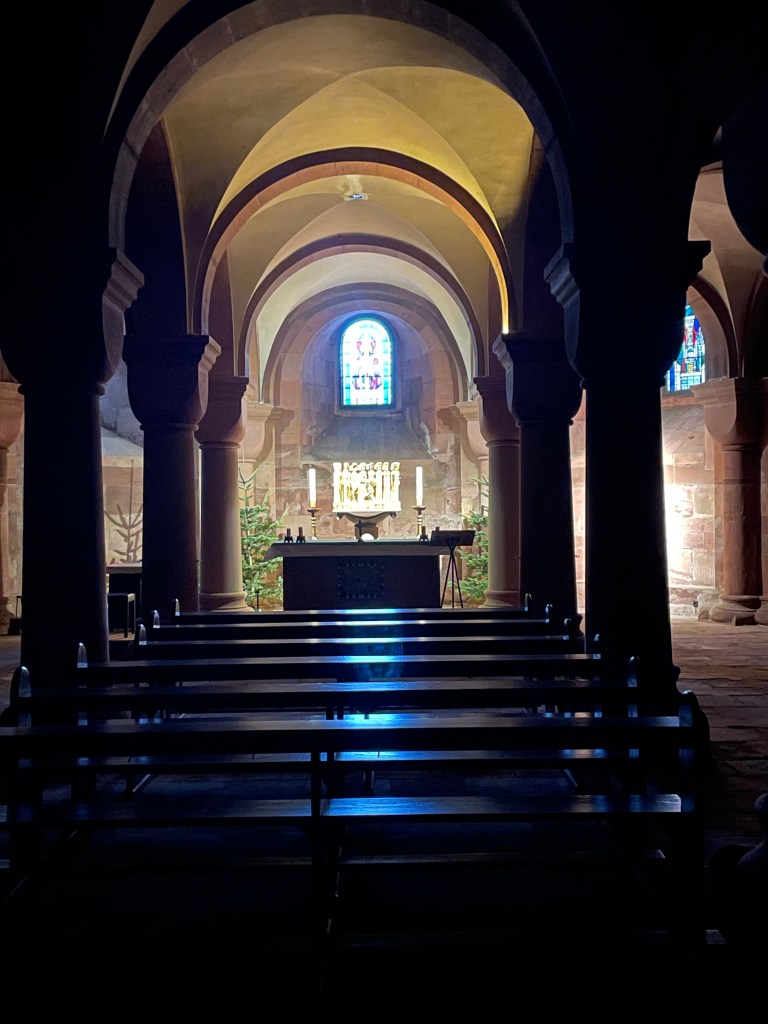
St. Stephan’s Church was our next meeting point at 1:00. We had a paid tour guide to teach our group about Marc Chagall and his 9 famous windows with 18 shades of blue. The filtered light in the chapel was also blue.
It was interesting to learn more about Chagall. I didn’t know he was Jewish and most of his family was killed in WWII. He’d fled to France. The Bishop in Mainz begged him to create a single window for the church here. It took him 2 years to decide to do it and when he finally agreed, he wanted it to represent reconciliation and peace. His themes were from the Old Testament.

From Wikipedia:
Marc Chagall[a] (born Moishe Shagal; 6 July [O.S. 24 June] 1887 – 28 March 1985) was a Russian and French artist. An early modernist, he was associated with the École de Paris, as well as several major artistic styles and created works in a wide range of artistic formats, including painting, drawings, book illustrations, stained glass, stage sets, ceramics, tapestries and fine art prints.
Chagall was born in 1887, into a Jewish family near Vitebsk, today in Belarus, but at that time in the Pale of Settlement of the Russian Empire. Before World War I, he traveled between Saint Petersburg, Paris, and Berlin. During that period, he created his own mixture and style of modern art, based on his ideas of Eastern European and Jewish folklore. He spent the wartime years in his native Belarus, becoming one of the country’s most distinguished artists and a member of the modernist avant-garde, founding the Vitebsk Arts College. He later worked in and near Moscow in difficult conditions during hard times in Russia following the Bolshevik Revolution, before leaving again for Paris in 1923. During World War II, he escaped occupied France to the United States, where he lived in New York City for seven years before returning to France in 1948.
Art critic Robert Hughes referred to Chagall as “the quintessential Jewish artist of the twentieth century.” According to art historian Michael J. Lewis, Chagall was considered to be “the last survivor of the first generation of European modernists.” For decades, he “had also been respected as the world’s pre-eminent Jewish artist.” Using the medium of stained glass, he produced windows for the cathedrals of Reims and Metz as well as the Fraumünster in Zürich, windows for the UN and the Art Institute of Chicago and the Jerusalem Windows in Israel. He also did large-scale paintings, including part of the ceiling of the Paris Opéra. He experienced modernism’s “golden age” in Paris, where “he synthesized the art forms of Cubism, Symbolism, and Fauvism, and the influence of Fauvism gave rise to Surrealism”. Yet throughout these phases of his style “he remained most emphatically a Jewish artist, whose work was one long dreamy reverie of life in his native village of Vitebsk.” “When Matisse dies,” Pablo Picasso remarked in the 1950s, “Chagall will be the only painter left who understands what colour really is.”
The Windows of Marc Chagall
Genesis: After completing the restoration of the church, which had been badly damaged in the war, Pastor Klaus Mayer turned to the Jewish-Russian artist Marc Chagall (1887-1985), the master of color and the biblical message, in the spring of 1973 with the request to make a statement in the east choir of St. Stephen’s Church with church windows designed by him. The contact was followed by letters and later meetings. The artist began designing a central window in December 1976. On September 23, 1978, the first Chagall window with the “Vision of the God of the Fathers” was presented to the parish.
A few days later, the then 91-year-old artist began designing the two flanking central windows with the “Vision of Salvation History”. These two windows were inaugurated on September 15, 1979.
The elderly artist went to work again at the turn of the year 1979/1980 to create the side windows of the east choir with the theme “Praise of Creation” and thus close off the choir area. On September 19, 1981, the three side windows were handed over to the parish. With them, the east choir has gained its closedness and thus the choir area its optimal light fluid, since the windows also influence each other in terms of light.
At the end of 1982, at the age of 96, Marc Chagall created the designs for the three large, three-track windows in the transept, completely unexpectedly. He wanted to create a “vestibule” and “preparation” for the biblical message in the windows of the east choir. On May 11, 1985, the parish received Marc Chagall’s last windows, shortly after his death on March 28, 1985.
The glass surface of all nine windows created by Marc Chagall in the east choir and the transept totals 177.6 square meters.
(Text by Monsignor Klaus Mayer, quoted from the “Small Art Guide to St. Stephan in Mainz”, Verlag Schnell & Steiner, 16th expanded edition 2012).





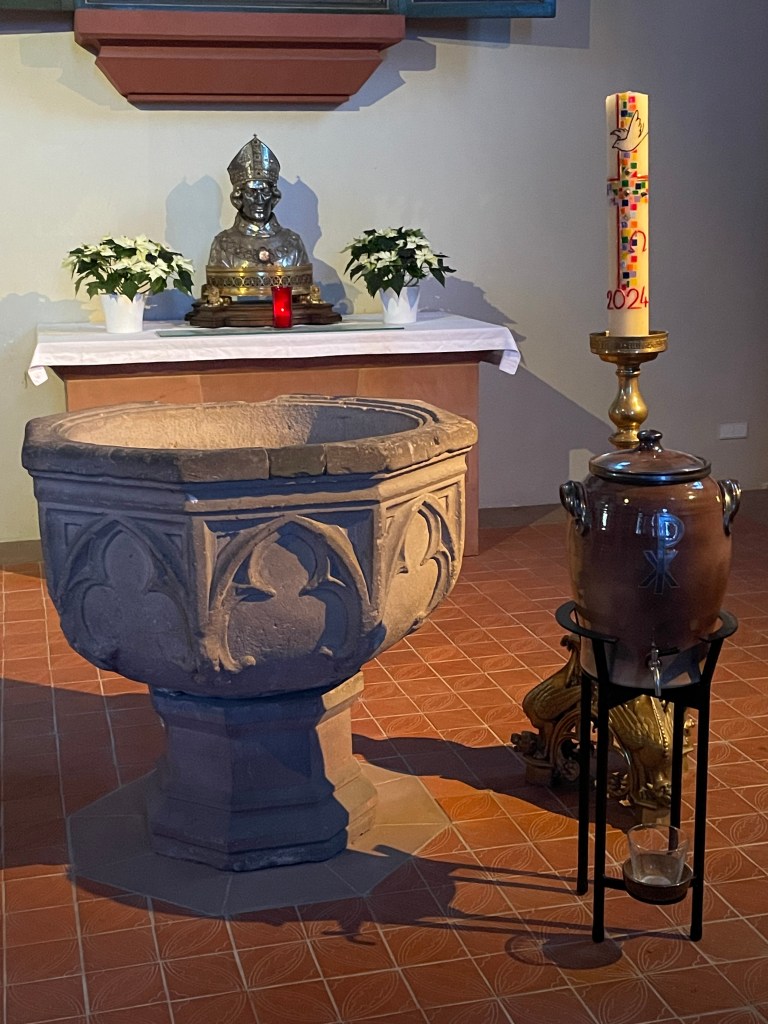
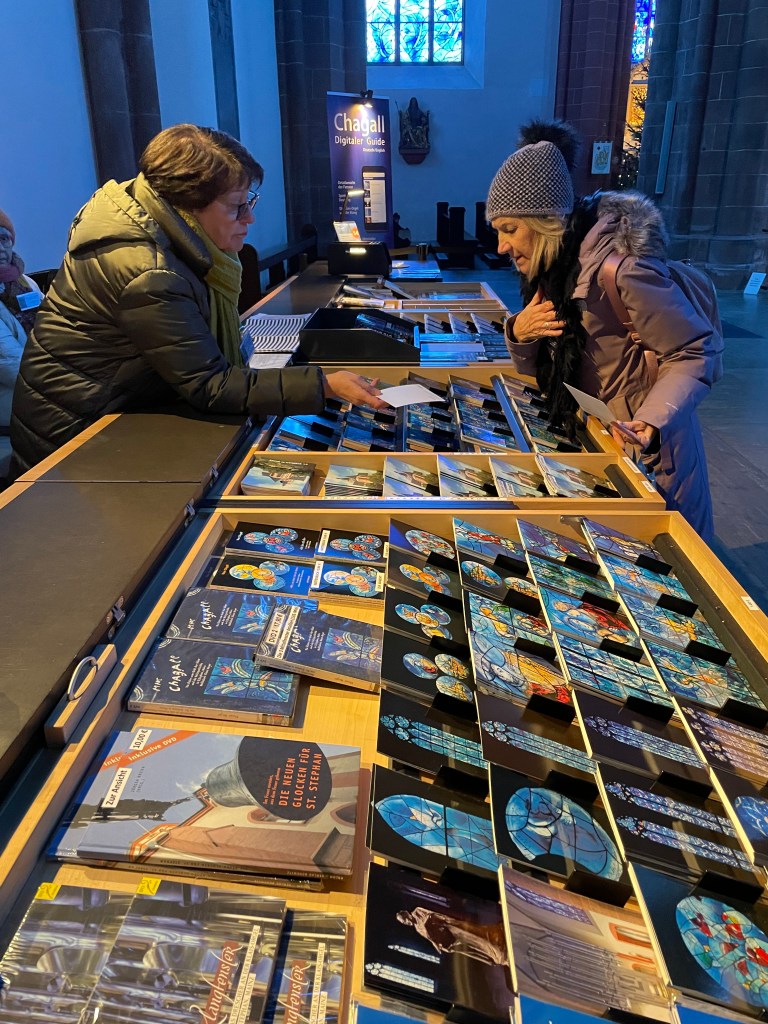


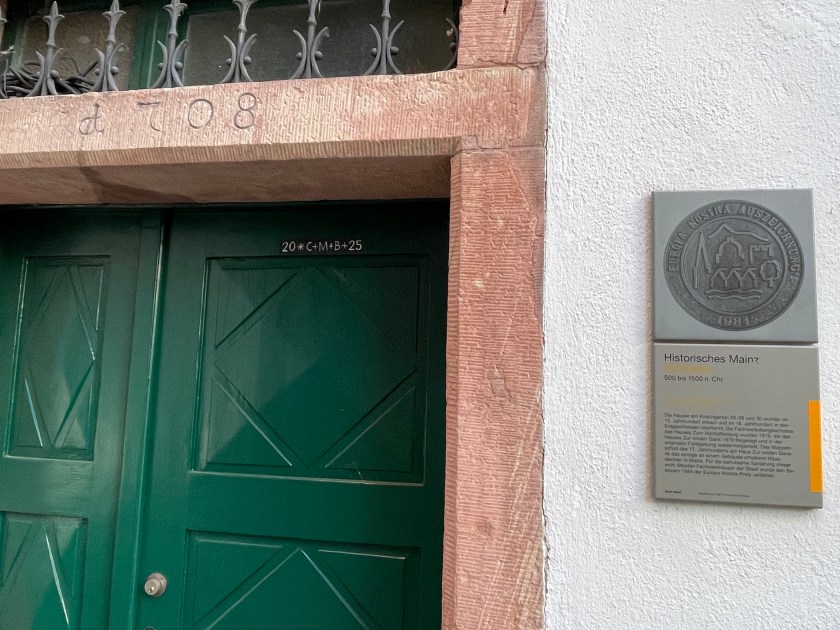
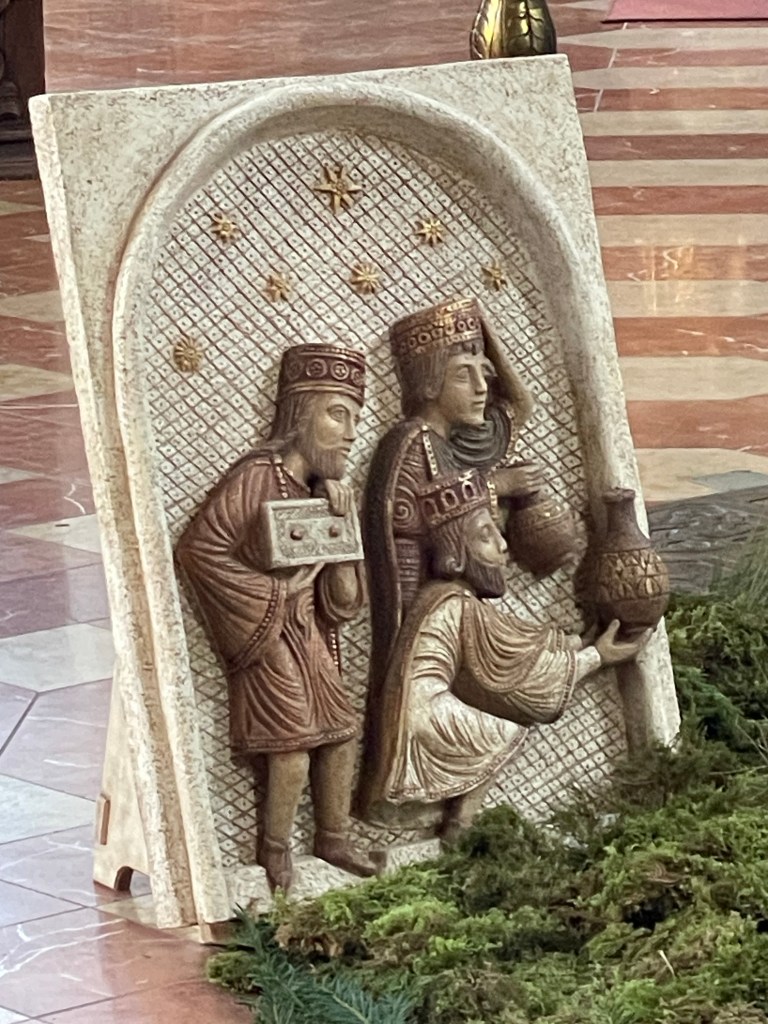
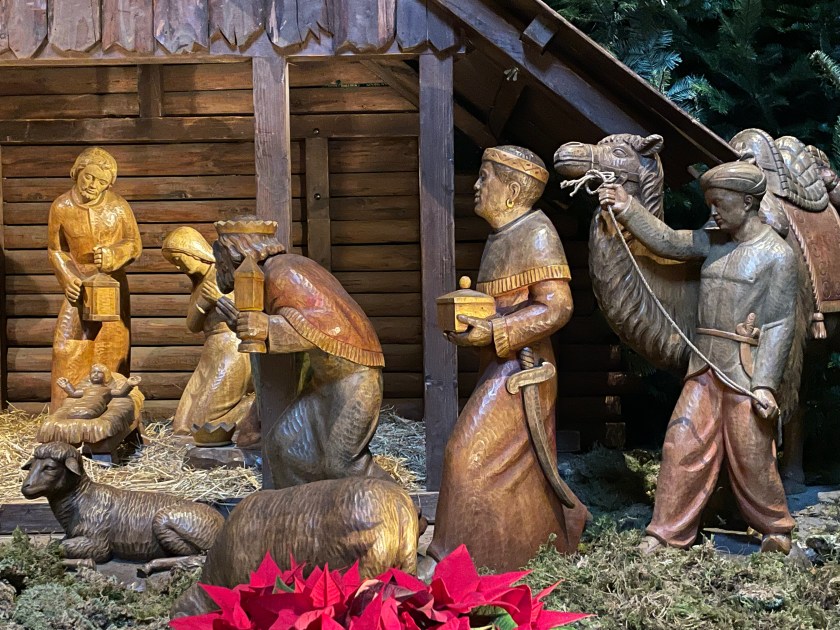
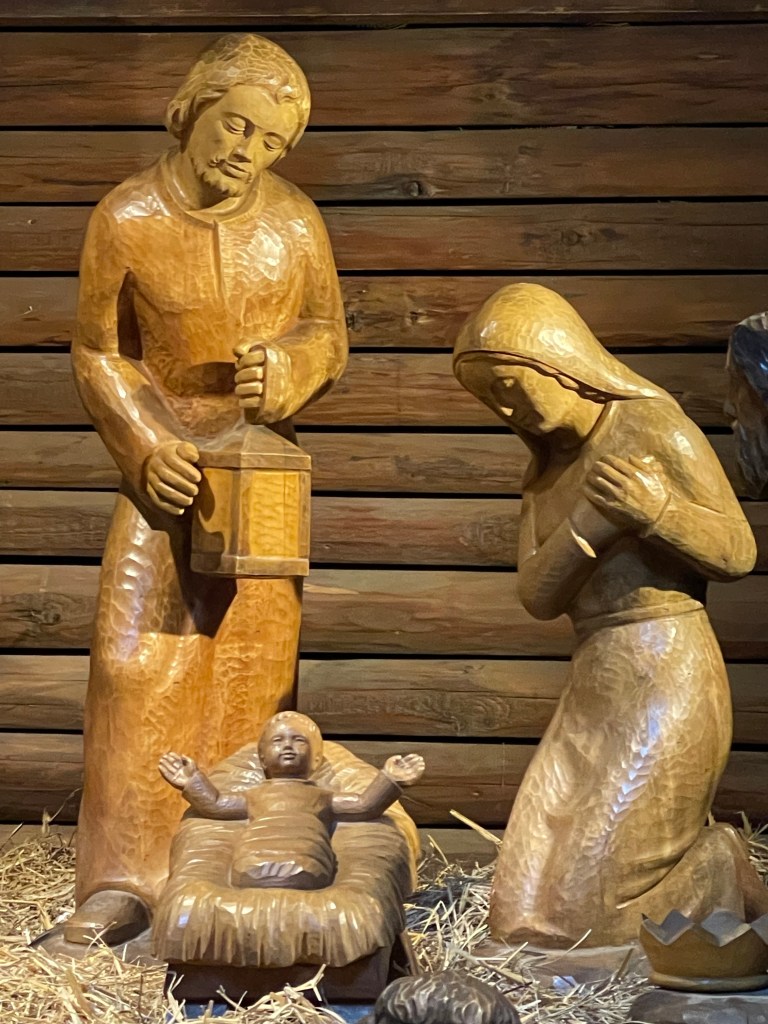
These are the stickers that are placed on doorways on Three Kings Day (Epiphany), commemorating the biblical journey of the magi, or three wise men, to visit the baby Jesus. They presented gifts of gold, frankincense, and myrrh.
The tradition of chalking the door dates back to the 16th century and involves dressing up as the three kings and going door to door singing carols and collecting money for charity. At each house they visit, children chalk the year, an asterisk, and “C+M+B” on the door. Sometimes they use these stickers.



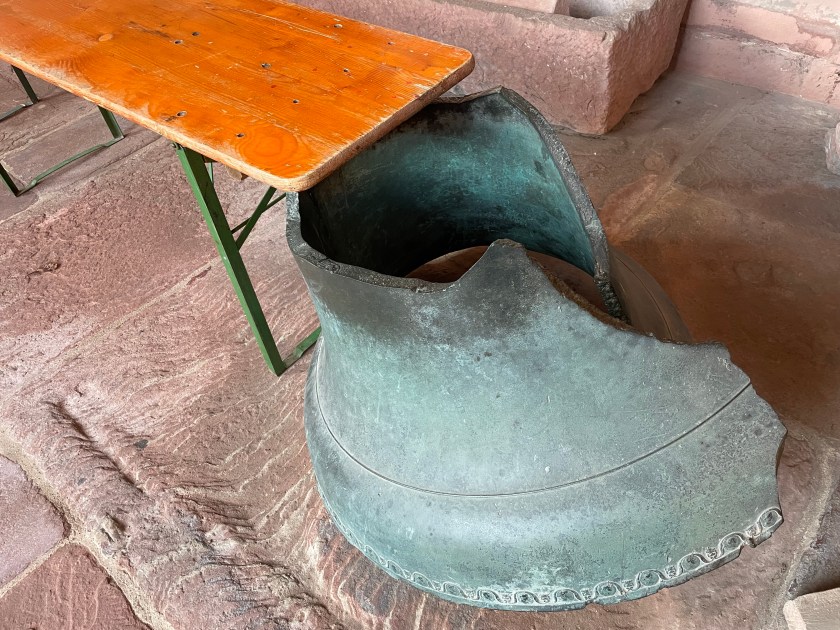

Here’s a marker that says on 27 Feb 1945, 1200 people died here in the heaviest bombing unleashed by Hitler in Mainz. NEVER AGAIN WAR.



And here is a little house filled with food and nesting materials for birds.



































































































 Our Frankfurt Germany Mission