Every Wednesday at noon we have a Book of Mormon study class for all of the Senior missionaries. We take turns teaching. Today John and I took our turn. Our assigned section was in the book of Mosiah, chapters 7-10. I took chapters 7-8 and John talked about chapters 9-10.
I always like to write my notes because ideas come out of my fingertips when I type. These are the notes I spoke from today in our class.
Book of Mormon Class for Senior Missionaries
15 November 2023
Mosiah 7-8
These seem to be fairly routine chapters but there are some profound messages strategically placed here by Mormon
Have everyone quickly read the first 4 verses.
Today I want to share 3 things I’ve been thinking a lot about from Mosiah 7 and 8:
I want to talk about Wandering in the Wilderness.
I want to talk about the gift of Speech.
I want to talk about being Delivered from Bondage.
According to the dictionary, wander means to speak, move, or travel about without fixed destination, plan, or purpose; to roam or to rove; go casually or by an indirect route; to deviate in conduct, or opinion; to go astray.
Two kinds of WILDERNESS WANDERINGS described in the Scriptures:
Wanderings caused by disobedience and wrong choices (Prodigal Son)
Wanderings that remove us from the world, separate and teach us through causing us to pass through dark or hard times, trials, or even sickness
Wandering and Wondering
KELLY D. PATTERSON, BYU Devotional
June 4, 2013
on righteous wandering:
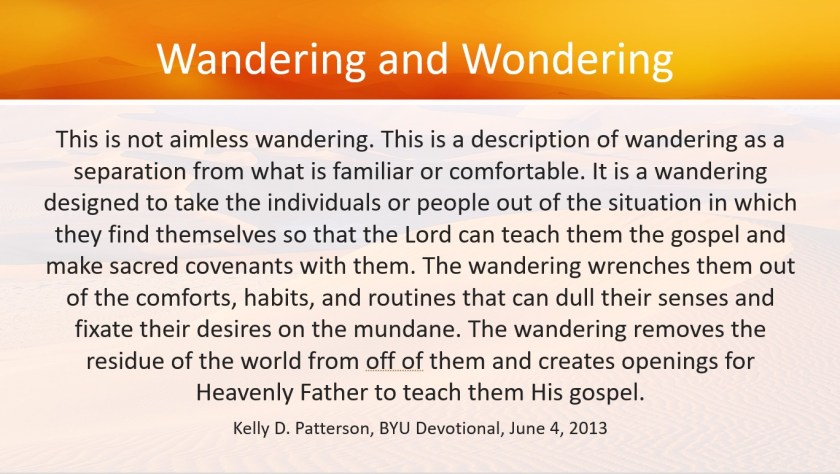
This reminds me of why we spend so much energy giving our youth experiences like girls camp or trek. Someone once said, “it’s not an adventure unless you wish you were home.” I suppose the same can be said of Wandering Times in our lives. We would rather be comfortably Home.
In my experience, the darkest wilderness times in my life have been followed by the greatest outpourings of the Spirit. It’s felt as if the contrast was necessary for me to fully understand the brightness and clarity of the gifts and glimpses given to me by God following these hard times.
I’ve always been struck by some often unnoticed words in Lehi’s Dream Experience:
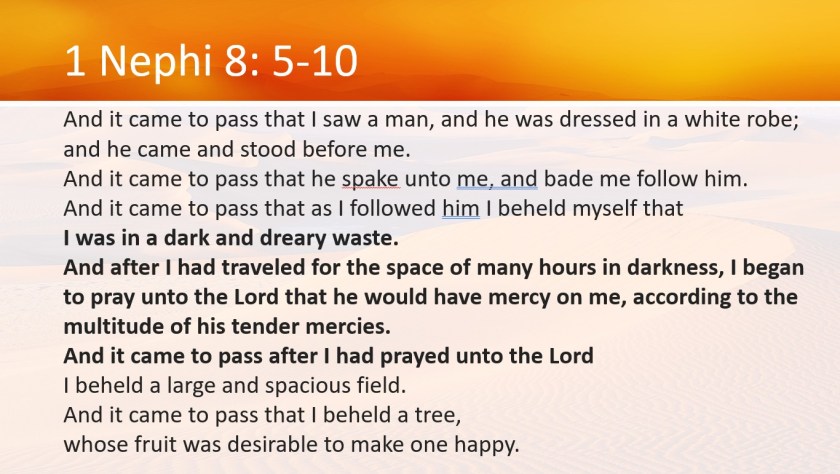
Oh, the contrast! Many hours in a dark and dreary place probably fearing for his life, then the fruit: “white to exceed all the whiteness that I had ever seen. And as I partook of the fruit thereof it filled my soul with exceeding great joy. . . It was desirable above all other fruit.”
———-
Screwtape:
“Do not be deceived, Wormwood. Our cause is never more in danger than when a human, . . . looks round upon a universe from which every trace of Him seems to have vanished, and asks why he has been forsaken, and still obeys.”
———-
How do we respond to our wilderness experiences?
What was Lehi’s response to “traveling many hours in darkness?”
He Prayed.
The number 40 shows up often in the Bible (158 times). Because 40 appears so often in contexts dealing with judgment or testing, many scholars understand it to be the number of “probation” or “trial.” This doesn’t mean that 40 is entirely symbolic; it still has a literal meaning in Scripture. “Forty days” means “forty days,” but it does seem that God has chosen this number to help emphasize times of trouble and hardship.
Book of Mormon Central:
Jesus was in the wilderness fasting for 40 days before the devil came to tempt Him. The number 40 shows up many times in scripture. Some of the most famous examples include:

After Ammon and his brethren wandered in the wilderness for 40 days, they were blessed by finally entering the land of Nephi and eventually being able to help deliver the people of Limhi out of bondage.
While the children of Israel often complained to the Lord during their 40 years of probation in the wilderness, Jesus Christ symbolically reversed all these acts of faithlessness by His own acts of faithfulness during His own 40 days in the wilderness.
———-
Taylor Halverson:
The number 40 is the symbol that is relevant for our day and time.
In scripture, the number 40 symbolizes a time of trial, testing, uncertainty, difficulty, effort, wandering, and wondering. The number 40 represents times when people’s faith is put to the test for an indeterminate amount of time. That is the paradox of the number 40 in scripture. Though to us that is a number that we can grasp, make sense of, count. But in reality, ancient scripture writers would use the number 40 to identify an indeterminate amount of time of wandering suffering, learning, testing and difficulty.
Israelites Wandered for 40 Years
The earliest example of this is the 40 years of testing and wandering experienced by the Israelites in the Sinai wilderness. (In fact, the Biblical book called Numbers is actually called “In the Wilderness” in the original Hebrew.) God saved the House of Israel from the oppressive bondage of Egyptian servitude. He saved them by mighty acts of marvel and wonder. He brought them to Mount Sinai in order to reveal His covenantal expectations of them (the 10 Commandments and the Law of Moses). But even after being invited into His presence, the Israelites wavered and then were condemned to wander in the wilderness. Only have a period of 40 years of testing and trial in the wilderness were they allowed to enter the Promised Land.
Elijah Fasted for 40 Days
We have another story where the prophet of Elijah fasted for 40 days as he wandered his way back to Mount Sinai (1 Kings 19). Discouraged at the wickedness he saw in his society, discouraged that he had been so thoroughly rejected, discouraged that many sought to take his life, he sought solace at the founding epicenter of Israelite faith, Mount Sinai. The journey took him 40 days, symbolizing the wandering and testing he experienced as he sought the presence of God. Furthermore, his 40 day return journey to Sinai symbolized in reverse the 40 years of wandering that the Israelites had endured as they learned to finally and fully trust God.
Jesus Fasted for 40 Days
Then there is the well-known story of Jesus fasting for 40 days after his baptism (Matthew 4). During this time of physical privation, Jesus was also tested and tried spiritually and mentally by the adversary. This was a time of trial, a time of learning, a time of probation and proving. Jesus successfully passed the tests and demonstrated his mastery of his soul.
Ammon and His Men Wandered 40 Days
Mosiah 7-10. Nephites in Zarahemla wondered what happened to their brethren who had returned up to the Land of Nephi several generations before under the leadership of Zeniff. Ammon led a group from Zarahemla up to Nephi. But their course was not a direct and easy route. We know that they suffered and struggled because the scriptures tell us explicitly that they did while also using the symbolic number 40 to alert us to the wandering testing they endured.
“And now, they knew not the course they should travel in the wilderness to go up to the land of Lehi-Nephi; therefore they wandered many days in the wilderness, even forty days did they wander.” (Mosiah 7:4)
We Are All Symbolically Wandering for 40 Days or 40 Years
Why do these stories matter? We can look back to our spiritual forebearers and take heart. We are like them, wandering in the wilderness of affliction. We are being tested. We are experiencing trials. We don’t always know how long the journey will take. We may worry about whether we’ll achieve positive outcomes. We do not always know the course that we should travel.
———-
This week I watched again the scene of Charlton Heston in The Ten Commandments when he was sent by Ramses out into the Wilderness. Do you remember that scene and what it did for Moses? Remember as you watch that he had NO IDEA what would come next.
Show video clip:
https://www.youtube.com/watch?v=OwBWdeQgWvo&list=PLeGnfbJRp8LGVzRHcj-R64l8XZ1aeEVg-&index=6
Watch this section: minutes 1:52 to 4:44
One year ago I was diagnosed with breast cancer. That same week, a friend we served with on one of our missions received the same news. Compared to her, my path was fairly easy, allowing us to come here a few months ago. My friend, on the other hand, has been enduring a daily dark wilderness experience, she has spent most of this last year in hospital beds, sicker than you can even imagine. Her journey is not over. The outcome is not sure. But has she grown in every imaginable way? YES.
Christa recently wrote:
This scripture sums it up perfectly:
2 Cor 12:7-10:
… there was given to me a thorn (stupid cancer) in the flesh, (or the marrow) ….
8. For this thing I besought the Lord thrice,(maybe more than thrice) that it might depart from me.
9. And he said unto me, My grace is sufficient for thee: for my STRENGTH is made perfect in weakness. Most GLADLY therefore will I rather GLORY in my INFIRMITIES, (a little harder than it looks) that the POWER of CHRIST may rest upon me.
10. Therefore I take pleasure (at least I try to ) in infirmities…. for Christ’s sake: for when I am weak, then AM I STRONG!!!
FOR WHEN I AM WEAK, THEN AM I STRONG!!!
Her faith has grown every day. Her relationships with her family have strengthened. (Her daughter left on a mission last week.) She is not the same person she was a year ago.
———-
First Presidency Message
Walking in Circles
By President Dieter F. Uchtdorf, June 2013
Second Counselor in the First Presidency
Have you ever heard the old saying that people who get lost tend to walk in circles?
[Keep in mind here the visual of wandering in a wilderness.]
Jan L. Souman, a German psychologist, wanted to determine scientifically if this was true. He took participants of an experiment to a large forest area and to the Sahara desert and used a global positioning system to track where they went. They had no compass or any other device. Instructions to them were simple: walk in a straight line in the direction indicated.
Dr. Souman later described what happened. “[Some] of them walked on a cloudy day, with the sun hidden behind the clouds [and with no reference points in view]. … [They] all walked in circles, with [several] of them repeatedly crossing their own path without noticing it.” Other participants walked while the sun was shining, with faraway reference points in view. “These … followed an almost perfectly straight course.”
This study has been repeated by others with different methodologies.
All returned similar results.
Without visible landmarks, human beings tend to walk in circles.
https://www.churchofjesuschrist.org/study/liahona/2013/06/walking-in-circles?lang=eng#title2
———-
Back to Ammon and his 16 strong brethren who wandered in the wilderness searching for the people who went off into another land.
They wandered “40 days” before finding their people, who, not recognizing them, took them, bound them and cast them into prison. It wasn’t over yet.
vs. 11 Limhi, the (son of Noah) “suffered that they might be preserved” so that he could ask why they dared come into his land. “Or else I should have caused that my guards should have put you to death.”
Then Limhi said this: “YE ARE PERMITTED TO SPEAK.”
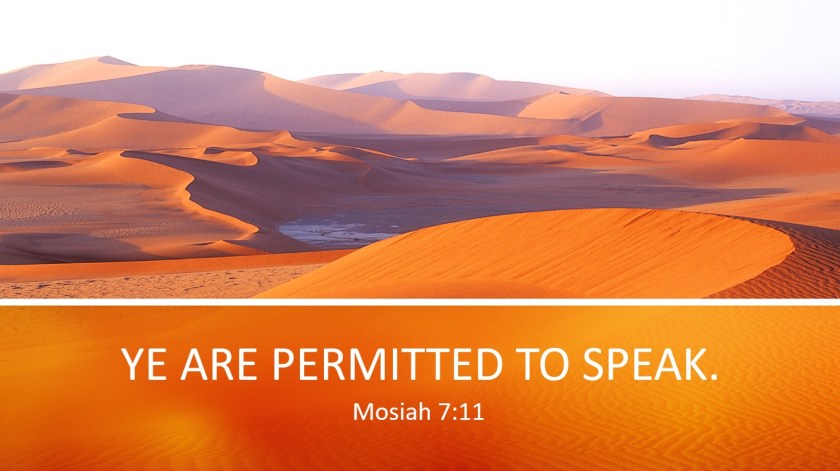
Those words also stop me in my tracks. Ye are permitted to speak. What a gift!!
As Communication Specialists, those words are like music to my ears!
If you were held in bondage (of any kind), and then brought out in chains and Permitted to Speak, what would you say??/div>
Pres Monson, Oct 2008 General Conference talk
In the 1960s, during the Vietnam War, Church member Jay Hess, an airman, was shot down over North Vietnam. For two years his family had no idea whether he was dead or alive. His captors in Hanoi eventually allowed him to write home but limited his message to less than 25 words. What would you and I say to our families if we were in the same situation—not having seen them for over two years and not knowing if we would ever see them again? Wanting to provide something his family could recognize as having come from him and also wanting to give them valuable counsel, Brother Hess wrote—and I quote: “These things are important: temple marriage, mission, college. Press on, set goals, write history, take pictures twice a year.”
If you could only speak or write 25 words, what would they be??
A few weeks ago, Elder Andrus came by our office area to give Elder Garber his laptop before heading home. His means for communicating was turned off. As I watched him hand the computer over, I told Elder Andrus he was like Moroni burying the plates. His digital communication was turned off, ended. He was silenced. For me, my computer is my voice. I don’t know how I would live without it.
Now I want to talk about Deliverance from Bondage
Mormon spends the rest of chapter 7 describing the bondage Zeniff’s people were in.
You know the story. It wasn’t good–they settled in peace, but were now required to pay heavy taxes to the Lamanites.
After his summary of their afflictions, Mormon concludes:

The 16 men who wandered in the wilderness before finding Zeniff’s people became the MEANS of helping to deliver the people out of bondage.
Then in chapter 8, Zeniff tells the story of sending 43 people into the wilderness to find the land of Zarahemla, to appeal to them for deliverance from their bondage.
They discovered a land that had been highly populated, finding ruins of buildings and bones and battlefields strewn with swords, and brass and copper breastplates. They also found 24 engraved gold plates written in another language.
Zeniff asked Ammon if he could translate them. He told Zeniff no, but he knew of someone who could. He then describes seers, revelators and prophets, and the gifts they have from God.
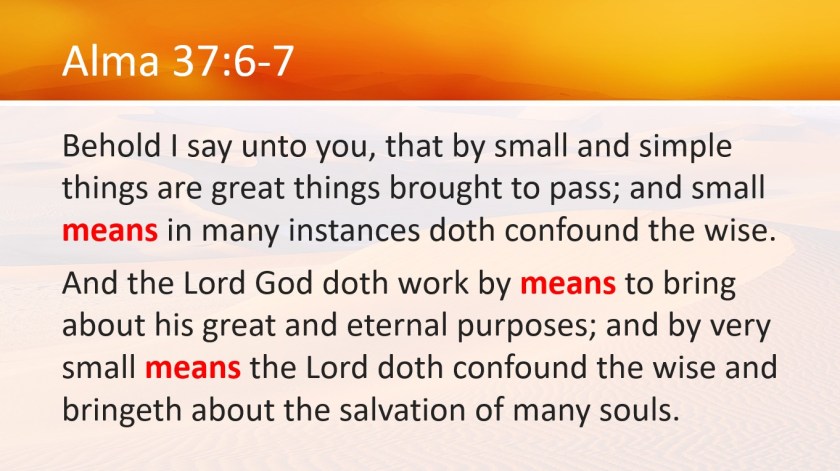
Mormon, compiling these records, uses this story to teach us about MEANS.
Means to ends. Means for deliverance.
Mosiah 8:15-16
And the king said that a seer is greater than a prophet.
And Ammon said that a seer is a revelator and a prophet also; and a gift which is greater can no man have, except he should possess the power of God, which no man can; yet a man may have great power given him from God.
Mosiah 8:17-18
But a seer can know of things which are past, and also of things which are to come, and by them shall all things be revealed, or, rather, shall secret things be made manifest, and hidden things shall come to light, and things which are not known shall be made known by them, and also things shall be made known by them which otherwise could not be known.
Thus God has provided a means that man, through faith, might work mighty miracles; therefore he becometh a great benefit to his fellow beings.
———-
Recommend:
Sheri Dew, BYU Hawaii Devotional
Prophets Can See Around Corners
By Sheri Dew, November 02, 2022
We have been given Prophets, Scriptures, Prayer, Wegweisers, Liahonas and other Means to guide us through wildernesses.
What have been some of your personal Means?
In closing my part today, I remind you to think about what Mormon has shown us in the sequence he recorded: We Wander, We are given voice, A Means is provided for our Deliverance (or we may become a Means for someone else’s deliverance).
I echo what Mormon wrote at the end of Mosiah 8, vs. 20:
O how marvelous are the works of the Lord, and how long doth he suffer with his people . . .”
No matter if we are lost or found, if we wander or see clearly, the Lord is with us and he has provided the means for our deliverance.
I testify of this in the name of Jesus Christ, Amen.














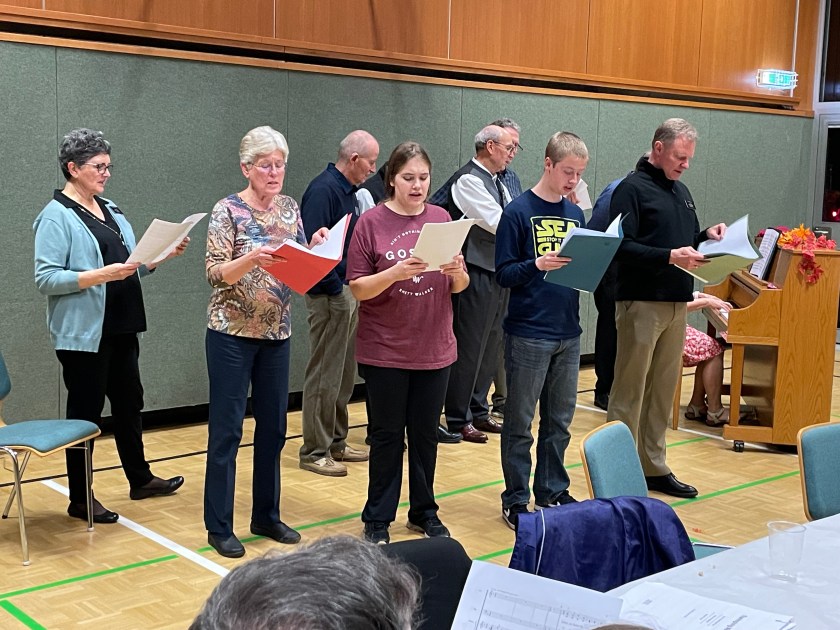

























































 Our Frankfurt Germany Mission