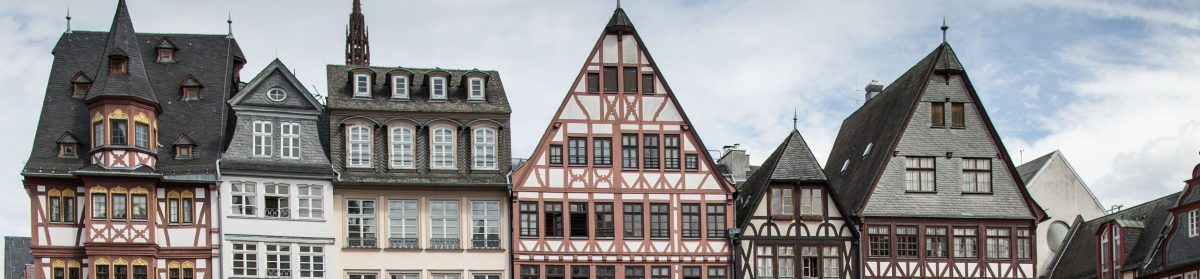

This fascinating article was published on the Frankfurter Neue Press website, found here. I feel it’s so important to understand this part of history–not just the horrible destruction that happened during Hitler’s reign, but the rebuilding of that history and the resilience of the people who lived through it.
It’s also a reminder to me that nothing is permanent and things can change from one day to the next. There are no guarantees. We must live as if we will be here forever, but also live as if it might all be taken from us tomorrow.
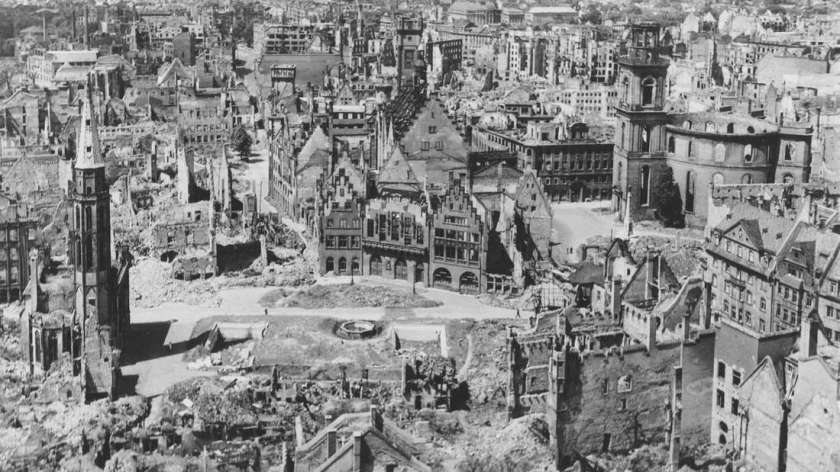
1001 dead, 180,000 homeless and severe destruction after Allied bombing raids 80 years ago today, the historic old town of Frankfurt, one of the largest and most beautiful in Germany, was razed to the ground in Allied bombing raids. Around 1200 late medieval half-timbered houses fell victim to the firestorm, and 1001 people died.
After the attacks on March 18 and 22, 180,000 people were left homeless and 90 percent of the apartments in the city center were destroyed.

Frankfurt – Wednesday, March 22nd, 1944. At around 10:15 p.m., the art historian and “old town father” Fried Lübbecke (60) and his wife Emma are on the stairs to the air raid shelter of their house at Schöne Aussicht 16 on the north bank of the Main when the next bombs whistle from the sky. Lübbecke: “A terrible explosion knocks us down, knocks windows and doors down on us, buries us under rubble, mortar and dust, as thick as a sandstorm. Bomb after bomb comes rushing down.” They only stay in the unsafe cellar for a short time and flee together with neighbors to the nearby Old Bridge. At Brickegickel they watch in horror as their classicist house, built in 1805 by city architect Johann Georg Christian Hess, burns like a huge torch. Lübbecke: “A sky-high cloud of fire drifts over the roofs to the Main, driven by the firestorm. Now the cathedral stands high and free above the Main, above the old bridge. No one has ever seen it like this before.”
The scene seemed unreal, ghostly – and bizarre: Lübbecke’s companions had dragged an old sofa from the philosopher Arthur Schopenhauer’s former apartment on the ground floor of Schöne Aussicht 16 onto the bridge – Schopenhauer’s death sofa. The eccentric, choleric man had died on this piece of furniture on September 21, 1860. Fried Lübbecke gave the building the name Schopenhauerhaus, which has been in use ever since.
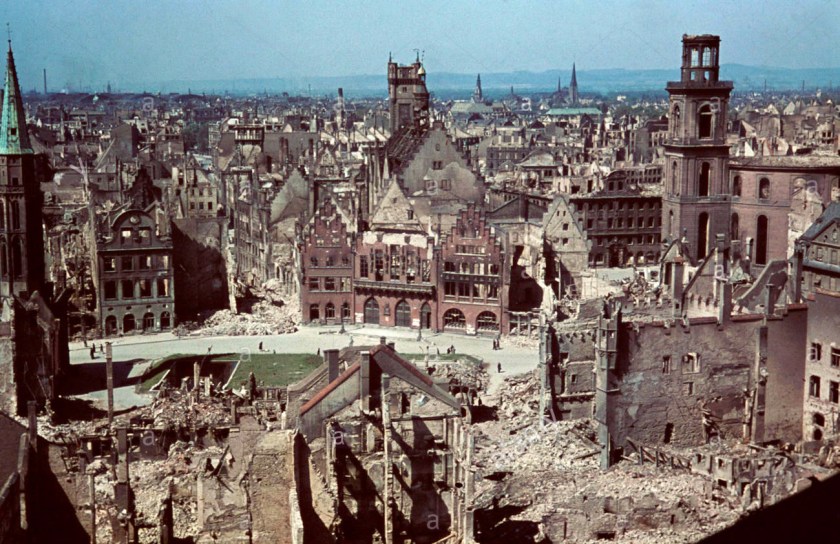
When the few sirens that were still working sounded at 9:45 p.m. that evening, more than 800 British long-range bombers – which had taken off from the English Channel coast – were already over Frankfurt. The air defenses had been fooled by a mock attack by the Royal Air Force on Kassel. Just two minutes before the alarm went off, the first bomb hit the Protestant St. Catherine’s Church at the Hauptwache – the tower clock stopped at 9:43 p.m. For ten years – until reconstruction was completed in 1954 – the hands remained in this position, commemorating the minute in which the Goethe family’s church burned down completely and the precious baroque interior was destroyed.
Precise and devastating strategy
During the attack on March 22, the British Air Force used a tried-and-tested concept, a precise, devastating strategy. In addition to around 500 conventional explosive bombs, the planes initially dropped almost as many so-called aerial mines (weighing between 1.8 and 3.6 tons). On August 29, 2017, one such 1.8-ton monster bomb of the HC 4000 type was found during construction work on the Westend campus of Goethe University. Five days later, the largest evacuation measure to date in Germany was carried out to defuse the unexploded bomb: around 70,000 people had to leave their homes.
During their devastating detonations on March 22, 1944, the aerial mines triggered such powerful pressure waves that roofs within a radius of several hundred meters were blown off. The attackers threw over 700,000 stick incendiary bombs into the now exposed roof trusses – after a short time, the entire western old town was in flames. The British Air Force called the aerial mines “blockbusters” because of their destructive power. A firestorm of apocalyptic proportions spread rapidly from house to house through the winding streets and rolled down the historic heart of Frankfurt. Historic buildings such as the Römer, the Paulskirche, the Carmelite monastery, the Hauptwache and the Alte Oper were destroyed. It was the 112th anniversary of Goethe’s death when his birthplace in the Grosser Hirschgraben burned down to the ground.
underground rescue system
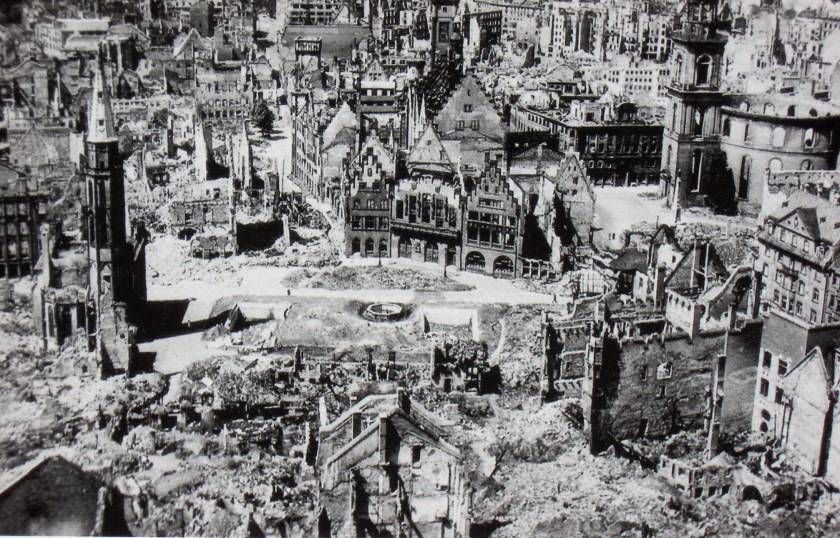
Preserving the historic city center was the heart of Fried Lübbecke, who founded the “Association of Active Old Town Friends” in 1922. By 1942, a major renovation program by the city of Frankfurt under the direction of the art historian with a doctorate had restored more than half of the old town buildings. Two years later, his life’s work went up in flames, and magnificent half-timbered houses became smoking piles of rubble and burnt-out skeletons – a gigantic wasteland of rubble. Lübbecke’s bitter conclusion: “In two hours, the English destroyed what had taken a millennium to build.”
From 1940 onwards, the Gothic vaulted cellars under the old town houses were connected by openings in the walls on the orders of the Luftwaffe, which were then only temporarily closed again with thin brick walls. The city linked these cellars with underground escape routes. The tunnel network under the old town had a central emergency exit on the Römerberg next to the Justizbrunnen. From here, people could flee to the nearby Main. To protect against flames and heat, the fire brigade used numerous hoses to create a wall of water at the Fahrtor, the bottleneck on the escape route. Many people had the underground rescue system and the fire brigade to thank for escaping the fiery hell. The total number of Frankfurt fatalities in the air war, 5,559, is low compared to other German cities: Hamburg lost 55,000 lives, Dresden 25,000, and Cologne 20,000.
The protective veil of water from the fire department at the Fahrtor also had a side effect: it meant that of the approximately 1,200 half-timbered houses in the old town, only one, the Wertheim House, was preserved in its original state. It was first mentioned in 1383, and the current building was built around 1600. The historian Thomas Bauer puts the total number of victims of the Nazi dictatorship in Frankfurt at around 36,000. In addition to the 5,559 victims of the air war, there were around 18,000 fallen soldiers and 12,555 murdered Jews. In 1933, the Frankfurt Jewish community, with almost 30,000 members, was the second largest in Germany after the community in Berlin.
Rolf Schmitz and Gustav “Gus” Lerch, friends who grew up in the narrow streets of the old town and were both born in 1929, had to watch on March 22, 1944, as the world of their childhood was wiped out forever. Lerch turned 15 on March 20, two days before the inferno, and Schmitz three months later. The friends survived the war largely unscathed physically, but the horror of the nights of bombing left deep wounds in their young souls, scars that remained for life.
Both saw it as their life’s work to describe the horror of the war as contemporary witnesses and to talk about everyday life in the old town. Lerch spent decades meticulously working on the twelve-part documentary “Frankfurt am Main in the Air War” and bequeathed it, including numerous collection items, to the Institute for Urban History in Frankfurt in 2007. He died in 2013 at the age of 84.
Rolf Schmitz, known throughout the city as “Klaa Rölfche” since his appearances at the popular Römerberg Festival in 1935, was committed to the reconstruction of “his” old town. At the topping-out ceremony for the new, attractive center of Frankfurt on October 15, 2016 – a few weeks before his death – the 87-year-old Schmitz was the guest of honor. With tears of joy in his eyes.

 Our Frankfurt Germany Mission