

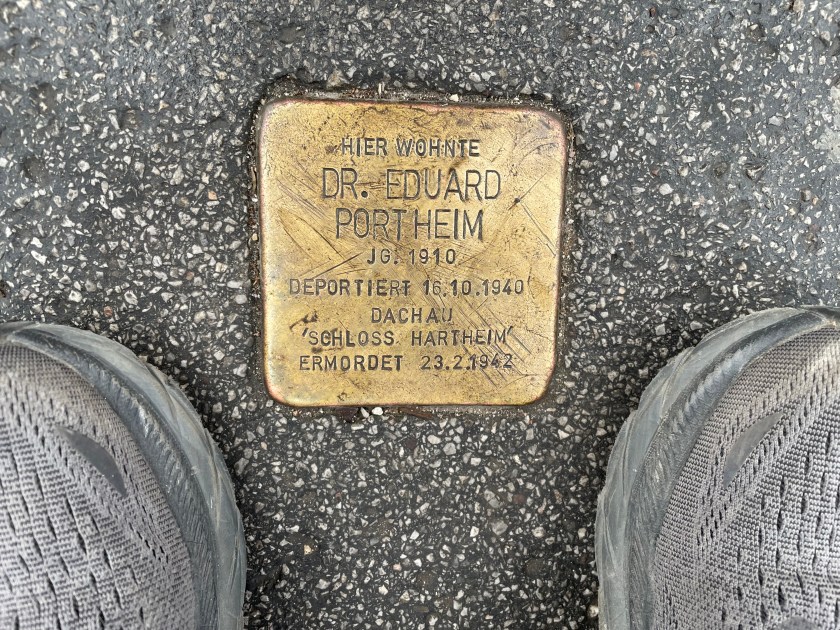
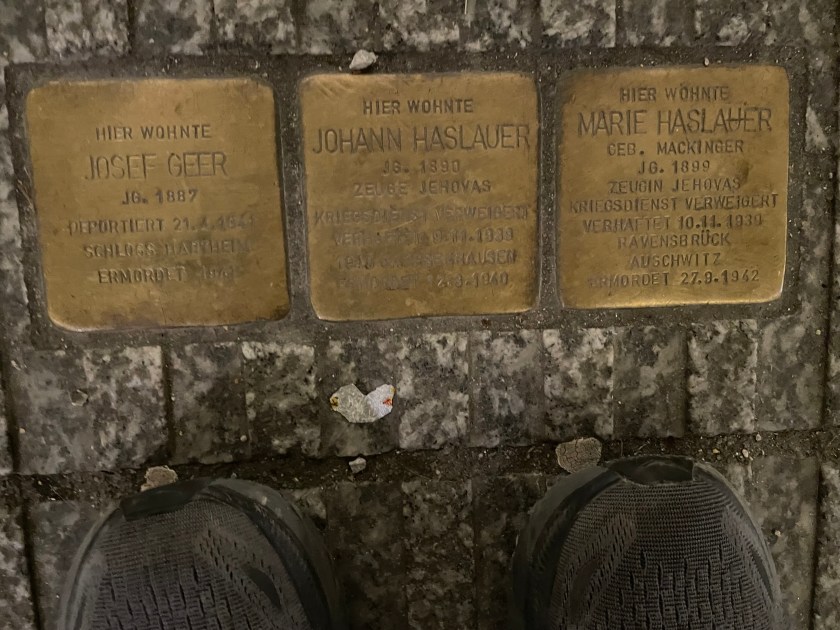
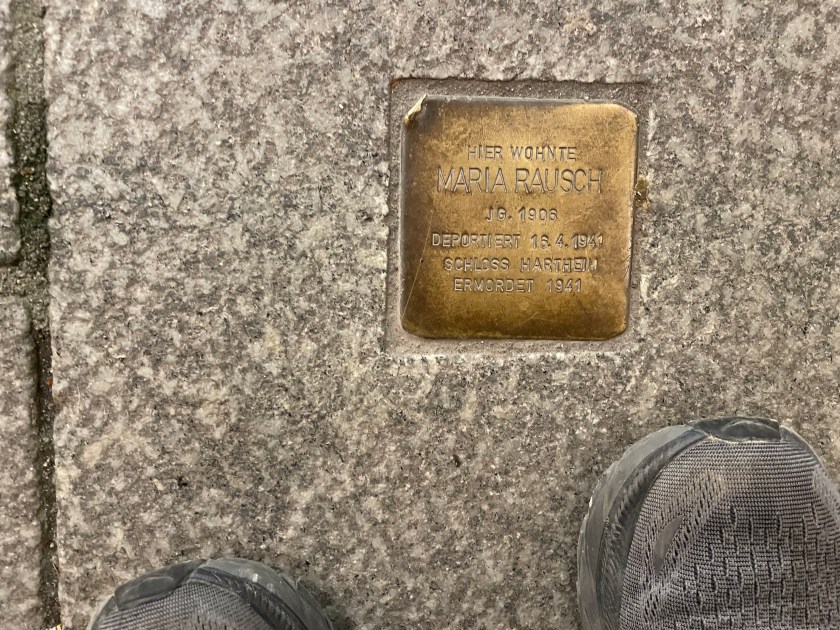
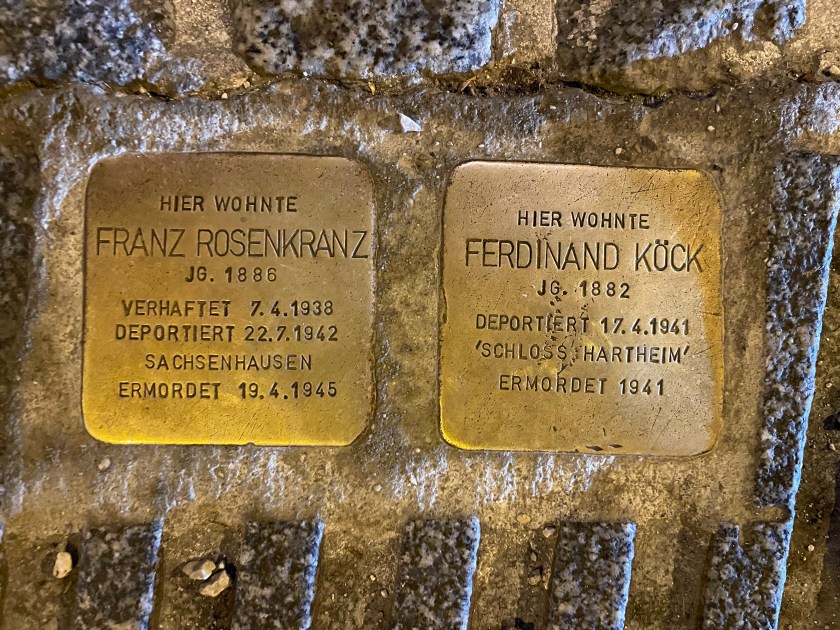
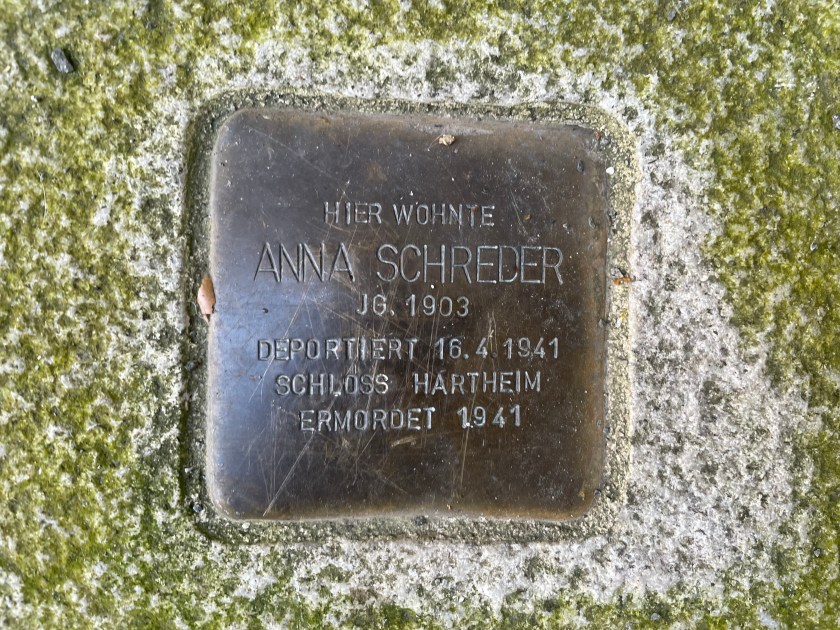
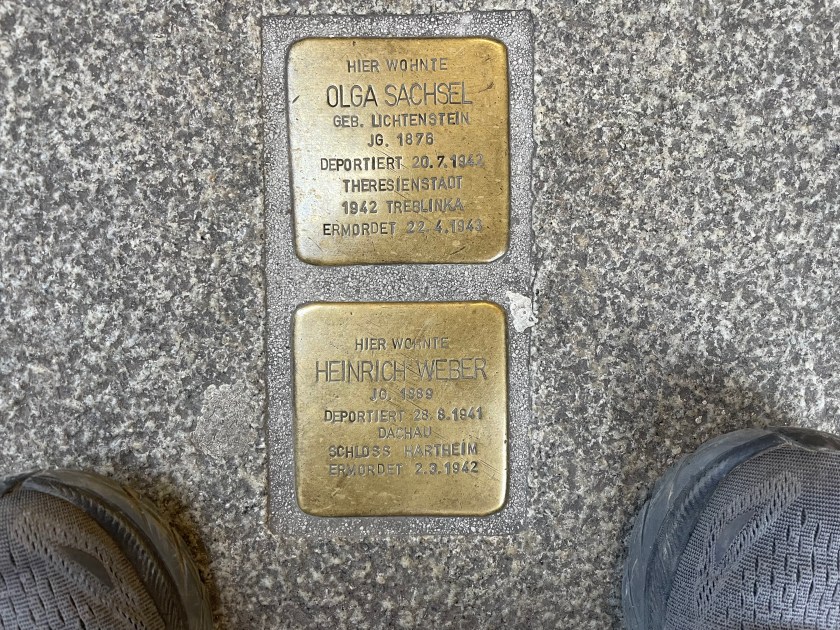
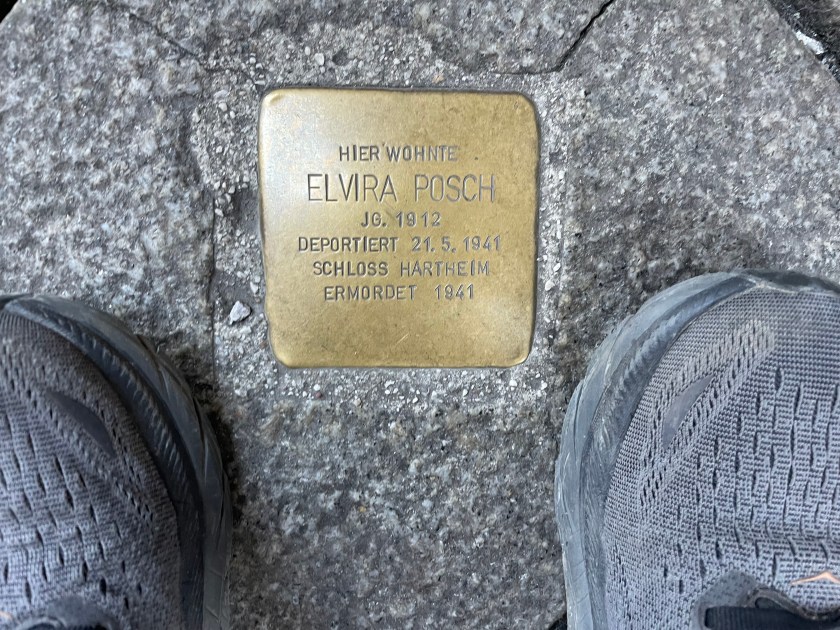
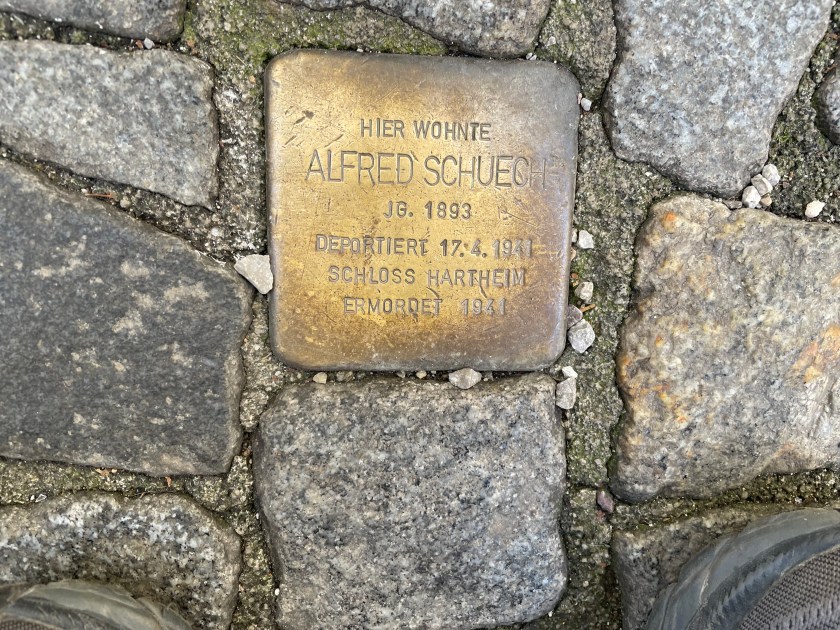
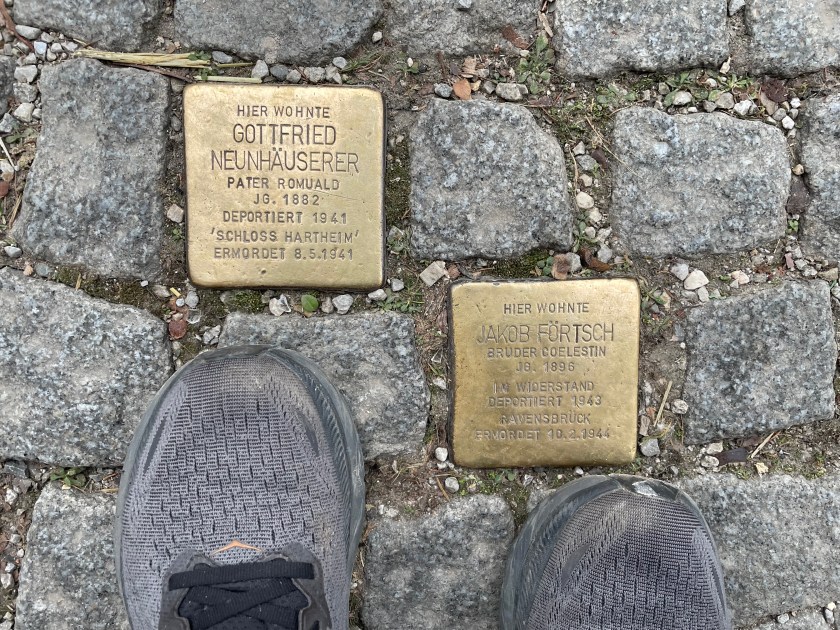
While in Salzburg, we saw so many Stolpersteine listing Schloss Hartheim as the place of death. I learned that this was one of the 6 euthanasia centers (in Germany and this one in Austria) where thousands of people who “weren’t perfect” were killed during WWII.
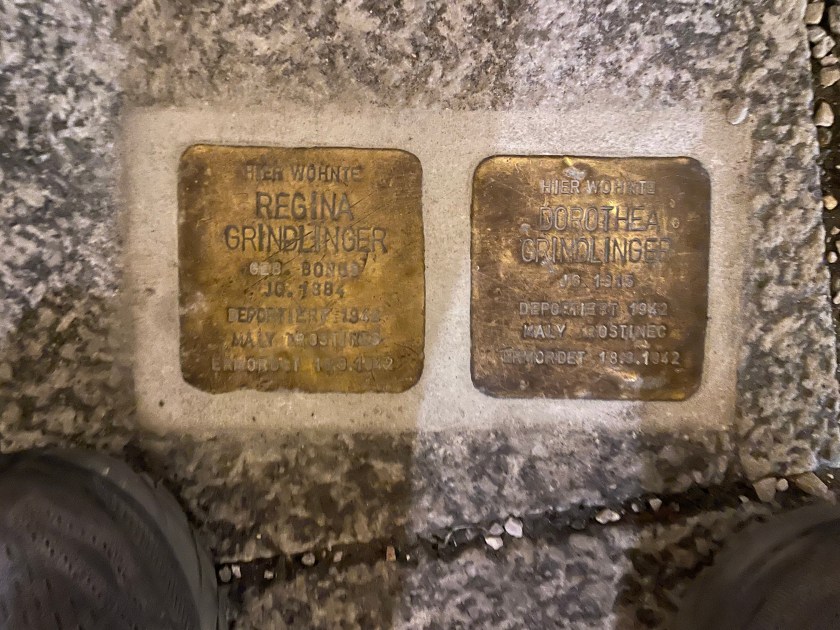
Everything about this piece of history is heartbreaking. At the end of this post are all the Stolpersteine we noticed that memorialize people from Salzburg who died in Schloss Hartheim. These are just a few.
The information below is taken from the Holocaust Museum website: https://encyclopedia.ushmm.org/content/de/article/euthanasia-program
program to kill people with disabilities
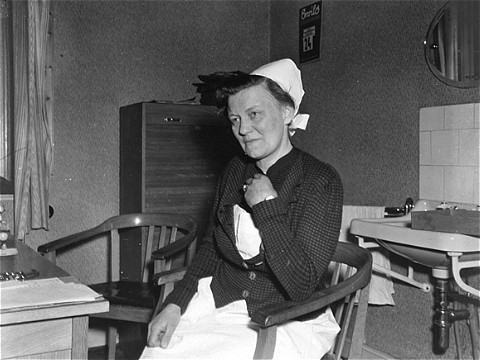
The euthanasia program envisaged the systematic killing of people with disabilities housed in German institutions. It was enforced starting in 1939, about two years before the Nazis began the systematic murder of European Jews as part of their “Final Solution to the Jewish Question.” The program was one of many radical eugenic measures aimed at restoring the country’s “racial integrity.” Its goal was to eliminate what eugenicists and their followers considered “life unworthy of life”: people who, in their view, posed both a genetic and financial burden on German society and the state due to severe psychiatric, neurological or physical disabilities.
child euthanasia program
During the spring and summer months of 1939, a group of planners began organizing a secret operation to kill disabled children. The group was led by Philipp Bouhler, the director of Hitler’s private office, and Karl Brandt, Hitler’s personal physician.
On August 18, 1939, the Reich Ministry of the Interior issued a decree requiring all doctors, nurses and midwives to report newborns and children under the age of three who showed signs of severe mental or physical disability.
From October 1939, the health authorities began to encourage parents of children with disabilities to entrust their young children to one of the specially designed children’s clinics in Germany and Austria. In reality, the clinics were killing centers for children. Specially recruited medical personnel administered lethal overdoses of medication to the children or left them to starve.
Initially, doctors and hospital officials only included infants and small children in the program. However, as the measure was expanded, young people up to 17 years of age were also included. According to conservative estimates, at least 10,000 physically and mentally disabled German children died as a result of the child “euthanasia program” during the war years.
Action T4: Expansion of the “Euthanasia Program”
Officials quickly moved to extend the killing program to include disabled adults housed in institutions. In the fall of 1939, Adolf Hitler signed a secret authorization to protect participating doctors, medical personnel, and administration from prosecution. This authorization was backdated to September 1, 1939, to give the program the appearance of a wartime measure.
The Führer’s Chancellery was a compact unit, separate from the state, government or party apparatus. For these reasons, Hitler chose the Chancellery as the headquarters for the “euthanasia program.” The code name for it was “Action T4.” It refers to the address of the program’s coordination office in Berlin: Tiergartenstrasse 4.
According to Hitler’s instructions, the head of the Führer’s office, Phillip Bouhler, and the doctor Karl Brandt were responsible for the killing operations. Under their leadership, the T4 employees set up six gassing sites for adults as part of the “euthanasia measures”. These were located in:
- Brandenburg an der Havel, west of Berlin
- Grafeneck in southwest Germany
- Bernburg in Saxony
- Sonnenstein in Saxony
- Hartheim near Linz on the Danube (Austria)
- Hadamar in Hesse
Using a procedure originally developed for the child “euthanasia program,” in the fall of 1939 T4 planners began distributing meticulously worded questionnaires to all health authorities, public and private hospitals, psychiatric institutions, and nursing homes for the chronically ill and elderly. The limited space and wording on the forms, as well as the instructions in the accompanying cover letter, gave the impression that this was merely a survey designed to collect statistical data.
The sinister purpose of the form could only be suspected based on the emphasis on the patient’s ability to work and the patient categories that had to be specified by the health authorities. The following patient categories were available:
- Patients suffering from schizophrenia, epilepsy, dementia, encephalitis and other chronic psychiatric or neurological disorders
- Patients who were not of German or “related blood”
- mentally disturbed criminals or criminally convicted persons
- Patients who had been admitted to the facility for more than five years
Secretly recruited “medical experts” and doctors, many of them with excellent reputations, worked in teams of three to evaluate the forms. Based on their decisions, the T4 officials began removing the patients selected for the euthanasia program from their original facilities in January 1940. The patients were transported by bus or train to one of the central gassing sites to be murdered there.
Within hours of arriving at the centers, the victims died in the gas chambers. Pure carbon monoxide gas, bottled in bottles, was introduced into the gas chambers, disguised as shower rooms. T4 officials burned the bodies in crematoria adjacent to the gassing sites. Workers randomly removed ashes from the cremated victims and sent them in urns to relatives. The victims’ families or guardians received the urn along with a death certificate and other documents stating a fictitious cause and date of death.
Because the program was classified, the T4 planners and officials went to great lengths to conceal the program’s murderous goal. Although doctors and administrators meticulously falsified official records to make it appear that the victims had died of natural causes, the true background of the “euthanasia program” quickly became an open secret. The measures were widely known to the public. The killings met with private and public protest, particularly from members of the German clergy. Among these clergy was the Bishop of Münster, Clemens August Graf von Galen. He protested against the T4 murders in a sermon on August 3, 1941. In light of the public’s knowledge and protests, Hitler ordered a halt to the “euthanasia program” in late August 1941.
According to the internal records of the T4 officials, between January 1940 and August 1941, 70,273 mentally and physically disabled people were murdered in the six gassing sites as part of the “euthanasia program.”
Second Phase
Hitler’s order to stop the T4 operation did not, however, mean the end of the “euthanasia killings.” For children, the “euthanasia program” continued as before. German doctors and medical personnel continued the killings in August 1942, but with more discretion than before. More decentralized than in the first phase of the gassings, the new measures were now closely tied to regional requirements, with local authorities determining the pace of the killings.
In the second phase, which was widespread throughout the Reich, the killings were carried out less obviously. Overdoses of medication and lethal injections were usually administered, as was already common practice in the child “euthanasia program.” In many institutions, adults and children were also systematically starved to death.
The “euthanasia program” continued until the last days of World War II and was expanded to include ever broader target groups, including geriatric patients, bomb victims and foreign forced laborers. Historians estimate that a total of 250,000 people fell victim to the “euthanasia program.”
———————
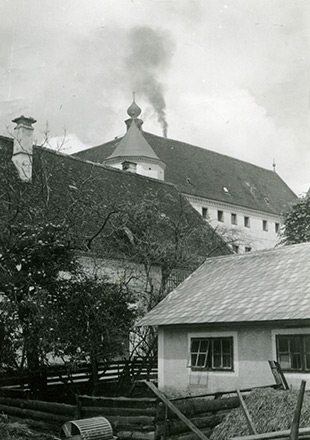
Between May 1940 and December 1944, it is estimated that around 30,000 people were murdered in Hartheim. Among those murdered were the (mentally) ill, physically and mentally handicapped people, as well as concentration camp prisoners from various concentration camps and foreign forced laborers.
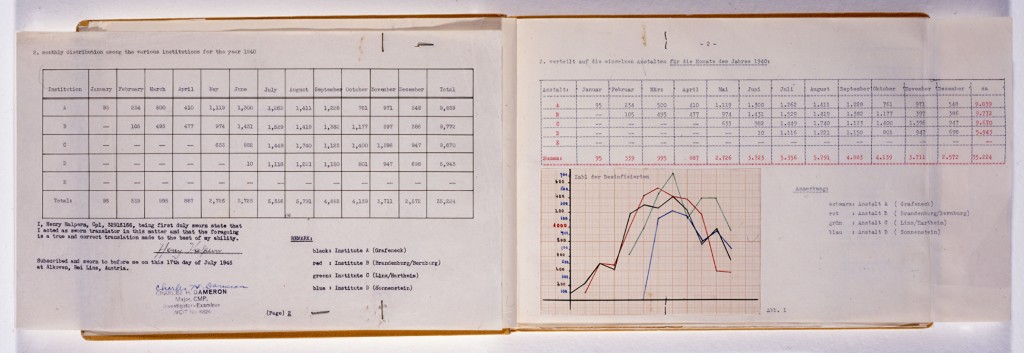
In June 1945, the American investigating officer Charles Dameron found a brochure with the so-called “Hartheim Statistics” in the castle. It contained monthly statistical information on the killings of handicapped or mentally ill people with carbon monoxide in the six T4 killing centers in the then Reich. This was also used to calculate the alleged savings in food, rent, personnel costs, etc.
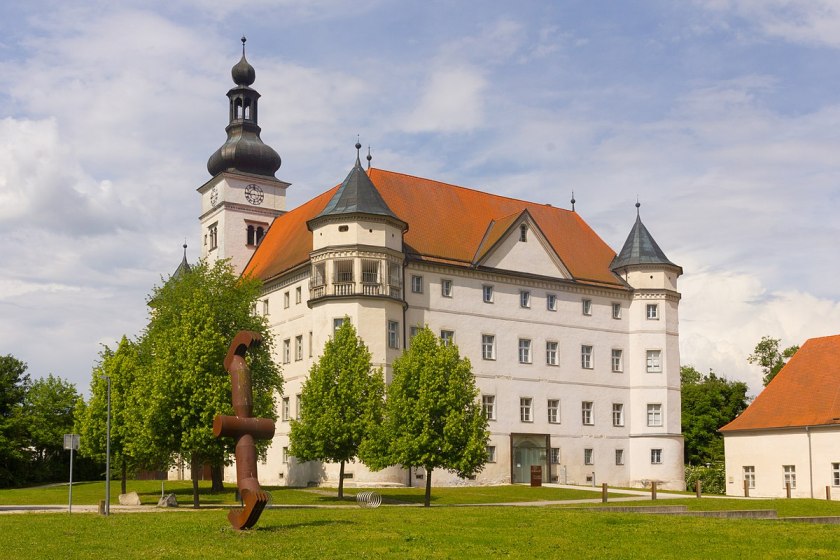
Hartheim killing center: Nazi era and aftermath (Wikipedia)
Beginning in 1939, the Nazis used Hartheim and five other sites as killing facilities for Aktion T4, which performed mass sterilizations and mass murder of “undesirable” members of German society, specifically those with physical and mental disabilities. In total, an estimated 200,000 people were murdered across all these facilities, including thousands of children. These actions were in keeping with Nazi ideas about eugenics. While officially ended in 1941, Aktion T4 lasted until the German surrender in 1945.
During the first phase of Aktion T4 at Schloss Hartheim, about 18,000 people with physical and mental disabilities were murdered gassing with carbon monoxide. The facility was also used to murder about twelve thousand prisoners from the Dachau and Mauthausen concentration camps who were sent here to be gassed, as were hundreds of women sent from Ravensbrück concentration camp in 1944, predominantly sufferers of TB and those deemed mentally infirm. The castle was regularly visited by the psychiatrists Karl Brandt, Professor of Psychiatry at Würzburg University, and Werner Heyde. In December 1944 Schloss Hartheim was closed as an extermination center and restored as a sanatorium after being cleared of evidence of the crimes committed therein.
In 1946, Alice Ricciardi-von Platen, a psychiatrist and psychoanalyst who practiced near Linz, Austria, was invited to join the German team observing the so-called Doctors’ trial in Nuremberg. The trial was presided over by American judges, who indicted Karl Brandt and 22 others. The 16 who were convicted included Josef Mengele; seven were sentenced to death. Her 1948 book, Die Tötung Geisteskranker in Deutschland, (“The killing of the mentally ill in Germany”), was judged a scandal by German medical professionals.
After World War II, the building was converted into apartments. 1969, the first memorial rooms were opened in the former gas chamber and admission room. Since 2003, Hartheim Castle has been a memorial site dedicated to the ten thousands of physically and mentally handicapped persons, concentration camp prisoners and forced laborers who were murdered there by the Nazis. Also in 2003 the exhibition “Value of Life” was opened.
Below are stones we noticed remembering people who died at Schloss Hartheim.





 Our Frankfurt Germany Mission