
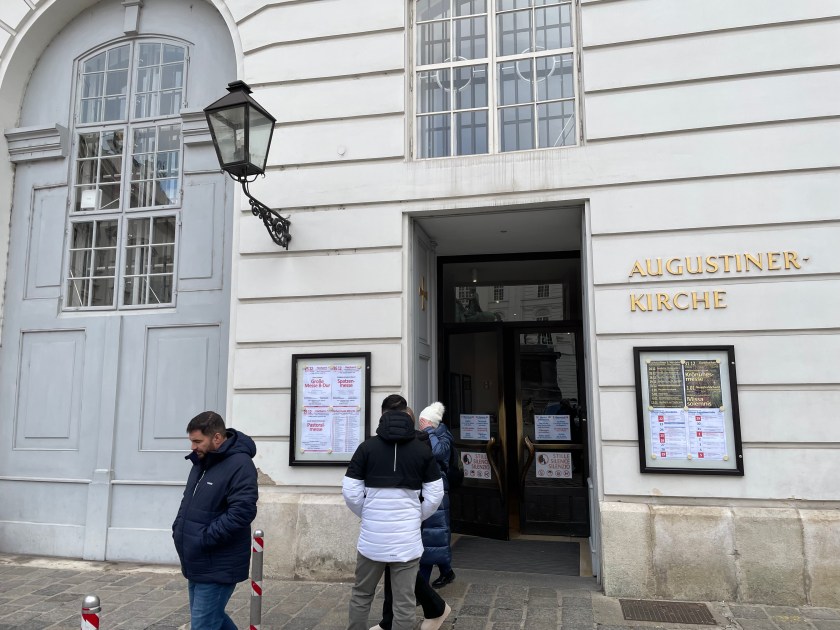
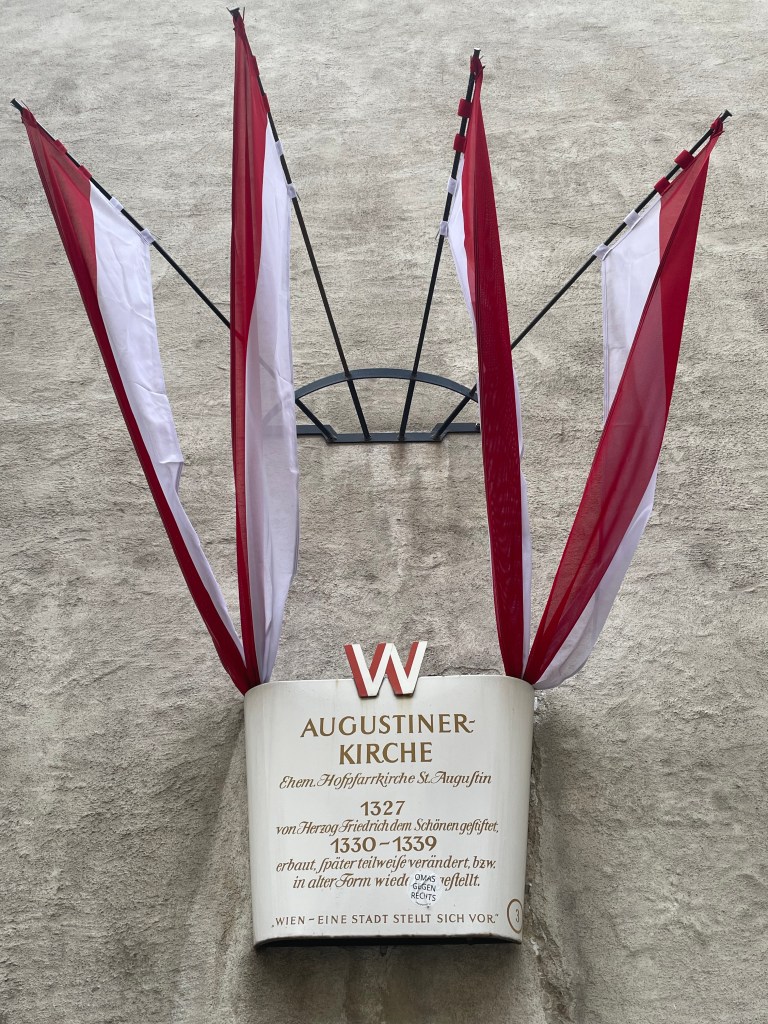
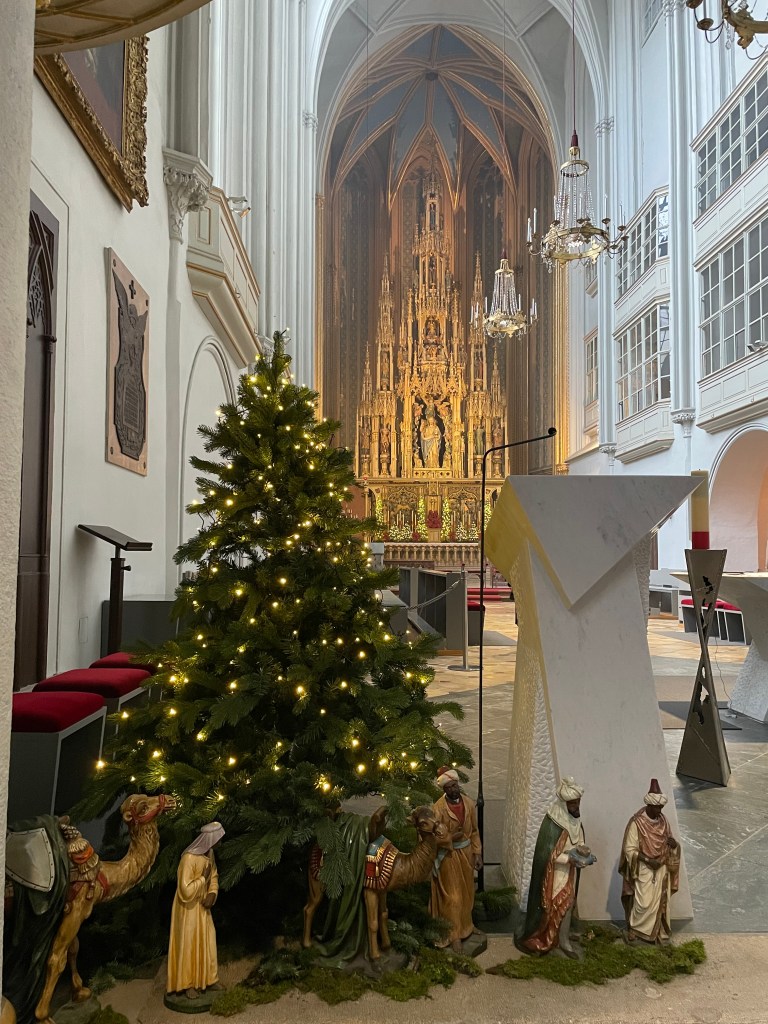
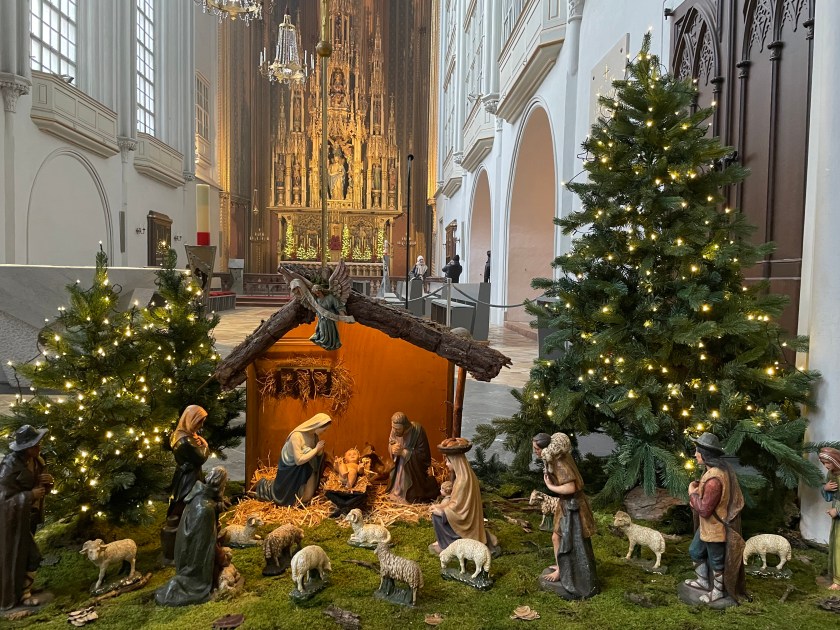
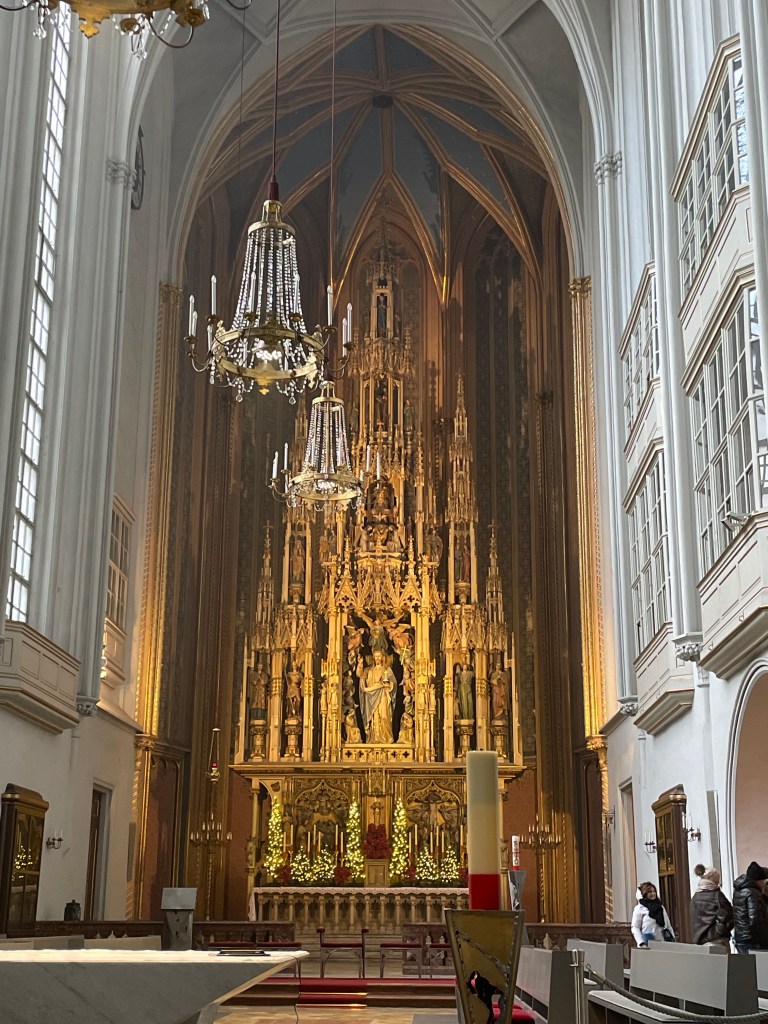
Whenever we see a church, we enter it and feel it. This is the Augustinerkirche in Vienna, a beautiful haven for us on this Christmas afternoon. This church was the Habsburg monarchy’s court church for almost 300 years, built in 1327.
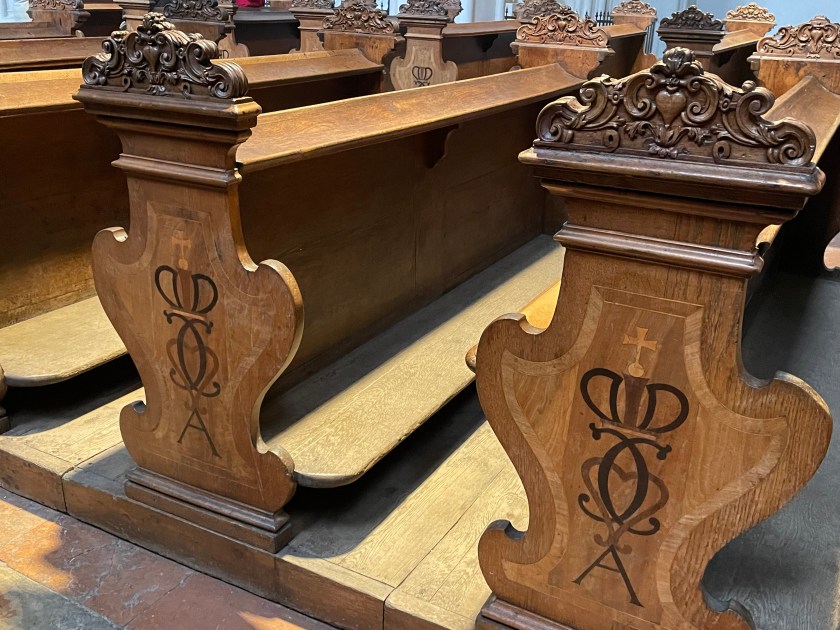
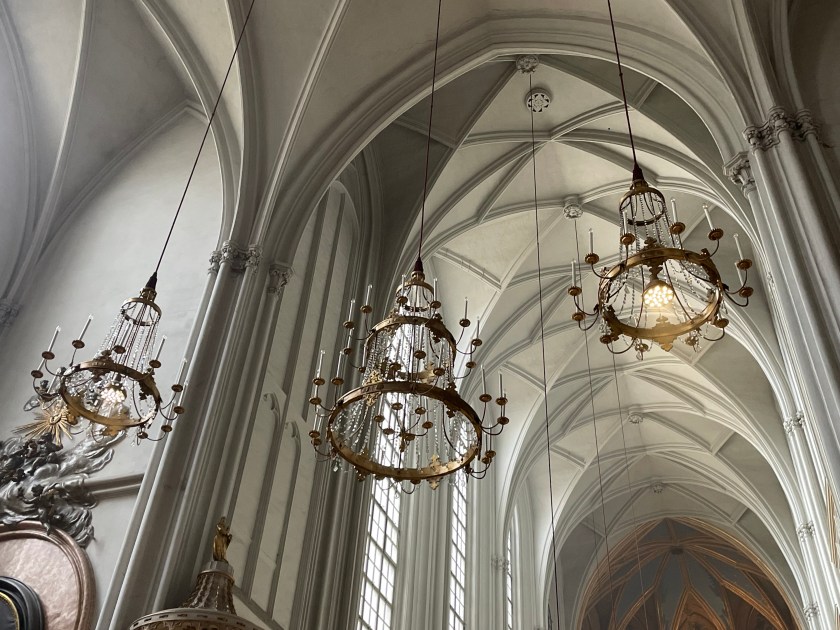
A church service here had just ended. We sat and took it all in. I especially loved the graceful bell-shaped chandeliers hanging overhead with candles (now electric). Everything about this church was graceful.





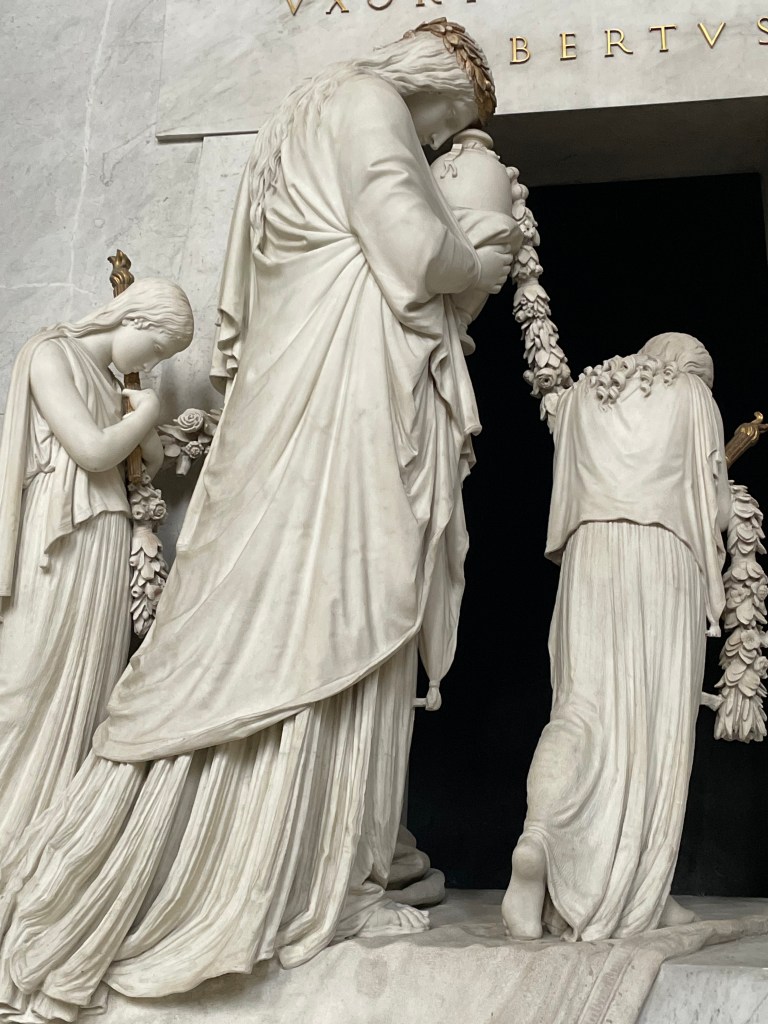
Below is a marble memorial to Archduchess Marie Christine (1742-1798), sculpted by Antonio Canova and commissioned by her husband (Albert of Albertina fame), and completed in 1805.


Various symbolic figures form a funeral procession that seems to enter a darkened gateway to the underworld.


From the Visiting Vienna website:
The Augustinerkirche is not a self-contained landmark like Stephansdom cathedral.

Instead, the building shares a near-continuous façade with the Albertina on one side and the extraordinary state hall and other offices of the National Library on the other.
The modest, unassuming appearance can mislead visitors, since the church is redolent with history.
From 1634 to 1918, for example, it served as the official court church for the Habsburg monarchs. The hearts of many of them rest in a crypt within the church walls.
Most famously, perhaps, the church played host to various royal weddings. Among the couples joined together beneath its roof:
- Emperor Franz Joseph and Elisabeth of Bavaria (1854)
- Crown Prince Rudolf and Stephanie of Belgium (1881)
- Empress Maria Theresa and Franz Stephan of Lorraine (1736)
- Archduchess Marie Louise and Napoleon Bonaparte (1810)
- Maria Antonia (Marie Antoinette) and King Louis XVI of France (1770)
The last two weddings mentioned took place in the absence of the bridegroom (which was a thing in those days). For example, Napoleon asked Marie Louise’s uncle, Archduke Karl, to represent him.
—————
The crypt with the hearts of the Habsburgers is also found in a nave in this church (we did not see it today). Some very interesting information is below.

From Wikipedia:
private chapel of the Habsburgs
Over time, the Loreto Chapel in the Augustinian Church became the most important pilgrimage center for the Viennese and the nobility. The Augustinian Church itself was elevated to the status of an imperial court parish church in 1634 and the Loreto Chapel was given the status of a public private chapel of the imperial family. Emperor Ferdinand II used to pray here for the victorious outcome of his military campaigns. As a result, the custom became established of dedicating battlefields, flags and victory trophies taken from the enemy to the “Mother of Loreto” and placing them in the chapel.
The first court wedding that took place in the small chapel was that of the future Emperor Ferdinand III with the Infanta Maria Anna of Spain in 1631. His wedding and that of his sister Cecilia Renata are the only weddings that took place in this small chapel. But even subsequently, no court wedding took place in the Augustinian Church without prior devotions in the Loreto Chapel.
The women of the House of Habsburg prayed for offspring in the chapel, and the first devotions of the imperial mothers after the birth of their children were held here. In 1756, Maria Theresa had the weight of her youngest son Maximilian Franz weighed in gold and placed on the altar of the “House Mother of the Arch-House of Austria” in the Loreto Chapel.
burial place of the Habsburg
The Loreto Chapel became the burial place of the Habsburgs when Ferdinand IV (1633–1654) had his heart buried here. During his lifetime, he had particularly venerated the Mother of God Mary and stipulated in his will that his “ heart should be laid under the feet of our beloved Fawen Maria in Loreto and buried . ”
Until then, the hearts of the deceased Habsburgs had usually been buried next to the body in the same coffin or in St. Stephen’s Cathedral . When Ferdinand IV died, his body was dissected that same evening, his heart was placed in a cup and displayed next to the body on the display bed during the solemn laying in state . One day after his death, at nine o’clock in the evening, the heart was transferred to the Augustinian Church, where it was buried in a simple ceremony next to the statue of the Virgin Mary in the Loreto Chapel.
The later Austrian Habsburgs kept this custom until the 19th century. In a court decree from 1754, the custom of “distributing the body for burial at different locations ” is described as follows: “ In the Archducal House of Austria, three churches in Vienna always have a share in the body of a ruling lord .”
The bodies of the deceased monarchs and their closest relatives were buried in the Capuchin Crypt , the hearts in the Loreto Chapel of the Augustinian Church and the entrails in the Duke’s Crypt in St. Stephen’s Cathedral . The organs were wrapped in silk cloths, placed in spirit and the containers were soldered shut.
Until 1784, the heart crypt consisted of a small marble-lined chamber in the floor behind the altar and the wall niche with the statue of the Virgin Mary. The chamber in which the heart urns were placed was about 40 cm deep. An iron plate and a marble plate above it formed the closure. The sacristy chronicle of the Augustinian Church gives the following description of this old sepulchre: “ The little chamber where the hearts of the emperors and all of the House of Austria are located is in the Loreto Chapel under Our Lady in front of the fireplace. Under the pavement there is a slab, 3 shoes 6 inches long and 3 shoes 4 inches wide, under which is the little stone chamber, like a little dagger, a shoe and a half deep, two shoes 10 and a half inches long in width and two and a half shoes wide in width, in which the boxes with the hearts are located. ”
Until the Loreto Chapel was moved to its current location, 21 hearts of members of the House of Habsburg were buried in the Heart Crypt.

 Our Frankfurt Germany Mission