
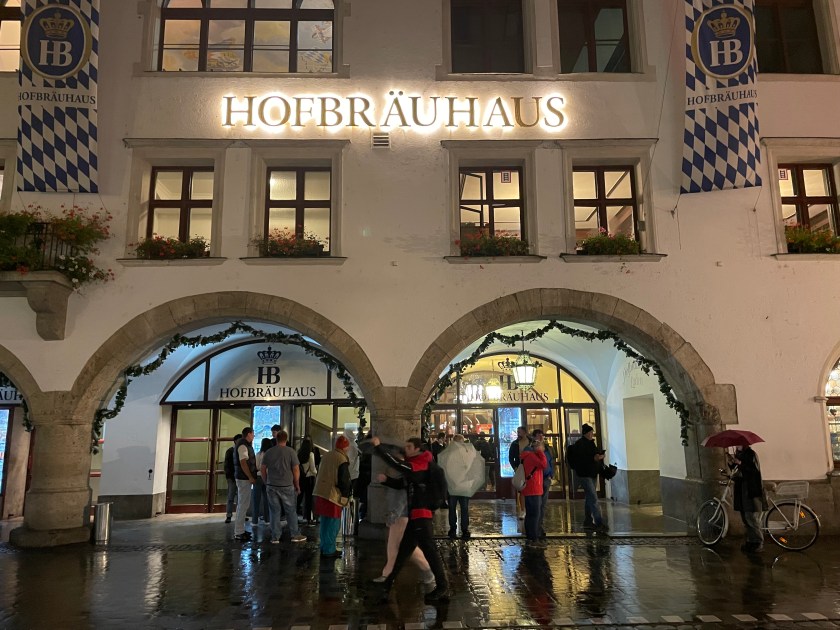
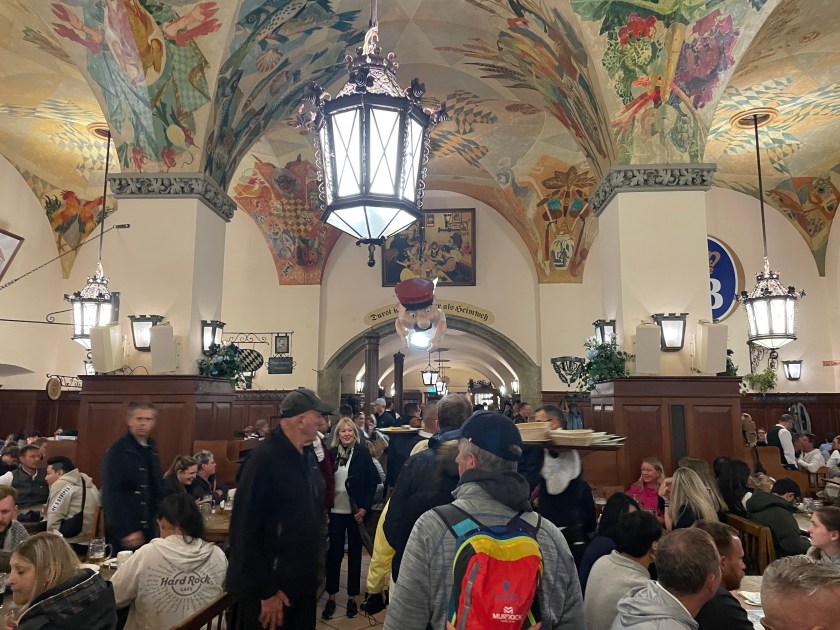
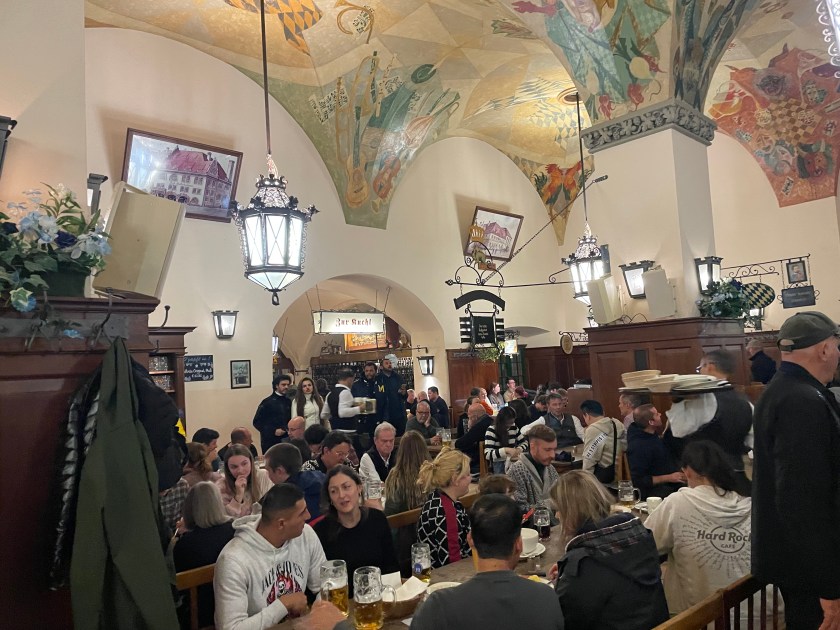
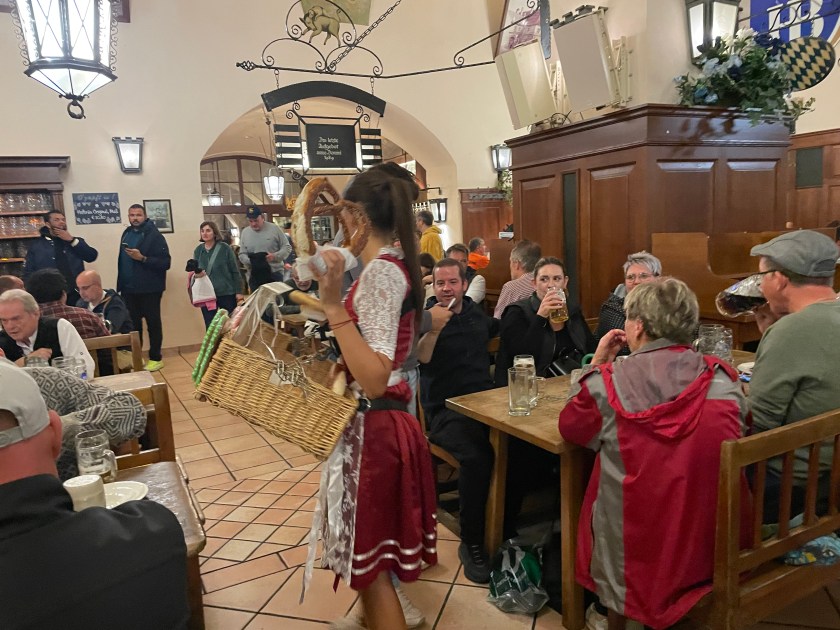
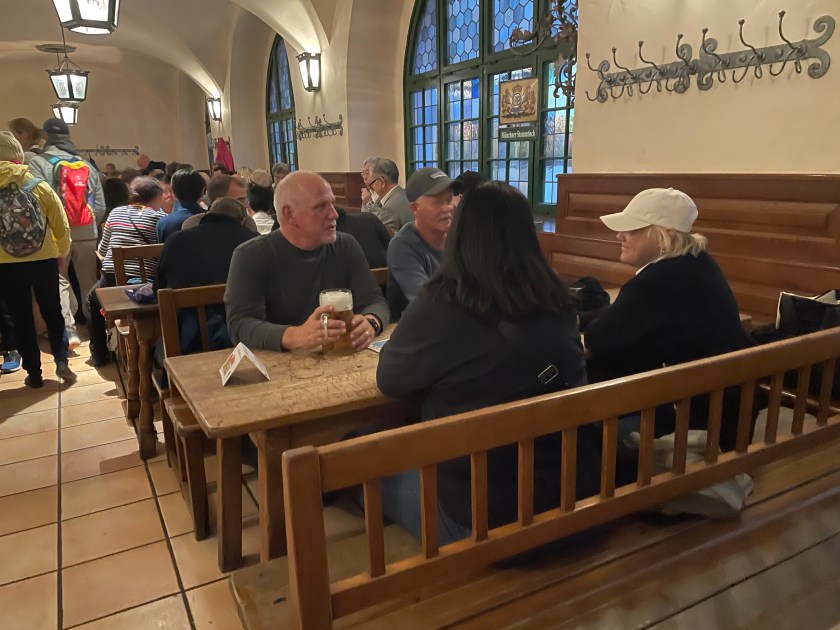
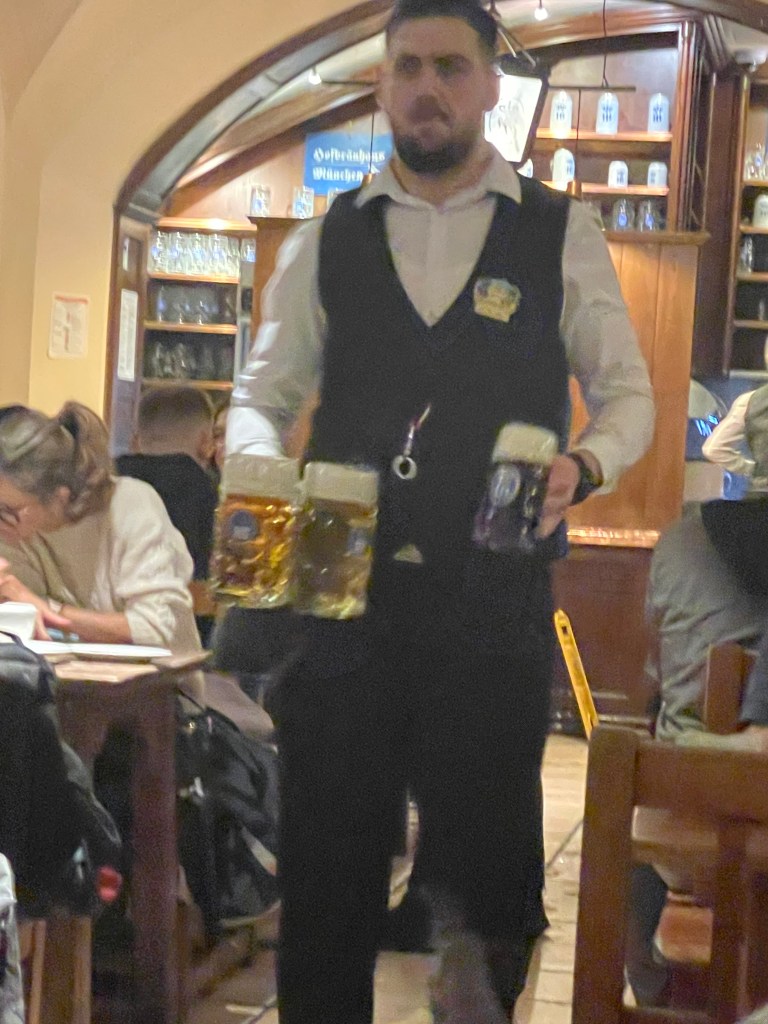
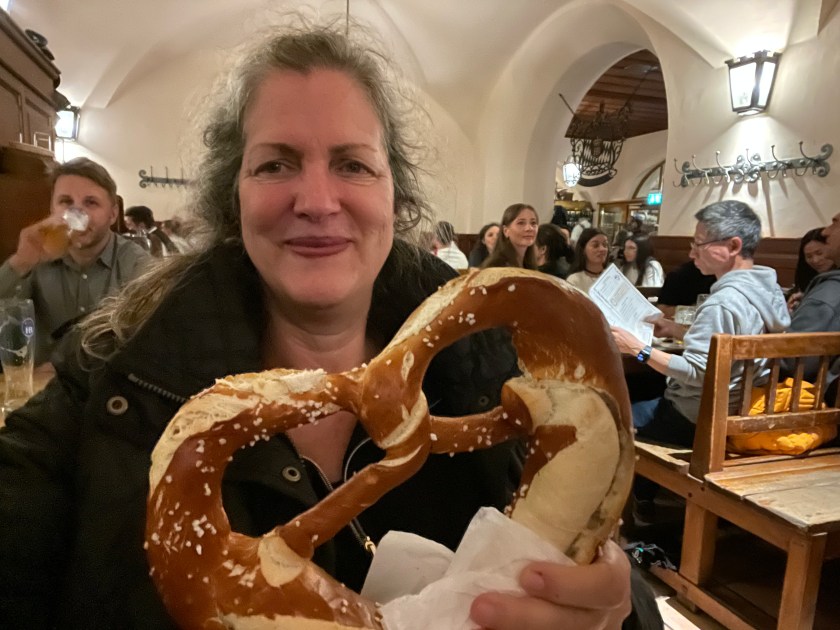
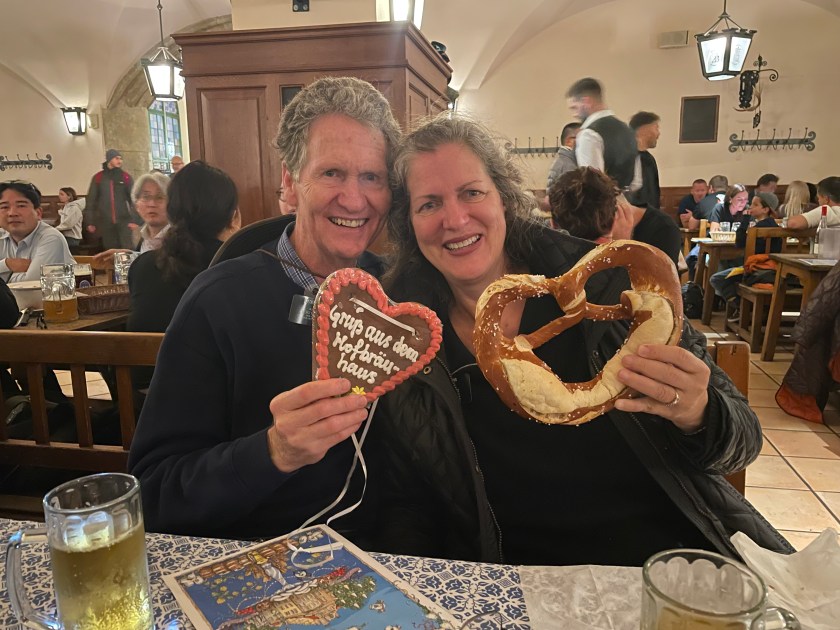
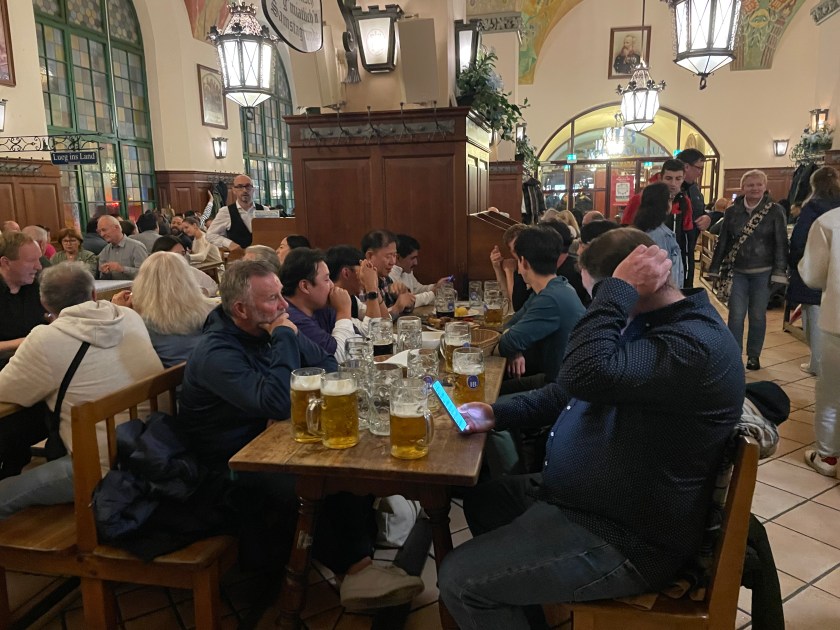
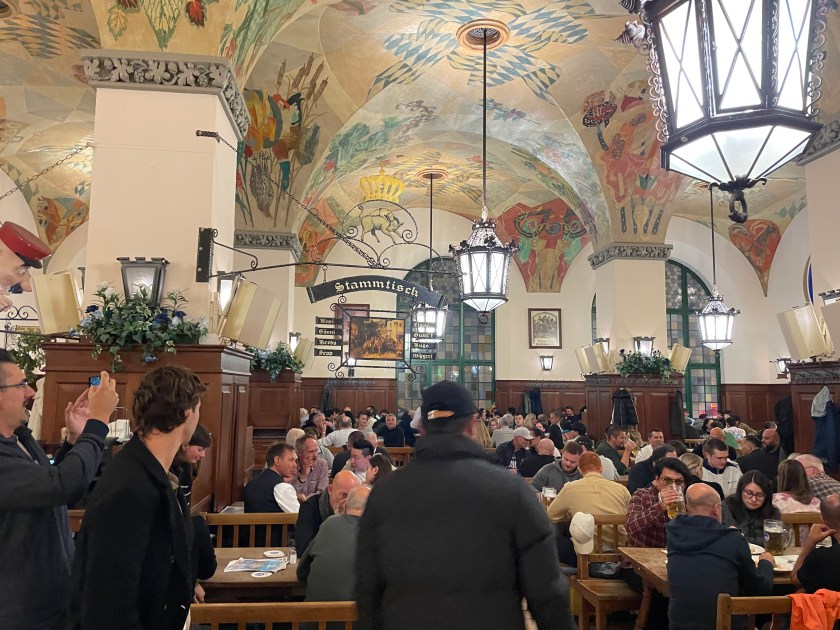
The Hofbrauhaus in Munich is a big sprawling old restaurant with an outdoor Biergarten (too rainy tonight) that seats 100s. It was packed full of people. You cannot make reservations–you just hover and wait for a table to be cleared. There were 100s of people there. It was rustic with heavy wooden tables that seat about 8–you just add yourselves to the others there. There were busy waiters with their hands wrapped around 4-6 Biersteins at a time and cute young girls with trays suspended with ribbons around their necks toting huge fresh pretzels and Lebkuchen. The girl told me they bake about 400 of these huge (5 Euro) pretzels every day. We got one to eat while we waited for our food and it was delicious.
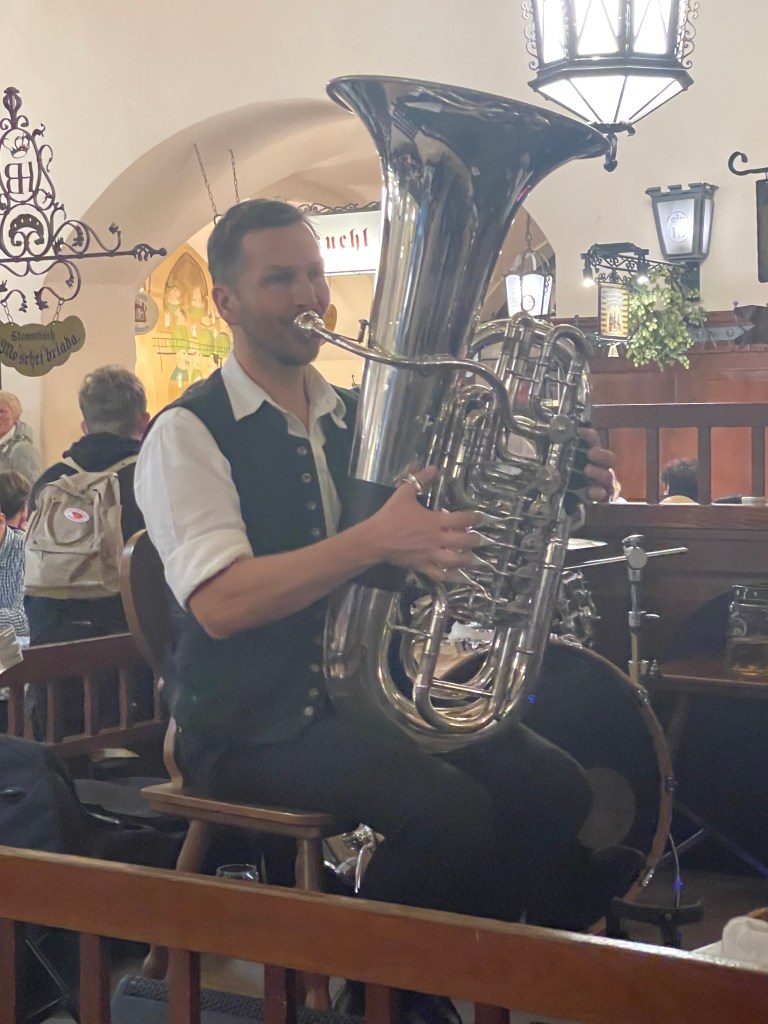
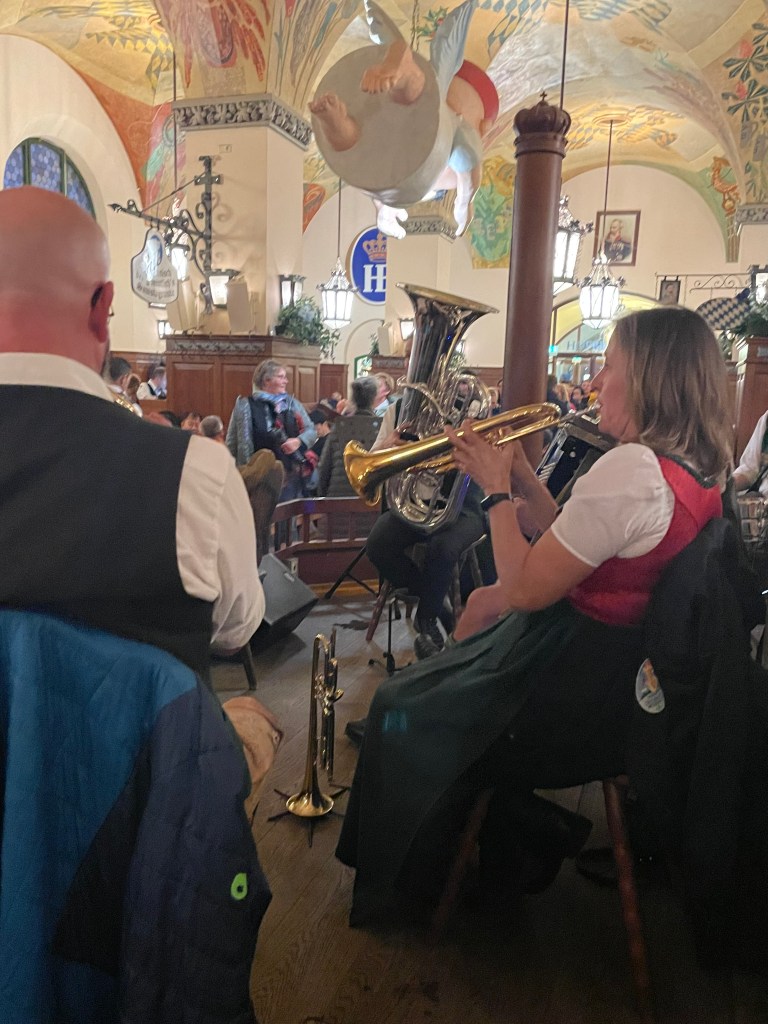
The place was crowded and loud. There was an oom pa-pa band playing live music, especially the famous “In Munchen steht ein Hofbrauhaus, eins, zwei, g-suffa!”
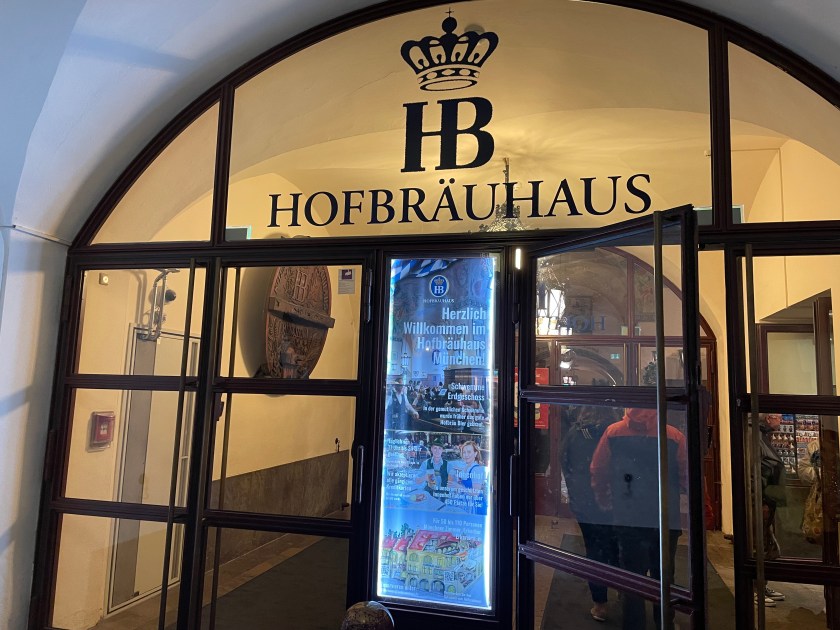
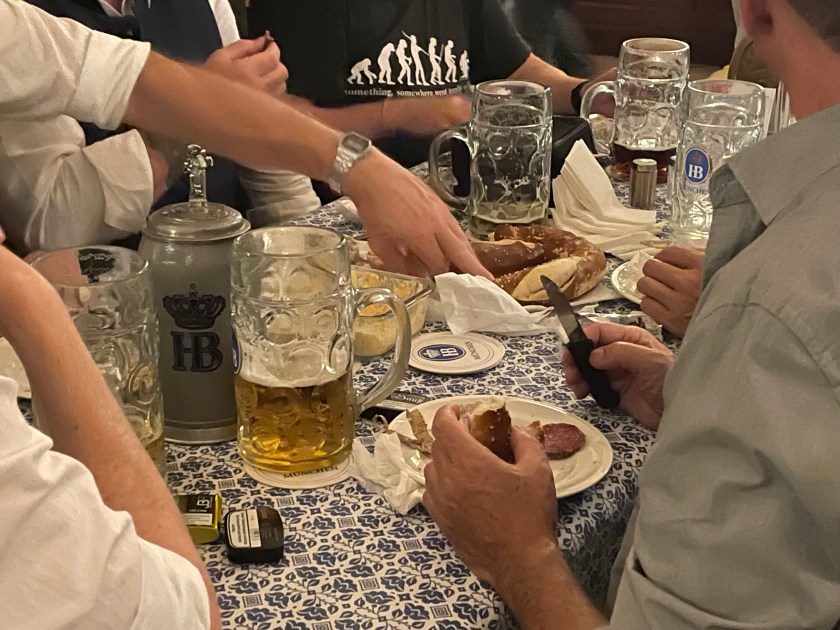

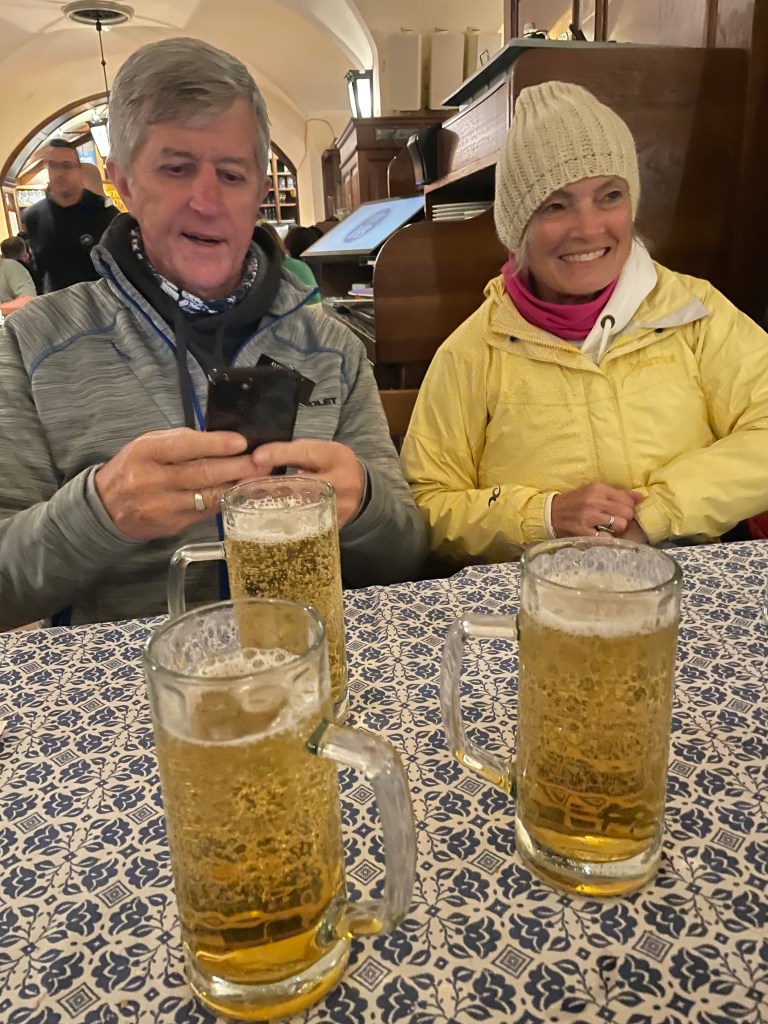
When we didn’t order beer, the waiter stared at us in unbelief. We asked for Apfel Schorle, or fizzy apple juice.


Here’s some interesting information found in Wikipedia and various sites about this historic place:
The Hofbräuhaus am Platzl is a beer hall in Munich, Bavaria, Germany, originally built in 1589 by Bavarian Duke Maximilian I as an extension of the Staatliches Hofbräuhaus in München brewery. The general public was admitted in 1828 by Ludwig I. The building was completely remodeled in 1897 by Max Littmann when the brewery moved to the suburbs. All of the rooms except the historic beer hall (“Schwemme”) were destroyed in the World War II bombings. The reopening of the Festival Hall in 1958 marked the end of the post-war restoration work.
History
William V, Duke of Bavaria found the beer in Munich bad so he imported beer from Saxony. He eventually asked his royal court to find a solution. A local brewery followed in 1589.
On February 24, 1920, the Hofbräuhaus am Platzl is where Nazi Germany dictator Adolf Hitler made a speech founding the National Socialist German Workers’ Party, or the Nazi Party.
The Hofbräuhaus was largely destroyed from allied bombing raids during World War II, but by Munich’s 800th anniversary in 1958 the building had been faithfully reconstructed.
Features
The Hofbräuhaus Saal c. 1902
The restaurant comprises most of the Hofbräuhaus am Platzl, which also includes a ballroom and outdoor Wirtsgarten. Its menu features such traditional favorites of Bavarian cuisine as Brezn (soft pretzel), Obatzda (cheese dip), Hax’n, and sausages such as Bratwurst and Weisswurst. Brews include Helles and Dunkles served in a Maß, Weißbier, and wine.
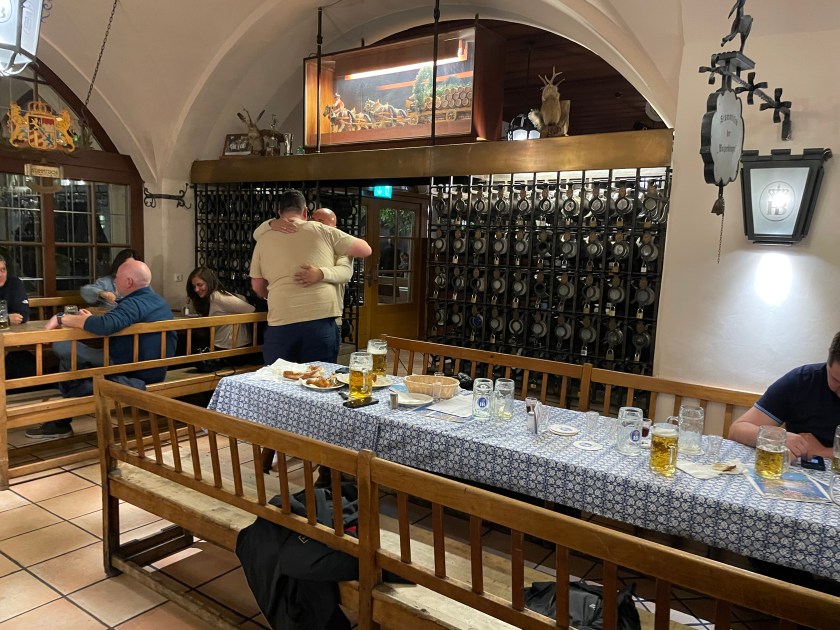
Munich’s largest tourist attraction after the Oktoberfest, the Hofbräuhaus am Platzl is also frequented by locals, many of whom keep their personal mugs (“Krüge”) stored there. During regular hours traditional Bavarian music is played. The famous Hofbräuhaus song (Hofbräuhaus-Lied), composed in 1935 by Wilhelm “Wiga” Gabriel, goes: “In München steht ein Hofbräuhaus, eine, zwei, g’suffa!” (“There’s a Hofbräuhaus in Munich—one, two, down the hatch!” in the local dialect).
Famous patrons
Wolfgang Amadeus Mozart lived around the block from the beer hall in the late eighteenth century. In a poem he wrote, Mozart claimed to have written the opera Idomeneo after several visits to the Hofbräuhaus fortified him for the task.[citation needed] In the nineteenth century, most of the breweries in Munich, including the Hofbräuhaus, were converted into large beer halls, restaurants, and entertainment centers with large, cavernous meeting rooms for weddings, concerts, and plays. In the period just before World War One, Vladimir Lenin lived in Munich and reportedly visited the Hofbräuhaus on a regular basis. In 1919, the Munich Communist government set up headquarters in the beer hall, and in February 1920 Adolf Hitler and the National Socialists held their first meeting in the Festsaal, the Festival Room, on the third floor.
On 24th February 1920, Hitler presented the Nazi Party’s Twenty Five Point Program in the Hofbräuhaus. On that day, the Nazi party held a large public meeting and whilst Hitler was speaking, the meeting erupted into a melee. There was a massive fight between the Social Democrat and Communist opponents of the Nazi party, whose thugs eventually won the melee. Hitler managed to finish his address, notwithstanding the chaos of smashed tables and chairs and hurled beer mugs all about him. On 4 November 1921 the Hofbräuhaus was also the birthplace of the later feared Nazi street fighting organization, the Sturmabteilungen, or SA.
—————–
Lyrics to Hofbräuhaus-Lied, one of the all-time classic songs at the Munich Oktoberfest
This is one of the best-known German classics – right up there with Nena and her 99 Luftballons.
The Hofbräuhaus-Lied (Hofbräuhaus Song) is a classic of the German oom-pah form and a principal ode to Munich’s famed beer hall.
It was written in 1935, not by a Munich local, but a Berliner known as Wilhelm “Wiga” Gabriel.
hofbrauhaus lied lyricsWiga’s other “hits” were unfortunately patriotic marching anthems for the Third Reich.
But that said, no-one seems to remember when the song comes ’round at Oktoberfest anyway.
English Hofbräuhaus-Lied Lyrics
“the Hofbräuhaus-Song”
There, where the green Isar flows,
Where you greet with “Greetings God!”, [Wo man mit “GrüßGott” dich grüßt,]
Lies my beautiful Munich city,
The likes of which you’ve never seen.
Water is cheap, pure and good,
But it thins our blood,
Far better is a drop of golden wine,
But the best is this:
In Munich is the Hofbräuhaus:
One, two, drink up! [g-suffa is more like “down the hatch]
There so many kegs are emptied:
One, two, drink up!
There is always some good man:
One, two, drink up!
Who wants to show how much he can drink
He starts in the early morning
And late in the evening he comes out
Because it’s so nice at the Hofbräuhaus.
There you don’t drink out of a glass,
There’s only “the big beer krug!”
And when the first beer krug is empty,
The waitress Reserl soon brings you more.
Often the women at home get a fright,
That the man’s gone so long.
But the good neighbors,
They know better!
In Munich is the Hofbräuhaus:
One, two, drink up!
There so many kegs are emptied:
One, two, drink up!
There is always some good man:
One, two, drink up!
Who wants to show how much he can drink
He starts in the early morning
And late in the evening he comes out
Because it’s so nice at the Hofbräuhaus.
Although so many other cities,
Have things to see,
There’s one thing that’s nowhere else but here: That’s Munich beer.
Who thought up this little song
Has for so many long nights
Studied Munich’s beer
And has comprehensively tried it out.
In Munich is the Hofbräuhaus:
One, two, drink up!
Where the kegs are always flowing:
One, two, drink up!
There is always some brave man:
One, two, drink up!
Who wants to show how much he can drink
He starts in the early morning
And late in the evening he comes out
Because it’s so nice at the Hofbräuhaus.
—————-



I also found this interview with the manager very interesting:

What a very fun evening in a wild and crazy place!

 Our Frankfurt Germany Mission