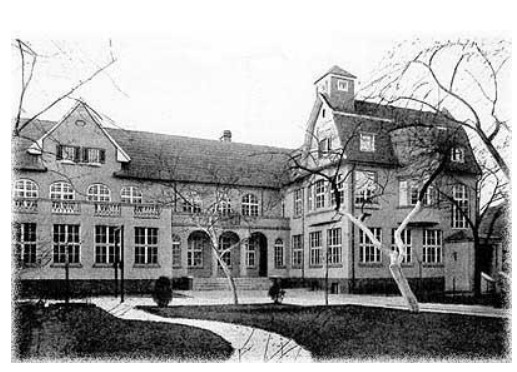
Here is a sad story about the Museum/former textile factory we visited: The Museum Wäschefabrik (linen wear factory museum) at Bielefeld is one of the relatively few places at which the heritage of the manufacture of clothing (as distinct from the production of fabrics) is commemorated. It is also a testimony to the fate of Jewish industrialists during the Third Reich.
The factory was established in 1913 by Hugo Juhl (d. 1939) and his wife Clara (b. 1887) for the manufacture of table linen, bed linen, women’s underclothes and men’s shirts. In 1938 they were forced to sell the business to the Winkel brothers who ran it until the 1980s after which a voluntary body, the Föderverein Projekt Wäschefabrik, was established to ensure the preservation of the factory. A museum (the one we just visited) was opened in the building in 1997. Visitors can see how clothing was made in the mid-twentieth century in rooms filled with ranks of sewing machines, rolls of fabric and reels of thread. They can also learn of the fate of Hugo Juhl’s family.
In 1933, fearing the onset of persecution of the Jews, Juhl’s daughter Hanna (b. 1913) who was married to Fritz Bender, fled to the Netherlands. Hugo Juhl died from natural causes soon after the enforced sale of the factory after which his wife and his other daughter Mathilde (b. 1910) went to the Netherlands. After the Nazi invasion the three women took their own lives rather than face deportation to an extermination camp, although Fritz Bender escaped. There are Stolpersteine (commemorative stones in the pavement) for the three women outside the museum in Bielefeld.

Kein Fluchtweg mehr offen
Hanna had just graduated from high school when she got engaged in 1932. Her bridegroom Fritz Bender moved to Bielefeld and joined her father’s company. Hugo Juhl owned an underwear factory with 70 employees in Viktoriastrasse. But after Adolf Hitler’s “seizure of power,” the Jewish couple no longer believed in a future in Germany.
Hanna and Fritz took a thoughtful approach to emigrating to the Netherlands. In order to bring as much of their wealth across the border as possible, they left separately. They invited all their relatives to their wedding in the seaside resort of Scheveningen. Each guest brought them 200 Reichsmarks, which were then reimbursed by the fathers of the bride and groom. The young couple set up a new life in Amsterdam. Fritz found a pharmaceutical factory. Their daughter Anneken was born.
When the Second World War began and the German Wehrmacht invaded Holland, the family tried to flee to England by boat. The first attempt failed because of the harbor barriers. Hanna then urged her husband to try it alone. Fritz actually managed the dangerous journey across the North Sea in a rowing boat. When Hanna realized that there was no escape route left for her and her five-year-old daughter, she opened the gas tap and put an end to both of their lives.

 Our Frankfurt Germany Mission